SUBSCRIBE TO OUR FREE NEWSLETTER
Daily news & progressive opinion—funded by the people, not the corporations—delivered straight to your inbox.
5
#000000
#FFFFFF
To donate by check, phone, or other method, see our More Ways to Give page.
Daily news & progressive opinion—funded by the people, not the corporations—delivered straight to your inbox.
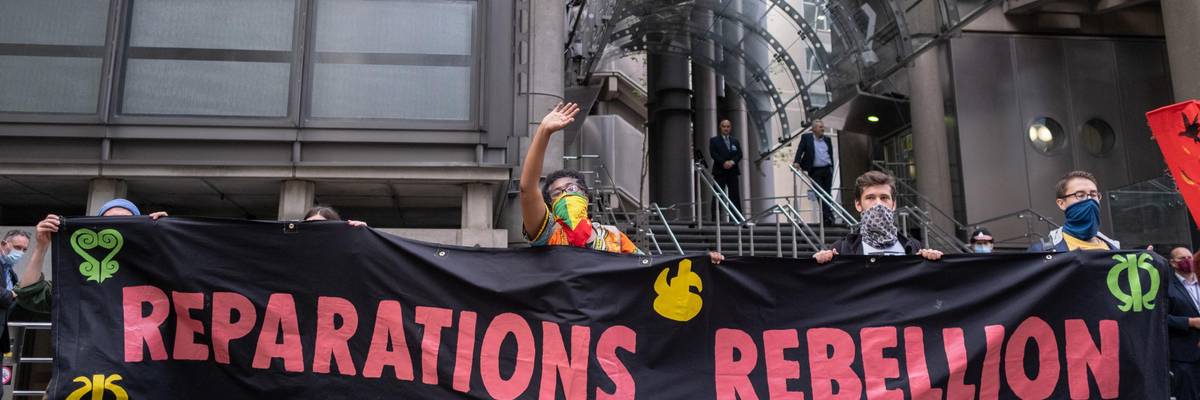
Extinction Rebellion Climate Change activists take their Environmental and Economy protest called 'The Walk of Shame' to the City of London, the capital's financial district , on 4th September 2020, in London, England. According to XR, "companies and institutions have profited from the slave trade and the profit from the exploitation of people and the planet. (Photo: Richard Baker / In Pictures via Getty Images)
"A brief and rapidly closing window to secure a liveable future."
That's the sobering assessment made by scientists on the United Nations' Intergovernmental Panel on Climate Change (IPCC), which earlier this week published its latest report, on the impacts of the climate crisis.
Demands such as these would not just be an attempt to right historical injustices created simultaneously by colonialism and climate change, but to prevent them occurring again in the future.
In it, the IPPC argues that roughly 3.5 billion people--45% of the world's population--currently live in areas of "high vulnerability" to climate change, meaning they will be heavily impacted by floods, droughts or extreme weather in the decades to come.
Yet even more striking than the sheer scale of these impacts is their inequality and unfairness. The vast majority of those 3.5 billion people are in "west-, central- and east Africa, south Asia, Central and South America, small island developing states and the Arctic." These regions--which have some of the lowest per capita carbon emissions in the world--are now suffering the effects of a crisis that has been driven and exacerbated by the looting of their lands for wealth and natural resources.
Not only are these countries and communities faced with displacement, food shortages, water insecurity and more, unless there is concerted global action, the report also asserts that many losses are already happening now, and are irreversible.
This situation is a result of the failure (or perhaps more accurately, refusal) of rich countries to support the Global South against the climate crisis in UN negotiations. Not only have these "Annex 1" countries, including the US, UK, Canada, Australia and most of the EU, repeatedly resisted ambitious, binding targets on emissions reductions, they have also repeatedly broken promises on financial assistance.
Last November, at COP26 in Glasgow, the Global South had three key demands on finance: greatly increased climate finance grants; far more funding for climate adaptation; and a new pot of money to compensate for the loss and damage already being suffered by frontline communities.
This week's report highlights that, despite a 2009 pledge (at COP15) to commit roughly half of $100bn a year in climate finance to adaptation, only 4-8% of funding has supported projects that help vulnerable communities live with the impacts of the climate crisis (and some of those projects actually increase climate vulnerability). Those communities are now being sacrificed to the selfishness of rich governments that resist paying for the crisis they have caused every step of the way.
The demand for loss and damage compensation has also been heavily resisted at every previous COP. At COP26, the establishment of a new funding pot was rejected and almost all references were removed in the final agreement, the Glasgow Climate Pact.
Campaigners have hailed the promise for further discussions on loss and damage as a small win, and will push hard to make it a key issue at COP27 in Egypt this coming November. Yet, insiders have now raised concerns that there was significant pressure from the Biden administration to remove any mention of loss and damage from the latest IPCC report.
Meanwhile, frontline communities, such as in Sub-Saharan African, South East Asia and small island states in the Pacific and Caribbean, continue to lose homes, livelihoods and families to the climate crisis. For example, just before Christmas, while it also dealing with a steep rise in COVID-19 infections, the Philippines was hit by super typhoon Rai (also called Odette), which displaced half a million people and impacted nearly five million in total.
Lower income countries spend five times their climate adaptation budgets on external debt payments
Just a few weeks ago, tropical storm Ana affected nearly 200,000 people across several countries in southern Africa. Without adequate finance, countries often need to take out loans to rebuild, forcing them further into a colonial debt trap that forces them to prioritise debt payments over protecting their citizens. Research suggests that lower income countries spend five times their climate adaptation budgets on external debt payments.
Take Mozambique, which, after devastating cyclones in 2019, was forced to take on a $118m loan from the International Monetary Fund. World Bank data suggests that an average person in Mozambique contributes 76 times less carbon emissions than their US counterpart, yet it is Mozambicans and other frontline communities who are paying--with their wallets and their lives--for this crisis.
Increasing the transfer of finance from the Global North to the Global South is therefore an important element of limiting the devastation, and moving towards climate justice, but it alone cannot repair all the damage done by capitalist extractivism.
Increasingly, social movements are calling for a broad programme of climate reparations to atone for the Global North's role in creating and accelerating the climate crisis. These calls are not new: campaigns for African reparations for colonialism have existed for centuries, while it has been more than a decade since climate movements called for financial and technology transfer to the Global South. However, the calls for reparations are growing in volume, and found support among youth strikers and climate justice activists at COP26.
As reparationist Esther Stanford-Xosei argues, reparations are not simply a matter of financial compensation, but must include bigger, more radical changes that help us build "new economic systems that don't produce and reproduce inequality." Alongside the much needed adaptation and loss and damage finance, a climate reparations programme in this vein could include (but would not be limited to) the patent-free sharing of green tech with the Global South, wealth taxation, debt cancellation, tax transparency reforms, and reforms to international institutions.
Demands such as these would not just be an attempt to right historical injustices created simultaneously by colonialism and climate change, but to prevent them occurring again in the future. As Olufemi Taiwo says, these types of reparations are "central to the expansive project of building a more just world".
As radical as this might seem, for billions across the Global South it is the only just and liveable future. And the window to achieve it is closing rapidly.
Dear Common Dreams reader, It’s been nearly 30 years since I co-founded Common Dreams with my late wife, Lina Newhouser. We had the radical notion that journalism should serve the public good, not corporate profits. It was clear to us from the outset what it would take to build such a project. No paid advertisements. No corporate sponsors. No millionaire publisher telling us what to think or do. Many people said we wouldn't last a year, but we proved those doubters wrong. Together with a tremendous team of journalists and dedicated staff, we built an independent media outlet free from the constraints of profits and corporate control. Our mission has always been simple: To inform. To inspire. To ignite change for the common good. Building Common Dreams was not easy. Our survival was never guaranteed. When you take on the most powerful forces—Wall Street greed, fossil fuel industry destruction, Big Tech lobbyists, and uber-rich oligarchs who have spent billions upon billions rigging the economy and democracy in their favor—the only bulwark you have is supporters who believe in your work. But here’s the urgent message from me today. It's never been this bad out there. And it's never been this hard to keep us going. At the very moment Common Dreams is most needed, the threats we face are intensifying. We need your support now more than ever. We don't accept corporate advertising and never will. We don't have a paywall because we don't think people should be blocked from critical news based on their ability to pay. Everything we do is funded by the donations of readers like you. When everyone does the little they can afford, we are strong. But if that support retreats or dries up, so do we. Will you donate now to make sure Common Dreams not only survives but thrives? —Craig Brown, Co-founder |
"A brief and rapidly closing window to secure a liveable future."
That's the sobering assessment made by scientists on the United Nations' Intergovernmental Panel on Climate Change (IPCC), which earlier this week published its latest report, on the impacts of the climate crisis.
Demands such as these would not just be an attempt to right historical injustices created simultaneously by colonialism and climate change, but to prevent them occurring again in the future.
In it, the IPPC argues that roughly 3.5 billion people--45% of the world's population--currently live in areas of "high vulnerability" to climate change, meaning they will be heavily impacted by floods, droughts or extreme weather in the decades to come.
Yet even more striking than the sheer scale of these impacts is their inequality and unfairness. The vast majority of those 3.5 billion people are in "west-, central- and east Africa, south Asia, Central and South America, small island developing states and the Arctic." These regions--which have some of the lowest per capita carbon emissions in the world--are now suffering the effects of a crisis that has been driven and exacerbated by the looting of their lands for wealth and natural resources.
Not only are these countries and communities faced with displacement, food shortages, water insecurity and more, unless there is concerted global action, the report also asserts that many losses are already happening now, and are irreversible.
This situation is a result of the failure (or perhaps more accurately, refusal) of rich countries to support the Global South against the climate crisis in UN negotiations. Not only have these "Annex 1" countries, including the US, UK, Canada, Australia and most of the EU, repeatedly resisted ambitious, binding targets on emissions reductions, they have also repeatedly broken promises on financial assistance.
Last November, at COP26 in Glasgow, the Global South had three key demands on finance: greatly increased climate finance grants; far more funding for climate adaptation; and a new pot of money to compensate for the loss and damage already being suffered by frontline communities.
This week's report highlights that, despite a 2009 pledge (at COP15) to commit roughly half of $100bn a year in climate finance to adaptation, only 4-8% of funding has supported projects that help vulnerable communities live with the impacts of the climate crisis (and some of those projects actually increase climate vulnerability). Those communities are now being sacrificed to the selfishness of rich governments that resist paying for the crisis they have caused every step of the way.
The demand for loss and damage compensation has also been heavily resisted at every previous COP. At COP26, the establishment of a new funding pot was rejected and almost all references were removed in the final agreement, the Glasgow Climate Pact.
Campaigners have hailed the promise for further discussions on loss and damage as a small win, and will push hard to make it a key issue at COP27 in Egypt this coming November. Yet, insiders have now raised concerns that there was significant pressure from the Biden administration to remove any mention of loss and damage from the latest IPCC report.
Meanwhile, frontline communities, such as in Sub-Saharan African, South East Asia and small island states in the Pacific and Caribbean, continue to lose homes, livelihoods and families to the climate crisis. For example, just before Christmas, while it also dealing with a steep rise in COVID-19 infections, the Philippines was hit by super typhoon Rai (also called Odette), which displaced half a million people and impacted nearly five million in total.
Lower income countries spend five times their climate adaptation budgets on external debt payments
Just a few weeks ago, tropical storm Ana affected nearly 200,000 people across several countries in southern Africa. Without adequate finance, countries often need to take out loans to rebuild, forcing them further into a colonial debt trap that forces them to prioritise debt payments over protecting their citizens. Research suggests that lower income countries spend five times their climate adaptation budgets on external debt payments.
Take Mozambique, which, after devastating cyclones in 2019, was forced to take on a $118m loan from the International Monetary Fund. World Bank data suggests that an average person in Mozambique contributes 76 times less carbon emissions than their US counterpart, yet it is Mozambicans and other frontline communities who are paying--with their wallets and their lives--for this crisis.
Increasing the transfer of finance from the Global North to the Global South is therefore an important element of limiting the devastation, and moving towards climate justice, but it alone cannot repair all the damage done by capitalist extractivism.
Increasingly, social movements are calling for a broad programme of climate reparations to atone for the Global North's role in creating and accelerating the climate crisis. These calls are not new: campaigns for African reparations for colonialism have existed for centuries, while it has been more than a decade since climate movements called for financial and technology transfer to the Global South. However, the calls for reparations are growing in volume, and found support among youth strikers and climate justice activists at COP26.
As reparationist Esther Stanford-Xosei argues, reparations are not simply a matter of financial compensation, but must include bigger, more radical changes that help us build "new economic systems that don't produce and reproduce inequality." Alongside the much needed adaptation and loss and damage finance, a climate reparations programme in this vein could include (but would not be limited to) the patent-free sharing of green tech with the Global South, wealth taxation, debt cancellation, tax transparency reforms, and reforms to international institutions.
Demands such as these would not just be an attempt to right historical injustices created simultaneously by colonialism and climate change, but to prevent them occurring again in the future. As Olufemi Taiwo says, these types of reparations are "central to the expansive project of building a more just world".
As radical as this might seem, for billions across the Global South it is the only just and liveable future. And the window to achieve it is closing rapidly.
"A brief and rapidly closing window to secure a liveable future."
That's the sobering assessment made by scientists on the United Nations' Intergovernmental Panel on Climate Change (IPCC), which earlier this week published its latest report, on the impacts of the climate crisis.
Demands such as these would not just be an attempt to right historical injustices created simultaneously by colonialism and climate change, but to prevent them occurring again in the future.
In it, the IPPC argues that roughly 3.5 billion people--45% of the world's population--currently live in areas of "high vulnerability" to climate change, meaning they will be heavily impacted by floods, droughts or extreme weather in the decades to come.
Yet even more striking than the sheer scale of these impacts is their inequality and unfairness. The vast majority of those 3.5 billion people are in "west-, central- and east Africa, south Asia, Central and South America, small island developing states and the Arctic." These regions--which have some of the lowest per capita carbon emissions in the world--are now suffering the effects of a crisis that has been driven and exacerbated by the looting of their lands for wealth and natural resources.
Not only are these countries and communities faced with displacement, food shortages, water insecurity and more, unless there is concerted global action, the report also asserts that many losses are already happening now, and are irreversible.
This situation is a result of the failure (or perhaps more accurately, refusal) of rich countries to support the Global South against the climate crisis in UN negotiations. Not only have these "Annex 1" countries, including the US, UK, Canada, Australia and most of the EU, repeatedly resisted ambitious, binding targets on emissions reductions, they have also repeatedly broken promises on financial assistance.
Last November, at COP26 in Glasgow, the Global South had three key demands on finance: greatly increased climate finance grants; far more funding for climate adaptation; and a new pot of money to compensate for the loss and damage already being suffered by frontline communities.
This week's report highlights that, despite a 2009 pledge (at COP15) to commit roughly half of $100bn a year in climate finance to adaptation, only 4-8% of funding has supported projects that help vulnerable communities live with the impacts of the climate crisis (and some of those projects actually increase climate vulnerability). Those communities are now being sacrificed to the selfishness of rich governments that resist paying for the crisis they have caused every step of the way.
The demand for loss and damage compensation has also been heavily resisted at every previous COP. At COP26, the establishment of a new funding pot was rejected and almost all references were removed in the final agreement, the Glasgow Climate Pact.
Campaigners have hailed the promise for further discussions on loss and damage as a small win, and will push hard to make it a key issue at COP27 in Egypt this coming November. Yet, insiders have now raised concerns that there was significant pressure from the Biden administration to remove any mention of loss and damage from the latest IPCC report.
Meanwhile, frontline communities, such as in Sub-Saharan African, South East Asia and small island states in the Pacific and Caribbean, continue to lose homes, livelihoods and families to the climate crisis. For example, just before Christmas, while it also dealing with a steep rise in COVID-19 infections, the Philippines was hit by super typhoon Rai (also called Odette), which displaced half a million people and impacted nearly five million in total.
Lower income countries spend five times their climate adaptation budgets on external debt payments
Just a few weeks ago, tropical storm Ana affected nearly 200,000 people across several countries in southern Africa. Without adequate finance, countries often need to take out loans to rebuild, forcing them further into a colonial debt trap that forces them to prioritise debt payments over protecting their citizens. Research suggests that lower income countries spend five times their climate adaptation budgets on external debt payments.
Take Mozambique, which, after devastating cyclones in 2019, was forced to take on a $118m loan from the International Monetary Fund. World Bank data suggests that an average person in Mozambique contributes 76 times less carbon emissions than their US counterpart, yet it is Mozambicans and other frontline communities who are paying--with their wallets and their lives--for this crisis.
Increasing the transfer of finance from the Global North to the Global South is therefore an important element of limiting the devastation, and moving towards climate justice, but it alone cannot repair all the damage done by capitalist extractivism.
Increasingly, social movements are calling for a broad programme of climate reparations to atone for the Global North's role in creating and accelerating the climate crisis. These calls are not new: campaigns for African reparations for colonialism have existed for centuries, while it has been more than a decade since climate movements called for financial and technology transfer to the Global South. However, the calls for reparations are growing in volume, and found support among youth strikers and climate justice activists at COP26.
As reparationist Esther Stanford-Xosei argues, reparations are not simply a matter of financial compensation, but must include bigger, more radical changes that help us build "new economic systems that don't produce and reproduce inequality." Alongside the much needed adaptation and loss and damage finance, a climate reparations programme in this vein could include (but would not be limited to) the patent-free sharing of green tech with the Global South, wealth taxation, debt cancellation, tax transparency reforms, and reforms to international institutions.
Demands such as these would not just be an attempt to right historical injustices created simultaneously by colonialism and climate change, but to prevent them occurring again in the future. As Olufemi Taiwo says, these types of reparations are "central to the expansive project of building a more just world".
As radical as this might seem, for billions across the Global South it is the only just and liveable future. And the window to achieve it is closing rapidly.