

SUBSCRIBE TO OUR FREE NEWSLETTER
Daily news & progressive opinion—funded by the people, not the corporations—delivered straight to your inbox.
5
#000000
#FFFFFF
To donate by check, phone, or other method, see our More Ways to Give page.
Daily news & progressive opinion—funded by the people, not the corporations—delivered straight to your inbox.
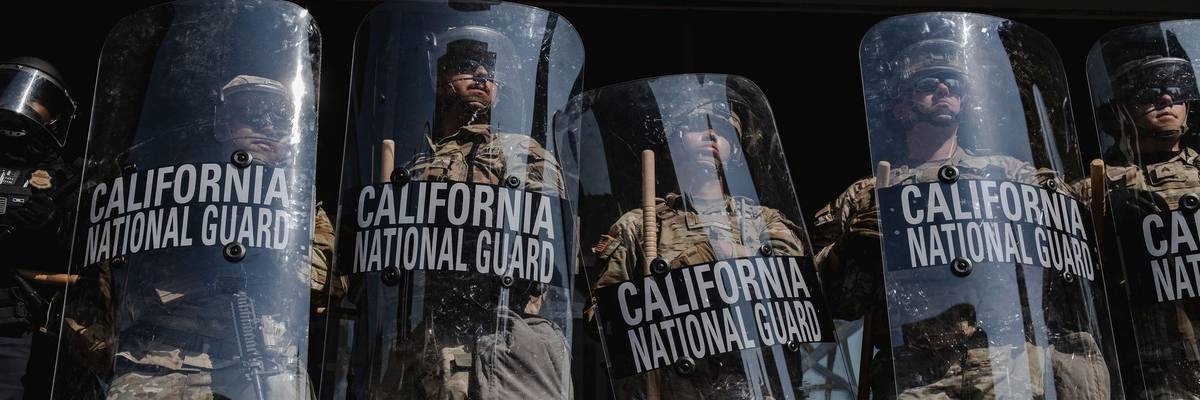
National Guardsmen stand outside of the Edward Roybal Federal Building on June 9, 2025 in Downtown Los Angeles, California. Tensions in the city remain high after the Trump administration called in the National Guard against the wishes of city leaders.
Squeezed domestic spending and extravagant military spending have widened inequality, with dire consequences for democracy.
No single explanation exists for how our American democracy came under siege. But with Donald Trump having spent 2025 in escalating conflict across the hemispheres, there is one big factor we shouldn't keep ignoring: the role that our bloated military budget has played in expanding authoritarianism in the United States.
Year after year, trillions are spent on military affairs—via the Pentagon, nuclear weapons programs, Veterans Affairs, and interest on war debt. War and preparation for it takes an ever-bigger bite—now two-thirds—of the discretionary federal budget. Add security work in Homeland Security and the Justice Department, and just 25% of Trump's 2026 budget request is left for Americans' other needs, including transportation, housing, disaster response, cancer research, education, and more.
Squeezed domestic spending and extravagant military spending have widened inequality, with dire consequences for democracy.
That Pentagon spending creates a more unequal America may seem counterintuitive when it is so often touted as a boon to communities with military bases or weapons makers. But military spending has complex effects that belie its reputation as an economic good for the American public as a whole.
Making it harder to go to war is one critical way to help revive democracy.
The truth is that millitary expenditures create far fewer domestic jobs than other types of federal spending—health, education or housing, for example. What Mary Kaldor called the "baroque arsenal" of ultraexpensive, advanced technologies requires a much smaller workforce than did the more numerous mass-produced weapons of the past.
So, where does all of that federal spending on defense go? To military contractors. In the 1980s, many uniformed military jobs were outsourced to private companies; then came phenomenal consolidation in the defense industry. The top five contractors now eat more than half the Pentagon budget. While enlisted soldiers receive pay that leaves many qualifying for SNAP benefits, CEOs and stockholders of these firms dine on the rewards of larger budgets.
Some of this spending goes to a few tech billionaires, whose wealth explodes as most Americans' sputters. Pro-authoritarian Trump donors such as Palantir's Peter Thiel and SpaceX's Elon Musk walk the halls of power as systems providers, policy advisors, and surveillance installers.
Inequality has also been worsened by how the U.S. finances its military. Political scientist Rosella Capella Zielinski explains: “Deficit financing, indirect taxation, and printing money…contribute to war inflation, reducing the purchasing power of low- to middle-income households."
Studies of 21st century democracies show that the risk of electing an authoritarian leader rises as the wealth gap widens. In the U.S., the contrast between the yachts of the oligarchs and the leaky boats of the majority has fostered cynicism and a sense that our government cannot meet people's needs. MAGA politicians have capitalized on this cynicism to scapegoat immigrants and others for the disappointments and struggles caused by tax and spending policies that promote inequality. This dark tangle of experience and disinformation helped Trump regain power.
Trump’s authoritarian impulses have an outlet in a presidency that has become more “imperial” as our military reach has expanded across the globe since World War II. POTUS's war-making role, meant by the founders to be rarely exercised, has moved to the center of presidential energy and identity. Our massive military budget meets Trump's thirst to use the military as the crucial instrument and spectacle of his power. The repressive capacity of a man with more military dollars in his fist than any authoritarian in history should inspire dread.
The campaign story many voters embraced—that Trump was reticent to start wars and eager to end them—has been blown up by the man himself. He has struck inside Iran and Yemen; suggested seizing the Panama Canal, annexing Greenland and Canada, and invading Mexico; and extended U.S. support of Israel's destruction in Gaza. He is calling for renewed nuclear testing, reviving old Latin American bases, striking boats in the Caribbean, and provoking war with Venezuela.
Therein lies some hope. Pushback from the MAGA base and pols who wish to lead them in the future might help as Trump's net approval drops lower than low. Before Rep. Marjorie Taylor Greene split from Trump on the Epstein files, she had diverged on his Iran bombings and on Gaza. She lamented, “We elected the president to stop sending tax dollars and weapons for the foreign wars.” Americans have soured on militarism: Only a quarter surveyed in 2023 believed the US improves things in the countries in which it intervenes militarily.
Serious change, however, can only come after Congress reasserts its authority to declare war and provide oversight informed by public opinion. Making it harder to go to war is one critical way to help revive democracy. It could allow us to reallocate funding to improve the lives of Americans and restore faith in the democratic system.
Dear Common Dreams reader, It’s been nearly 30 years since I co-founded Common Dreams with my late wife, Lina Newhouser. We had the radical notion that journalism should serve the public good, not corporate profits. It was clear to us from the outset what it would take to build such a project. No paid advertisements. No corporate sponsors. No millionaire publisher telling us what to think or do. Many people said we wouldn't last a year, but we proved those doubters wrong. Together with a tremendous team of journalists and dedicated staff, we built an independent media outlet free from the constraints of profits and corporate control. Our mission has always been simple: To inform. To inspire. To ignite change for the common good. Building Common Dreams was not easy. Our survival was never guaranteed. When you take on the most powerful forces—Wall Street greed, fossil fuel industry destruction, Big Tech lobbyists, and uber-rich oligarchs who have spent billions upon billions rigging the economy and democracy in their favor—the only bulwark you have is supporters who believe in your work. But here’s the urgent message from me today. It's never been this bad out there. And it's never been this hard to keep us going. At the very moment Common Dreams is most needed, the threats we face are intensifying. We need your support now more than ever. We don't accept corporate advertising and never will. We don't have a paywall because we don't think people should be blocked from critical news based on their ability to pay. Everything we do is funded by the donations of readers like you. When everyone does the little they can afford, we are strong. But if that support retreats or dries up, so do we. Will you donate now to make sure Common Dreams not only survives but thrives? —Craig Brown, Co-founder |
No single explanation exists for how our American democracy came under siege. But with Donald Trump having spent 2025 in escalating conflict across the hemispheres, there is one big factor we shouldn't keep ignoring: the role that our bloated military budget has played in expanding authoritarianism in the United States.
Year after year, trillions are spent on military affairs—via the Pentagon, nuclear weapons programs, Veterans Affairs, and interest on war debt. War and preparation for it takes an ever-bigger bite—now two-thirds—of the discretionary federal budget. Add security work in Homeland Security and the Justice Department, and just 25% of Trump's 2026 budget request is left for Americans' other needs, including transportation, housing, disaster response, cancer research, education, and more.
Squeezed domestic spending and extravagant military spending have widened inequality, with dire consequences for democracy.
That Pentagon spending creates a more unequal America may seem counterintuitive when it is so often touted as a boon to communities with military bases or weapons makers. But military spending has complex effects that belie its reputation as an economic good for the American public as a whole.
Making it harder to go to war is one critical way to help revive democracy.
The truth is that millitary expenditures create far fewer domestic jobs than other types of federal spending—health, education or housing, for example. What Mary Kaldor called the "baroque arsenal" of ultraexpensive, advanced technologies requires a much smaller workforce than did the more numerous mass-produced weapons of the past.
So, where does all of that federal spending on defense go? To military contractors. In the 1980s, many uniformed military jobs were outsourced to private companies; then came phenomenal consolidation in the defense industry. The top five contractors now eat more than half the Pentagon budget. While enlisted soldiers receive pay that leaves many qualifying for SNAP benefits, CEOs and stockholders of these firms dine on the rewards of larger budgets.
Some of this spending goes to a few tech billionaires, whose wealth explodes as most Americans' sputters. Pro-authoritarian Trump donors such as Palantir's Peter Thiel and SpaceX's Elon Musk walk the halls of power as systems providers, policy advisors, and surveillance installers.
Inequality has also been worsened by how the U.S. finances its military. Political scientist Rosella Capella Zielinski explains: “Deficit financing, indirect taxation, and printing money…contribute to war inflation, reducing the purchasing power of low- to middle-income households."
Studies of 21st century democracies show that the risk of electing an authoritarian leader rises as the wealth gap widens. In the U.S., the contrast between the yachts of the oligarchs and the leaky boats of the majority has fostered cynicism and a sense that our government cannot meet people's needs. MAGA politicians have capitalized on this cynicism to scapegoat immigrants and others for the disappointments and struggles caused by tax and spending policies that promote inequality. This dark tangle of experience and disinformation helped Trump regain power.
Trump’s authoritarian impulses have an outlet in a presidency that has become more “imperial” as our military reach has expanded across the globe since World War II. POTUS's war-making role, meant by the founders to be rarely exercised, has moved to the center of presidential energy and identity. Our massive military budget meets Trump's thirst to use the military as the crucial instrument and spectacle of his power. The repressive capacity of a man with more military dollars in his fist than any authoritarian in history should inspire dread.
The campaign story many voters embraced—that Trump was reticent to start wars and eager to end them—has been blown up by the man himself. He has struck inside Iran and Yemen; suggested seizing the Panama Canal, annexing Greenland and Canada, and invading Mexico; and extended U.S. support of Israel's destruction in Gaza. He is calling for renewed nuclear testing, reviving old Latin American bases, striking boats in the Caribbean, and provoking war with Venezuela.
Therein lies some hope. Pushback from the MAGA base and pols who wish to lead them in the future might help as Trump's net approval drops lower than low. Before Rep. Marjorie Taylor Greene split from Trump on the Epstein files, she had diverged on his Iran bombings and on Gaza. She lamented, “We elected the president to stop sending tax dollars and weapons for the foreign wars.” Americans have soured on militarism: Only a quarter surveyed in 2023 believed the US improves things in the countries in which it intervenes militarily.
Serious change, however, can only come after Congress reasserts its authority to declare war and provide oversight informed by public opinion. Making it harder to go to war is one critical way to help revive democracy. It could allow us to reallocate funding to improve the lives of Americans and restore faith in the democratic system.
No single explanation exists for how our American democracy came under siege. But with Donald Trump having spent 2025 in escalating conflict across the hemispheres, there is one big factor we shouldn't keep ignoring: the role that our bloated military budget has played in expanding authoritarianism in the United States.
Year after year, trillions are spent on military affairs—via the Pentagon, nuclear weapons programs, Veterans Affairs, and interest on war debt. War and preparation for it takes an ever-bigger bite—now two-thirds—of the discretionary federal budget. Add security work in Homeland Security and the Justice Department, and just 25% of Trump's 2026 budget request is left for Americans' other needs, including transportation, housing, disaster response, cancer research, education, and more.
Squeezed domestic spending and extravagant military spending have widened inequality, with dire consequences for democracy.
That Pentagon spending creates a more unequal America may seem counterintuitive when it is so often touted as a boon to communities with military bases or weapons makers. But military spending has complex effects that belie its reputation as an economic good for the American public as a whole.
Making it harder to go to war is one critical way to help revive democracy.
The truth is that millitary expenditures create far fewer domestic jobs than other types of federal spending—health, education or housing, for example. What Mary Kaldor called the "baroque arsenal" of ultraexpensive, advanced technologies requires a much smaller workforce than did the more numerous mass-produced weapons of the past.
So, where does all of that federal spending on defense go? To military contractors. In the 1980s, many uniformed military jobs were outsourced to private companies; then came phenomenal consolidation in the defense industry. The top five contractors now eat more than half the Pentagon budget. While enlisted soldiers receive pay that leaves many qualifying for SNAP benefits, CEOs and stockholders of these firms dine on the rewards of larger budgets.
Some of this spending goes to a few tech billionaires, whose wealth explodes as most Americans' sputters. Pro-authoritarian Trump donors such as Palantir's Peter Thiel and SpaceX's Elon Musk walk the halls of power as systems providers, policy advisors, and surveillance installers.
Inequality has also been worsened by how the U.S. finances its military. Political scientist Rosella Capella Zielinski explains: “Deficit financing, indirect taxation, and printing money…contribute to war inflation, reducing the purchasing power of low- to middle-income households."
Studies of 21st century democracies show that the risk of electing an authoritarian leader rises as the wealth gap widens. In the U.S., the contrast between the yachts of the oligarchs and the leaky boats of the majority has fostered cynicism and a sense that our government cannot meet people's needs. MAGA politicians have capitalized on this cynicism to scapegoat immigrants and others for the disappointments and struggles caused by tax and spending policies that promote inequality. This dark tangle of experience and disinformation helped Trump regain power.
Trump’s authoritarian impulses have an outlet in a presidency that has become more “imperial” as our military reach has expanded across the globe since World War II. POTUS's war-making role, meant by the founders to be rarely exercised, has moved to the center of presidential energy and identity. Our massive military budget meets Trump's thirst to use the military as the crucial instrument and spectacle of his power. The repressive capacity of a man with more military dollars in his fist than any authoritarian in history should inspire dread.
The campaign story many voters embraced—that Trump was reticent to start wars and eager to end them—has been blown up by the man himself. He has struck inside Iran and Yemen; suggested seizing the Panama Canal, annexing Greenland and Canada, and invading Mexico; and extended U.S. support of Israel's destruction in Gaza. He is calling for renewed nuclear testing, reviving old Latin American bases, striking boats in the Caribbean, and provoking war with Venezuela.
Therein lies some hope. Pushback from the MAGA base and pols who wish to lead them in the future might help as Trump's net approval drops lower than low. Before Rep. Marjorie Taylor Greene split from Trump on the Epstein files, she had diverged on his Iran bombings and on Gaza. She lamented, “We elected the president to stop sending tax dollars and weapons for the foreign wars.” Americans have soured on militarism: Only a quarter surveyed in 2023 believed the US improves things in the countries in which it intervenes militarily.
Serious change, however, can only come after Congress reasserts its authority to declare war and provide oversight informed by public opinion. Making it harder to go to war is one critical way to help revive democracy. It could allow us to reallocate funding to improve the lives of Americans and restore faith in the democratic system.

