
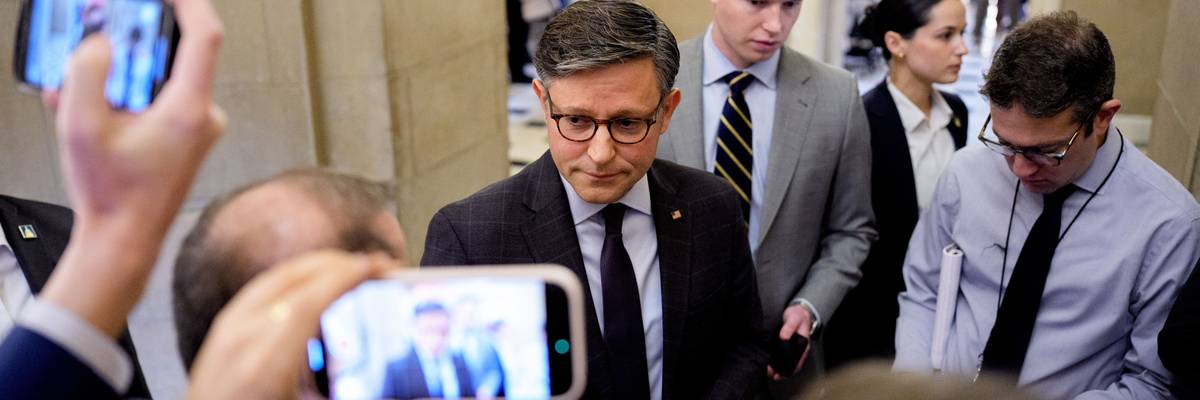
House Speaker Mike Johnson (R-La.) takes a question from a reporter outside his office at the US Capitol Building on December 3, 2025 in Washington, DC.
Mike Johnson Touts $901 Billion Military Budget Plan After Gutting Medicaid, SNAP
"At such a time, bipartisan agreement to provide additional funds to the Pentagon would deliver a cruel message to the American public," advocacy groups warned.
Republican congressional leaders unveiled a sprawling military policy bill late Sunday that would authorize $901 billion in US military spending for the coming fiscal year, just months after GOP lawmakers and President Donald Trump pushed through the largest-ever cuts to Medicaid and federal nutrition assistance.
House Speaker Mike Johnson (R-La.), who aggressively pushed cuts to Medicaid by peddling false claims of large-scale fraud, touted the 3,086-page National Defense Authorization Act (NDAA) as legislation that would "ensure our military forces remain the most lethal in the world."
The bill, a compromise between House and Senate versions of the annual legislation, would authorize $8 billion more in US military spending than Trump asked for in his 2026 budget request.
If passed, the 2026 NDAA would pump billions of dollars more into the Pentagon, a cesspool of the kinds of waste, fraud, and abuse that Johnson and other Republicans claim to be targeting when they cut safety net programs, stripping health insurance and food aid from millions. The Pentagon has never passed an independent audit and continues to have "significant fraud exposure," the Government Accountability Office said earlier this year.
"The surge in Pentagon spending stands in sharp contrast to the drastic cuts in healthcare and food assistance programs imposed by the reconciliation package."
Final passage of the NDAA would push total military spending authorized by Congress this year above $1 trillion, including the $150 billion in Pentagon funds included in the Trump-GOP budget law enacted over the summer.
Last month, as Common Dreams reported, a coalition of watchdog and anti-war groups implored Congress not to approve any funding above the originally requested $892.6 billion, warning that additional money for the Pentagon would enable the Trump administration's lawless use of the military in US streets and overseas.
The groups also noted that "the surge in Pentagon spending stands in sharp contrast to the drastic cuts in healthcare and food assistance programs imposed by the reconciliation package."
"At such a time," they wrote in a letter to lawmakers, "bipartisan agreement to provide additional funds to the Pentagon would deliver a cruel message to the American public, one out of step with Democratic messaging over healthcare, reconciliation, and the shutdown."
We are at a crossroads
This country and this world are at a monumental crossroads. In a few short weeks, US voters will have an opportunity to beat back the forces of fascism and confront the billionaires who are rigging the economy, our media system, and our democracy, making it increasingly impossible for ordinary people to get by. We’re not just talking about the election. We’re talking about what must be done once these fascist elements are vanquished from power. We need a bolder set of solutions than what either major party has so far been willing to offer and a working-class movement ready to fight like hell for it. Trump didn't emerge from nowhere. The conditions that fueled MAGA authoritarianism were created by decades of radical neoliberal economic policies and a corrupt political system dominated by corporate interests. They slashed taxes on the super-rich, promising that the benefits would trickle down. They said giveaways to the corporate titans would make life more affordable for the rest of us. It was all bullshit. And when a bitter, betrayed populace searches for someone to blame, right-wing demagogues have little trouble finding scapegoats. People know when they're being lied to, but you won't hear any of this from the corporate media. Only independent journalism—powered and funded by people who believe in building a better world—can deliver truly trustworthy daily news. Our Fall Campaign is underway, and we need your help. To power our newsroom through the rest of the year, we need to raise $125,000 by midnight on October 31. So if you share our vision, please contribute whatever you can to sustain our work. |
Republican congressional leaders unveiled a sprawling military policy bill late Sunday that would authorize $901 billion in US military spending for the coming fiscal year, just months after GOP lawmakers and President Donald Trump pushed through the largest-ever cuts to Medicaid and federal nutrition assistance.
House Speaker Mike Johnson (R-La.), who aggressively pushed cuts to Medicaid by peddling false claims of large-scale fraud, touted the 3,086-page National Defense Authorization Act (NDAA) as legislation that would "ensure our military forces remain the most lethal in the world."
The bill, a compromise between House and Senate versions of the annual legislation, would authorize $8 billion more in US military spending than Trump asked for in his 2026 budget request.
If passed, the 2026 NDAA would pump billions of dollars more into the Pentagon, a cesspool of the kinds of waste, fraud, and abuse that Johnson and other Republicans claim to be targeting when they cut safety net programs, stripping health insurance and food aid from millions. The Pentagon has never passed an independent audit and continues to have "significant fraud exposure," the Government Accountability Office said earlier this year.
"The surge in Pentagon spending stands in sharp contrast to the drastic cuts in healthcare and food assistance programs imposed by the reconciliation package."
Final passage of the NDAA would push total military spending authorized by Congress this year above $1 trillion, including the $150 billion in Pentagon funds included in the Trump-GOP budget law enacted over the summer.
Last month, as Common Dreams reported, a coalition of watchdog and anti-war groups implored Congress not to approve any funding above the originally requested $892.6 billion, warning that additional money for the Pentagon would enable the Trump administration's lawless use of the military in US streets and overseas.
The groups also noted that "the surge in Pentagon spending stands in sharp contrast to the drastic cuts in healthcare and food assistance programs imposed by the reconciliation package."
"At such a time," they wrote in a letter to lawmakers, "bipartisan agreement to provide additional funds to the Pentagon would deliver a cruel message to the American public, one out of step with Democratic messaging over healthcare, reconciliation, and the shutdown."
Republican congressional leaders unveiled a sprawling military policy bill late Sunday that would authorize $901 billion in US military spending for the coming fiscal year, just months after GOP lawmakers and President Donald Trump pushed through the largest-ever cuts to Medicaid and federal nutrition assistance.
House Speaker Mike Johnson (R-La.), who aggressively pushed cuts to Medicaid by peddling false claims of large-scale fraud, touted the 3,086-page National Defense Authorization Act (NDAA) as legislation that would "ensure our military forces remain the most lethal in the world."
The bill, a compromise between House and Senate versions of the annual legislation, would authorize $8 billion more in US military spending than Trump asked for in his 2026 budget request.
If passed, the 2026 NDAA would pump billions of dollars more into the Pentagon, a cesspool of the kinds of waste, fraud, and abuse that Johnson and other Republicans claim to be targeting when they cut safety net programs, stripping health insurance and food aid from millions. The Pentagon has never passed an independent audit and continues to have "significant fraud exposure," the Government Accountability Office said earlier this year.
"The surge in Pentagon spending stands in sharp contrast to the drastic cuts in healthcare and food assistance programs imposed by the reconciliation package."
Final passage of the NDAA would push total military spending authorized by Congress this year above $1 trillion, including the $150 billion in Pentagon funds included in the Trump-GOP budget law enacted over the summer.
Last month, as Common Dreams reported, a coalition of watchdog and anti-war groups implored Congress not to approve any funding above the originally requested $892.6 billion, warning that additional money for the Pentagon would enable the Trump administration's lawless use of the military in US streets and overseas.
The groups also noted that "the surge in Pentagon spending stands in sharp contrast to the drastic cuts in healthcare and food assistance programs imposed by the reconciliation package."
"At such a time," they wrote in a letter to lawmakers, "bipartisan agreement to provide additional funds to the Pentagon would deliver a cruel message to the American public, one out of step with Democratic messaging over healthcare, reconciliation, and the shutdown."