

SUBSCRIBE TO OUR FREE NEWSLETTER
Daily news & progressive opinion—funded by the people, not the corporations—delivered straight to your inbox.
5
#000000
#FFFFFF
To donate by check, phone, or other method, see our More Ways to Give page.
Daily news & progressive opinion—funded by the people, not the corporations—delivered straight to your inbox.
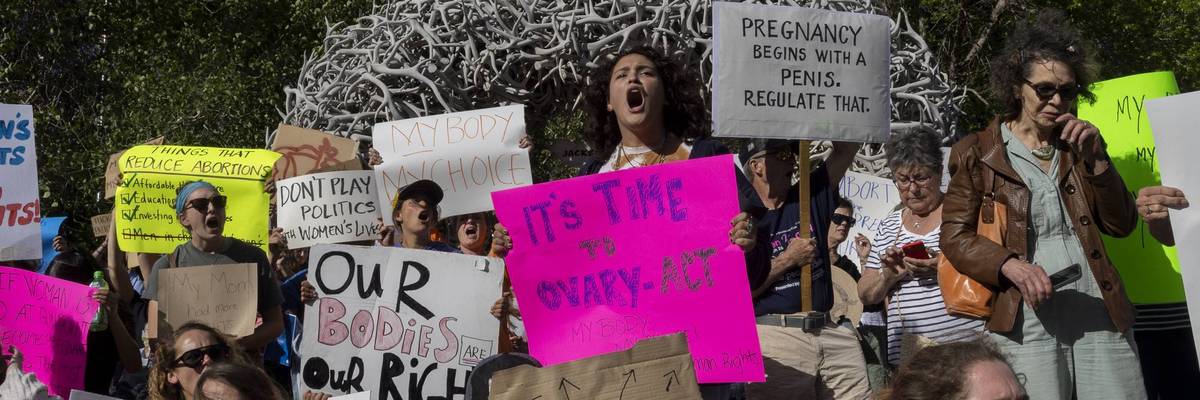
Abortion rights defenders protest the US Supreme Court's overturning of Roe v. Wade during a demonstration in Jackson Hole, Wyoming on June 24, 2022 in Jackson Hole, Wyoming.
"This new law is part of a relentless campaign by anti-abortion extremists who continue to push restrictions regardless of settled law, patient safety, or basic compassion," said one critic.
A reproductive rights group coalition that recently got two anti-abortion laws overturned in Wyoming's Supreme Court filed a legal challenge on Tuesday against the insidiously named "fetal heartbeat" legislation signed earlier this week by the state's Republican governor.
The advocacy groups Chelsea's Fund and Just the Pill; Wellspring Health Access, Wyoming's only abortion clinic; and three physicians filed a motion seeking to block HB 0126, the so-called Human Heartbeat Act, which was signed Monday by Gov. Mark Gordon.
The law bans abortion when there is a "detectable fetal heartbeat." Critics note that the term "fetal heartbeat" is medically inaccurate and misleading, as what can be detected with a transvaginal ultrasound at around six weeks of gestation is not an actual heartbeat, but rather electrical activity in fetal tissue that later develops into a heart.
The legislation contains an exception to “preserve the woman from an imminent peril that substantially endangers her life or health, according to appropriate medical judgment," but forces victims of rape and incest to carry their abusers' fetus to term.
The “uNfOrTuNaTe fLaW” he's referring to is that the state's abortion ban has no rape or incest exception. 🤬But this is no accident; these policies are DESIGNED to violate our basic human rights. For the extremists who champion these violent laws, this is a feature, not a bug.
[image or embed]
— Center for Reproductive Rights (@reprorights.org) March 11, 2026 at 7:51 AM
Gordon called the glaring lack of exceptions for rape or incest "an unfortunate flaw."
Wyoming's Republican-dominated Legislature passed the law after the state Supreme Court struck down two other pieces of forced-birth legislation in January.
One of the overturned laws outlawed abortion in nearly all cases, except when the pregnant patient’s life is in danger or for victims of rape or incest. The other banned abortion pills. Both laws were passed after the US Supreme Court overturned Roe v. Wade, reversing half a century of federal abortion rights.
In striking down the laws, the state's high court ruled that they violated residents' ability to make their own healthcare decisions—a right enshrined in the Wyoming Constitution.
The groups challenging the new law echoed the ruling in their motion, arguing the legislation "transgresses the constitutional guarantee of plaintiffs’ and individuals’ to make healthcare decisions without interference from the government."
Chelsea's Fund executive director Janean Forsyth expressed dismay over state lawmakers' relentless attacks on healthcare.
“I'm thinking about everyone from the 15-year-old that we supported, whose grandmother actually reached out, a victim of sexual assault,” Forsyth told Wyoming Public Radio on Wednesday. “I'm thinking about a family with a very wanted pregnancy that we supported in eventually seeking an abortion for a severe fetal anomaly.”
"It's not only affecting access to abortion care, it's affecting reproductive healthcare access generally for parents and children, which is really unfortunate,” she added, referring to medical professionals who are leaving the state for fear of prosecution.
On Wednesday, Brittany Fonteno, president and CEO of the National Abortion Federation (NAF), said in a statement:
A mere two months after two abortion bans were struck down by the state’s Supreme Court, Wyoming’s anti-abortion leaders have enacted yet another ban despite clear judicial rulings and public support for the constitutional right to make personal healthcare decisions. This new law is part of a relentless campaign by anti-abortion extremists who continue to push restrictions regardless of settled law, patient safety, or basic compassion.
“But as they have before, providers are standing firm and fighting back," Fonteno added. "NAF is proud to support Wellspring Health Access and the advocates challenging this ban, and we remain committed to ensuring abortion care is not only legal, but accessible and protected for every person, in every state.”
Abortion access has been tenuous in Wyoming in recent years, with bans and a 2022 arson attack on the Wellspring Health Access clinic in Casper—the state's only full-service abortion facility—causing uncertainty and delays.
Lawmakers in Wyoming considered putting the issue before voters in a referendum but decided against doing so, as such ballot measures have repeatedly resulted in the protection of abortion rights—even in deep "red" and conservative-leaning states including Arizona, Kansas, Michigan, Missouri, Montana, and Ohio.
Wyoming is the fifth state to ban abortion at around six weeks, joining Florida, Georgia, Iowa, and South Carolina.
According to the Guttmacher Institute, 13 states currently have near-total abortion bans, while 28 other states restrict the procedure. Numerous forced-birth bills are pending across the nation, and—while unlikely to pass—the most severe proposals including punishing the medical procedure with lengthy imprisonment and even the death penalty for healthcare providers and patients.
Wyoming’s governor signed into law a so-called “fetal heartbeat” ban. Abortion is now banned in the state when “cardiac activity” is detected, around 6 wks of pregnancy. WY now shifts from “Restrictive” to “Very Restrictive” on our interactive map. Learn more: https://gu.tt/4985P4S#AbortionAccess
[image or embed]
— Guttmacher (@guttmacher.org) March 11, 2026 at 6:00 AM
On Monday, the Center for Reproductive Rights published a report examining the human and economic toll of abortion bans, which a separate study last year by the Population Reference Bureau has linked to 478 excess infant deaths and 59 excess deaths of pregnant people since Roe was struck down nearly four years ago.
It's not only state-level bans that harm patients. Republicans' so-called One Big Beautiful Bill Act, signed into law by President Donald Trump last year, contains the biggest cuts to Medicaid in the program's 60-year history. Dramatically decreased Medicaid funding has resulted in the closure of at least 50 Planned Parenthood clinics nationwide, and the reduction of services at many others.
Dear Common Dreams reader, It’s been nearly 30 years since I co-founded Common Dreams with my late wife, Lina Newhouser. We had the radical notion that journalism should serve the public good, not corporate profits. It was clear to us from the outset what it would take to build such a project. No paid advertisements. No corporate sponsors. No millionaire publisher telling us what to think or do. Many people said we wouldn't last a year, but we proved those doubters wrong. Together with a tremendous team of journalists and dedicated staff, we built an independent media outlet free from the constraints of profits and corporate control. Our mission has always been simple: To inform. To inspire. To ignite change for the common good. Building Common Dreams was not easy. Our survival was never guaranteed. When you take on the most powerful forces—Wall Street greed, fossil fuel industry destruction, Big Tech lobbyists, and uber-rich oligarchs who have spent billions upon billions rigging the economy and democracy in their favor—the only bulwark you have is supporters who believe in your work. But here’s the urgent message from me today. It's never been this bad out there. And it's never been this hard to keep us going. At the very moment Common Dreams is most needed, the threats we face are intensifying. We need your support now more than ever. We don't accept corporate advertising and never will. We don't have a paywall because we don't think people should be blocked from critical news based on their ability to pay. Everything we do is funded by the donations of readers like you. When everyone does the little they can afford, we are strong. But if that support retreats or dries up, so do we. Will you donate now to make sure Common Dreams not only survives but thrives? —Craig Brown, Co-founder |
A reproductive rights group coalition that recently got two anti-abortion laws overturned in Wyoming's Supreme Court filed a legal challenge on Tuesday against the insidiously named "fetal heartbeat" legislation signed earlier this week by the state's Republican governor.
The advocacy groups Chelsea's Fund and Just the Pill; Wellspring Health Access, Wyoming's only abortion clinic; and three physicians filed a motion seeking to block HB 0126, the so-called Human Heartbeat Act, which was signed Monday by Gov. Mark Gordon.
The law bans abortion when there is a "detectable fetal heartbeat." Critics note that the term "fetal heartbeat" is medically inaccurate and misleading, as what can be detected with a transvaginal ultrasound at around six weeks of gestation is not an actual heartbeat, but rather electrical activity in fetal tissue that later develops into a heart.
The legislation contains an exception to “preserve the woman from an imminent peril that substantially endangers her life or health, according to appropriate medical judgment," but forces victims of rape and incest to carry their abusers' fetus to term.
The “uNfOrTuNaTe fLaW” he's referring to is that the state's abortion ban has no rape or incest exception. 🤬But this is no accident; these policies are DESIGNED to violate our basic human rights. For the extremists who champion these violent laws, this is a feature, not a bug.
[image or embed]
— Center for Reproductive Rights (@reprorights.org) March 11, 2026 at 7:51 AM
Gordon called the glaring lack of exceptions for rape or incest "an unfortunate flaw."
Wyoming's Republican-dominated Legislature passed the law after the state Supreme Court struck down two other pieces of forced-birth legislation in January.
One of the overturned laws outlawed abortion in nearly all cases, except when the pregnant patient’s life is in danger or for victims of rape or incest. The other banned abortion pills. Both laws were passed after the US Supreme Court overturned Roe v. Wade, reversing half a century of federal abortion rights.
In striking down the laws, the state's high court ruled that they violated residents' ability to make their own healthcare decisions—a right enshrined in the Wyoming Constitution.
The groups challenging the new law echoed the ruling in their motion, arguing the legislation "transgresses the constitutional guarantee of plaintiffs’ and individuals’ to make healthcare decisions without interference from the government."
Chelsea's Fund executive director Janean Forsyth expressed dismay over state lawmakers' relentless attacks on healthcare.
“I'm thinking about everyone from the 15-year-old that we supported, whose grandmother actually reached out, a victim of sexual assault,” Forsyth told Wyoming Public Radio on Wednesday. “I'm thinking about a family with a very wanted pregnancy that we supported in eventually seeking an abortion for a severe fetal anomaly.”
"It's not only affecting access to abortion care, it's affecting reproductive healthcare access generally for parents and children, which is really unfortunate,” she added, referring to medical professionals who are leaving the state for fear of prosecution.
On Wednesday, Brittany Fonteno, president and CEO of the National Abortion Federation (NAF), said in a statement:
A mere two months after two abortion bans were struck down by the state’s Supreme Court, Wyoming’s anti-abortion leaders have enacted yet another ban despite clear judicial rulings and public support for the constitutional right to make personal healthcare decisions. This new law is part of a relentless campaign by anti-abortion extremists who continue to push restrictions regardless of settled law, patient safety, or basic compassion.
“But as they have before, providers are standing firm and fighting back," Fonteno added. "NAF is proud to support Wellspring Health Access and the advocates challenging this ban, and we remain committed to ensuring abortion care is not only legal, but accessible and protected for every person, in every state.”
Abortion access has been tenuous in Wyoming in recent years, with bans and a 2022 arson attack on the Wellspring Health Access clinic in Casper—the state's only full-service abortion facility—causing uncertainty and delays.
Lawmakers in Wyoming considered putting the issue before voters in a referendum but decided against doing so, as such ballot measures have repeatedly resulted in the protection of abortion rights—even in deep "red" and conservative-leaning states including Arizona, Kansas, Michigan, Missouri, Montana, and Ohio.
Wyoming is the fifth state to ban abortion at around six weeks, joining Florida, Georgia, Iowa, and South Carolina.
According to the Guttmacher Institute, 13 states currently have near-total abortion bans, while 28 other states restrict the procedure. Numerous forced-birth bills are pending across the nation, and—while unlikely to pass—the most severe proposals including punishing the medical procedure with lengthy imprisonment and even the death penalty for healthcare providers and patients.
Wyoming’s governor signed into law a so-called “fetal heartbeat” ban. Abortion is now banned in the state when “cardiac activity” is detected, around 6 wks of pregnancy. WY now shifts from “Restrictive” to “Very Restrictive” on our interactive map. Learn more: https://gu.tt/4985P4S#AbortionAccess
[image or embed]
— Guttmacher (@guttmacher.org) March 11, 2026 at 6:00 AM
On Monday, the Center for Reproductive Rights published a report examining the human and economic toll of abortion bans, which a separate study last year by the Population Reference Bureau has linked to 478 excess infant deaths and 59 excess deaths of pregnant people since Roe was struck down nearly four years ago.
It's not only state-level bans that harm patients. Republicans' so-called One Big Beautiful Bill Act, signed into law by President Donald Trump last year, contains the biggest cuts to Medicaid in the program's 60-year history. Dramatically decreased Medicaid funding has resulted in the closure of at least 50 Planned Parenthood clinics nationwide, and the reduction of services at many others.
A reproductive rights group coalition that recently got two anti-abortion laws overturned in Wyoming's Supreme Court filed a legal challenge on Tuesday against the insidiously named "fetal heartbeat" legislation signed earlier this week by the state's Republican governor.
The advocacy groups Chelsea's Fund and Just the Pill; Wellspring Health Access, Wyoming's only abortion clinic; and three physicians filed a motion seeking to block HB 0126, the so-called Human Heartbeat Act, which was signed Monday by Gov. Mark Gordon.
The law bans abortion when there is a "detectable fetal heartbeat." Critics note that the term "fetal heartbeat" is medically inaccurate and misleading, as what can be detected with a transvaginal ultrasound at around six weeks of gestation is not an actual heartbeat, but rather electrical activity in fetal tissue that later develops into a heart.
The legislation contains an exception to “preserve the woman from an imminent peril that substantially endangers her life or health, according to appropriate medical judgment," but forces victims of rape and incest to carry their abusers' fetus to term.
The “uNfOrTuNaTe fLaW” he's referring to is that the state's abortion ban has no rape or incest exception. 🤬But this is no accident; these policies are DESIGNED to violate our basic human rights. For the extremists who champion these violent laws, this is a feature, not a bug.
[image or embed]
— Center for Reproductive Rights (@reprorights.org) March 11, 2026 at 7:51 AM
Gordon called the glaring lack of exceptions for rape or incest "an unfortunate flaw."
Wyoming's Republican-dominated Legislature passed the law after the state Supreme Court struck down two other pieces of forced-birth legislation in January.
One of the overturned laws outlawed abortion in nearly all cases, except when the pregnant patient’s life is in danger or for victims of rape or incest. The other banned abortion pills. Both laws were passed after the US Supreme Court overturned Roe v. Wade, reversing half a century of federal abortion rights.
In striking down the laws, the state's high court ruled that they violated residents' ability to make their own healthcare decisions—a right enshrined in the Wyoming Constitution.
The groups challenging the new law echoed the ruling in their motion, arguing the legislation "transgresses the constitutional guarantee of plaintiffs’ and individuals’ to make healthcare decisions without interference from the government."
Chelsea's Fund executive director Janean Forsyth expressed dismay over state lawmakers' relentless attacks on healthcare.
“I'm thinking about everyone from the 15-year-old that we supported, whose grandmother actually reached out, a victim of sexual assault,” Forsyth told Wyoming Public Radio on Wednesday. “I'm thinking about a family with a very wanted pregnancy that we supported in eventually seeking an abortion for a severe fetal anomaly.”
"It's not only affecting access to abortion care, it's affecting reproductive healthcare access generally for parents and children, which is really unfortunate,” she added, referring to medical professionals who are leaving the state for fear of prosecution.
On Wednesday, Brittany Fonteno, president and CEO of the National Abortion Federation (NAF), said in a statement:
A mere two months after two abortion bans were struck down by the state’s Supreme Court, Wyoming’s anti-abortion leaders have enacted yet another ban despite clear judicial rulings and public support for the constitutional right to make personal healthcare decisions. This new law is part of a relentless campaign by anti-abortion extremists who continue to push restrictions regardless of settled law, patient safety, or basic compassion.
“But as they have before, providers are standing firm and fighting back," Fonteno added. "NAF is proud to support Wellspring Health Access and the advocates challenging this ban, and we remain committed to ensuring abortion care is not only legal, but accessible and protected for every person, in every state.”
Abortion access has been tenuous in Wyoming in recent years, with bans and a 2022 arson attack on the Wellspring Health Access clinic in Casper—the state's only full-service abortion facility—causing uncertainty and delays.
Lawmakers in Wyoming considered putting the issue before voters in a referendum but decided against doing so, as such ballot measures have repeatedly resulted in the protection of abortion rights—even in deep "red" and conservative-leaning states including Arizona, Kansas, Michigan, Missouri, Montana, and Ohio.
Wyoming is the fifth state to ban abortion at around six weeks, joining Florida, Georgia, Iowa, and South Carolina.
According to the Guttmacher Institute, 13 states currently have near-total abortion bans, while 28 other states restrict the procedure. Numerous forced-birth bills are pending across the nation, and—while unlikely to pass—the most severe proposals including punishing the medical procedure with lengthy imprisonment and even the death penalty for healthcare providers and patients.
Wyoming’s governor signed into law a so-called “fetal heartbeat” ban. Abortion is now banned in the state when “cardiac activity” is detected, around 6 wks of pregnancy. WY now shifts from “Restrictive” to “Very Restrictive” on our interactive map. Learn more: https://gu.tt/4985P4S#AbortionAccess
[image or embed]
— Guttmacher (@guttmacher.org) March 11, 2026 at 6:00 AM
On Monday, the Center for Reproductive Rights published a report examining the human and economic toll of abortion bans, which a separate study last year by the Population Reference Bureau has linked to 478 excess infant deaths and 59 excess deaths of pregnant people since Roe was struck down nearly four years ago.
It's not only state-level bans that harm patients. Republicans' so-called One Big Beautiful Bill Act, signed into law by President Donald Trump last year, contains the biggest cuts to Medicaid in the program's 60-year history. Dramatically decreased Medicaid funding has resulted in the closure of at least 50 Planned Parenthood clinics nationwide, and the reduction of services at many others.

