

SUBSCRIBE TO OUR FREE NEWSLETTER
Daily news & progressive opinion—funded by the people, not the corporations—delivered straight to your inbox.
5
#000000
#FFFFFF
To donate by check, phone, or other method, see our More Ways to Give page.
Daily news & progressive opinion—funded by the people, not the corporations—delivered straight to your inbox.
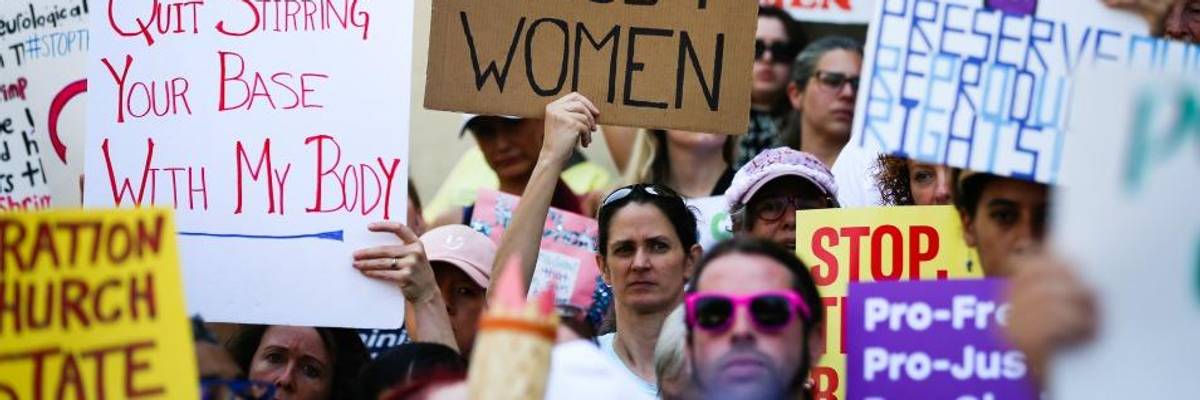
Women and men hold signs during a protest against recently passed abortion ban bills at the Georgia State Capitol building on May 21, 2019 in Atlanta. (Photo: Elijah Nouvelage/Getty Images)
As reproductive rights advocates fight a recent upswell in extremist state abortion bans, the nation's largest association for doctors specializing in women's health on Wednesday warned against using the misleading language deployed by the anti-choice movement.
The American College of Obstetricians and Gynecologists (ACOG) told reporters that so-called "heartbeat bills" which have passed in Georgia, Alabama, and Ohio in recent weeks should be referred to as "six-week abortion bans."
Using the term "heartbeat bill," as the mostly-Republican lawmakers who have pushed the regulations have, suggests that doctors can actually detect a fetal heartbeat at six weeks of pregnancy.
In fact, ACOG President Dr. Ted Anderson told The Guardian, "what is interpreted as a heartbeat in these bills is actually electrically induced flickering of a portion of the fetal tissue that will become the heart as the embryo develops."
The six-week cut-off which has been pushed in several states is "arbitrary," added Anderson, and "[does] not reflect medical accuracy or clinical understanding."
Other critics have made similar arguments, saying the anti-choice movement is interested not in protecting fetuses and six-week-old embryos but in controlling women's reproductive choices and attacking Roe v. Wade, the 1973 Supreme Court decision which affirmed that American women have the right to abortion care.
ACOG's recommendation came a day after the United Nations deputy commissioner on human rights, Kate Gilmore, denounced recent anti-choice laws in the U.S. as products of "extremist hate" aimed at women and called on rights advocates "to stand with the evidence and facts and in solidarity with women."
As women's rights advocate and author Rebecca Solnit wrote in The Guardian this week, the anti-choice movement has recently gained ground in its effort to curtail women's reproductive rights through the use of blatant lies about abortion care, specifically their claim that women and doctors commit infanticide during rare abortions which take place in the last trimester of pregnancy--often when the pregnant patient's life or health is at risk or when fetal abnormalities have been detected.
With its warning on Wednesday, ACOG suggested that misleading language about abortions early in pregnancy are part of that strategy as well.
"Anti-abortion laws are built on anti-abortion lies," wrote Solnit. "Lies about things like who has abortions, how abortions work, how women's bodies work, and how fetuses develop. The lies pave the way for the laws."
"To defeat the laws," Solnit added, "we must fight the lies."
Dear Common Dreams reader, It’s been nearly 30 years since I co-founded Common Dreams with my late wife, Lina Newhouser. We had the radical notion that journalism should serve the public good, not corporate profits. It was clear to us from the outset what it would take to build such a project. No paid advertisements. No corporate sponsors. No millionaire publisher telling us what to think or do. Many people said we wouldn't last a year, but we proved those doubters wrong. Together with a tremendous team of journalists and dedicated staff, we built an independent media outlet free from the constraints of profits and corporate control. Our mission has always been simple: To inform. To inspire. To ignite change for the common good. Building Common Dreams was not easy. Our survival was never guaranteed. When you take on the most powerful forces—Wall Street greed, fossil fuel industry destruction, Big Tech lobbyists, and uber-rich oligarchs who have spent billions upon billions rigging the economy and democracy in their favor—the only bulwark you have is supporters who believe in your work. But here’s the urgent message from me today. It's never been this bad out there. And it's never been this hard to keep us going. At the very moment Common Dreams is most needed, the threats we face are intensifying. We need your support now more than ever. We don't accept corporate advertising and never will. We don't have a paywall because we don't think people should be blocked from critical news based on their ability to pay. Everything we do is funded by the donations of readers like you. When everyone does the little they can afford, we are strong. But if that support retreats or dries up, so do we. Will you donate now to make sure Common Dreams not only survives but thrives? —Craig Brown, Co-founder |
As reproductive rights advocates fight a recent upswell in extremist state abortion bans, the nation's largest association for doctors specializing in women's health on Wednesday warned against using the misleading language deployed by the anti-choice movement.
The American College of Obstetricians and Gynecologists (ACOG) told reporters that so-called "heartbeat bills" which have passed in Georgia, Alabama, and Ohio in recent weeks should be referred to as "six-week abortion bans."
Using the term "heartbeat bill," as the mostly-Republican lawmakers who have pushed the regulations have, suggests that doctors can actually detect a fetal heartbeat at six weeks of pregnancy.
In fact, ACOG President Dr. Ted Anderson told The Guardian, "what is interpreted as a heartbeat in these bills is actually electrically induced flickering of a portion of the fetal tissue that will become the heart as the embryo develops."
The six-week cut-off which has been pushed in several states is "arbitrary," added Anderson, and "[does] not reflect medical accuracy or clinical understanding."
Other critics have made similar arguments, saying the anti-choice movement is interested not in protecting fetuses and six-week-old embryos but in controlling women's reproductive choices and attacking Roe v. Wade, the 1973 Supreme Court decision which affirmed that American women have the right to abortion care.
ACOG's recommendation came a day after the United Nations deputy commissioner on human rights, Kate Gilmore, denounced recent anti-choice laws in the U.S. as products of "extremist hate" aimed at women and called on rights advocates "to stand with the evidence and facts and in solidarity with women."
As women's rights advocate and author Rebecca Solnit wrote in The Guardian this week, the anti-choice movement has recently gained ground in its effort to curtail women's reproductive rights through the use of blatant lies about abortion care, specifically their claim that women and doctors commit infanticide during rare abortions which take place in the last trimester of pregnancy--often when the pregnant patient's life or health is at risk or when fetal abnormalities have been detected.
With its warning on Wednesday, ACOG suggested that misleading language about abortions early in pregnancy are part of that strategy as well.
"Anti-abortion laws are built on anti-abortion lies," wrote Solnit. "Lies about things like who has abortions, how abortions work, how women's bodies work, and how fetuses develop. The lies pave the way for the laws."
"To defeat the laws," Solnit added, "we must fight the lies."
As reproductive rights advocates fight a recent upswell in extremist state abortion bans, the nation's largest association for doctors specializing in women's health on Wednesday warned against using the misleading language deployed by the anti-choice movement.
The American College of Obstetricians and Gynecologists (ACOG) told reporters that so-called "heartbeat bills" which have passed in Georgia, Alabama, and Ohio in recent weeks should be referred to as "six-week abortion bans."
Using the term "heartbeat bill," as the mostly-Republican lawmakers who have pushed the regulations have, suggests that doctors can actually detect a fetal heartbeat at six weeks of pregnancy.
In fact, ACOG President Dr. Ted Anderson told The Guardian, "what is interpreted as a heartbeat in these bills is actually electrically induced flickering of a portion of the fetal tissue that will become the heart as the embryo develops."
The six-week cut-off which has been pushed in several states is "arbitrary," added Anderson, and "[does] not reflect medical accuracy or clinical understanding."
Other critics have made similar arguments, saying the anti-choice movement is interested not in protecting fetuses and six-week-old embryos but in controlling women's reproductive choices and attacking Roe v. Wade, the 1973 Supreme Court decision which affirmed that American women have the right to abortion care.
ACOG's recommendation came a day after the United Nations deputy commissioner on human rights, Kate Gilmore, denounced recent anti-choice laws in the U.S. as products of "extremist hate" aimed at women and called on rights advocates "to stand with the evidence and facts and in solidarity with women."
As women's rights advocate and author Rebecca Solnit wrote in The Guardian this week, the anti-choice movement has recently gained ground in its effort to curtail women's reproductive rights through the use of blatant lies about abortion care, specifically their claim that women and doctors commit infanticide during rare abortions which take place in the last trimester of pregnancy--often when the pregnant patient's life or health is at risk or when fetal abnormalities have been detected.
With its warning on Wednesday, ACOG suggested that misleading language about abortions early in pregnancy are part of that strategy as well.
"Anti-abortion laws are built on anti-abortion lies," wrote Solnit. "Lies about things like who has abortions, how abortions work, how women's bodies work, and how fetuses develop. The lies pave the way for the laws."
"To defeat the laws," Solnit added, "we must fight the lies."

