SUBSCRIBE TO OUR FREE NEWSLETTER
Daily news & progressive opinion—funded by the people, not the corporations—delivered straight to your inbox.
5
#000000
#FFFFFF
To donate by check, phone, or other method, see our More Ways to Give page.
Daily news & progressive opinion—funded by the people, not the corporations—delivered straight to your inbox.
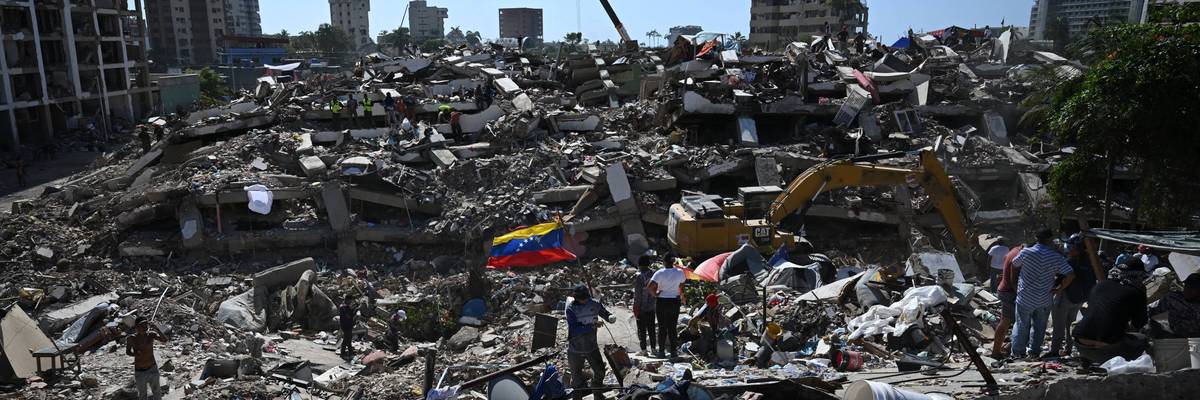
Locals stand on top of the rubble in Caraballeda, La Guaira state, Venezuela, on July 7, 2026, following earthquakes that struck the region, killing at least thousands of people.
The experts laid out various policies they argued are "required to prevent avoidable deaths, stabilize a sanctioned economy, and allow Venezuelans to rebuild with dignity."
With at least 3,535 people dead, 16,740 injured, and tens of thousands still missing after a pair of major earthquakes hit Venezuela last month, over 100 economists and scholars on Tuesday jointly called for "immediate action to unfetter Venezuela's humanitarian response and reconstruction from ongoing economic and financial sanctions, asset freezes, and onerous debt burdens."
Such demands began to emerge shortly after the 7.2- and 7.5-magnitude quakes, both centered in Yaracuy, on June 24. The new letter, shared with Common Dreams by the Center for Economic and Policy Research, follows a similar message sent to President Donald Trump and Secretary of State Marco Rubio last week by CEPR, Just Foreign Policy, Latin America Working Group, Venezuelan American Community Action, Peace Action, the Quincy Institute for Responsible Statecraft, and a dozen other organizations.
The academics and economists, including several experts at CEPR as well as James Galbraith, Jayati Ghosh, Jason Hickel, Ann Pettifor, Jeffrey Sachs, Robert Wade, and Isabella Weber, highlighted that "Venezuela enters this disaster after years of unilateral coercive measures, financial sanctions, and export controls that have damaged its economy and infrastructure."
That includes decades of US sanctions. On top of those economic moves, Trump earlier this year sent troops into Venezuela to abduct President Nicolás Maduro, then took control of the South American country's nationalized oil industry. The New York Times reported earlier this week that the Trump administration has seized at least $8 billion worth of Venezuela's oil wealth this year.
In a Tuesday piece for Just Security, a pair of experts who signed the new letter—George Lopez, professor emeritus of peace studies at the University of Notre Dame, and Venezuelan economist and CEPR senior Research Fellow Francisco Rodríguez—noted that post-earthquakes, "the United States pledged $300 million to relief agencies, mobilized civilian and military teams to Venezuela that are trained on disaster relief, and issued a limited sanctions waiver for earthquake relief activities.
"But these measures are far from enough," they stressed, explaining that "the United Nations estimates the losses from the quakes stand at $37 billion," or 32% of Venezuela's gross domestic product. They suggested that "the United States should spearhead a major reconstruction effort and lift all remaining sanctions on the Venezuelan economy."
The US was eager to take control in Venezuela earlier this year.Now that the country is facing devastating loss after twin earthquakes, the US should spearhead a major reconstruction effort and lift all remaining sanctions.From Francisco Rodríguez and George A. Lopez:
[image or embed]
— Just Security (@justsecurity.org) July 7, 2026 at 9:06 AM
The broader group argued that "whatever one's position on Venezuela's internal politics, the current set of coercive economic measures directed at the country is an indiscriminate instrument. Sanctions on the central bank, public banking, oil industry, and debt transactions do not land surgically on officials; they incapacitate payment systems, raise import costs, block correspondent banking, freeze reserves, deter suppliers, and produce scarcity across an entire society. This is precisely the moment to remove any economic and financial obstacles to relief and reconstruction."
They called on the Trump administration specifically to lift all economic sanctions, "including any that may impact the Banco Central de Venezuela (BCV), government institutions, Petróleos de Venezuela, SA (PDVSA), public financial institutions, the oil and mining sectors, banking, transportation, shipping, telecommunications, travel, and all related activities," and to immediately issue "the Section 25B certification that is required to enable the BCV to receive, control, use, and transact through its accounts and assets at the Federal Reserve and US banks."
The experts also took aim at the United Kingdom and the Portuguese, calling on the governments to respectively work with "the Bank of England to ensure the immediate unfreezing of the BCV's gold reserves, worth about $5 billion and representing a third of the central bank's reported assets," as well as with Novo Banco, "to return $1.2 billion belonging to Venezuela's development bank, BANDES, and PDVSA affiliates, as set out in a 2023 court decision."
They further pressured the International Monetary Fund (IMF) to "ensure that Venezuela has full access to its approximately $5 billion in special drawing rights (SDRs) for emergency stabilization and imports," and to approve a $4 billion rapid financing instrument (RFI) disbursement immediately, using its emergency and natural disaster rationale, with no conditions."
Beyond those specific recommendations, the economists and scholars urged "a coordinated debt jubilee for Venezuela," writing that "all official bilateral creditors, multilateral creditors to the extent legally possible, and public agencies holding claims should cancel or suspend debt service, interest, penalties, and arrears, and pursue a comprehensive debt reduction consistent with a rights-based recovery and climate-resilient reconstruction."
"A new fund should be established—perhaps financed by the IMF's Resilience and Sustainability Trust (RST)—to repurchase distressed debt from the secondary market, with legal protections against holdout litigation and asset seizures," they proposed. "Money owed to creditors cannot at the same time rebuild hospitals, schools, housing, water systems, and the grid. A debt crisis in these conditions is a developmental and humanitarian crisis."
"Venezuela's people must not be made to pay twice: first through disaster, and then through sanctions, frozen reserves, and unsustainable debt servicing," they concluded. "We urge governments, international financial institutions, and creditors to act now, on the principle that lives, public health, and economic recovery take precedence over coercion and collection. Emergency liquidity, full sanctions relief, SDR access, RFI financing, and debt cancellation are not acts of charity. They are the minimum policy response required to prevent avoidable deaths, stabilize a sanctioned economy, and allow Venezuelans to rebuild with dignity."
Dear Common Dreams reader, It’s been nearly 30 years since I co-founded Common Dreams with my late wife, Lina Newhouser. We had the radical notion that journalism should serve the public good, not corporate profits. It was clear to us from the outset what it would take to build such a project. No paid advertisements. No corporate sponsors. No millionaire publisher telling us what to think or do. Many people said we wouldn't last a year, but we proved those doubters wrong. Together with a tremendous team of journalists and dedicated staff, we built an independent media outlet free from the constraints of profits and corporate control. Our mission has always been simple: To inform. To inspire. To ignite change for the common good. Building Common Dreams was not easy. Our survival was never guaranteed. When you take on the most powerful forces—Wall Street greed, fossil fuel industry destruction, Big Tech lobbyists, and uber-rich oligarchs who have spent billions upon billions rigging the economy and democracy in their favor—the only bulwark you have is supporters who believe in your work. But here’s the urgent message from me today. It's never been this bad out there. And it's never been this hard to keep us going. At the very moment Common Dreams is most needed, the threats we face are intensifying. We need your support now more than ever. We don't accept corporate advertising and never will. We don't have a paywall because we don't think people should be blocked from critical news based on their ability to pay. Everything we do is funded by the donations of readers like you. When everyone does the little they can afford, we are strong. But if that support retreats or dries up, so do we. Will you donate now to make sure Common Dreams not only survives but thrives? —Craig Brown, Co-founder |
With at least 3,535 people dead, 16,740 injured, and tens of thousands still missing after a pair of major earthquakes hit Venezuela last month, over 100 economists and scholars on Tuesday jointly called for "immediate action to unfetter Venezuela's humanitarian response and reconstruction from ongoing economic and financial sanctions, asset freezes, and onerous debt burdens."
Such demands began to emerge shortly after the 7.2- and 7.5-magnitude quakes, both centered in Yaracuy, on June 24. The new letter, shared with Common Dreams by the Center for Economic and Policy Research, follows a similar message sent to President Donald Trump and Secretary of State Marco Rubio last week by CEPR, Just Foreign Policy, Latin America Working Group, Venezuelan American Community Action, Peace Action, the Quincy Institute for Responsible Statecraft, and a dozen other organizations.
The academics and economists, including several experts at CEPR as well as James Galbraith, Jayati Ghosh, Jason Hickel, Ann Pettifor, Jeffrey Sachs, Robert Wade, and Isabella Weber, highlighted that "Venezuela enters this disaster after years of unilateral coercive measures, financial sanctions, and export controls that have damaged its economy and infrastructure."
That includes decades of US sanctions. On top of those economic moves, Trump earlier this year sent troops into Venezuela to abduct President Nicolás Maduro, then took control of the South American country's nationalized oil industry. The New York Times reported earlier this week that the Trump administration has seized at least $8 billion worth of Venezuela's oil wealth this year.
In a Tuesday piece for Just Security, a pair of experts who signed the new letter—George Lopez, professor emeritus of peace studies at the University of Notre Dame, and Venezuelan economist and CEPR senior Research Fellow Francisco Rodríguez—noted that post-earthquakes, "the United States pledged $300 million to relief agencies, mobilized civilian and military teams to Venezuela that are trained on disaster relief, and issued a limited sanctions waiver for earthquake relief activities.
"But these measures are far from enough," they stressed, explaining that "the United Nations estimates the losses from the quakes stand at $37 billion," or 32% of Venezuela's gross domestic product. They suggested that "the United States should spearhead a major reconstruction effort and lift all remaining sanctions on the Venezuelan economy."
The US was eager to take control in Venezuela earlier this year.Now that the country is facing devastating loss after twin earthquakes, the US should spearhead a major reconstruction effort and lift all remaining sanctions.From Francisco Rodríguez and George A. Lopez:
[image or embed]
— Just Security (@justsecurity.org) July 7, 2026 at 9:06 AM
The broader group argued that "whatever one's position on Venezuela's internal politics, the current set of coercive economic measures directed at the country is an indiscriminate instrument. Sanctions on the central bank, public banking, oil industry, and debt transactions do not land surgically on officials; they incapacitate payment systems, raise import costs, block correspondent banking, freeze reserves, deter suppliers, and produce scarcity across an entire society. This is precisely the moment to remove any economic and financial obstacles to relief and reconstruction."
They called on the Trump administration specifically to lift all economic sanctions, "including any that may impact the Banco Central de Venezuela (BCV), government institutions, Petróleos de Venezuela, SA (PDVSA), public financial institutions, the oil and mining sectors, banking, transportation, shipping, telecommunications, travel, and all related activities," and to immediately issue "the Section 25B certification that is required to enable the BCV to receive, control, use, and transact through its accounts and assets at the Federal Reserve and US banks."
The experts also took aim at the United Kingdom and the Portuguese, calling on the governments to respectively work with "the Bank of England to ensure the immediate unfreezing of the BCV's gold reserves, worth about $5 billion and representing a third of the central bank's reported assets," as well as with Novo Banco, "to return $1.2 billion belonging to Venezuela's development bank, BANDES, and PDVSA affiliates, as set out in a 2023 court decision."
They further pressured the International Monetary Fund (IMF) to "ensure that Venezuela has full access to its approximately $5 billion in special drawing rights (SDRs) for emergency stabilization and imports," and to approve a $4 billion rapid financing instrument (RFI) disbursement immediately, using its emergency and natural disaster rationale, with no conditions."
Beyond those specific recommendations, the economists and scholars urged "a coordinated debt jubilee for Venezuela," writing that "all official bilateral creditors, multilateral creditors to the extent legally possible, and public agencies holding claims should cancel or suspend debt service, interest, penalties, and arrears, and pursue a comprehensive debt reduction consistent with a rights-based recovery and climate-resilient reconstruction."
"A new fund should be established—perhaps financed by the IMF's Resilience and Sustainability Trust (RST)—to repurchase distressed debt from the secondary market, with legal protections against holdout litigation and asset seizures," they proposed. "Money owed to creditors cannot at the same time rebuild hospitals, schools, housing, water systems, and the grid. A debt crisis in these conditions is a developmental and humanitarian crisis."
"Venezuela's people must not be made to pay twice: first through disaster, and then through sanctions, frozen reserves, and unsustainable debt servicing," they concluded. "We urge governments, international financial institutions, and creditors to act now, on the principle that lives, public health, and economic recovery take precedence over coercion and collection. Emergency liquidity, full sanctions relief, SDR access, RFI financing, and debt cancellation are not acts of charity. They are the minimum policy response required to prevent avoidable deaths, stabilize a sanctioned economy, and allow Venezuelans to rebuild with dignity."
With at least 3,535 people dead, 16,740 injured, and tens of thousands still missing after a pair of major earthquakes hit Venezuela last month, over 100 economists and scholars on Tuesday jointly called for "immediate action to unfetter Venezuela's humanitarian response and reconstruction from ongoing economic and financial sanctions, asset freezes, and onerous debt burdens."
Such demands began to emerge shortly after the 7.2- and 7.5-magnitude quakes, both centered in Yaracuy, on June 24. The new letter, shared with Common Dreams by the Center for Economic and Policy Research, follows a similar message sent to President Donald Trump and Secretary of State Marco Rubio last week by CEPR, Just Foreign Policy, Latin America Working Group, Venezuelan American Community Action, Peace Action, the Quincy Institute for Responsible Statecraft, and a dozen other organizations.
The academics and economists, including several experts at CEPR as well as James Galbraith, Jayati Ghosh, Jason Hickel, Ann Pettifor, Jeffrey Sachs, Robert Wade, and Isabella Weber, highlighted that "Venezuela enters this disaster after years of unilateral coercive measures, financial sanctions, and export controls that have damaged its economy and infrastructure."
That includes decades of US sanctions. On top of those economic moves, Trump earlier this year sent troops into Venezuela to abduct President Nicolás Maduro, then took control of the South American country's nationalized oil industry. The New York Times reported earlier this week that the Trump administration has seized at least $8 billion worth of Venezuela's oil wealth this year.
In a Tuesday piece for Just Security, a pair of experts who signed the new letter—George Lopez, professor emeritus of peace studies at the University of Notre Dame, and Venezuelan economist and CEPR senior Research Fellow Francisco Rodríguez—noted that post-earthquakes, "the United States pledged $300 million to relief agencies, mobilized civilian and military teams to Venezuela that are trained on disaster relief, and issued a limited sanctions waiver for earthquake relief activities.
"But these measures are far from enough," they stressed, explaining that "the United Nations estimates the losses from the quakes stand at $37 billion," or 32% of Venezuela's gross domestic product. They suggested that "the United States should spearhead a major reconstruction effort and lift all remaining sanctions on the Venezuelan economy."
The US was eager to take control in Venezuela earlier this year.Now that the country is facing devastating loss after twin earthquakes, the US should spearhead a major reconstruction effort and lift all remaining sanctions.From Francisco Rodríguez and George A. Lopez:
[image or embed]
— Just Security (@justsecurity.org) July 7, 2026 at 9:06 AM
The broader group argued that "whatever one's position on Venezuela's internal politics, the current set of coercive economic measures directed at the country is an indiscriminate instrument. Sanctions on the central bank, public banking, oil industry, and debt transactions do not land surgically on officials; they incapacitate payment systems, raise import costs, block correspondent banking, freeze reserves, deter suppliers, and produce scarcity across an entire society. This is precisely the moment to remove any economic and financial obstacles to relief and reconstruction."
They called on the Trump administration specifically to lift all economic sanctions, "including any that may impact the Banco Central de Venezuela (BCV), government institutions, Petróleos de Venezuela, SA (PDVSA), public financial institutions, the oil and mining sectors, banking, transportation, shipping, telecommunications, travel, and all related activities," and to immediately issue "the Section 25B certification that is required to enable the BCV to receive, control, use, and transact through its accounts and assets at the Federal Reserve and US banks."
The experts also took aim at the United Kingdom and the Portuguese, calling on the governments to respectively work with "the Bank of England to ensure the immediate unfreezing of the BCV's gold reserves, worth about $5 billion and representing a third of the central bank's reported assets," as well as with Novo Banco, "to return $1.2 billion belonging to Venezuela's development bank, BANDES, and PDVSA affiliates, as set out in a 2023 court decision."
They further pressured the International Monetary Fund (IMF) to "ensure that Venezuela has full access to its approximately $5 billion in special drawing rights (SDRs) for emergency stabilization and imports," and to approve a $4 billion rapid financing instrument (RFI) disbursement immediately, using its emergency and natural disaster rationale, with no conditions."
Beyond those specific recommendations, the economists and scholars urged "a coordinated debt jubilee for Venezuela," writing that "all official bilateral creditors, multilateral creditors to the extent legally possible, and public agencies holding claims should cancel or suspend debt service, interest, penalties, and arrears, and pursue a comprehensive debt reduction consistent with a rights-based recovery and climate-resilient reconstruction."
"A new fund should be established—perhaps financed by the IMF's Resilience and Sustainability Trust (RST)—to repurchase distressed debt from the secondary market, with legal protections against holdout litigation and asset seizures," they proposed. "Money owed to creditors cannot at the same time rebuild hospitals, schools, housing, water systems, and the grid. A debt crisis in these conditions is a developmental and humanitarian crisis."
"Venezuela's people must not be made to pay twice: first through disaster, and then through sanctions, frozen reserves, and unsustainable debt servicing," they concluded. "We urge governments, international financial institutions, and creditors to act now, on the principle that lives, public health, and economic recovery take precedence over coercion and collection. Emergency liquidity, full sanctions relief, SDR access, RFI financing, and debt cancellation are not acts of charity. They are the minimum policy response required to prevent avoidable deaths, stabilize a sanctioned economy, and allow Venezuelans to rebuild with dignity."