SUBSCRIBE TO OUR FREE NEWSLETTER
Daily news & progressive opinion—funded by the people, not the corporations—delivered straight to your inbox.
5
#000000
#FFFFFF
To donate by check, phone, or other method, see our More Ways to Give page.
Daily news & progressive opinion—funded by the people, not the corporations—delivered straight to your inbox.
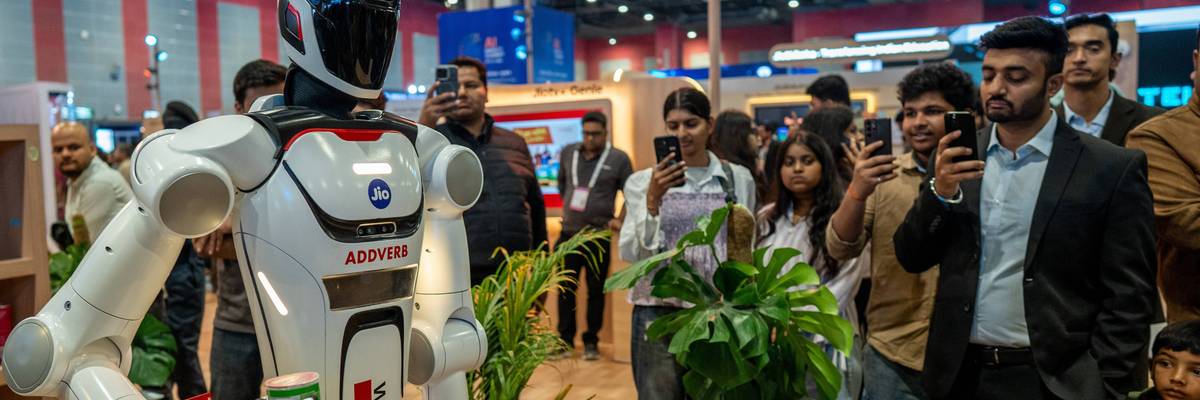
Attendees observe and record a robot during the AI Impact Summit in New Delhi on February 20, 2026.
To date, Trump’s most notable artificial intelligence regulation has been his executive order against “woke AI."
As delegates from dozens of nations attending a key artificial intelligence summit in India prepare to deliver a statement Saturday on how humanity should handle development of the rapidly evolving technology, the Trump administration stood out for opposing centralized regulation of generative AI.
"We are barreling into the unknown. AI innovation is moving at the speed of light—outpacing our collective ability to fully understand it—let alone govern it," United Nations Secretary-General António Guterres said Friday during his address to attendees at the AI Impact Summit.
"AI does not stop at borders—and no nation can fully grasp its implications on its own," Guterres continued. "If we want AI to serve humanity, policy cannot be built on guesswork. It cannot be built on hype or disinformation. We need facts we can trust—and share—across countries and across sectors."
"That is why the United Nations is building a practical architecture that puts science at the center of international cooperation on AI," he added. "And it starts with the Independent International Scientific Panel on Artificial Intelligence."
The panel—whose creation was recommended in a 2024 report authored by a high-level advisory board created by Guterres—is calling for a global AI governance framework and shared standards and monitoring mechanisms.
Looking forward to Saturday's statement, Indian Information Technology Minister Ashwini Vaishnaw told reporters Friday that "there is huge consensus on the declaration, we are just trying to maximize the number" of endorsing nations, which he said he hoped would top 80. The United States apparently will not be one of them.
"As the Trump administration has now said many times, we totally reject global governance of AI," White House technology adviser Michael Kratsios said in New Delhi. "We believe AI adoption cannot lead to a brighter future if it is subject to bureaucracies and centralized control."
Although Republican US lawmakers' bid to slip a 10-year ban on state-level AI regulation into the massive One Big Beautiful Bill Act signed by President Donald Trump last July was shot down in the Senate, a bill introduced last September by Rep. Michael Baumgartner (R-Wash.) would, if passed, impose a temporary moratorium on state laws regulating artificial intelligence.
To date, Trump’s most notable artificial intelligence regulation has been his July 2025 executive order aimed at preventing “woke AI.” His other AI-related edicts have rolled back regulations, including some meager steps taken under former President Joe Biden to bolster safety.
As was the case during the breakneck nuclear arms race during the Cold War, US officials have attempted to justify unfettered AI development by claiming that guardrails would slow progress and give adversaries like China an edge. And as with thermonuclear weapons during the Cold War, experts warn that a poorly governed race toward general artificial intelligence—a hypothetical advanced AI that can understand, learn, and apply knowledge of any subject as well as or better than a typical human—could pose an existential threat to humanity.
With so much uncertainty—and potential danger—alongside the unprecedented promise of AI, an increasingly aware public favors caution. Majorities of respondents to poll after poll say they want more, not less, AI regulation.
While very real, existential threats posed by AI are still many years off. However, there are pressing concerns over AI that are affecting the world today. Guterres noted Friday that AI can "deepen inequality, amplify bias, and fuel harm."
"As AI’s energy and water demands soar, data centers and supply chains must switch to clean power—not shift costs to vulnerable communities," he continued.
"We must invest in workers so AI augments human potential—not replaces it," Guterres stressed. "We must protect people from exploitation, manipulation, and abuse. No child should be a test subject for unregulated AI."
"Real impact means technology that improves lives and protects the planet," he argued. "So let’s build AI for everyone—with dignity as the default setting. Let us be clear: Science informs, but humans decide."
"Our goal is to make human control a technical reality—not a slogan," Guterres added. "And that requires meaningful human oversight in every high-stakes decision... And it requires clear accountability, so responsibility is never outsourced to an algorithm."
Dear Common Dreams reader, It’s been nearly 30 years since I co-founded Common Dreams with my late wife, Lina Newhouser. We had the radical notion that journalism should serve the public good, not corporate profits. It was clear to us from the outset what it would take to build such a project. No paid advertisements. No corporate sponsors. No millionaire publisher telling us what to think or do. Many people said we wouldn't last a year, but we proved those doubters wrong. Together with a tremendous team of journalists and dedicated staff, we built an independent media outlet free from the constraints of profits and corporate control. Our mission has always been simple: To inform. To inspire. To ignite change for the common good. Building Common Dreams was not easy. Our survival was never guaranteed. When you take on the most powerful forces—Wall Street greed, fossil fuel industry destruction, Big Tech lobbyists, and uber-rich oligarchs who have spent billions upon billions rigging the economy and democracy in their favor—the only bulwark you have is supporters who believe in your work. But here’s the urgent message from me today. It's never been this bad out there. And it's never been this hard to keep us going. At the very moment Common Dreams is most needed, the threats we face are intensifying. We need your support now more than ever. We don't accept corporate advertising and never will. We don't have a paywall because we don't think people should be blocked from critical news based on their ability to pay. Everything we do is funded by the donations of readers like you. When everyone does the little they can afford, we are strong. But if that support retreats or dries up, so do we. Will you donate now to make sure Common Dreams not only survives but thrives? —Craig Brown, Co-founder |
As delegates from dozens of nations attending a key artificial intelligence summit in India prepare to deliver a statement Saturday on how humanity should handle development of the rapidly evolving technology, the Trump administration stood out for opposing centralized regulation of generative AI.
"We are barreling into the unknown. AI innovation is moving at the speed of light—outpacing our collective ability to fully understand it—let alone govern it," United Nations Secretary-General António Guterres said Friday during his address to attendees at the AI Impact Summit.
"AI does not stop at borders—and no nation can fully grasp its implications on its own," Guterres continued. "If we want AI to serve humanity, policy cannot be built on guesswork. It cannot be built on hype or disinformation. We need facts we can trust—and share—across countries and across sectors."
"That is why the United Nations is building a practical architecture that puts science at the center of international cooperation on AI," he added. "And it starts with the Independent International Scientific Panel on Artificial Intelligence."
The panel—whose creation was recommended in a 2024 report authored by a high-level advisory board created by Guterres—is calling for a global AI governance framework and shared standards and monitoring mechanisms.
Looking forward to Saturday's statement, Indian Information Technology Minister Ashwini Vaishnaw told reporters Friday that "there is huge consensus on the declaration, we are just trying to maximize the number" of endorsing nations, which he said he hoped would top 80. The United States apparently will not be one of them.
"As the Trump administration has now said many times, we totally reject global governance of AI," White House technology adviser Michael Kratsios said in New Delhi. "We believe AI adoption cannot lead to a brighter future if it is subject to bureaucracies and centralized control."
Although Republican US lawmakers' bid to slip a 10-year ban on state-level AI regulation into the massive One Big Beautiful Bill Act signed by President Donald Trump last July was shot down in the Senate, a bill introduced last September by Rep. Michael Baumgartner (R-Wash.) would, if passed, impose a temporary moratorium on state laws regulating artificial intelligence.
To date, Trump’s most notable artificial intelligence regulation has been his July 2025 executive order aimed at preventing “woke AI.” His other AI-related edicts have rolled back regulations, including some meager steps taken under former President Joe Biden to bolster safety.
As was the case during the breakneck nuclear arms race during the Cold War, US officials have attempted to justify unfettered AI development by claiming that guardrails would slow progress and give adversaries like China an edge. And as with thermonuclear weapons during the Cold War, experts warn that a poorly governed race toward general artificial intelligence—a hypothetical advanced AI that can understand, learn, and apply knowledge of any subject as well as or better than a typical human—could pose an existential threat to humanity.
With so much uncertainty—and potential danger—alongside the unprecedented promise of AI, an increasingly aware public favors caution. Majorities of respondents to poll after poll say they want more, not less, AI regulation.
While very real, existential threats posed by AI are still many years off. However, there are pressing concerns over AI that are affecting the world today. Guterres noted Friday that AI can "deepen inequality, amplify bias, and fuel harm."
"As AI’s energy and water demands soar, data centers and supply chains must switch to clean power—not shift costs to vulnerable communities," he continued.
"We must invest in workers so AI augments human potential—not replaces it," Guterres stressed. "We must protect people from exploitation, manipulation, and abuse. No child should be a test subject for unregulated AI."
"Real impact means technology that improves lives and protects the planet," he argued. "So let’s build AI for everyone—with dignity as the default setting. Let us be clear: Science informs, but humans decide."
"Our goal is to make human control a technical reality—not a slogan," Guterres added. "And that requires meaningful human oversight in every high-stakes decision... And it requires clear accountability, so responsibility is never outsourced to an algorithm."
As delegates from dozens of nations attending a key artificial intelligence summit in India prepare to deliver a statement Saturday on how humanity should handle development of the rapidly evolving technology, the Trump administration stood out for opposing centralized regulation of generative AI.
"We are barreling into the unknown. AI innovation is moving at the speed of light—outpacing our collective ability to fully understand it—let alone govern it," United Nations Secretary-General António Guterres said Friday during his address to attendees at the AI Impact Summit.
"AI does not stop at borders—and no nation can fully grasp its implications on its own," Guterres continued. "If we want AI to serve humanity, policy cannot be built on guesswork. It cannot be built on hype or disinformation. We need facts we can trust—and share—across countries and across sectors."
"That is why the United Nations is building a practical architecture that puts science at the center of international cooperation on AI," he added. "And it starts with the Independent International Scientific Panel on Artificial Intelligence."
The panel—whose creation was recommended in a 2024 report authored by a high-level advisory board created by Guterres—is calling for a global AI governance framework and shared standards and monitoring mechanisms.
Looking forward to Saturday's statement, Indian Information Technology Minister Ashwini Vaishnaw told reporters Friday that "there is huge consensus on the declaration, we are just trying to maximize the number" of endorsing nations, which he said he hoped would top 80. The United States apparently will not be one of them.
"As the Trump administration has now said many times, we totally reject global governance of AI," White House technology adviser Michael Kratsios said in New Delhi. "We believe AI adoption cannot lead to a brighter future if it is subject to bureaucracies and centralized control."
Although Republican US lawmakers' bid to slip a 10-year ban on state-level AI regulation into the massive One Big Beautiful Bill Act signed by President Donald Trump last July was shot down in the Senate, a bill introduced last September by Rep. Michael Baumgartner (R-Wash.) would, if passed, impose a temporary moratorium on state laws regulating artificial intelligence.
To date, Trump’s most notable artificial intelligence regulation has been his July 2025 executive order aimed at preventing “woke AI.” His other AI-related edicts have rolled back regulations, including some meager steps taken under former President Joe Biden to bolster safety.
As was the case during the breakneck nuclear arms race during the Cold War, US officials have attempted to justify unfettered AI development by claiming that guardrails would slow progress and give adversaries like China an edge. And as with thermonuclear weapons during the Cold War, experts warn that a poorly governed race toward general artificial intelligence—a hypothetical advanced AI that can understand, learn, and apply knowledge of any subject as well as or better than a typical human—could pose an existential threat to humanity.
With so much uncertainty—and potential danger—alongside the unprecedented promise of AI, an increasingly aware public favors caution. Majorities of respondents to poll after poll say they want more, not less, AI regulation.
While very real, existential threats posed by AI are still many years off. However, there are pressing concerns over AI that are affecting the world today. Guterres noted Friday that AI can "deepen inequality, amplify bias, and fuel harm."
"As AI’s energy and water demands soar, data centers and supply chains must switch to clean power—not shift costs to vulnerable communities," he continued.
"We must invest in workers so AI augments human potential—not replaces it," Guterres stressed. "We must protect people from exploitation, manipulation, and abuse. No child should be a test subject for unregulated AI."
"Real impact means technology that improves lives and protects the planet," he argued. "So let’s build AI for everyone—with dignity as the default setting. Let us be clear: Science informs, but humans decide."
"Our goal is to make human control a technical reality—not a slogan," Guterres added. "And that requires meaningful human oversight in every high-stakes decision... And it requires clear accountability, so responsibility is never outsourced to an algorithm."