

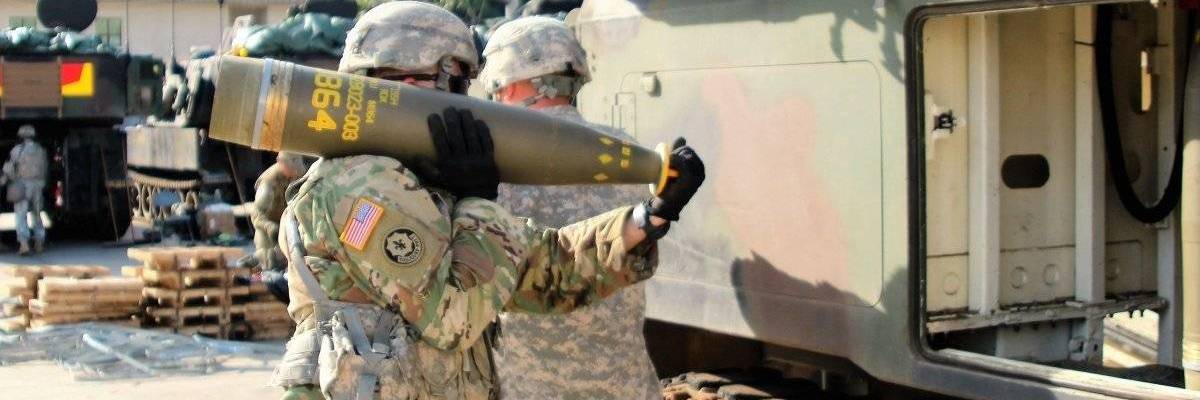
US soldiers carry a cluster munition in this undated Pentagon photo.
Warning of 'Lasting Risk to Civilians,' Groups Urge Congress to Block Purchase of Israeli Cluster Bombs
“The Trump administration’s decision to purchase cluster munitions shows that the Pentagon no longer considers protecting civilians a priority," said one critic.
A coalition of advocacy groups is imploring US lawmakers to stop the purchase of next-generation cluster bombs from an Israeli state arms maker, citing "severe, foreseeable dangers" that the internationally banned weapons pose to civilians.
Responsible Statecraft said Wednesday that the 36 human rights, peace, and faith groups shared an open letter they sent to lawmakers urging them to cancel a $210 million no-bid contract with Tomer to produce weapons, including a new generation of US 155-millimeter cluster munition shells for land-based artillery.
The letter's signatories—who include Amnesty International USA, Arms Control Association, Centers for Civilians in Conflict, Center for International Policy, Human Rights Watch, the Quincy Institute for Responsible Statecraft, RootsAction, and United Methodist Church—note that these weapons are "dramatically out of step with civilian protection practices" because they "disperse submunitions across broad areas, making it exceedingly difficult to confine their impact to lawful military targets."
"We urge members of Congress to take immediate action to oppose this purchase and prevent the transfer of cluster munitions, which pose well-documented and lasting risks to civilian populations," the letter states.
Congressional efforts to ban the transfer of cluster bombs have failed, most recently in late 2023, when House lawmakers voted down a proposed amendment to the 2024 military spending bill a week after then-President Joe Biden said the US would send some of its stockpiled cluster munitions to Ukraine to help defend against Russia's invasion.
Last year, a group of congressional Democrats led by Reps. Delia Ramirez (Ill.), Sara Jacobs (Calif.), Pramila Jayapal (Wash.), and Mark Pocan (Wis.) introduced the Block the Bombs Act, stalled legislation that would withhold the transfer of offensive weapons to Israel as it wages a genocidal war on Gaza. The bill is backed by the Congressional Progressive Caucus.
Cluster bombs are no longer manufactured domestically. However, the United States has not joined the 2008 Convention on Cluster Munitions, which has been ratified by more than 111 nations but not some of the world's biggest military powers, including China, Russia, India, and Israel. Last year, Lithuania became the first country to withdraw from the treaty, citing threats from Russia.
According to the Intercept, which first reported the proposed new sale:
Known as the XM1208 munition, America’s new cluster shells are designed to have a dud rate—or risk of failure to explode—of less than 1%. They rely on more complex fuses and self-destruct features to reduce long-term danger to civilians, according to army procurement documents and weapons experts. But researchers say those low failure rates in testing do not reflect real-world performance, and advocates argue that cluster weapons’ battlefield effectiveness cannot justify their humanitarian costs.
"These weapons’ humanitarian impacts vastly outweigh any possible tactical benefit that they provide,” Ursala Knudsen-Latta of the Friends Committee on National Legislation, which signed the letter, told Responsible Statecraft. “Unfortunately, it is really sowing seeds of terror for generations to come anywhere they are used.”
A 2025 report published by the governance board of the International Campaign to Ban Landmines and the Cluster Munition Coalition revealed that 100% of reported cluster bomb casualties in 2024 were civilians, and 42% were children.
Unexploded cluster bomblets are often found by children, who sometimes mistake them for toys. Unexploded ordnance (UXO) including cluster munitions have killed and maimed at least tens of thousands of people since the US stopped dropping them on countries like Vietnam, Cambodia, Laos, and Iraq.
“They are inherently indiscriminate,” Brian Castner, an Amnesty International weapons investigator and former US Air Force explosive ordnance disposal officer, said of cluster bombs in an interview with the Intercept earlier this month. “There’s not a way to use them responsibly, in that you can’t control where they land, and with this high dud rate you can’t control the effect on the civilian population afterwards.”
Rights groups have been sounding the alarm on the Trump administration’s systematic erosion of policies meant to minimize civilian harm and uphold international law. For example, last year Defense Secretary Pete Hegseth lifted restrictions on US use of antipersonnel landmines, which killed or wounded more than 6,000 people worldwide in 2024, according to Landmine Monitor.
“The US government’s revival of indiscriminate weapons that the world has worked to ban puts civilian lives at risk,” Sarah Yager, Washington director at Human Rights Watch, said Tuesday. “The Trump administration is simply disregarding foreseeable harm to civilians, from children who pick up unexploded bomblets to communities forced to live with unmarked minefields long after a conflict ends."
“The Trump administration’s decision to purchase cluster munitions shows that the Pentagon no longer considers protecting civilians a priority," Yager added.
We are at a crossroads
This country and this world are at a monumental crossroads. In a few short weeks, US voters will have an opportunity to beat back the forces of fascism and confront the billionaires who are rigging the economy, our media system, and our democracy, making it increasingly impossible for ordinary people to get by. We’re not just talking about the election. We’re talking about what must be done once these fascist elements are vanquished from power. We need a bolder set of solutions than what either major party has so far been willing to offer and a working-class movement ready to fight like hell for it. Trump didn't emerge from nowhere. The conditions that fueled MAGA authoritarianism were created by decades of radical neoliberal economic policies and a corrupt political system dominated by corporate interests. They slashed taxes on the super-rich, promising that the benefits would trickle down. They said giveaways to the corporate titans would make life more affordable for the rest of us. It was all bullshit. And when a bitter, betrayed populace searches for someone to blame, right-wing demagogues have little trouble finding scapegoats. People know when they're being lied to, but you won't hear any of this from the corporate media. Only independent journalism—powered and funded by people who believe in building a better world—can deliver truly trustworthy daily news. Our Fall Campaign is underway, and we need your help. To power our newsroom through the rest of the year, we need to raise $125,000 by midnight on October 31. So if you share our vision, please contribute whatever you can to sustain our work. |
A coalition of advocacy groups is imploring US lawmakers to stop the purchase of next-generation cluster bombs from an Israeli state arms maker, citing "severe, foreseeable dangers" that the internationally banned weapons pose to civilians.
Responsible Statecraft said Wednesday that the 36 human rights, peace, and faith groups shared an open letter they sent to lawmakers urging them to cancel a $210 million no-bid contract with Tomer to produce weapons, including a new generation of US 155-millimeter cluster munition shells for land-based artillery.
The letter's signatories—who include Amnesty International USA, Arms Control Association, Centers for Civilians in Conflict, Center for International Policy, Human Rights Watch, the Quincy Institute for Responsible Statecraft, RootsAction, and United Methodist Church—note that these weapons are "dramatically out of step with civilian protection practices" because they "disperse submunitions across broad areas, making it exceedingly difficult to confine their impact to lawful military targets."
"We urge members of Congress to take immediate action to oppose this purchase and prevent the transfer of cluster munitions, which pose well-documented and lasting risks to civilian populations," the letter states.
Congressional efforts to ban the transfer of cluster bombs have failed, most recently in late 2023, when House lawmakers voted down a proposed amendment to the 2024 military spending bill a week after then-President Joe Biden said the US would send some of its stockpiled cluster munitions to Ukraine to help defend against Russia's invasion.
Last year, a group of congressional Democrats led by Reps. Delia Ramirez (Ill.), Sara Jacobs (Calif.), Pramila Jayapal (Wash.), and Mark Pocan (Wis.) introduced the Block the Bombs Act, stalled legislation that would withhold the transfer of offensive weapons to Israel as it wages a genocidal war on Gaza. The bill is backed by the Congressional Progressive Caucus.
Cluster bombs are no longer manufactured domestically. However, the United States has not joined the 2008 Convention on Cluster Munitions, which has been ratified by more than 111 nations but not some of the world's biggest military powers, including China, Russia, India, and Israel. Last year, Lithuania became the first country to withdraw from the treaty, citing threats from Russia.
According to the Intercept, which first reported the proposed new sale:
Known as the XM1208 munition, America’s new cluster shells are designed to have a dud rate—or risk of failure to explode—of less than 1%. They rely on more complex fuses and self-destruct features to reduce long-term danger to civilians, according to army procurement documents and weapons experts. But researchers say those low failure rates in testing do not reflect real-world performance, and advocates argue that cluster weapons’ battlefield effectiveness cannot justify their humanitarian costs.
"These weapons’ humanitarian impacts vastly outweigh any possible tactical benefit that they provide,” Ursala Knudsen-Latta of the Friends Committee on National Legislation, which signed the letter, told Responsible Statecraft. “Unfortunately, it is really sowing seeds of terror for generations to come anywhere they are used.”
A 2025 report published by the governance board of the International Campaign to Ban Landmines and the Cluster Munition Coalition revealed that 100% of reported cluster bomb casualties in 2024 were civilians, and 42% were children.
Unexploded cluster bomblets are often found by children, who sometimes mistake them for toys. Unexploded ordnance (UXO) including cluster munitions have killed and maimed at least tens of thousands of people since the US stopped dropping them on countries like Vietnam, Cambodia, Laos, and Iraq.
“They are inherently indiscriminate,” Brian Castner, an Amnesty International weapons investigator and former US Air Force explosive ordnance disposal officer, said of cluster bombs in an interview with the Intercept earlier this month. “There’s not a way to use them responsibly, in that you can’t control where they land, and with this high dud rate you can’t control the effect on the civilian population afterwards.”
Rights groups have been sounding the alarm on the Trump administration’s systematic erosion of policies meant to minimize civilian harm and uphold international law. For example, last year Defense Secretary Pete Hegseth lifted restrictions on US use of antipersonnel landmines, which killed or wounded more than 6,000 people worldwide in 2024, according to Landmine Monitor.
“The US government’s revival of indiscriminate weapons that the world has worked to ban puts civilian lives at risk,” Sarah Yager, Washington director at Human Rights Watch, said Tuesday. “The Trump administration is simply disregarding foreseeable harm to civilians, from children who pick up unexploded bomblets to communities forced to live with unmarked minefields long after a conflict ends."
“The Trump administration’s decision to purchase cluster munitions shows that the Pentagon no longer considers protecting civilians a priority," Yager added.
A coalition of advocacy groups is imploring US lawmakers to stop the purchase of next-generation cluster bombs from an Israeli state arms maker, citing "severe, foreseeable dangers" that the internationally banned weapons pose to civilians.
Responsible Statecraft said Wednesday that the 36 human rights, peace, and faith groups shared an open letter they sent to lawmakers urging them to cancel a $210 million no-bid contract with Tomer to produce weapons, including a new generation of US 155-millimeter cluster munition shells for land-based artillery.
The letter's signatories—who include Amnesty International USA, Arms Control Association, Centers for Civilians in Conflict, Center for International Policy, Human Rights Watch, the Quincy Institute for Responsible Statecraft, RootsAction, and United Methodist Church—note that these weapons are "dramatically out of step with civilian protection practices" because they "disperse submunitions across broad areas, making it exceedingly difficult to confine their impact to lawful military targets."
"We urge members of Congress to take immediate action to oppose this purchase and prevent the transfer of cluster munitions, which pose well-documented and lasting risks to civilian populations," the letter states.
Congressional efforts to ban the transfer of cluster bombs have failed, most recently in late 2023, when House lawmakers voted down a proposed amendment to the 2024 military spending bill a week after then-President Joe Biden said the US would send some of its stockpiled cluster munitions to Ukraine to help defend against Russia's invasion.
Last year, a group of congressional Democrats led by Reps. Delia Ramirez (Ill.), Sara Jacobs (Calif.), Pramila Jayapal (Wash.), and Mark Pocan (Wis.) introduced the Block the Bombs Act, stalled legislation that would withhold the transfer of offensive weapons to Israel as it wages a genocidal war on Gaza. The bill is backed by the Congressional Progressive Caucus.
Cluster bombs are no longer manufactured domestically. However, the United States has not joined the 2008 Convention on Cluster Munitions, which has been ratified by more than 111 nations but not some of the world's biggest military powers, including China, Russia, India, and Israel. Last year, Lithuania became the first country to withdraw from the treaty, citing threats from Russia.
According to the Intercept, which first reported the proposed new sale:
Known as the XM1208 munition, America’s new cluster shells are designed to have a dud rate—or risk of failure to explode—of less than 1%. They rely on more complex fuses and self-destruct features to reduce long-term danger to civilians, according to army procurement documents and weapons experts. But researchers say those low failure rates in testing do not reflect real-world performance, and advocates argue that cluster weapons’ battlefield effectiveness cannot justify their humanitarian costs.
"These weapons’ humanitarian impacts vastly outweigh any possible tactical benefit that they provide,” Ursala Knudsen-Latta of the Friends Committee on National Legislation, which signed the letter, told Responsible Statecraft. “Unfortunately, it is really sowing seeds of terror for generations to come anywhere they are used.”
A 2025 report published by the governance board of the International Campaign to Ban Landmines and the Cluster Munition Coalition revealed that 100% of reported cluster bomb casualties in 2024 were civilians, and 42% were children.
Unexploded cluster bomblets are often found by children, who sometimes mistake them for toys. Unexploded ordnance (UXO) including cluster munitions have killed and maimed at least tens of thousands of people since the US stopped dropping them on countries like Vietnam, Cambodia, Laos, and Iraq.
“They are inherently indiscriminate,” Brian Castner, an Amnesty International weapons investigator and former US Air Force explosive ordnance disposal officer, said of cluster bombs in an interview with the Intercept earlier this month. “There’s not a way to use them responsibly, in that you can’t control where they land, and with this high dud rate you can’t control the effect on the civilian population afterwards.”
Rights groups have been sounding the alarm on the Trump administration’s systematic erosion of policies meant to minimize civilian harm and uphold international law. For example, last year Defense Secretary Pete Hegseth lifted restrictions on US use of antipersonnel landmines, which killed or wounded more than 6,000 people worldwide in 2024, according to Landmine Monitor.
“The US government’s revival of indiscriminate weapons that the world has worked to ban puts civilian lives at risk,” Sarah Yager, Washington director at Human Rights Watch, said Tuesday. “The Trump administration is simply disregarding foreseeable harm to civilians, from children who pick up unexploded bomblets to communities forced to live with unmarked minefields long after a conflict ends."
“The Trump administration’s decision to purchase cluster munitions shows that the Pentagon no longer considers protecting civilians a priority," Yager added.