SUBSCRIBE TO OUR FREE NEWSLETTER
Daily news & progressive opinion—funded by the people, not the corporations—delivered straight to your inbox.
5
#000000
#FFFFFF
To donate by check, phone, or other method, see our More Ways to Give page.
Daily news & progressive opinion—funded by the people, not the corporations—delivered straight to your inbox.
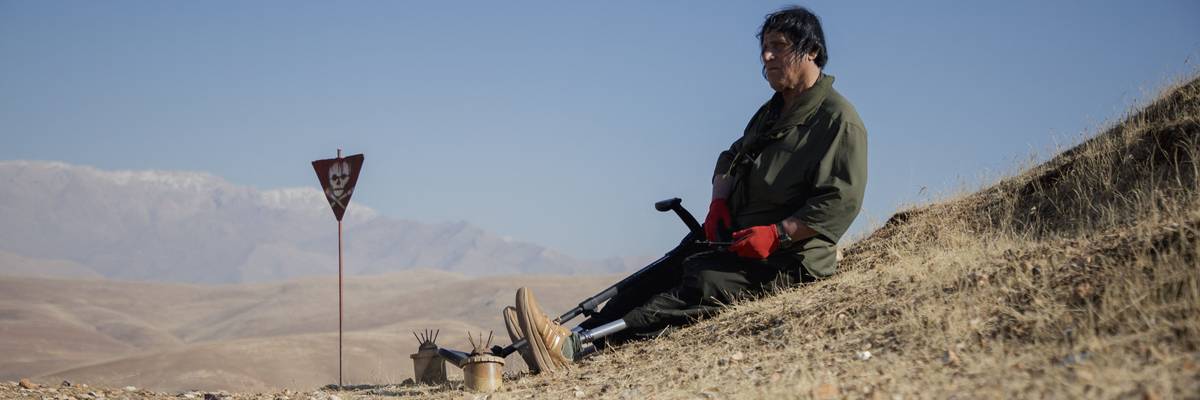
Hoshyar Ali, who lost both legs and several family members to explosions, sits near landmines on a hillside in Halabja, Iraq on November 20, 2025. He has been clearing landmines for over four decades.
"Even when fighting stops, these hidden killers remain active for decades, continuing to destroy lives long after the combat has stopped," said one campaigner.
The 27th annual Landmine Monitor report revealed on Monday that antipersonnel landmines and other explosive remnants of war killed at least 1,945 people and injured another 4,325 in 2024—the highest yearly casualty figure since 2020 and a 9% increase from the previous year.
Since the Mine Ban Treaty entered into force in 1999, "casualty records have included 165,724 people recorded as killed (47,904) or injured (113,595) or of unknown survival outcome (4,225)," according to the new report from the Nobel Peace Prize-winning International Campaign to Ban Landmines (ICBL).
The ICBL published the report as state parties to the treaty kicked off a meeting in Geneva, Switzerland. It details not only casualties but also treaty updates; production, transfers, and stockpiles of mines; alleged or confirmed uses; existing contamination; and international efforts to aid victims and clean up impacted regions.
Also known as the Ottawa Treaty, it is now supported by 166 countries, after the Marshall Islands ratified the pact in March and Tonga acceded in June. Despite that progress, there have also been steps backward, as Mark Hiznay, Landmine Monitor editor for ban policy, highlighted in a Monday statement.
"Five states renounced their treaty obligations in a matter of months," Hiznay said, "when evidence shows if they use mines, it can take decades and enormous resources to clear contaminated land and assist the new victims, who will feel the impact of mine use long after the conflict has ceased."
The state parties in the process of legally withdrawing are Estonia, Finland, Latvia, Lithuania, and Poland. ICBL director Tamar Gabelnick argued Monday that "governments must speak out to uphold the treaty, prevent further departures, reinforce its provisions globally, and ensure no more countries use, produce, or acquire antipersonnel mines."
"Turning back is not an option; we have come too far, and the human cost is simply too high," Gabelnick warned.
The 2025 Landmine Monitor is out now.Casualties from landmines and unexploded bombs have risen. On average, 17 people were killed or injured every day in 2024, nearly half of them children.As states meet for the Mine Ban Treaty this week, MAG urges renewed commitment.More ➡️ buff.ly/CP8m0BL
[image or embed]
— MAG (Mines Advisory Group) (@minesadvisorygroup.bsky.social) December 1, 2025 at 5:35 AM
There have been recent reports of mine use by both state parties to the pact and countries that have refused to embrace the treaty. The publication notes alleged use by government forces in Myanmar; by Iran, along its borders with Afghanistan and Pakistan; and by North Korea, along its borders with China and South Korea. Additionally, in July, Thailand accused a fellow state party, Cambodia, of using mines along their disputed border. Cambodia has denied the allegations.
Another state party, Ukraine, is trying to unlawfully "suspend the operation" of the treaty while battling a Russian invasion, and the report points to "increasing indications" of mine use by Ukrainian forces in 2024-25. Russia—one of the few dozen nations that have not signed on to the agreement—has used mines "extensively" since invading its neighbor in February 2022.
The United States has also never formally joined the treaty and has come under fire for recent decisions. After initially aiming to accede to the treaty, the outgoing Biden administration last year approved a plan to provide antipersonnel landmines to Ukraine. This year, the Trump administration has made deep cuts to foreign aid that have disrupted mine clearance operations.
The global ban on antipersonnel landmines saves civilian lives but faces serious threats from countries leaving the treaty and new landmine use.Immediate and strong action is needed to counter these life-threatening developments.New Landmine Monitor 2025, out now⤵️
[image or embed]
— Jan Kooy (@kooyjan.bsky.social) December 1, 2025 at 5:14 AM
"Even when fighting stops, these hidden killers remain active for decades, continuing to destroy lives long after the combat has stopped," Anne Héry, advocacy director at the group Humanity & Inclusion US, said in a Monday statement. "States parties must live up to their obligations under the Mine Ban Treaty: to condemn, in the strongest possible terms, any use of antipersonnel mines by any actor, under any circumstance."
"A large part of the victims recorded in the Landmine Monitor 2025, like in the previous years, are injured or killed by landmines and explosive remnants long after the fighting has ended, when people return to their homes believing they can start a new life," she continued. "Landmines are truly barbaric weapons that kill and injure largely outside periods of active conflict."
On Wednesday, Humanity & Inclusion US executive director Hannah Guedenet will join fellow experts for a virtual briefing "to discuss the latest Monitor reports, the human cost of these weapons, and the role US leadership must play at this pivotal moment," the group leader previewed in a Monday opinion piece for Common Dreams.
"Bringing these insights directly to policymakers and advocates is essential to strengthening global norms and advancing effective solutions," she wrote. Despite never joining the Mine Ban Treaty or the 2010 Convention on Cluster Munitions, "the United States has long been one of the world's largest supporters of mine clearance and victim assistance, helping make former battlefields safe for farming, economic investment, and community life."
"The case for action is both moral and pragmatic. Every mine removed or cluster bomb destroyed reopens land for cultivation, enables displaced families to return home, and prevents future casualties. These are tangible, measurable outcomes that support US foreign policy priorities: stability, economic recovery, and the protection of civilians in conflict," she added. "In a time of never-ending partisan fights, this is a place where both sides can come together and agree on the right steps forward."
Dear Common Dreams reader, It’s been nearly 30 years since I co-founded Common Dreams with my late wife, Lina Newhouser. We had the radical notion that journalism should serve the public good, not corporate profits. It was clear to us from the outset what it would take to build such a project. No paid advertisements. No corporate sponsors. No millionaire publisher telling us what to think or do. Many people said we wouldn't last a year, but we proved those doubters wrong. Together with a tremendous team of journalists and dedicated staff, we built an independent media outlet free from the constraints of profits and corporate control. Our mission has always been simple: To inform. To inspire. To ignite change for the common good. Building Common Dreams was not easy. Our survival was never guaranteed. When you take on the most powerful forces—Wall Street greed, fossil fuel industry destruction, Big Tech lobbyists, and uber-rich oligarchs who have spent billions upon billions rigging the economy and democracy in their favor—the only bulwark you have is supporters who believe in your work. But here’s the urgent message from me today. It's never been this bad out there. And it's never been this hard to keep us going. At the very moment Common Dreams is most needed, the threats we face are intensifying. We need your support now more than ever. We don't accept corporate advertising and never will. We don't have a paywall because we don't think people should be blocked from critical news based on their ability to pay. Everything we do is funded by the donations of readers like you. When everyone does the little they can afford, we are strong. But if that support retreats or dries up, so do we. Will you donate now to make sure Common Dreams not only survives but thrives? —Craig Brown, Co-founder |
The 27th annual Landmine Monitor report revealed on Monday that antipersonnel landmines and other explosive remnants of war killed at least 1,945 people and injured another 4,325 in 2024—the highest yearly casualty figure since 2020 and a 9% increase from the previous year.
Since the Mine Ban Treaty entered into force in 1999, "casualty records have included 165,724 people recorded as killed (47,904) or injured (113,595) or of unknown survival outcome (4,225)," according to the new report from the Nobel Peace Prize-winning International Campaign to Ban Landmines (ICBL).
The ICBL published the report as state parties to the treaty kicked off a meeting in Geneva, Switzerland. It details not only casualties but also treaty updates; production, transfers, and stockpiles of mines; alleged or confirmed uses; existing contamination; and international efforts to aid victims and clean up impacted regions.
Also known as the Ottawa Treaty, it is now supported by 166 countries, after the Marshall Islands ratified the pact in March and Tonga acceded in June. Despite that progress, there have also been steps backward, as Mark Hiznay, Landmine Monitor editor for ban policy, highlighted in a Monday statement.
"Five states renounced their treaty obligations in a matter of months," Hiznay said, "when evidence shows if they use mines, it can take decades and enormous resources to clear contaminated land and assist the new victims, who will feel the impact of mine use long after the conflict has ceased."
The state parties in the process of legally withdrawing are Estonia, Finland, Latvia, Lithuania, and Poland. ICBL director Tamar Gabelnick argued Monday that "governments must speak out to uphold the treaty, prevent further departures, reinforce its provisions globally, and ensure no more countries use, produce, or acquire antipersonnel mines."
"Turning back is not an option; we have come too far, and the human cost is simply too high," Gabelnick warned.
The 2025 Landmine Monitor is out now.Casualties from landmines and unexploded bombs have risen. On average, 17 people were killed or injured every day in 2024, nearly half of them children.As states meet for the Mine Ban Treaty this week, MAG urges renewed commitment.More ➡️ buff.ly/CP8m0BL
[image or embed]
— MAG (Mines Advisory Group) (@minesadvisorygroup.bsky.social) December 1, 2025 at 5:35 AM
There have been recent reports of mine use by both state parties to the pact and countries that have refused to embrace the treaty. The publication notes alleged use by government forces in Myanmar; by Iran, along its borders with Afghanistan and Pakistan; and by North Korea, along its borders with China and South Korea. Additionally, in July, Thailand accused a fellow state party, Cambodia, of using mines along their disputed border. Cambodia has denied the allegations.
Another state party, Ukraine, is trying to unlawfully "suspend the operation" of the treaty while battling a Russian invasion, and the report points to "increasing indications" of mine use by Ukrainian forces in 2024-25. Russia—one of the few dozen nations that have not signed on to the agreement—has used mines "extensively" since invading its neighbor in February 2022.
The United States has also never formally joined the treaty and has come under fire for recent decisions. After initially aiming to accede to the treaty, the outgoing Biden administration last year approved a plan to provide antipersonnel landmines to Ukraine. This year, the Trump administration has made deep cuts to foreign aid that have disrupted mine clearance operations.
The global ban on antipersonnel landmines saves civilian lives but faces serious threats from countries leaving the treaty and new landmine use.Immediate and strong action is needed to counter these life-threatening developments.New Landmine Monitor 2025, out now⤵️
[image or embed]
— Jan Kooy (@kooyjan.bsky.social) December 1, 2025 at 5:14 AM
"Even when fighting stops, these hidden killers remain active for decades, continuing to destroy lives long after the combat has stopped," Anne Héry, advocacy director at the group Humanity & Inclusion US, said in a Monday statement. "States parties must live up to their obligations under the Mine Ban Treaty: to condemn, in the strongest possible terms, any use of antipersonnel mines by any actor, under any circumstance."
"A large part of the victims recorded in the Landmine Monitor 2025, like in the previous years, are injured or killed by landmines and explosive remnants long after the fighting has ended, when people return to their homes believing they can start a new life," she continued. "Landmines are truly barbaric weapons that kill and injure largely outside periods of active conflict."
On Wednesday, Humanity & Inclusion US executive director Hannah Guedenet will join fellow experts for a virtual briefing "to discuss the latest Monitor reports, the human cost of these weapons, and the role US leadership must play at this pivotal moment," the group leader previewed in a Monday opinion piece for Common Dreams.
"Bringing these insights directly to policymakers and advocates is essential to strengthening global norms and advancing effective solutions," she wrote. Despite never joining the Mine Ban Treaty or the 2010 Convention on Cluster Munitions, "the United States has long been one of the world's largest supporters of mine clearance and victim assistance, helping make former battlefields safe for farming, economic investment, and community life."
"The case for action is both moral and pragmatic. Every mine removed or cluster bomb destroyed reopens land for cultivation, enables displaced families to return home, and prevents future casualties. These are tangible, measurable outcomes that support US foreign policy priorities: stability, economic recovery, and the protection of civilians in conflict," she added. "In a time of never-ending partisan fights, this is a place where both sides can come together and agree on the right steps forward."
The 27th annual Landmine Monitor report revealed on Monday that antipersonnel landmines and other explosive remnants of war killed at least 1,945 people and injured another 4,325 in 2024—the highest yearly casualty figure since 2020 and a 9% increase from the previous year.
Since the Mine Ban Treaty entered into force in 1999, "casualty records have included 165,724 people recorded as killed (47,904) or injured (113,595) or of unknown survival outcome (4,225)," according to the new report from the Nobel Peace Prize-winning International Campaign to Ban Landmines (ICBL).
The ICBL published the report as state parties to the treaty kicked off a meeting in Geneva, Switzerland. It details not only casualties but also treaty updates; production, transfers, and stockpiles of mines; alleged or confirmed uses; existing contamination; and international efforts to aid victims and clean up impacted regions.
Also known as the Ottawa Treaty, it is now supported by 166 countries, after the Marshall Islands ratified the pact in March and Tonga acceded in June. Despite that progress, there have also been steps backward, as Mark Hiznay, Landmine Monitor editor for ban policy, highlighted in a Monday statement.
"Five states renounced their treaty obligations in a matter of months," Hiznay said, "when evidence shows if they use mines, it can take decades and enormous resources to clear contaminated land and assist the new victims, who will feel the impact of mine use long after the conflict has ceased."
The state parties in the process of legally withdrawing are Estonia, Finland, Latvia, Lithuania, and Poland. ICBL director Tamar Gabelnick argued Monday that "governments must speak out to uphold the treaty, prevent further departures, reinforce its provisions globally, and ensure no more countries use, produce, or acquire antipersonnel mines."
"Turning back is not an option; we have come too far, and the human cost is simply too high," Gabelnick warned.
The 2025 Landmine Monitor is out now.Casualties from landmines and unexploded bombs have risen. On average, 17 people were killed or injured every day in 2024, nearly half of them children.As states meet for the Mine Ban Treaty this week, MAG urges renewed commitment.More ➡️ buff.ly/CP8m0BL
[image or embed]
— MAG (Mines Advisory Group) (@minesadvisorygroup.bsky.social) December 1, 2025 at 5:35 AM
There have been recent reports of mine use by both state parties to the pact and countries that have refused to embrace the treaty. The publication notes alleged use by government forces in Myanmar; by Iran, along its borders with Afghanistan and Pakistan; and by North Korea, along its borders with China and South Korea. Additionally, in July, Thailand accused a fellow state party, Cambodia, of using mines along their disputed border. Cambodia has denied the allegations.
Another state party, Ukraine, is trying to unlawfully "suspend the operation" of the treaty while battling a Russian invasion, and the report points to "increasing indications" of mine use by Ukrainian forces in 2024-25. Russia—one of the few dozen nations that have not signed on to the agreement—has used mines "extensively" since invading its neighbor in February 2022.
The United States has also never formally joined the treaty and has come under fire for recent decisions. After initially aiming to accede to the treaty, the outgoing Biden administration last year approved a plan to provide antipersonnel landmines to Ukraine. This year, the Trump administration has made deep cuts to foreign aid that have disrupted mine clearance operations.
The global ban on antipersonnel landmines saves civilian lives but faces serious threats from countries leaving the treaty and new landmine use.Immediate and strong action is needed to counter these life-threatening developments.New Landmine Monitor 2025, out now⤵️
[image or embed]
— Jan Kooy (@kooyjan.bsky.social) December 1, 2025 at 5:14 AM
"Even when fighting stops, these hidden killers remain active for decades, continuing to destroy lives long after the combat has stopped," Anne Héry, advocacy director at the group Humanity & Inclusion US, said in a Monday statement. "States parties must live up to their obligations under the Mine Ban Treaty: to condemn, in the strongest possible terms, any use of antipersonnel mines by any actor, under any circumstance."
"A large part of the victims recorded in the Landmine Monitor 2025, like in the previous years, are injured or killed by landmines and explosive remnants long after the fighting has ended, when people return to their homes believing they can start a new life," she continued. "Landmines are truly barbaric weapons that kill and injure largely outside periods of active conflict."
On Wednesday, Humanity & Inclusion US executive director Hannah Guedenet will join fellow experts for a virtual briefing "to discuss the latest Monitor reports, the human cost of these weapons, and the role US leadership must play at this pivotal moment," the group leader previewed in a Monday opinion piece for Common Dreams.
"Bringing these insights directly to policymakers and advocates is essential to strengthening global norms and advancing effective solutions," she wrote. Despite never joining the Mine Ban Treaty or the 2010 Convention on Cluster Munitions, "the United States has long been one of the world's largest supporters of mine clearance and victim assistance, helping make former battlefields safe for farming, economic investment, and community life."
"The case for action is both moral and pragmatic. Every mine removed or cluster bomb destroyed reopens land for cultivation, enables displaced families to return home, and prevents future casualties. These are tangible, measurable outcomes that support US foreign policy priorities: stability, economic recovery, and the protection of civilians in conflict," she added. "In a time of never-ending partisan fights, this is a place where both sides can come together and agree on the right steps forward."