SUBSCRIBE TO OUR FREE NEWSLETTER
Daily news & progressive opinion—funded by the people, not the corporations—delivered straight to your inbox.
5
#000000
#FFFFFF
To donate by check, phone, or other method, see our More Ways to Give page.
Daily news & progressive opinion—funded by the people, not the corporations—delivered straight to your inbox.

Ukrainian women photograph the remnants of a cluster munition dropped on Sloviansk, Ukraine, on June 27, 2022.
"The Convention on Cluster Munitions provides a vital framework for ending the immediate and long-term harm and suffering caused by these abhorrent weapons," said one of the treaty's architects.
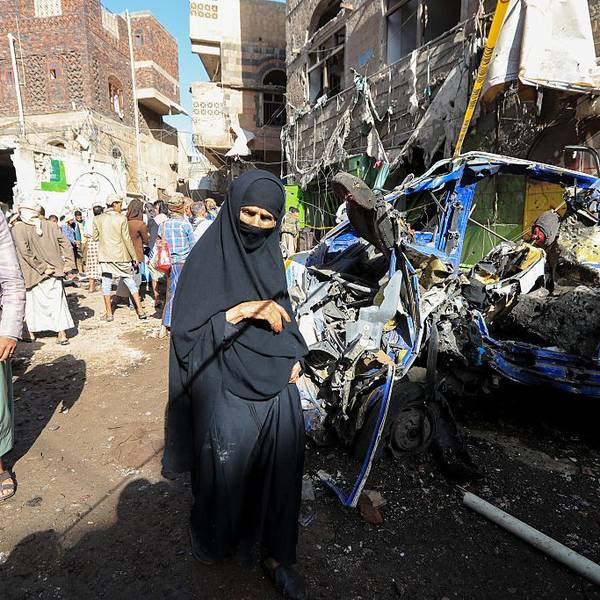
The overwhelming majority of cluster bomb casualties last year were civilians, with children making up nearly half of those killed or maimed by remnants of the internationally banned munitions, a report published Monday revealed.
Human Rights Watch (HRW) published its annual Cluster Munition Monitor report, which "details the policy and practice of all countries with respect to the international treaty that prohibits cluster munitions and requires destruction of stockpiles, clearance of areas contaminated by cluster munition remnants, and victim assistance."
That treaty, the landmark Convention on Cluster Munitions, has been ratified by 112 nations. However, numerous countries that are not parties to the agreement—including Myanmar, Russia, Syria, Ukraine, and the United States—continued to use or sell cluster bombs.
"Cluster munitions can be fired from the ground by artillery, rockets, missiles, or mortars, or dropped by aircraft," HRW explained. "They typically open in the air, dispersing multiple submunitions or bomblets over a wide area. Many submunitions fail to explode on initial impact, leaving unexploded duds that can indiscriminately injure and kill like landmines for years, until they are found and destroyed."
The results have been devastating. According to the report, 93% of cluster munition casualties reported by the monitor last year were civilians, while children made up 47% of those killed or wounded by cluster bomb remnants. Children are particularly vulnerable to unexploded cluster bomblets, which are often mistaken for toys.
According to the report, the following countries suffered more than 1,000 cluster bomb casualties in 2023: Laos (7,810), Syria (4,445), Iraq (3,201), Vietnam (2,135), and Ukraine (1,213).
HRW noted that "Russia has used stocks of old cluster munitions and newly developed models in Ukraine since 2022" and that "between July 2023 and April 2024, U.S. President Joe Biden approved five transfers to Ukraine of U.S. cluster munitions delivered by 155mm artillery projectiles and by ballistic missiles."
Meanwhile, unexploded cluster munitions dropped by the United States during the Vietnam War are still killing and maiming people, mostly children. In Laos, where the U.S. dropped more bombs than all sides in World War II combined, as many as 270 million cluster munitions were sprinkled over the country. Unexploded bomblets have killed an estimated 20,000 Laotians since the end of the war. It is believed that less than 1% of unexploded cluster munitions have been cleared in Laos.
The report highlighted some promising developments:
In December 2023, the convention reached a major milestone when Peru completed the destruction of its stockpiled cluster munitions, as it was the last state party with declared stocks to complete this obligation. Bulgaria, Slovakia, and South Africa announced the completion of the destruction of their respective cluster munition stocks in September 2023. These developments mean that member countries have collectively now destroyed 100% of their declared cluster munition stocks, destroying 1.49 million cluster munitions and 179 million submunitions.
However, there were also setbacks, such as legislation in Lithuania approving the Baltic nation's withdrawal from the cluster bomb treaty.
"Lithuania's ill-considered move to leave the Convention on Cluster Munitions stains its otherwise excellent reputation on humanitarian disarmament and ignores the risks of civilian harm," said HRW deputy crisis, conflict, and arms director Mary Wareham, who edited the new report. "It's not too late for Lithuania to heed calls to stop its planned withdrawal."
Speaking more broadly of the new report, Wareham—a joint recipient of the 1997 Nobel Peace Prize for her work with the International Campaign to Ban Landmines—said that "the Convention on Cluster Munitions provides a vital framework for ending the immediate and long-term harm and suffering caused by these abhorrent weapons."
"All countries should join and adhere to the convention if they are serious about protecting civilians from these weapons in the face of rising conflict," Wareham added.
Dear Common Dreams reader, It’s been nearly 30 years since I co-founded Common Dreams with my late wife, Lina Newhouser. We had the radical notion that journalism should serve the public good, not corporate profits. It was clear to us from the outset what it would take to build such a project. No paid advertisements. No corporate sponsors. No millionaire publisher telling us what to think or do. Many people said we wouldn't last a year, but we proved those doubters wrong. Together with a tremendous team of journalists and dedicated staff, we built an independent media outlet free from the constraints of profits and corporate control. Our mission has always been simple: To inform. To inspire. To ignite change for the common good. Building Common Dreams was not easy. Our survival was never guaranteed. When you take on the most powerful forces—Wall Street greed, fossil fuel industry destruction, Big Tech lobbyists, and uber-rich oligarchs who have spent billions upon billions rigging the economy and democracy in their favor—the only bulwark you have is supporters who believe in your work. But here’s the urgent message from me today. It's never been this bad out there. And it's never been this hard to keep us going. At the very moment Common Dreams is most needed, the threats we face are intensifying. We need your support now more than ever. We don't accept corporate advertising and never will. We don't have a paywall because we don't think people should be blocked from critical news based on their ability to pay. Everything we do is funded by the donations of readers like you. When everyone does the little they can afford, we are strong. But if that support retreats or dries up, so do we. Will you donate now to make sure Common Dreams not only survives but thrives? —Craig Brown, Co-founder |
The overwhelming majority of cluster bomb casualties last year were civilians, with children making up nearly half of those killed or maimed by remnants of the internationally banned munitions, a report published Monday revealed.
Human Rights Watch (HRW) published its annual Cluster Munition Monitor report, which "details the policy and practice of all countries with respect to the international treaty that prohibits cluster munitions and requires destruction of stockpiles, clearance of areas contaminated by cluster munition remnants, and victim assistance."
That treaty, the landmark Convention on Cluster Munitions, has been ratified by 112 nations. However, numerous countries that are not parties to the agreement—including Myanmar, Russia, Syria, Ukraine, and the United States—continued to use or sell cluster bombs.
"Cluster munitions can be fired from the ground by artillery, rockets, missiles, or mortars, or dropped by aircraft," HRW explained. "They typically open in the air, dispersing multiple submunitions or bomblets over a wide area. Many submunitions fail to explode on initial impact, leaving unexploded duds that can indiscriminately injure and kill like landmines for years, until they are found and destroyed."
The results have been devastating. According to the report, 93% of cluster munition casualties reported by the monitor last year were civilians, while children made up 47% of those killed or wounded by cluster bomb remnants. Children are particularly vulnerable to unexploded cluster bomblets, which are often mistaken for toys.
According to the report, the following countries suffered more than 1,000 cluster bomb casualties in 2023: Laos (7,810), Syria (4,445), Iraq (3,201), Vietnam (2,135), and Ukraine (1,213).
HRW noted that "Russia has used stocks of old cluster munitions and newly developed models in Ukraine since 2022" and that "between July 2023 and April 2024, U.S. President Joe Biden approved five transfers to Ukraine of U.S. cluster munitions delivered by 155mm artillery projectiles and by ballistic missiles."
Meanwhile, unexploded cluster munitions dropped by the United States during the Vietnam War are still killing and maiming people, mostly children. In Laos, where the U.S. dropped more bombs than all sides in World War II combined, as many as 270 million cluster munitions were sprinkled over the country. Unexploded bomblets have killed an estimated 20,000 Laotians since the end of the war. It is believed that less than 1% of unexploded cluster munitions have been cleared in Laos.
The report highlighted some promising developments:
In December 2023, the convention reached a major milestone when Peru completed the destruction of its stockpiled cluster munitions, as it was the last state party with declared stocks to complete this obligation. Bulgaria, Slovakia, and South Africa announced the completion of the destruction of their respective cluster munition stocks in September 2023. These developments mean that member countries have collectively now destroyed 100% of their declared cluster munition stocks, destroying 1.49 million cluster munitions and 179 million submunitions.
However, there were also setbacks, such as legislation in Lithuania approving the Baltic nation's withdrawal from the cluster bomb treaty.
"Lithuania's ill-considered move to leave the Convention on Cluster Munitions stains its otherwise excellent reputation on humanitarian disarmament and ignores the risks of civilian harm," said HRW deputy crisis, conflict, and arms director Mary Wareham, who edited the new report. "It's not too late for Lithuania to heed calls to stop its planned withdrawal."
Speaking more broadly of the new report, Wareham—a joint recipient of the 1997 Nobel Peace Prize for her work with the International Campaign to Ban Landmines—said that "the Convention on Cluster Munitions provides a vital framework for ending the immediate and long-term harm and suffering caused by these abhorrent weapons."
"All countries should join and adhere to the convention if they are serious about protecting civilians from these weapons in the face of rising conflict," Wareham added.
The overwhelming majority of cluster bomb casualties last year were civilians, with children making up nearly half of those killed or maimed by remnants of the internationally banned munitions, a report published Monday revealed.
Human Rights Watch (HRW) published its annual Cluster Munition Monitor report, which "details the policy and practice of all countries with respect to the international treaty that prohibits cluster munitions and requires destruction of stockpiles, clearance of areas contaminated by cluster munition remnants, and victim assistance."
That treaty, the landmark Convention on Cluster Munitions, has been ratified by 112 nations. However, numerous countries that are not parties to the agreement—including Myanmar, Russia, Syria, Ukraine, and the United States—continued to use or sell cluster bombs.
"Cluster munitions can be fired from the ground by artillery, rockets, missiles, or mortars, or dropped by aircraft," HRW explained. "They typically open in the air, dispersing multiple submunitions or bomblets over a wide area. Many submunitions fail to explode on initial impact, leaving unexploded duds that can indiscriminately injure and kill like landmines for years, until they are found and destroyed."
The results have been devastating. According to the report, 93% of cluster munition casualties reported by the monitor last year were civilians, while children made up 47% of those killed or wounded by cluster bomb remnants. Children are particularly vulnerable to unexploded cluster bomblets, which are often mistaken for toys.
According to the report, the following countries suffered more than 1,000 cluster bomb casualties in 2023: Laos (7,810), Syria (4,445), Iraq (3,201), Vietnam (2,135), and Ukraine (1,213).
HRW noted that "Russia has used stocks of old cluster munitions and newly developed models in Ukraine since 2022" and that "between July 2023 and April 2024, U.S. President Joe Biden approved five transfers to Ukraine of U.S. cluster munitions delivered by 155mm artillery projectiles and by ballistic missiles."
Meanwhile, unexploded cluster munitions dropped by the United States during the Vietnam War are still killing and maiming people, mostly children. In Laos, where the U.S. dropped more bombs than all sides in World War II combined, as many as 270 million cluster munitions were sprinkled over the country. Unexploded bomblets have killed an estimated 20,000 Laotians since the end of the war. It is believed that less than 1% of unexploded cluster munitions have been cleared in Laos.
The report highlighted some promising developments:
In December 2023, the convention reached a major milestone when Peru completed the destruction of its stockpiled cluster munitions, as it was the last state party with declared stocks to complete this obligation. Bulgaria, Slovakia, and South Africa announced the completion of the destruction of their respective cluster munition stocks in September 2023. These developments mean that member countries have collectively now destroyed 100% of their declared cluster munition stocks, destroying 1.49 million cluster munitions and 179 million submunitions.
However, there were also setbacks, such as legislation in Lithuania approving the Baltic nation's withdrawal from the cluster bomb treaty.
"Lithuania's ill-considered move to leave the Convention on Cluster Munitions stains its otherwise excellent reputation on humanitarian disarmament and ignores the risks of civilian harm," said HRW deputy crisis, conflict, and arms director Mary Wareham, who edited the new report. "It's not too late for Lithuania to heed calls to stop its planned withdrawal."
Speaking more broadly of the new report, Wareham—a joint recipient of the 1997 Nobel Peace Prize for her work with the International Campaign to Ban Landmines—said that "the Convention on Cluster Munitions provides a vital framework for ending the immediate and long-term harm and suffering caused by these abhorrent weapons."
"All countries should join and adhere to the convention if they are serious about protecting civilians from these weapons in the face of rising conflict," Wareham added.