5
#000000
#FFFFFF
To donate by check, phone, or other method, see our More Ways to Give page.
Daily news & progressive opinion—funded by the people, not the corporations—delivered straight to your inbox.
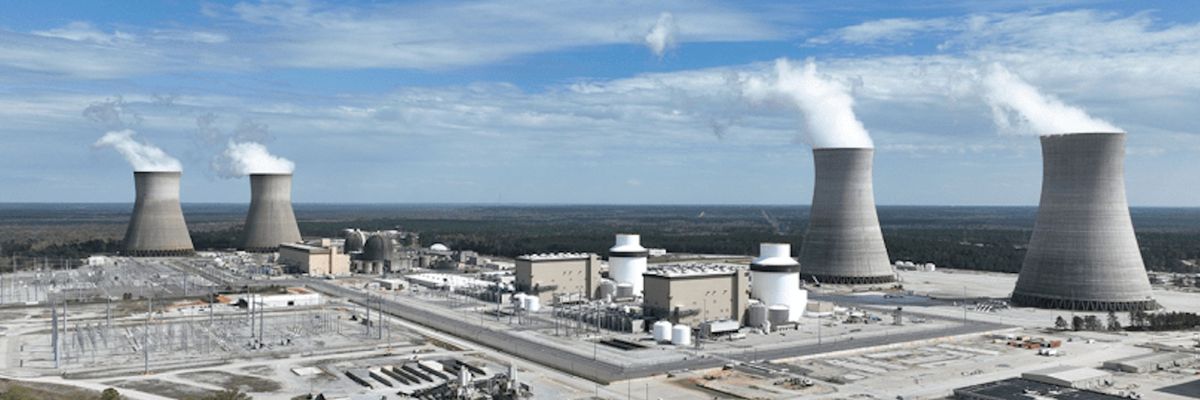
This undated Department of Energy photo shows the Alvin W. Vogtle Electric Generating Plant, also known as Plant Vogtle, in Waynesboro, Georgia.
"This is not about making the reactor licensing process more efficient, but about weakening safety and security oversight across the board, a long-standing industry goal," says one nuclear safety expert.
As U.S. senators prepare to vote on a bipartisan bill proponents say will accelerate the development and commercialization of advanced nuclear reactor technologies, the Union of Concerned Scientists warned Monday that the legislation would increase the chances of a "catastrophic" meltdown by weakening the Nuclear Regulatory Commission—an agency already ridden by conflicts of interest.
Upper chamber lawmakers are expected to vote this week on a package that includes provisions from the Accelerating Deployment of Versatile, Advanced Nuclear for Clean Energy (ADVANCE) Act, introduced last year by Sen. Shelley Moore Capito (R-W.Va.), and legislation passed by the House of Representatives in a 365-36 vote on February 28.
Proponents of the legislation argue it will facilitate U.S. nuclear leadership, develop and deploy new reactor technology, preserve existing nuclear energy, and more.
"A compromised NRC could lead to a catastrophic reactor meltdown impacting an entire region for a generation."
However, critics including the Union of Concerned Scientists (UCS) argue that the bill threatens the independence of the Nuclear Regulatory Commission (NRC), some of whose officials have long been criticized for their dangerously close ties to the industry they regulate. Additionally, NRC advisers have been accused of undisclosed conflicts of interest.
"It's extremely disappointing that, without any meaningful debate, Congress is about to erase 50 years of independent nuclear safety oversight by changing the NRC's mission to not only protect public health and safety but also to protect the financial health of the industry and its investors," UCS director of nuclear power safety Edwin Lyman said in a statement Monday.
"Just as lax regulation by the [Federal Aviation Administration]—an agency already burdened by conflicts of interests—can lead to a catastrophic failure of an aircraft, a compromised NRC could lead to a catastrophic reactor meltdown impacting an entire region for a generation," he continued.
"Make no mistake: This is not about making the reactor licensing process more efficient, but about weakening safety and security oversight across the board, a long-standing industry goal," Lyman contended. "The change to the NRC's mission effectively directs the agency to enforce only the bare minimum level of regulation at every facility it oversees across the United States."
"Passage of this legislation will only increase the danger to people already living downwind of nuclear facilities from a severe accident or terrorist attack, and it will make it even more difficult for communities to prevent risky, experimental reactors from being sited in their midst," he added.
In a February opinion piece published by The Hill, Lyman asserted that the ADVANCE Act would "put the proverbial fox in charge of the henhouse" by eroding the independence of an agency that critics say is already too cozy with the nuclear industry.
"Congress needs to strengthen, rather than weaken, the NRC's science-based safety focus," Lyman stressed.
This post has been updated to clarify that the Senate and House bills are part of a broader package, which senators ultimately passed on June 18.
This country and this world are at a monumental crossroads. US voters have an opportunity to beat back the forces of fascism and confront the billionaires who are rigging the economy, our media system, and our democracy, making it increasingly impossible for ordinary people to get by. We’re not just talking about the election. We’re talking about what must be done once these fascist elements are vanquished from power. We need a bolder set of solutions than what either major party has so far been willing to offer and a working-class movement ready to fight like hell for it. Trump didn't emerge from nowhere. The conditions that fueled MAGA authoritarianism were created by decades of radical neoliberal economic policies and a corrupt political system dominated by corporate interests. They slashed taxes on the super-rich, promising that the benefits would trickle down. They said giveaways to the corporate titans would make life more affordable for the rest of us. It was all bullshit. And when a bitter, betrayed populace searches for someone to blame, right-wing demagogues have little trouble finding scapegoats. People know when they're being lied to, but you won't hear any of this from the corporate media. Only independent journalism—powered and funded by people who believe in building a better world—can deliver truly trustworthy daily news. If you share our vision, please contribute whatever you can to sustain our work. |
As U.S. senators prepare to vote on a bipartisan bill proponents say will accelerate the development and commercialization of advanced nuclear reactor technologies, the Union of Concerned Scientists warned Monday that the legislation would increase the chances of a "catastrophic" meltdown by weakening the Nuclear Regulatory Commission—an agency already ridden by conflicts of interest.
Upper chamber lawmakers are expected to vote this week on a package that includes provisions from the Accelerating Deployment of Versatile, Advanced Nuclear for Clean Energy (ADVANCE) Act, introduced last year by Sen. Shelley Moore Capito (R-W.Va.), and legislation passed by the House of Representatives in a 365-36 vote on February 28.
Proponents of the legislation argue it will facilitate U.S. nuclear leadership, develop and deploy new reactor technology, preserve existing nuclear energy, and more.
"A compromised NRC could lead to a catastrophic reactor meltdown impacting an entire region for a generation."
However, critics including the Union of Concerned Scientists (UCS) argue that the bill threatens the independence of the Nuclear Regulatory Commission (NRC), some of whose officials have long been criticized for their dangerously close ties to the industry they regulate. Additionally, NRC advisers have been accused of undisclosed conflicts of interest.
"It's extremely disappointing that, without any meaningful debate, Congress is about to erase 50 years of independent nuclear safety oversight by changing the NRC's mission to not only protect public health and safety but also to protect the financial health of the industry and its investors," UCS director of nuclear power safety Edwin Lyman said in a statement Monday.
"Just as lax regulation by the [Federal Aviation Administration]—an agency already burdened by conflicts of interests—can lead to a catastrophic failure of an aircraft, a compromised NRC could lead to a catastrophic reactor meltdown impacting an entire region for a generation," he continued.
"Make no mistake: This is not about making the reactor licensing process more efficient, but about weakening safety and security oversight across the board, a long-standing industry goal," Lyman contended. "The change to the NRC's mission effectively directs the agency to enforce only the bare minimum level of regulation at every facility it oversees across the United States."
"Passage of this legislation will only increase the danger to people already living downwind of nuclear facilities from a severe accident or terrorist attack, and it will make it even more difficult for communities to prevent risky, experimental reactors from being sited in their midst," he added.
In a February opinion piece published by The Hill, Lyman asserted that the ADVANCE Act would "put the proverbial fox in charge of the henhouse" by eroding the independence of an agency that critics say is already too cozy with the nuclear industry.
"Congress needs to strengthen, rather than weaken, the NRC's science-based safety focus," Lyman stressed.
This post has been updated to clarify that the Senate and House bills are part of a broader package, which senators ultimately passed on June 18.