SUBSCRIBE TO OUR FREE NEWSLETTER
Daily news & progressive opinion—funded by the people, not the corporations—delivered straight to your inbox.
5
#000000
#FFFFFF
To donate by check, phone, or other method, see our More Ways to Give page.
Daily news & progressive opinion—funded by the people, not the corporations—delivered straight to your inbox.
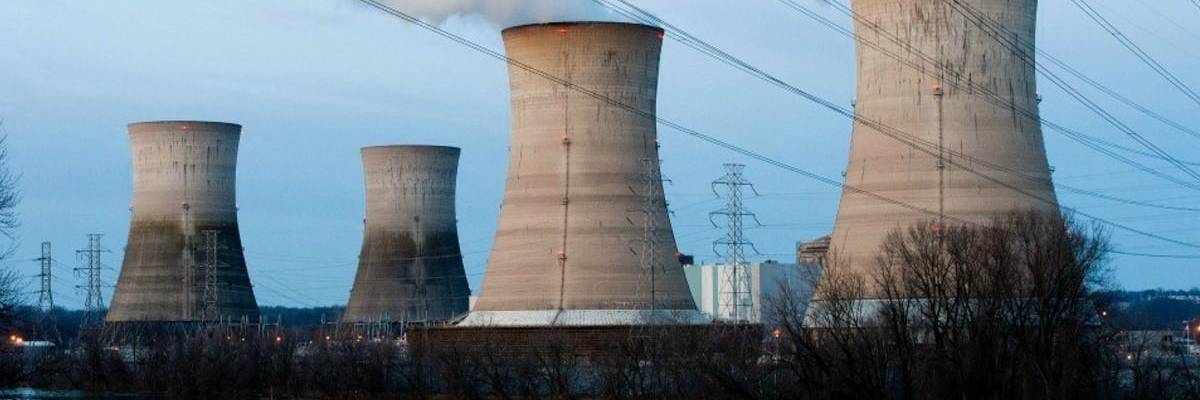
The Nuclear Regulatory Commission is considering rolling back some safety standards for nuclear power plants. (Photo: Jeff Fusco/Getty Images)
"Guinea Pig Nation: How the NRC's new licensing rules could turn communities into test beds for risky, experimental nuclear plants," is what physicist Dr. Edwin Lyman, Director of Nuclear Power Safety with the Union of Concerned Scientists, titled his presentation last week.
"If 'Part 53' is enacted, first-of-a kind reactors would be located in densely populated urban areas without any promise for emergency evacuation, planning, without security forces to protect against terrorist attack, and without highly trained operators--and all without meaningful opportunities for public input."
The talk was about how the U.S. Nuclear Regulatory Commission is involved in a major change of its "rules" and "guidance" to reduce government regulations for what the nuclear industry calls "advanced" nuclear power plants.
Already, Lyman said, at a "Night with the Experts" online session organized by the Nuclear Energy Information Service, the NRC has moved to allow nuclear power plants to be built in thickly populated areas. This "change in policy" was approved in a vote by NRC commissioners in July.
For a more than a half-century, the NRC and its predecessor agency, the U.S. Atomic Energy Commission, sought to have nuclear power plants sited in areas of "low population density"--because of the threat of a major nuclear plant accident.
But, said Lyman, who specializes in nuclear power safety, nuclear proliferation and nuclear terrorism, the NRC in a decision titled "Population-Related Siting Considerations for Advanced Reactors," substantially altered this policy.
The lone NRC vote against the change came from Commissioner Jeffery Baran who in casting his 'no' vote wrote "Multiple, independent layers of protection against potential radiological exposure are necessary because we do not have perfect knowledge of new reactor technologies and their unique potential accident scenarios....Unlike light-water reactors, new advanced reactor designs do not have decades of operating experience; in many cases, the new designs have never been built or operated before."
He noted a NRC "criteria" document which declared that the agency "has a longstanding policy of siting nuclear reactors away from densely populated centers and preferring areas of low population density."
But, said Baran, under the new policy, a "reactor could be sited within a town of 25,000 people and right next to a large city. For reactor designs that have not been deployed before and do not have operating experience, that approach may be insufficiently protective of public health and safety...And it would not maintain the key defense-in-depth principle of having prudent siting limitations regardless of the features of a particular reactor design--a principle that has been a bedrock of nuclear safety."
That is just one of the many reductions proposed in safety standards.
"The central issue," commented Lyman in an interview following his November 17th presentation, "is that the NRC is accepting on faith that these new reactors are going to be safer and wants to adjust its regulations accordingly, to make them less stringent--on faith."
The key motivation, he said, behind the nuclear industry's push to significantly weaken safety standards is that the line of smaller nuclear power plants the nuclear industry is now pushing--including what it calls the "small modular nuclear reactor"--is that they are going to be "much more expensive" than the existing light-water nuclear power plants, the most common type of nuclear power plant which are large and are cooled by plain water. Thus, he said, these "advanced" nuclear plants would be more costly to operate than using energy alternatives, "certainly wind and solar."
And the NRC is complying with the nuclear industry.
It's a demonstration of one of the alternatives for the acronym for the NRC--Nuclear Rubberstamp Commission.
The list of proposed safety reductions in the PowerPoint portion of Lyman's presentation under "Cutting corners on safety and security to cut costs," and what the nuclear industry "wants" in what the NRC calls its "Part 53" assemblage of changes, included, in addition to the already completed alteration of siting criteria:
Lyman commented: "I could go on and on."
The Nuclear Energy Information Service's summary of his presentation stated: "Under the direction of Congress, the NRC is developing new regulations to facilitate licensing of experimental reactors by relaxing safety security standards and by relying on safety demonstrations that utilize computer simulations rather than experimental data. The major focus of this effort, known as 'Part 53,' is being written with an unprecedented level of industry involvement. If 'Part 53' is enacted, first-of-a kind reactors would be located in densely populated urban areas without any promise for emergency evacuation, planning, without security forces to protect against terrorist attack, and without highly trained operators--and all without meaningful opportunities for public input."
In his talk, Lyman referenced a 140-page report of the Union of Concerned Scientists which he authored, issued last year, titled "Advanced" Isn't Always Better, Assessing the Safety, Security, and Environmental Impacts of Non-Light-Water Nuclear Reactors.
The report states: "Almost all nuclear power reactors operating and under construction today are LWRs, so called because they use ordinary water to cool their hot, highly radioactive cores. Some observers believe that the LWR, the industry workhorse, has inherent flaws that are inhibiting nuclear power's growth....In response, the US Department of Energy's national laboratories, universities, and numerous private vendors--from large established companies to small startups--are pursuing the development of reactors that differ fundamentally from LWRs. These non-light-water reactors are cooled not by water, but by other substances, such as liquid sodium, helium gas, or even molten salts."
These "are sometimes referred to as 'advanced reactors.' However, that is a misnomer for most designs being pursued today...largely descend from those proposed many decades ago," the report continued.
"In part," it went on, "the nuclear industry's push to commercialize NLWRs is driven by its desire to show the public and policymakers that there is a high-tech alternative to the static, LWR-dominated status quo: a new generation of 'advanced' reactors. But a fundamental question remains: Is different actually better? The short answer is no. Nearly all of the NLWRs currently on the drawing board fail to provide significant enough improvements over LWRs to justify their considerable risks."
In the report, Lyman extensively examines issues involving each of the NLWR (Non Light Water Reactors) or "advanced" reactors.
David Kraft, director of the Chicago-based Nuclear Energy Information Service, after Lyman's talk said in an interview: "Dr. Lyman warns us all once again how largely beholden to the nuclear industry the NRC is. NRC is willing to twist and contort even reasonable safety regulations in ways that cater to nuclear industry desires to a degree that would rival a toy balloon-dog at a children's party. It is this kind of almost institutionalized acquiescence to industry wants that has led many to believe that NRC stands for Not Really Concerned."
Kraft continued: "Make no mistake about it--while NRC is doing its part to serve nuclear industry needs, we should not lose sight of the fact that it is the aggressive pro-nuclear agenda of the Biden Administration that has unleashed a juggernaut of financial and PR support for new nuclear reactors. Everything from the tens of billions of dollars allocated for new nuclear in the Infrastructure Act and the IRA [Inflation Reduction Act, which establishes a nuclear power production tax credit], to the national dog-and-pony show [the recent U.S. tour promoting nuclear power] of Energy Secretary Jennifer Granholm, demonstrates the administration's intentions to run roughshod over the objections of the public. We have a hard fight ahead of us."
The Nuclear Energy Information Service is among the safe-energy, anti-nuclear organizations that are challenging the NRC's effort to change its "rules" and "guidance" to boost "advanced" nuclear plants. Founded in 1981, its website is neis.org. It plans to soon post through its website a recording of Lyman's Zoom presentation.
Lyman's PowerPoint included a slide saying the "NRC is not currently" accepting comments on its plan for changes in its regulations for "advanced" reactors. But, it said, "the public is always free to weigh in" on NRC actions and recommended people attend any public meetings held on the issue.
Lyman joined the Union of Concerned Scientists in 2003 and is based in its Washington, D.C. office. Previously, he was president of the Nuclear Control Institute in Washington. Before that he was a postdoctoral research associate at Princeton University's Center for Energy and Environmental Studies, now the Science and Global Security Program. He earned a doctorate in physics from Cornell University in 1992. He is a co-author of the book Fukushima: The Story of a Nuclear Disaster.
Dear Common Dreams reader, It’s been nearly 30 years since I co-founded Common Dreams with my late wife, Lina Newhouser. We had the radical notion that journalism should serve the public good, not corporate profits. It was clear to us from the outset what it would take to build such a project. No paid advertisements. No corporate sponsors. No millionaire publisher telling us what to think or do. Many people said we wouldn't last a year, but we proved those doubters wrong. Together with a tremendous team of journalists and dedicated staff, we built an independent media outlet free from the constraints of profits and corporate control. Our mission has always been simple: To inform. To inspire. To ignite change for the common good. Building Common Dreams was not easy. Our survival was never guaranteed. When you take on the most powerful forces—Wall Street greed, fossil fuel industry destruction, Big Tech lobbyists, and uber-rich oligarchs who have spent billions upon billions rigging the economy and democracy in their favor—the only bulwark you have is supporters who believe in your work. But here’s the urgent message from me today. It's never been this bad out there. And it's never been this hard to keep us going. At the very moment Common Dreams is most needed, the threats we face are intensifying. We need your support now more than ever. We don't accept corporate advertising and never will. We don't have a paywall because we don't think people should be blocked from critical news based on their ability to pay. Everything we do is funded by the donations of readers like you. When everyone does the little they can afford, we are strong. But if that support retreats or dries up, so do we. Will you donate now to make sure Common Dreams not only survives but thrives? —Craig Brown, Co-founder |
"Guinea Pig Nation: How the NRC's new licensing rules could turn communities into test beds for risky, experimental nuclear plants," is what physicist Dr. Edwin Lyman, Director of Nuclear Power Safety with the Union of Concerned Scientists, titled his presentation last week.
"If 'Part 53' is enacted, first-of-a kind reactors would be located in densely populated urban areas without any promise for emergency evacuation, planning, without security forces to protect against terrorist attack, and without highly trained operators--and all without meaningful opportunities for public input."
The talk was about how the U.S. Nuclear Regulatory Commission is involved in a major change of its "rules" and "guidance" to reduce government regulations for what the nuclear industry calls "advanced" nuclear power plants.
Already, Lyman said, at a "Night with the Experts" online session organized by the Nuclear Energy Information Service, the NRC has moved to allow nuclear power plants to be built in thickly populated areas. This "change in policy" was approved in a vote by NRC commissioners in July.
For a more than a half-century, the NRC and its predecessor agency, the U.S. Atomic Energy Commission, sought to have nuclear power plants sited in areas of "low population density"--because of the threat of a major nuclear plant accident.
But, said Lyman, who specializes in nuclear power safety, nuclear proliferation and nuclear terrorism, the NRC in a decision titled "Population-Related Siting Considerations for Advanced Reactors," substantially altered this policy.
The lone NRC vote against the change came from Commissioner Jeffery Baran who in casting his 'no' vote wrote "Multiple, independent layers of protection against potential radiological exposure are necessary because we do not have perfect knowledge of new reactor technologies and their unique potential accident scenarios....Unlike light-water reactors, new advanced reactor designs do not have decades of operating experience; in many cases, the new designs have never been built or operated before."
He noted a NRC "criteria" document which declared that the agency "has a longstanding policy of siting nuclear reactors away from densely populated centers and preferring areas of low population density."
But, said Baran, under the new policy, a "reactor could be sited within a town of 25,000 people and right next to a large city. For reactor designs that have not been deployed before and do not have operating experience, that approach may be insufficiently protective of public health and safety...And it would not maintain the key defense-in-depth principle of having prudent siting limitations regardless of the features of a particular reactor design--a principle that has been a bedrock of nuclear safety."
That is just one of the many reductions proposed in safety standards.
"The central issue," commented Lyman in an interview following his November 17th presentation, "is that the NRC is accepting on faith that these new reactors are going to be safer and wants to adjust its regulations accordingly, to make them less stringent--on faith."
The key motivation, he said, behind the nuclear industry's push to significantly weaken safety standards is that the line of smaller nuclear power plants the nuclear industry is now pushing--including what it calls the "small modular nuclear reactor"--is that they are going to be "much more expensive" than the existing light-water nuclear power plants, the most common type of nuclear power plant which are large and are cooled by plain water. Thus, he said, these "advanced" nuclear plants would be more costly to operate than using energy alternatives, "certainly wind and solar."
And the NRC is complying with the nuclear industry.
It's a demonstration of one of the alternatives for the acronym for the NRC--Nuclear Rubberstamp Commission.
The list of proposed safety reductions in the PowerPoint portion of Lyman's presentation under "Cutting corners on safety and security to cut costs," and what the nuclear industry "wants" in what the NRC calls its "Part 53" assemblage of changes, included, in addition to the already completed alteration of siting criteria:
Lyman commented: "I could go on and on."
The Nuclear Energy Information Service's summary of his presentation stated: "Under the direction of Congress, the NRC is developing new regulations to facilitate licensing of experimental reactors by relaxing safety security standards and by relying on safety demonstrations that utilize computer simulations rather than experimental data. The major focus of this effort, known as 'Part 53,' is being written with an unprecedented level of industry involvement. If 'Part 53' is enacted, first-of-a kind reactors would be located in densely populated urban areas without any promise for emergency evacuation, planning, without security forces to protect against terrorist attack, and without highly trained operators--and all without meaningful opportunities for public input."
In his talk, Lyman referenced a 140-page report of the Union of Concerned Scientists which he authored, issued last year, titled "Advanced" Isn't Always Better, Assessing the Safety, Security, and Environmental Impacts of Non-Light-Water Nuclear Reactors.
The report states: "Almost all nuclear power reactors operating and under construction today are LWRs, so called because they use ordinary water to cool their hot, highly radioactive cores. Some observers believe that the LWR, the industry workhorse, has inherent flaws that are inhibiting nuclear power's growth....In response, the US Department of Energy's national laboratories, universities, and numerous private vendors--from large established companies to small startups--are pursuing the development of reactors that differ fundamentally from LWRs. These non-light-water reactors are cooled not by water, but by other substances, such as liquid sodium, helium gas, or even molten salts."
These "are sometimes referred to as 'advanced reactors.' However, that is a misnomer for most designs being pursued today...largely descend from those proposed many decades ago," the report continued.
"In part," it went on, "the nuclear industry's push to commercialize NLWRs is driven by its desire to show the public and policymakers that there is a high-tech alternative to the static, LWR-dominated status quo: a new generation of 'advanced' reactors. But a fundamental question remains: Is different actually better? The short answer is no. Nearly all of the NLWRs currently on the drawing board fail to provide significant enough improvements over LWRs to justify their considerable risks."
In the report, Lyman extensively examines issues involving each of the NLWR (Non Light Water Reactors) or "advanced" reactors.
David Kraft, director of the Chicago-based Nuclear Energy Information Service, after Lyman's talk said in an interview: "Dr. Lyman warns us all once again how largely beholden to the nuclear industry the NRC is. NRC is willing to twist and contort even reasonable safety regulations in ways that cater to nuclear industry desires to a degree that would rival a toy balloon-dog at a children's party. It is this kind of almost institutionalized acquiescence to industry wants that has led many to believe that NRC stands for Not Really Concerned."
Kraft continued: "Make no mistake about it--while NRC is doing its part to serve nuclear industry needs, we should not lose sight of the fact that it is the aggressive pro-nuclear agenda of the Biden Administration that has unleashed a juggernaut of financial and PR support for new nuclear reactors. Everything from the tens of billions of dollars allocated for new nuclear in the Infrastructure Act and the IRA [Inflation Reduction Act, which establishes a nuclear power production tax credit], to the national dog-and-pony show [the recent U.S. tour promoting nuclear power] of Energy Secretary Jennifer Granholm, demonstrates the administration's intentions to run roughshod over the objections of the public. We have a hard fight ahead of us."
The Nuclear Energy Information Service is among the safe-energy, anti-nuclear organizations that are challenging the NRC's effort to change its "rules" and "guidance" to boost "advanced" nuclear plants. Founded in 1981, its website is neis.org. It plans to soon post through its website a recording of Lyman's Zoom presentation.
Lyman's PowerPoint included a slide saying the "NRC is not currently" accepting comments on its plan for changes in its regulations for "advanced" reactors. But, it said, "the public is always free to weigh in" on NRC actions and recommended people attend any public meetings held on the issue.
Lyman joined the Union of Concerned Scientists in 2003 and is based in its Washington, D.C. office. Previously, he was president of the Nuclear Control Institute in Washington. Before that he was a postdoctoral research associate at Princeton University's Center for Energy and Environmental Studies, now the Science and Global Security Program. He earned a doctorate in physics from Cornell University in 1992. He is a co-author of the book Fukushima: The Story of a Nuclear Disaster.
"Guinea Pig Nation: How the NRC's new licensing rules could turn communities into test beds for risky, experimental nuclear plants," is what physicist Dr. Edwin Lyman, Director of Nuclear Power Safety with the Union of Concerned Scientists, titled his presentation last week.
"If 'Part 53' is enacted, first-of-a kind reactors would be located in densely populated urban areas without any promise for emergency evacuation, planning, without security forces to protect against terrorist attack, and without highly trained operators--and all without meaningful opportunities for public input."
The talk was about how the U.S. Nuclear Regulatory Commission is involved in a major change of its "rules" and "guidance" to reduce government regulations for what the nuclear industry calls "advanced" nuclear power plants.
Already, Lyman said, at a "Night with the Experts" online session organized by the Nuclear Energy Information Service, the NRC has moved to allow nuclear power plants to be built in thickly populated areas. This "change in policy" was approved in a vote by NRC commissioners in July.
For a more than a half-century, the NRC and its predecessor agency, the U.S. Atomic Energy Commission, sought to have nuclear power plants sited in areas of "low population density"--because of the threat of a major nuclear plant accident.
But, said Lyman, who specializes in nuclear power safety, nuclear proliferation and nuclear terrorism, the NRC in a decision titled "Population-Related Siting Considerations for Advanced Reactors," substantially altered this policy.
The lone NRC vote against the change came from Commissioner Jeffery Baran who in casting his 'no' vote wrote "Multiple, independent layers of protection against potential radiological exposure are necessary because we do not have perfect knowledge of new reactor technologies and their unique potential accident scenarios....Unlike light-water reactors, new advanced reactor designs do not have decades of operating experience; in many cases, the new designs have never been built or operated before."
He noted a NRC "criteria" document which declared that the agency "has a longstanding policy of siting nuclear reactors away from densely populated centers and preferring areas of low population density."
But, said Baran, under the new policy, a "reactor could be sited within a town of 25,000 people and right next to a large city. For reactor designs that have not been deployed before and do not have operating experience, that approach may be insufficiently protective of public health and safety...And it would not maintain the key defense-in-depth principle of having prudent siting limitations regardless of the features of a particular reactor design--a principle that has been a bedrock of nuclear safety."
That is just one of the many reductions proposed in safety standards.
"The central issue," commented Lyman in an interview following his November 17th presentation, "is that the NRC is accepting on faith that these new reactors are going to be safer and wants to adjust its regulations accordingly, to make them less stringent--on faith."
The key motivation, he said, behind the nuclear industry's push to significantly weaken safety standards is that the line of smaller nuclear power plants the nuclear industry is now pushing--including what it calls the "small modular nuclear reactor"--is that they are going to be "much more expensive" than the existing light-water nuclear power plants, the most common type of nuclear power plant which are large and are cooled by plain water. Thus, he said, these "advanced" nuclear plants would be more costly to operate than using energy alternatives, "certainly wind and solar."
And the NRC is complying with the nuclear industry.
It's a demonstration of one of the alternatives for the acronym for the NRC--Nuclear Rubberstamp Commission.
The list of proposed safety reductions in the PowerPoint portion of Lyman's presentation under "Cutting corners on safety and security to cut costs," and what the nuclear industry "wants" in what the NRC calls its "Part 53" assemblage of changes, included, in addition to the already completed alteration of siting criteria:
Lyman commented: "I could go on and on."
The Nuclear Energy Information Service's summary of his presentation stated: "Under the direction of Congress, the NRC is developing new regulations to facilitate licensing of experimental reactors by relaxing safety security standards and by relying on safety demonstrations that utilize computer simulations rather than experimental data. The major focus of this effort, known as 'Part 53,' is being written with an unprecedented level of industry involvement. If 'Part 53' is enacted, first-of-a kind reactors would be located in densely populated urban areas without any promise for emergency evacuation, planning, without security forces to protect against terrorist attack, and without highly trained operators--and all without meaningful opportunities for public input."
In his talk, Lyman referenced a 140-page report of the Union of Concerned Scientists which he authored, issued last year, titled "Advanced" Isn't Always Better, Assessing the Safety, Security, and Environmental Impacts of Non-Light-Water Nuclear Reactors.
The report states: "Almost all nuclear power reactors operating and under construction today are LWRs, so called because they use ordinary water to cool their hot, highly radioactive cores. Some observers believe that the LWR, the industry workhorse, has inherent flaws that are inhibiting nuclear power's growth....In response, the US Department of Energy's national laboratories, universities, and numerous private vendors--from large established companies to small startups--are pursuing the development of reactors that differ fundamentally from LWRs. These non-light-water reactors are cooled not by water, but by other substances, such as liquid sodium, helium gas, or even molten salts."
These "are sometimes referred to as 'advanced reactors.' However, that is a misnomer for most designs being pursued today...largely descend from those proposed many decades ago," the report continued.
"In part," it went on, "the nuclear industry's push to commercialize NLWRs is driven by its desire to show the public and policymakers that there is a high-tech alternative to the static, LWR-dominated status quo: a new generation of 'advanced' reactors. But a fundamental question remains: Is different actually better? The short answer is no. Nearly all of the NLWRs currently on the drawing board fail to provide significant enough improvements over LWRs to justify their considerable risks."
In the report, Lyman extensively examines issues involving each of the NLWR (Non Light Water Reactors) or "advanced" reactors.
David Kraft, director of the Chicago-based Nuclear Energy Information Service, after Lyman's talk said in an interview: "Dr. Lyman warns us all once again how largely beholden to the nuclear industry the NRC is. NRC is willing to twist and contort even reasonable safety regulations in ways that cater to nuclear industry desires to a degree that would rival a toy balloon-dog at a children's party. It is this kind of almost institutionalized acquiescence to industry wants that has led many to believe that NRC stands for Not Really Concerned."
Kraft continued: "Make no mistake about it--while NRC is doing its part to serve nuclear industry needs, we should not lose sight of the fact that it is the aggressive pro-nuclear agenda of the Biden Administration that has unleashed a juggernaut of financial and PR support for new nuclear reactors. Everything from the tens of billions of dollars allocated for new nuclear in the Infrastructure Act and the IRA [Inflation Reduction Act, which establishes a nuclear power production tax credit], to the national dog-and-pony show [the recent U.S. tour promoting nuclear power] of Energy Secretary Jennifer Granholm, demonstrates the administration's intentions to run roughshod over the objections of the public. We have a hard fight ahead of us."
The Nuclear Energy Information Service is among the safe-energy, anti-nuclear organizations that are challenging the NRC's effort to change its "rules" and "guidance" to boost "advanced" nuclear plants. Founded in 1981, its website is neis.org. It plans to soon post through its website a recording of Lyman's Zoom presentation.
Lyman's PowerPoint included a slide saying the "NRC is not currently" accepting comments on its plan for changes in its regulations for "advanced" reactors. But, it said, "the public is always free to weigh in" on NRC actions and recommended people attend any public meetings held on the issue.
Lyman joined the Union of Concerned Scientists in 2003 and is based in its Washington, D.C. office. Previously, he was president of the Nuclear Control Institute in Washington. Before that he was a postdoctoral research associate at Princeton University's Center for Energy and Environmental Studies, now the Science and Global Security Program. He earned a doctorate in physics from Cornell University in 1992. He is a co-author of the book Fukushima: The Story of a Nuclear Disaster.