SUBSCRIBE TO OUR FREE NEWSLETTER
Daily news & progressive opinion—funded by the people, not the corporations—delivered straight to your inbox.
5
#000000
#FFFFFF
To donate by check, phone, or other method, see our More Ways to Give page.
Daily news & progressive opinion—funded by the people, not the corporations—delivered straight to your inbox.
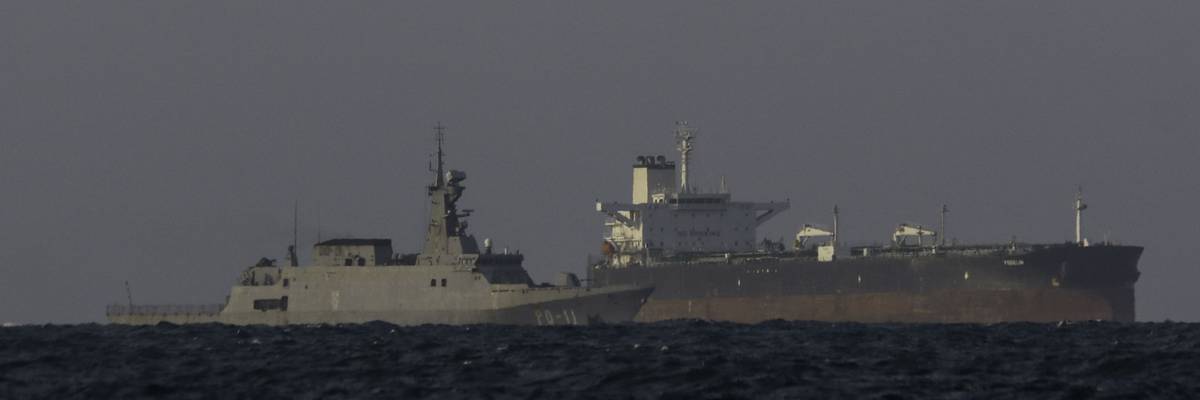
A Venezuelan navy patrol boat escorts Panamanian flagged crude oil tanker Yoselin near the El Palito refinery in Puerto Cabello, Venezuela on November 11, 2025.
Conflict like the US targeting of Venezuela is probably inevitable as long as the world depends on an energy source that is available only in a few places.
I don’t know enough maritime law to tell you exactly why it’s wrong for America to be dropping troops onto tankers to seize them—just to say that, no matter what legalistic excuse the administration cooks up, it looks exactly like being a pirate. (It’s worth remembering that the US Navy was founded largely to take on piracy, and thanks to the Barbary corsairs, the early Americans had a lot to say about the subject. George Washington, for instance: Pirates are “enemies to mankind.”)
But I can tell you this. In the ever-shrinking mind of our current president, the reason why it’s good to seize a tanker is because it carries oil, and oil is the source of all strength, his contemporary equivalent to pieces of his eight. It’s “a large tanker, very large,” Mr. Trump explained, continuing (inevitably) to describe it as “the largest one ever seized actually.” When asked what would happen to the cargo, he said “I assume we’re going to keep the oil.”
Oil is, and always has been, at the center of our concerns with Venezuela, which has the world’s largest proven reserves (though much of it is in the incredibly dirty and hard-to-recover form of tarsands). At the moment it’s a major supplier to China, and it claims sovereignty over a major oil field in Guyana which has attracted big investment from Exxon and Chevron. So if you wonder why we’ve been attacking “drug boats” from Venezuela on the grounds that they’re carrying fentanyl, which Venezuela does not produce, that may give you some sense. Indeed the pressure has been so intense that the Maduro government in Caracas apparently offered to essentially turn over its oil and mineral resources to America in October negotiations; we’ve apparently decided we’d rather just take them.
This kind of coercion on behalf of the hydrocarbon industry is becoming old hat for the Trump administration. It’s used tariff policy, for instance, to force country after country to agree to buy huge quantities of American liquefied natural gas. As CNBC reported last spring regarding one deal with the EU:
“They’re going to have to buy our energy from us, because they need it,” Trump told reporters at the White House. “We can knock off $350 billion in one week,” the president said. The European Union faces a 20% tariff rate if it does not reach a deal with Trump.
(Justin Mikulka has a pointed take on why this strategy won’t work for the LNG industry, and new data emerged this week showing just how badly it is going to penalize Americans who depend on propane for heating, since they’re now competing with so many other places for our supply of natural gas).
And of course in another sense we’ve been pirating the atmosphere for more than a century, filling up what is a common property with our emissions—America got rich burning fossil fuels, and the main result for other countries will be an ever higher temperature.
But for the moment let’s just think about the flow of oil, because it’s been behind, in large part, so much of the geopolitical tension of the last hundred years. Japan’s quest for oil played some real role in the attacks on Pearl Harbor; Germany invaded the USSR in no small part to secure the oil fields of the Caucasus. The Suez crisis hinged on the transport of oil to Europe. OPEC seized on our thirst for oil as a powerful weapon in the 1980s, and America’s determination to keep oil flowing has determined much of our global stance in the postwar years—I’ll never forget a sign I saw at an early demonstration against the war in Iraq: “How did our oil end up under their sand?”
The point here is that conflict like this is probably inevitable as long as the world depends on an energy source that is available only in a few places. Control of those places becomes too important—you end up with oligarchs, and with people who want to topple them.
So how nice to imagine a world where location doesn’t matter—where instead we depend on energy from the sun and the wind, available everywhere. In the crudest terms, it’s going to be difficult to fight a war over sunshine. No one will ever seize a tanker to get at its supply of solar energy. Which is good news for everyone except those profiting from the current paradigm—Trumpism represents its dying twitches, but obviously those twitches can do great damage, as the last 24 hours indicates.
Yes, we need sun and windpower to take a bite out of the climate crisis. But we also need it to take a bite out of the authoritarianism crisis. Our job is to make this transition happen faster; every new solar panel erodes just a little bit the logic of oil imperialism. The push for clean energy is the push for peace.
Dear Common Dreams reader, It’s been nearly 30 years since I co-founded Common Dreams with my late wife, Lina Newhouser. We had the radical notion that journalism should serve the public good, not corporate profits. It was clear to us from the outset what it would take to build such a project. No paid advertisements. No corporate sponsors. No millionaire publisher telling us what to think or do. Many people said we wouldn't last a year, but we proved those doubters wrong. Together with a tremendous team of journalists and dedicated staff, we built an independent media outlet free from the constraints of profits and corporate control. Our mission has always been simple: To inform. To inspire. To ignite change for the common good. Building Common Dreams was not easy. Our survival was never guaranteed. When you take on the most powerful forces—Wall Street greed, fossil fuel industry destruction, Big Tech lobbyists, and uber-rich oligarchs who have spent billions upon billions rigging the economy and democracy in their favor—the only bulwark you have is supporters who believe in your work. But here’s the urgent message from me today. It's never been this bad out there. And it's never been this hard to keep us going. At the very moment Common Dreams is most needed, the threats we face are intensifying. We need your support now more than ever. We don't accept corporate advertising and never will. We don't have a paywall because we don't think people should be blocked from critical news based on their ability to pay. Everything we do is funded by the donations of readers like you. When everyone does the little they can afford, we are strong. But if that support retreats or dries up, so do we. Will you donate now to make sure Common Dreams not only survives but thrives? —Craig Brown, Co-founder |
I don’t know enough maritime law to tell you exactly why it’s wrong for America to be dropping troops onto tankers to seize them—just to say that, no matter what legalistic excuse the administration cooks up, it looks exactly like being a pirate. (It’s worth remembering that the US Navy was founded largely to take on piracy, and thanks to the Barbary corsairs, the early Americans had a lot to say about the subject. George Washington, for instance: Pirates are “enemies to mankind.”)
But I can tell you this. In the ever-shrinking mind of our current president, the reason why it’s good to seize a tanker is because it carries oil, and oil is the source of all strength, his contemporary equivalent to pieces of his eight. It’s “a large tanker, very large,” Mr. Trump explained, continuing (inevitably) to describe it as “the largest one ever seized actually.” When asked what would happen to the cargo, he said “I assume we’re going to keep the oil.”
Oil is, and always has been, at the center of our concerns with Venezuela, which has the world’s largest proven reserves (though much of it is in the incredibly dirty and hard-to-recover form of tarsands). At the moment it’s a major supplier to China, and it claims sovereignty over a major oil field in Guyana which has attracted big investment from Exxon and Chevron. So if you wonder why we’ve been attacking “drug boats” from Venezuela on the grounds that they’re carrying fentanyl, which Venezuela does not produce, that may give you some sense. Indeed the pressure has been so intense that the Maduro government in Caracas apparently offered to essentially turn over its oil and mineral resources to America in October negotiations; we’ve apparently decided we’d rather just take them.
This kind of coercion on behalf of the hydrocarbon industry is becoming old hat for the Trump administration. It’s used tariff policy, for instance, to force country after country to agree to buy huge quantities of American liquefied natural gas. As CNBC reported last spring regarding one deal with the EU:
“They’re going to have to buy our energy from us, because they need it,” Trump told reporters at the White House. “We can knock off $350 billion in one week,” the president said. The European Union faces a 20% tariff rate if it does not reach a deal with Trump.
(Justin Mikulka has a pointed take on why this strategy won’t work for the LNG industry, and new data emerged this week showing just how badly it is going to penalize Americans who depend on propane for heating, since they’re now competing with so many other places for our supply of natural gas).
And of course in another sense we’ve been pirating the atmosphere for more than a century, filling up what is a common property with our emissions—America got rich burning fossil fuels, and the main result for other countries will be an ever higher temperature.
But for the moment let’s just think about the flow of oil, because it’s been behind, in large part, so much of the geopolitical tension of the last hundred years. Japan’s quest for oil played some real role in the attacks on Pearl Harbor; Germany invaded the USSR in no small part to secure the oil fields of the Caucasus. The Suez crisis hinged on the transport of oil to Europe. OPEC seized on our thirst for oil as a powerful weapon in the 1980s, and America’s determination to keep oil flowing has determined much of our global stance in the postwar years—I’ll never forget a sign I saw at an early demonstration against the war in Iraq: “How did our oil end up under their sand?”
The point here is that conflict like this is probably inevitable as long as the world depends on an energy source that is available only in a few places. Control of those places becomes too important—you end up with oligarchs, and with people who want to topple them.
So how nice to imagine a world where location doesn’t matter—where instead we depend on energy from the sun and the wind, available everywhere. In the crudest terms, it’s going to be difficult to fight a war over sunshine. No one will ever seize a tanker to get at its supply of solar energy. Which is good news for everyone except those profiting from the current paradigm—Trumpism represents its dying twitches, but obviously those twitches can do great damage, as the last 24 hours indicates.
Yes, we need sun and windpower to take a bite out of the climate crisis. But we also need it to take a bite out of the authoritarianism crisis. Our job is to make this transition happen faster; every new solar panel erodes just a little bit the logic of oil imperialism. The push for clean energy is the push for peace.
I don’t know enough maritime law to tell you exactly why it’s wrong for America to be dropping troops onto tankers to seize them—just to say that, no matter what legalistic excuse the administration cooks up, it looks exactly like being a pirate. (It’s worth remembering that the US Navy was founded largely to take on piracy, and thanks to the Barbary corsairs, the early Americans had a lot to say about the subject. George Washington, for instance: Pirates are “enemies to mankind.”)
But I can tell you this. In the ever-shrinking mind of our current president, the reason why it’s good to seize a tanker is because it carries oil, and oil is the source of all strength, his contemporary equivalent to pieces of his eight. It’s “a large tanker, very large,” Mr. Trump explained, continuing (inevitably) to describe it as “the largest one ever seized actually.” When asked what would happen to the cargo, he said “I assume we’re going to keep the oil.”
Oil is, and always has been, at the center of our concerns with Venezuela, which has the world’s largest proven reserves (though much of it is in the incredibly dirty and hard-to-recover form of tarsands). At the moment it’s a major supplier to China, and it claims sovereignty over a major oil field in Guyana which has attracted big investment from Exxon and Chevron. So if you wonder why we’ve been attacking “drug boats” from Venezuela on the grounds that they’re carrying fentanyl, which Venezuela does not produce, that may give you some sense. Indeed the pressure has been so intense that the Maduro government in Caracas apparently offered to essentially turn over its oil and mineral resources to America in October negotiations; we’ve apparently decided we’d rather just take them.
This kind of coercion on behalf of the hydrocarbon industry is becoming old hat for the Trump administration. It’s used tariff policy, for instance, to force country after country to agree to buy huge quantities of American liquefied natural gas. As CNBC reported last spring regarding one deal with the EU:
“They’re going to have to buy our energy from us, because they need it,” Trump told reporters at the White House. “We can knock off $350 billion in one week,” the president said. The European Union faces a 20% tariff rate if it does not reach a deal with Trump.
(Justin Mikulka has a pointed take on why this strategy won’t work for the LNG industry, and new data emerged this week showing just how badly it is going to penalize Americans who depend on propane for heating, since they’re now competing with so many other places for our supply of natural gas).
And of course in another sense we’ve been pirating the atmosphere for more than a century, filling up what is a common property with our emissions—America got rich burning fossil fuels, and the main result for other countries will be an ever higher temperature.
But for the moment let’s just think about the flow of oil, because it’s been behind, in large part, so much of the geopolitical tension of the last hundred years. Japan’s quest for oil played some real role in the attacks on Pearl Harbor; Germany invaded the USSR in no small part to secure the oil fields of the Caucasus. The Suez crisis hinged on the transport of oil to Europe. OPEC seized on our thirst for oil as a powerful weapon in the 1980s, and America’s determination to keep oil flowing has determined much of our global stance in the postwar years—I’ll never forget a sign I saw at an early demonstration against the war in Iraq: “How did our oil end up under their sand?”
The point here is that conflict like this is probably inevitable as long as the world depends on an energy source that is available only in a few places. Control of those places becomes too important—you end up with oligarchs, and with people who want to topple them.
So how nice to imagine a world where location doesn’t matter—where instead we depend on energy from the sun and the wind, available everywhere. In the crudest terms, it’s going to be difficult to fight a war over sunshine. No one will ever seize a tanker to get at its supply of solar energy. Which is good news for everyone except those profiting from the current paradigm—Trumpism represents its dying twitches, but obviously those twitches can do great damage, as the last 24 hours indicates.
Yes, we need sun and windpower to take a bite out of the climate crisis. But we also need it to take a bite out of the authoritarianism crisis. Our job is to make this transition happen faster; every new solar panel erodes just a little bit the logic of oil imperialism. The push for clean energy is the push for peace.