SUBSCRIBE TO OUR FREE NEWSLETTER
Daily news & progressive opinion—funded by the people, not the corporations—delivered straight to your inbox.
5
#000000
#FFFFFF
To donate by check, phone, or other method, see our More Ways to Give page.
Daily news & progressive opinion—funded by the people, not the corporations—delivered straight to your inbox.
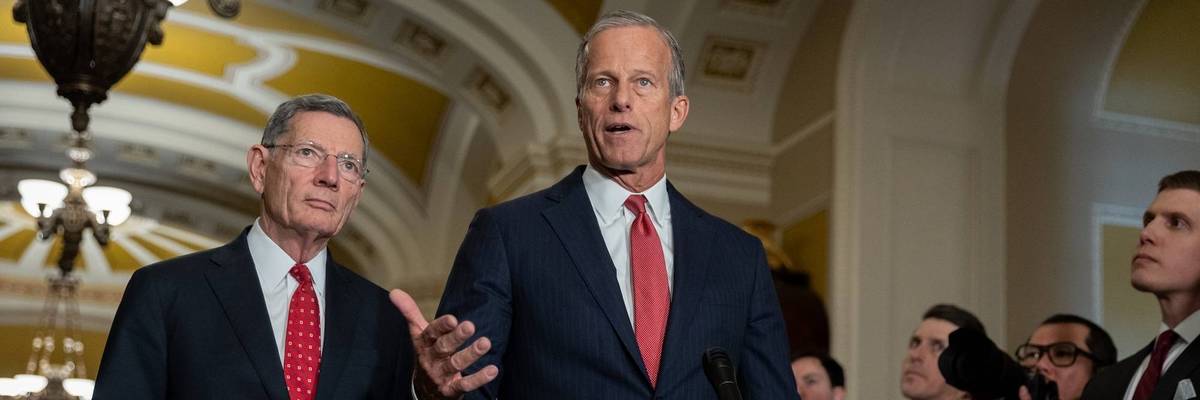
US Senate Majority Leader John Thune (R-SD) speaks at a press conference with other members of Senate Republican leadership in Washington, DC on February 10, 2026.
Sen. Ron Wyden called the tax giveaway "indefensible at a time when so many Americans are getting battered by inflation and barely staying afloat."
Nearly all US Senate Republicans on Tuesday voted to block a resolution that would have reversed a Trump administration regulatory change set to give some of the country's richest companies a $10.3 billion tax break.
The Congressional Review Act (CRA) resolution was spearheaded by Senate Finance Committee Ranking Member Ron Wyden (D-Ore.) and Angus King (I-Maine). The vote on whether to advance it was 47-51. The only Republican to vote in favor was the other Mainer, Susan Collins, who just confirmed she is running for another term, despite two strong Democratic challengers.
In a statement after the vote, Wyden tied the target of his resolution—an Internal Revenue Service guidance undermining the corporate alternative minimum tax (CAMT)—to the sweeping budget package that GOP lawmakers passed and President Donald Trump signed last summer, which also featured significant tax breaks for the rich.
"The ink is barely dry on the megabill Trump and Republicans passed to give $1 trillion in new tax breaks to giant corporations, and now his Treasury Department is throwing another $10 billion handout to the most profitable corporations in America," Wyden said.
"The pattern we're seeing is that the Trump administration gives big corporations and ultrawealthy donors whatever tax benefits they want the second they walk through the door at the Treasury Department, but that doesn't mean the Senate has to allow this giveaway to happen," he stressed. "Stuffing $10 billion into the coffers of corporations that are already raking in enormous profits is indefensible at a time when so many Americans are getting battered by inflation and barely staying afloat."
King similarly declared that "it's downright unfair to give billions in tax relief to America's most successful corporations when Maine people are struggling to afford their prescription drugs, childcare, and groceries." He described their resolution as "a commonsense step toward a fairer tax policy that prioritizes people over profits and levels the playing field."
Although the defeat was predictable, economic justice advocates lambasted Senate Republicans for killing the resolution.
Americans for Tax Fairness executive director David Kass said in a statement that "after passing historic tax giveaways for billionaires and big business through the One Big Beautiful Bill Act (OBBA), blowing up the deficit, and cutting billions from critical healthcare and nutrition programs to pay for it, Trump and his GOP allies in the Senate are taking every opportunity to ensure economic elites can avoid paying their fair share."
"This guidance would effectively circumvent Congress and create numerous opportunities for corporate tax evasion while increasing the deficit and national debt, thus creating more imbalance in a tax code that already favors the wealthy and large corporations," Kass said. "Sen. Wyden is right to lead the charge to stop this guidance—average Americans should not be forced to subsidize some of the most profitable companies on Earth."
Like the Senate, the House of Representatives is also narrowly controlled by the GOP. Matt Gardner, a senior fellow at the Institute on Taxation and Economic Policy, noted in a Tuesday blog post that "even if lawmakers of both parties had sufficient backbone to retake the legislative power that the executive branch has usurped, President Trump would veto such a bill."
"But as a matter of educating lawmakers and the public, the recently rejected measure was a success given that tax legislation (such as this resolution) up for a vote in Congress usually gets an official budget score from Congress' revenue estimators at the Joint Committee on Taxation," he wrote. "And in this case, that reveals that this unilateral corporate tax cut from the Trump administration will cost $10 billion over a decade unless it is reversed."
"The Senate's failure to ratify Wyden's resolution may be only the opening salvo for members of Congress who want to retake the power given them under the Constitution to make tax law," Gardner suggested. "The regulation in question is not the first, and surely not the last, attempt by President Trump to unilaterally cut corporate taxes."
Dear Common Dreams reader, It’s been nearly 30 years since I co-founded Common Dreams with my late wife, Lina Newhouser. We had the radical notion that journalism should serve the public good, not corporate profits. It was clear to us from the outset what it would take to build such a project. No paid advertisements. No corporate sponsors. No millionaire publisher telling us what to think or do. Many people said we wouldn't last a year, but we proved those doubters wrong. Together with a tremendous team of journalists and dedicated staff, we built an independent media outlet free from the constraints of profits and corporate control. Our mission has always been simple: To inform. To inspire. To ignite change for the common good. Building Common Dreams was not easy. Our survival was never guaranteed. When you take on the most powerful forces—Wall Street greed, fossil fuel industry destruction, Big Tech lobbyists, and uber-rich oligarchs who have spent billions upon billions rigging the economy and democracy in their favor—the only bulwark you have is supporters who believe in your work. But here’s the urgent message from me today. It's never been this bad out there. And it's never been this hard to keep us going. At the very moment Common Dreams is most needed, the threats we face are intensifying. We need your support now more than ever. We don't accept corporate advertising and never will. We don't have a paywall because we don't think people should be blocked from critical news based on their ability to pay. Everything we do is funded by the donations of readers like you. When everyone does the little they can afford, we are strong. But if that support retreats or dries up, so do we. Will you donate now to make sure Common Dreams not only survives but thrives? —Craig Brown, Co-founder |
Nearly all US Senate Republicans on Tuesday voted to block a resolution that would have reversed a Trump administration regulatory change set to give some of the country's richest companies a $10.3 billion tax break.
The Congressional Review Act (CRA) resolution was spearheaded by Senate Finance Committee Ranking Member Ron Wyden (D-Ore.) and Angus King (I-Maine). The vote on whether to advance it was 47-51. The only Republican to vote in favor was the other Mainer, Susan Collins, who just confirmed she is running for another term, despite two strong Democratic challengers.
In a statement after the vote, Wyden tied the target of his resolution—an Internal Revenue Service guidance undermining the corporate alternative minimum tax (CAMT)—to the sweeping budget package that GOP lawmakers passed and President Donald Trump signed last summer, which also featured significant tax breaks for the rich.
"The ink is barely dry on the megabill Trump and Republicans passed to give $1 trillion in new tax breaks to giant corporations, and now his Treasury Department is throwing another $10 billion handout to the most profitable corporations in America," Wyden said.
"The pattern we're seeing is that the Trump administration gives big corporations and ultrawealthy donors whatever tax benefits they want the second they walk through the door at the Treasury Department, but that doesn't mean the Senate has to allow this giveaway to happen," he stressed. "Stuffing $10 billion into the coffers of corporations that are already raking in enormous profits is indefensible at a time when so many Americans are getting battered by inflation and barely staying afloat."
King similarly declared that "it's downright unfair to give billions in tax relief to America's most successful corporations when Maine people are struggling to afford their prescription drugs, childcare, and groceries." He described their resolution as "a commonsense step toward a fairer tax policy that prioritizes people over profits and levels the playing field."
Although the defeat was predictable, economic justice advocates lambasted Senate Republicans for killing the resolution.
Americans for Tax Fairness executive director David Kass said in a statement that "after passing historic tax giveaways for billionaires and big business through the One Big Beautiful Bill Act (OBBA), blowing up the deficit, and cutting billions from critical healthcare and nutrition programs to pay for it, Trump and his GOP allies in the Senate are taking every opportunity to ensure economic elites can avoid paying their fair share."
"This guidance would effectively circumvent Congress and create numerous opportunities for corporate tax evasion while increasing the deficit and national debt, thus creating more imbalance in a tax code that already favors the wealthy and large corporations," Kass said. "Sen. Wyden is right to lead the charge to stop this guidance—average Americans should not be forced to subsidize some of the most profitable companies on Earth."
Like the Senate, the House of Representatives is also narrowly controlled by the GOP. Matt Gardner, a senior fellow at the Institute on Taxation and Economic Policy, noted in a Tuesday blog post that "even if lawmakers of both parties had sufficient backbone to retake the legislative power that the executive branch has usurped, President Trump would veto such a bill."
"But as a matter of educating lawmakers and the public, the recently rejected measure was a success given that tax legislation (such as this resolution) up for a vote in Congress usually gets an official budget score from Congress' revenue estimators at the Joint Committee on Taxation," he wrote. "And in this case, that reveals that this unilateral corporate tax cut from the Trump administration will cost $10 billion over a decade unless it is reversed."
"The Senate's failure to ratify Wyden's resolution may be only the opening salvo for members of Congress who want to retake the power given them under the Constitution to make tax law," Gardner suggested. "The regulation in question is not the first, and surely not the last, attempt by President Trump to unilaterally cut corporate taxes."
Nearly all US Senate Republicans on Tuesday voted to block a resolution that would have reversed a Trump administration regulatory change set to give some of the country's richest companies a $10.3 billion tax break.
The Congressional Review Act (CRA) resolution was spearheaded by Senate Finance Committee Ranking Member Ron Wyden (D-Ore.) and Angus King (I-Maine). The vote on whether to advance it was 47-51. The only Republican to vote in favor was the other Mainer, Susan Collins, who just confirmed she is running for another term, despite two strong Democratic challengers.
In a statement after the vote, Wyden tied the target of his resolution—an Internal Revenue Service guidance undermining the corporate alternative minimum tax (CAMT)—to the sweeping budget package that GOP lawmakers passed and President Donald Trump signed last summer, which also featured significant tax breaks for the rich.
"The ink is barely dry on the megabill Trump and Republicans passed to give $1 trillion in new tax breaks to giant corporations, and now his Treasury Department is throwing another $10 billion handout to the most profitable corporations in America," Wyden said.
"The pattern we're seeing is that the Trump administration gives big corporations and ultrawealthy donors whatever tax benefits they want the second they walk through the door at the Treasury Department, but that doesn't mean the Senate has to allow this giveaway to happen," he stressed. "Stuffing $10 billion into the coffers of corporations that are already raking in enormous profits is indefensible at a time when so many Americans are getting battered by inflation and barely staying afloat."
King similarly declared that "it's downright unfair to give billions in tax relief to America's most successful corporations when Maine people are struggling to afford their prescription drugs, childcare, and groceries." He described their resolution as "a commonsense step toward a fairer tax policy that prioritizes people over profits and levels the playing field."
Although the defeat was predictable, economic justice advocates lambasted Senate Republicans for killing the resolution.
Americans for Tax Fairness executive director David Kass said in a statement that "after passing historic tax giveaways for billionaires and big business through the One Big Beautiful Bill Act (OBBA), blowing up the deficit, and cutting billions from critical healthcare and nutrition programs to pay for it, Trump and his GOP allies in the Senate are taking every opportunity to ensure economic elites can avoid paying their fair share."
"This guidance would effectively circumvent Congress and create numerous opportunities for corporate tax evasion while increasing the deficit and national debt, thus creating more imbalance in a tax code that already favors the wealthy and large corporations," Kass said. "Sen. Wyden is right to lead the charge to stop this guidance—average Americans should not be forced to subsidize some of the most profitable companies on Earth."
Like the Senate, the House of Representatives is also narrowly controlled by the GOP. Matt Gardner, a senior fellow at the Institute on Taxation and Economic Policy, noted in a Tuesday blog post that "even if lawmakers of both parties had sufficient backbone to retake the legislative power that the executive branch has usurped, President Trump would veto such a bill."
"But as a matter of educating lawmakers and the public, the recently rejected measure was a success given that tax legislation (such as this resolution) up for a vote in Congress usually gets an official budget score from Congress' revenue estimators at the Joint Committee on Taxation," he wrote. "And in this case, that reveals that this unilateral corporate tax cut from the Trump administration will cost $10 billion over a decade unless it is reversed."
"The Senate's failure to ratify Wyden's resolution may be only the opening salvo for members of Congress who want to retake the power given them under the Constitution to make tax law," Gardner suggested. "The regulation in question is not the first, and surely not the last, attempt by President Trump to unilaterally cut corporate taxes."