SUBSCRIBE TO OUR FREE NEWSLETTER
Daily news & progressive opinion—funded by the people, not the corporations—delivered straight to your inbox.
5
#000000
#FFFFFF
To donate by check, phone, or other method, see our More Ways to Give page.
Daily news & progressive opinion—funded by the people, not the corporations—delivered straight to your inbox.
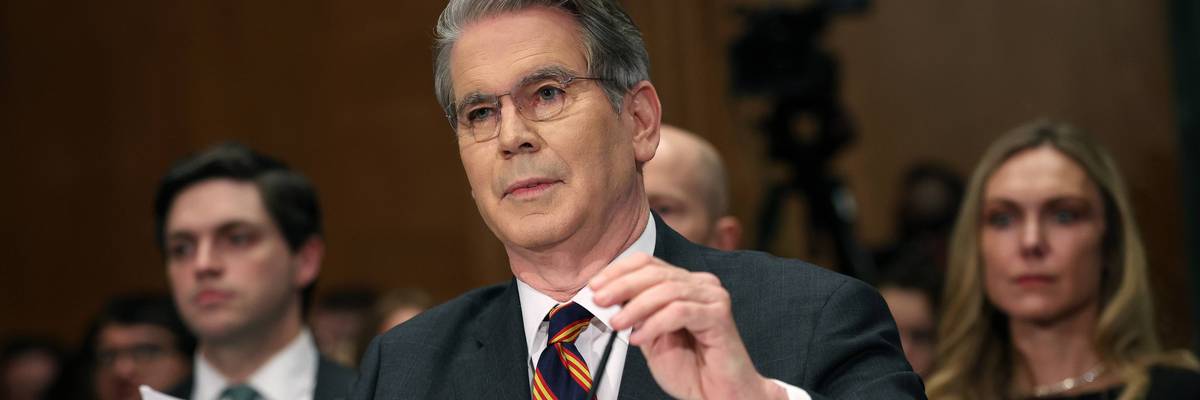
US Treasury Secretary Scott Bessent testifies before the Senate Committee on Banking, Housing, and Urban Affairs on February 5, 2026 in Washington, DC.
"Congress must not accept this unjustifiable, $10.3 billion giveaway," said the office of Sen. Ron Wyden, who is leading the repeal effort.
The Republican-controlled US Senate is expected to vote Tuesday on a Democratic resolution aimed at overturning a major tax giveaway to large corporations that the Trump administration quietly implemented last year without congressional approval.
The Congressional Review Act (CRA) resolution is led by Sen. Ron Wyden (D-Ore.), the top Democrat on the Senate Finance Committee. In a memo released ahead of Tuesday's vote, Wyden's office noted that the Trump administration's regulatory assault on the Biden-era corporate alternative minimum tax (CAMT) is expected to hand corporations and private equity firms more than $10 billion in tax breaks.
"This tax break is hidden inside new guidance, IRS Notice 2025-28," Wyden's office observed. "The notice makes changes to the rules governing how corporate giants and private equity firms can count income coming from partnerships they own, essentially giving those corporations a 'choose-your-own-tax-rate' adventure."
The CAMT, approved under the Inflation Reduction Act in an effort to combat corporate tax avoidance, requires highly profitable US companies to pay a tax of at least 15% on so-called book profits, the numbers that are reported to shareholders.
The Center on Budget and Policy Priorities, a liberal think tank, said in a statement opposing the Trump administration's weakening of the CAMT that the Trump administration's guidance "offers corporations a 'rainbow of choices' in how they calculate their share of partnership book income for minimum tax purposes, several of which deviate significantly from the statutory intent of tying corporate minimum tax liability to book income rather than taxable income."
"The weakened rules, combined with the administration’s hollowing out of IRS enforcement (which make it less likely that corporations, complex partnerships, and their owners will pay what they legally owe) mean corporations are racking up large tax cuts that weren’t enacted by Congress," the group added. "The corporate minimum tax was initially estimated to raise $222 billion over ten years, but the actual revenue will likely be far lower in part due to special giveaways already granted by the administration."
Wyden's effort to overturn the Trump administration's unilateral erosion of the CAMT—which comes on top of the massive tax cuts for corporations that congressional Republicans approved last summer—also drew support from the conservative Committee for a Responsible Federal Budget, whose president, Maya MacGuineas, said in a Tuesday statement that "we ought to be strengthening the tax base and improving tax enforcement, not opening up new loopholes that undermine the intent of the law."
"The current Congressional Review Act measure would help restore the Corporate Alternative Minimum Tax to its intended design," said MacGuineas. "It would be a small first step—a baby step really—toward beginning to get our fiscal house in order."
Dear Common Dreams reader, It’s been nearly 30 years since I co-founded Common Dreams with my late wife, Lina Newhouser. We had the radical notion that journalism should serve the public good, not corporate profits. It was clear to us from the outset what it would take to build such a project. No paid advertisements. No corporate sponsors. No millionaire publisher telling us what to think or do. Many people said we wouldn't last a year, but we proved those doubters wrong. Together with a tremendous team of journalists and dedicated staff, we built an independent media outlet free from the constraints of profits and corporate control. Our mission has always been simple: To inform. To inspire. To ignite change for the common good. Building Common Dreams was not easy. Our survival was never guaranteed. When you take on the most powerful forces—Wall Street greed, fossil fuel industry destruction, Big Tech lobbyists, and uber-rich oligarchs who have spent billions upon billions rigging the economy and democracy in their favor—the only bulwark you have is supporters who believe in your work. But here’s the urgent message from me today. It's never been this bad out there. And it's never been this hard to keep us going. At the very moment Common Dreams is most needed, the threats we face are intensifying. We need your support now more than ever. We don't accept corporate advertising and never will. We don't have a paywall because we don't think people should be blocked from critical news based on their ability to pay. Everything we do is funded by the donations of readers like you. When everyone does the little they can afford, we are strong. But if that support retreats or dries up, so do we. Will you donate now to make sure Common Dreams not only survives but thrives? —Craig Brown, Co-founder |
The Republican-controlled US Senate is expected to vote Tuesday on a Democratic resolution aimed at overturning a major tax giveaway to large corporations that the Trump administration quietly implemented last year without congressional approval.
The Congressional Review Act (CRA) resolution is led by Sen. Ron Wyden (D-Ore.), the top Democrat on the Senate Finance Committee. In a memo released ahead of Tuesday's vote, Wyden's office noted that the Trump administration's regulatory assault on the Biden-era corporate alternative minimum tax (CAMT) is expected to hand corporations and private equity firms more than $10 billion in tax breaks.
"This tax break is hidden inside new guidance, IRS Notice 2025-28," Wyden's office observed. "The notice makes changes to the rules governing how corporate giants and private equity firms can count income coming from partnerships they own, essentially giving those corporations a 'choose-your-own-tax-rate' adventure."
The CAMT, approved under the Inflation Reduction Act in an effort to combat corporate tax avoidance, requires highly profitable US companies to pay a tax of at least 15% on so-called book profits, the numbers that are reported to shareholders.
The Center on Budget and Policy Priorities, a liberal think tank, said in a statement opposing the Trump administration's weakening of the CAMT that the Trump administration's guidance "offers corporations a 'rainbow of choices' in how they calculate their share of partnership book income for minimum tax purposes, several of which deviate significantly from the statutory intent of tying corporate minimum tax liability to book income rather than taxable income."
"The weakened rules, combined with the administration’s hollowing out of IRS enforcement (which make it less likely that corporations, complex partnerships, and their owners will pay what they legally owe) mean corporations are racking up large tax cuts that weren’t enacted by Congress," the group added. "The corporate minimum tax was initially estimated to raise $222 billion over ten years, but the actual revenue will likely be far lower in part due to special giveaways already granted by the administration."
Wyden's effort to overturn the Trump administration's unilateral erosion of the CAMT—which comes on top of the massive tax cuts for corporations that congressional Republicans approved last summer—also drew support from the conservative Committee for a Responsible Federal Budget, whose president, Maya MacGuineas, said in a Tuesday statement that "we ought to be strengthening the tax base and improving tax enforcement, not opening up new loopholes that undermine the intent of the law."
"The current Congressional Review Act measure would help restore the Corporate Alternative Minimum Tax to its intended design," said MacGuineas. "It would be a small first step—a baby step really—toward beginning to get our fiscal house in order."
The Republican-controlled US Senate is expected to vote Tuesday on a Democratic resolution aimed at overturning a major tax giveaway to large corporations that the Trump administration quietly implemented last year without congressional approval.
The Congressional Review Act (CRA) resolution is led by Sen. Ron Wyden (D-Ore.), the top Democrat on the Senate Finance Committee. In a memo released ahead of Tuesday's vote, Wyden's office noted that the Trump administration's regulatory assault on the Biden-era corporate alternative minimum tax (CAMT) is expected to hand corporations and private equity firms more than $10 billion in tax breaks.
"This tax break is hidden inside new guidance, IRS Notice 2025-28," Wyden's office observed. "The notice makes changes to the rules governing how corporate giants and private equity firms can count income coming from partnerships they own, essentially giving those corporations a 'choose-your-own-tax-rate' adventure."
The CAMT, approved under the Inflation Reduction Act in an effort to combat corporate tax avoidance, requires highly profitable US companies to pay a tax of at least 15% on so-called book profits, the numbers that are reported to shareholders.
The Center on Budget and Policy Priorities, a liberal think tank, said in a statement opposing the Trump administration's weakening of the CAMT that the Trump administration's guidance "offers corporations a 'rainbow of choices' in how they calculate their share of partnership book income for minimum tax purposes, several of which deviate significantly from the statutory intent of tying corporate minimum tax liability to book income rather than taxable income."
"The weakened rules, combined with the administration’s hollowing out of IRS enforcement (which make it less likely that corporations, complex partnerships, and their owners will pay what they legally owe) mean corporations are racking up large tax cuts that weren’t enacted by Congress," the group added. "The corporate minimum tax was initially estimated to raise $222 billion over ten years, but the actual revenue will likely be far lower in part due to special giveaways already granted by the administration."
Wyden's effort to overturn the Trump administration's unilateral erosion of the CAMT—which comes on top of the massive tax cuts for corporations that congressional Republicans approved last summer—also drew support from the conservative Committee for a Responsible Federal Budget, whose president, Maya MacGuineas, said in a Tuesday statement that "we ought to be strengthening the tax base and improving tax enforcement, not opening up new loopholes that undermine the intent of the law."
"The current Congressional Review Act measure would help restore the Corporate Alternative Minimum Tax to its intended design," said MacGuineas. "It would be a small first step—a baby step really—toward beginning to get our fiscal house in order."