SUBSCRIBE TO OUR FREE NEWSLETTER
Daily news & progressive opinion—funded by the people, not the corporations—delivered straight to your inbox.
5
#000000
#FFFFFF
To donate by check, phone, or other method, see our More Ways to Give page.
Daily news & progressive opinion—funded by the people, not the corporations—delivered straight to your inbox.
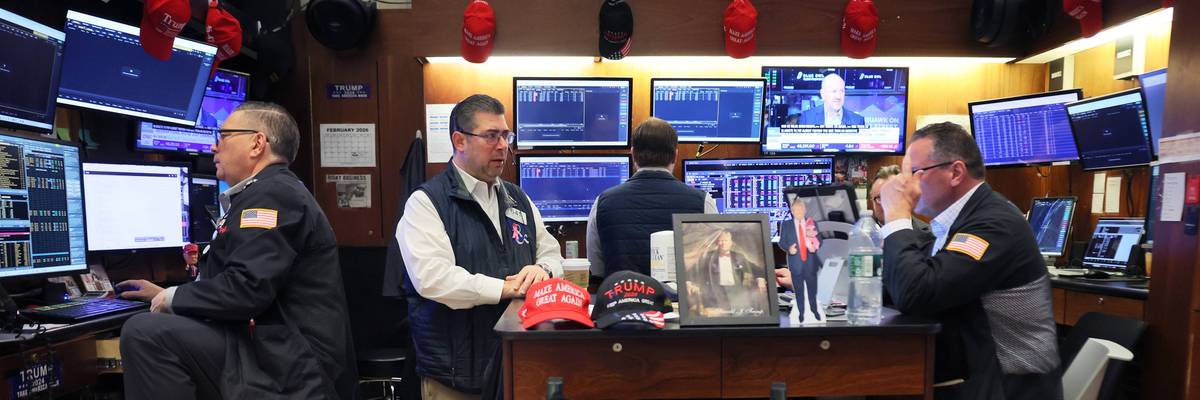
Traders work on the floor of the New York Stock Exchange during morning trading as the Supreme Court struck down President Donald Trump's tariffs on February 20, 2026.
"The economic damage Trump has already done to business investment, manufacturing, and working families’ budgets will linger for years to come."
The US Supreme Court on Friday ruled that President Donald Trump exceeded his authority when he invoked an emergency law to impose sweeping global tariffs, sparking a disastrous trade war and burdening American consumers and businesses with higher costs.
The 6-3 decision, authored by Chief Justice John Roberts, states that "nothing" in the text of the 1977 International Emergency Economic Powers Act (IEEPA) "enables the president to unilaterally impose tariffs."
"And needless to say," Roberts wrote, "without statutory authority, the president’s tariffs cannot stand." Justices Clarence Thomas, Brett Kavanaugh, and Samuel Alito dissented in the case, Learning Resources, Inc. v. Trump.
The ruling deals a massive blow to Trump's tariff regime, which he placed at the center of his economic policy agenda despite warnings that the sweeping import taxes would drive up costs for US consumers and businesses—which is precisely what happened.
An analysis released by congressional Democrats just after the Supreme Court handed down its ruling estimated that the average US family has paid more than $1,700 in tariff costs since the start of Trump's second White House term. While businesses may be eligible for tariff refunds in the wake of the high court's decision, it's far from clear that consumers who paid higher costs for groceries and other goods affected by the levies will have any such recourse.
The Supreme Court's decision does not directly address the issue of refunds for tariff costs, which tripled for midsize US companies last year.
"Any consumer looking for relief from tariff-driven price hikes did not find it at the Supreme Court today," said Alex Jacquez, chief of policy and advocacy at the Groundwork Collaborative. "The economic damage Trump has already done to business investment, manufacturing, and working families’ budgets will linger for years to come."
"Refunds for impacted businesses will take months or even years to process, and there is little reason to believe companies will pass those savings on to consumers," Jacquez added. "Trump must set aside his erratic tariff policy and instead pursue a trade agenda that protects workers, supports manufacturers, and doesn’t punish consumers.”
"Trump will try to do this again another way, because he is intent on continuing his unhinged economic sabotage."
Most of the tariffs Trump has imposed during his second term will be impacted by the Supreme Court's decision. NBC News noted that the decision "upends his tariffs in two categories. One is country-by-country or 'reciprocal' tariffs, which range from 34% for China to a 10% baseline for the rest of the world."
"The other is a 25% tariff Trump imposed on some goods from Canada, China, and Mexico for what the administration said was their failure to curb the flow of fentanyl," the outlet added.
On top of driving up costs for American consumers and businesses, Trump's tariffs failed to make a dent in the US trade deficit and did not stop the loss of manufacturing jobs, which declined by an estimated 108,000 during the president's first year back in the White House.
Fearing a negative Supreme Court ruling, Trump administration officials have reportedly been exploring alternatives to the IEEPA, prompting concerns that the president could swiftly pursue similar tariffs under a different authority.
"This decision is unlikely to alter US tariff rates or policies much because there are other statutes that could provide broad authority for Trump to impose tariffs," said Lori Wallach, director of the Rethink Trade program at the American Economic Liberties Project.
"In the immediate term, Section 122 of the Trade Act of 1974 explicitly authorizes a president to impose tariffs up to 15% for up to 150 days on any and all countries related to 'large and serious' balance of payments issues, which relates to the huge chronic US trade deficit," Wallach observed. "Section 122 does not require investigations or impose other procedural limits."
US Rep. Brendan Boyle (D-Pa.), the ranking member of the House Budget Committee, welcomed the Supreme Court's decision but warned that "Trump will try to do this again another way, because he is intent on continuing his unhinged economic sabotage."
Dear Common Dreams reader, It’s been nearly 30 years since I co-founded Common Dreams with my late wife, Lina Newhouser. We had the radical notion that journalism should serve the public good, not corporate profits. It was clear to us from the outset what it would take to build such a project. No paid advertisements. No corporate sponsors. No millionaire publisher telling us what to think or do. Many people said we wouldn't last a year, but we proved those doubters wrong. Together with a tremendous team of journalists and dedicated staff, we built an independent media outlet free from the constraints of profits and corporate control. Our mission has always been simple: To inform. To inspire. To ignite change for the common good. Building Common Dreams was not easy. Our survival was never guaranteed. When you take on the most powerful forces—Wall Street greed, fossil fuel industry destruction, Big Tech lobbyists, and uber-rich oligarchs who have spent billions upon billions rigging the economy and democracy in their favor—the only bulwark you have is supporters who believe in your work. But here’s the urgent message from me today. It's never been this bad out there. And it's never been this hard to keep us going. At the very moment Common Dreams is most needed, the threats we face are intensifying. We need your support now more than ever. We don't accept corporate advertising and never will. We don't have a paywall because we don't think people should be blocked from critical news based on their ability to pay. Everything we do is funded by the donations of readers like you. When everyone does the little they can afford, we are strong. But if that support retreats or dries up, so do we. Will you donate now to make sure Common Dreams not only survives but thrives? —Craig Brown, Co-founder |
The US Supreme Court on Friday ruled that President Donald Trump exceeded his authority when he invoked an emergency law to impose sweeping global tariffs, sparking a disastrous trade war and burdening American consumers and businesses with higher costs.
The 6-3 decision, authored by Chief Justice John Roberts, states that "nothing" in the text of the 1977 International Emergency Economic Powers Act (IEEPA) "enables the president to unilaterally impose tariffs."
"And needless to say," Roberts wrote, "without statutory authority, the president’s tariffs cannot stand." Justices Clarence Thomas, Brett Kavanaugh, and Samuel Alito dissented in the case, Learning Resources, Inc. v. Trump.
The ruling deals a massive blow to Trump's tariff regime, which he placed at the center of his economic policy agenda despite warnings that the sweeping import taxes would drive up costs for US consumers and businesses—which is precisely what happened.
An analysis released by congressional Democrats just after the Supreme Court handed down its ruling estimated that the average US family has paid more than $1,700 in tariff costs since the start of Trump's second White House term. While businesses may be eligible for tariff refunds in the wake of the high court's decision, it's far from clear that consumers who paid higher costs for groceries and other goods affected by the levies will have any such recourse.
The Supreme Court's decision does not directly address the issue of refunds for tariff costs, which tripled for midsize US companies last year.
"Any consumer looking for relief from tariff-driven price hikes did not find it at the Supreme Court today," said Alex Jacquez, chief of policy and advocacy at the Groundwork Collaborative. "The economic damage Trump has already done to business investment, manufacturing, and working families’ budgets will linger for years to come."
"Refunds for impacted businesses will take months or even years to process, and there is little reason to believe companies will pass those savings on to consumers," Jacquez added. "Trump must set aside his erratic tariff policy and instead pursue a trade agenda that protects workers, supports manufacturers, and doesn’t punish consumers.”
"Trump will try to do this again another way, because he is intent on continuing his unhinged economic sabotage."
Most of the tariffs Trump has imposed during his second term will be impacted by the Supreme Court's decision. NBC News noted that the decision "upends his tariffs in two categories. One is country-by-country or 'reciprocal' tariffs, which range from 34% for China to a 10% baseline for the rest of the world."
"The other is a 25% tariff Trump imposed on some goods from Canada, China, and Mexico for what the administration said was their failure to curb the flow of fentanyl," the outlet added.
On top of driving up costs for American consumers and businesses, Trump's tariffs failed to make a dent in the US trade deficit and did not stop the loss of manufacturing jobs, which declined by an estimated 108,000 during the president's first year back in the White House.
Fearing a negative Supreme Court ruling, Trump administration officials have reportedly been exploring alternatives to the IEEPA, prompting concerns that the president could swiftly pursue similar tariffs under a different authority.
"This decision is unlikely to alter US tariff rates or policies much because there are other statutes that could provide broad authority for Trump to impose tariffs," said Lori Wallach, director of the Rethink Trade program at the American Economic Liberties Project.
"In the immediate term, Section 122 of the Trade Act of 1974 explicitly authorizes a president to impose tariffs up to 15% for up to 150 days on any and all countries related to 'large and serious' balance of payments issues, which relates to the huge chronic US trade deficit," Wallach observed. "Section 122 does not require investigations or impose other procedural limits."
US Rep. Brendan Boyle (D-Pa.), the ranking member of the House Budget Committee, welcomed the Supreme Court's decision but warned that "Trump will try to do this again another way, because he is intent on continuing his unhinged economic sabotage."
The US Supreme Court on Friday ruled that President Donald Trump exceeded his authority when he invoked an emergency law to impose sweeping global tariffs, sparking a disastrous trade war and burdening American consumers and businesses with higher costs.
The 6-3 decision, authored by Chief Justice John Roberts, states that "nothing" in the text of the 1977 International Emergency Economic Powers Act (IEEPA) "enables the president to unilaterally impose tariffs."
"And needless to say," Roberts wrote, "without statutory authority, the president’s tariffs cannot stand." Justices Clarence Thomas, Brett Kavanaugh, and Samuel Alito dissented in the case, Learning Resources, Inc. v. Trump.
The ruling deals a massive blow to Trump's tariff regime, which he placed at the center of his economic policy agenda despite warnings that the sweeping import taxes would drive up costs for US consumers and businesses—which is precisely what happened.
An analysis released by congressional Democrats just after the Supreme Court handed down its ruling estimated that the average US family has paid more than $1,700 in tariff costs since the start of Trump's second White House term. While businesses may be eligible for tariff refunds in the wake of the high court's decision, it's far from clear that consumers who paid higher costs for groceries and other goods affected by the levies will have any such recourse.
The Supreme Court's decision does not directly address the issue of refunds for tariff costs, which tripled for midsize US companies last year.
"Any consumer looking for relief from tariff-driven price hikes did not find it at the Supreme Court today," said Alex Jacquez, chief of policy and advocacy at the Groundwork Collaborative. "The economic damage Trump has already done to business investment, manufacturing, and working families’ budgets will linger for years to come."
"Refunds for impacted businesses will take months or even years to process, and there is little reason to believe companies will pass those savings on to consumers," Jacquez added. "Trump must set aside his erratic tariff policy and instead pursue a trade agenda that protects workers, supports manufacturers, and doesn’t punish consumers.”
"Trump will try to do this again another way, because he is intent on continuing his unhinged economic sabotage."
Most of the tariffs Trump has imposed during his second term will be impacted by the Supreme Court's decision. NBC News noted that the decision "upends his tariffs in two categories. One is country-by-country or 'reciprocal' tariffs, which range from 34% for China to a 10% baseline for the rest of the world."
"The other is a 25% tariff Trump imposed on some goods from Canada, China, and Mexico for what the administration said was their failure to curb the flow of fentanyl," the outlet added.
On top of driving up costs for American consumers and businesses, Trump's tariffs failed to make a dent in the US trade deficit and did not stop the loss of manufacturing jobs, which declined by an estimated 108,000 during the president's first year back in the White House.
Fearing a negative Supreme Court ruling, Trump administration officials have reportedly been exploring alternatives to the IEEPA, prompting concerns that the president could swiftly pursue similar tariffs under a different authority.
"This decision is unlikely to alter US tariff rates or policies much because there are other statutes that could provide broad authority for Trump to impose tariffs," said Lori Wallach, director of the Rethink Trade program at the American Economic Liberties Project.
"In the immediate term, Section 122 of the Trade Act of 1974 explicitly authorizes a president to impose tariffs up to 15% for up to 150 days on any and all countries related to 'large and serious' balance of payments issues, which relates to the huge chronic US trade deficit," Wallach observed. "Section 122 does not require investigations or impose other procedural limits."
US Rep. Brendan Boyle (D-Pa.), the ranking member of the House Budget Committee, welcomed the Supreme Court's decision but warned that "Trump will try to do this again another way, because he is intent on continuing his unhinged economic sabotage."