SUBSCRIBE TO OUR FREE NEWSLETTER
Daily news & progressive opinion—funded by the people, not the corporations—delivered straight to your inbox.
5
#000000
#FFFFFF
To donate by check, phone, or other method, see our More Ways to Give page.
Daily news & progressive opinion—funded by the people, not the corporations—delivered straight to your inbox.
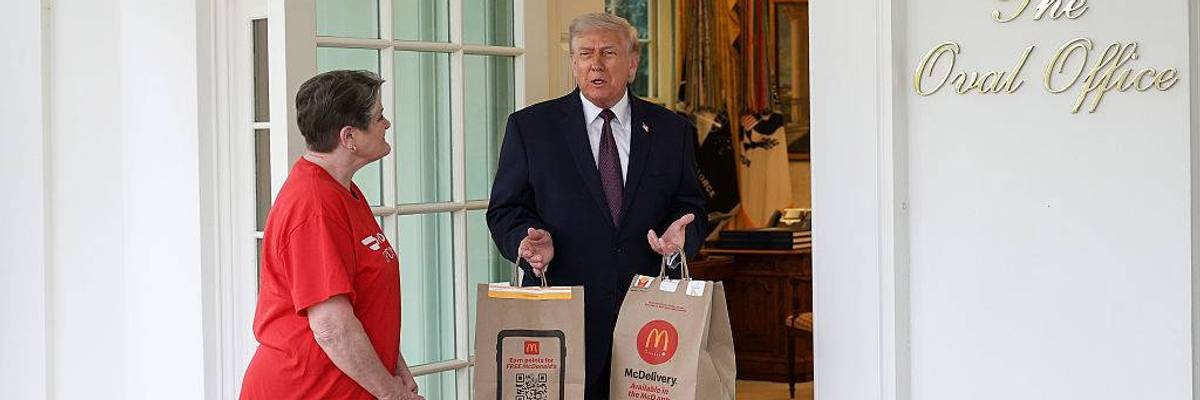
President Donald Trump receives a DoorDash delivery of McDonald's from Sharon Simmons outside the Oval Office of the White House on April 13, 2026 in Washington, DC.
"This economy could be delivering lower inflation, more jobs, and stronger growth, but instead, it’s being dragged in the wrong direction by this president’s policy choices."
With US consumer sentiment hitting an all-time low, the Center for American Progress on Wednesday released a report pinning the blame for Americans' economic gloom on President Donald Trump.
In total, the CAP analysis projects that by the fourth quarter of 2026, Trump's policies will lower real GDP by 1.3% while adding 1.39% to personal consumption expenditures (PCE) inflation.
The report also estimates that the economy would have created an additional 2 million jobs 2026 were it not for the Trump's tariffs, mass deportations, and war of choice with Iran.
Although the unemployment rate at the moment is low, the report explains, US employers are also hiring far fewer people, as "both labor demand and labor supply have fallen, leaving a job market with fewer opportunities and less resilience against downturns."
Trump's policies have also made borrowing more expensive, and CAP says that interest rates are now 60 basis points higher than they otherwise would have been without the president's policies.
Jared Bernstein, senior fellow at CAP and former chair of the Council of Economic Advisers under President Joe Biden, said the analysis shows "this economy could be delivering lower inflation, more jobs, and stronger growth, but instead, it’s being dragged in the wrong direction by this president’s policy choices."
Bernstein said Trump's tariffs were the primary culprit for higher-than-expected inflation in 2025, while the oil supply shock that came after Trump launched a war with Iran is expected to add even more inflation throughout 2026.
The end result, said Bernstein, is a kind of "stagflation," with low economic growth and higher-than-average inflation. He also warned that "longer-term costs from reduced investment in both people and public goods will also take a toll on future growth."
Job growth in the US has largely stalled ever since Trump announced his "liberation day" tariffs more than a year ago, and a CAP analysis published earlier this month found that the economy has created an average of fewer than 22,000 jobs per month over the last year.
The latest Consumer Price Index report released by the US Bureau of Labor Statistics found that prices in March rose by 3.3% from the previous year—the highest annual inflation rate since April 2024.
Despite this, Trump has continued to insist that he has created the "greatest" economy in the history of the world.
Dear Common Dreams reader, It’s been nearly 30 years since I co-founded Common Dreams with my late wife, Lina Newhouser. We had the radical notion that journalism should serve the public good, not corporate profits. It was clear to us from the outset what it would take to build such a project. No paid advertisements. No corporate sponsors. No millionaire publisher telling us what to think or do. Many people said we wouldn't last a year, but we proved those doubters wrong. Together with a tremendous team of journalists and dedicated staff, we built an independent media outlet free from the constraints of profits and corporate control. Our mission has always been simple: To inform. To inspire. To ignite change for the common good. Building Common Dreams was not easy. Our survival was never guaranteed. When you take on the most powerful forces—Wall Street greed, fossil fuel industry destruction, Big Tech lobbyists, and uber-rich oligarchs who have spent billions upon billions rigging the economy and democracy in their favor—the only bulwark you have is supporters who believe in your work. But here’s the urgent message from me today. It's never been this bad out there. And it's never been this hard to keep us going. At the very moment Common Dreams is most needed, the threats we face are intensifying. We need your support now more than ever. We don't accept corporate advertising and never will. We don't have a paywall because we don't think people should be blocked from critical news based on their ability to pay. Everything we do is funded by the donations of readers like you. When everyone does the little they can afford, we are strong. But if that support retreats or dries up, so do we. Will you donate now to make sure Common Dreams not only survives but thrives? —Craig Brown, Co-founder |
With US consumer sentiment hitting an all-time low, the Center for American Progress on Wednesday released a report pinning the blame for Americans' economic gloom on President Donald Trump.
In total, the CAP analysis projects that by the fourth quarter of 2026, Trump's policies will lower real GDP by 1.3% while adding 1.39% to personal consumption expenditures (PCE) inflation.
The report also estimates that the economy would have created an additional 2 million jobs 2026 were it not for the Trump's tariffs, mass deportations, and war of choice with Iran.
Although the unemployment rate at the moment is low, the report explains, US employers are also hiring far fewer people, as "both labor demand and labor supply have fallen, leaving a job market with fewer opportunities and less resilience against downturns."
Trump's policies have also made borrowing more expensive, and CAP says that interest rates are now 60 basis points higher than they otherwise would have been without the president's policies.
Jared Bernstein, senior fellow at CAP and former chair of the Council of Economic Advisers under President Joe Biden, said the analysis shows "this economy could be delivering lower inflation, more jobs, and stronger growth, but instead, it’s being dragged in the wrong direction by this president’s policy choices."
Bernstein said Trump's tariffs were the primary culprit for higher-than-expected inflation in 2025, while the oil supply shock that came after Trump launched a war with Iran is expected to add even more inflation throughout 2026.
The end result, said Bernstein, is a kind of "stagflation," with low economic growth and higher-than-average inflation. He also warned that "longer-term costs from reduced investment in both people and public goods will also take a toll on future growth."
Job growth in the US has largely stalled ever since Trump announced his "liberation day" tariffs more than a year ago, and a CAP analysis published earlier this month found that the economy has created an average of fewer than 22,000 jobs per month over the last year.
The latest Consumer Price Index report released by the US Bureau of Labor Statistics found that prices in March rose by 3.3% from the previous year—the highest annual inflation rate since April 2024.
Despite this, Trump has continued to insist that he has created the "greatest" economy in the history of the world.
With US consumer sentiment hitting an all-time low, the Center for American Progress on Wednesday released a report pinning the blame for Americans' economic gloom on President Donald Trump.
In total, the CAP analysis projects that by the fourth quarter of 2026, Trump's policies will lower real GDP by 1.3% while adding 1.39% to personal consumption expenditures (PCE) inflation.
The report also estimates that the economy would have created an additional 2 million jobs 2026 were it not for the Trump's tariffs, mass deportations, and war of choice with Iran.
Although the unemployment rate at the moment is low, the report explains, US employers are also hiring far fewer people, as "both labor demand and labor supply have fallen, leaving a job market with fewer opportunities and less resilience against downturns."
Trump's policies have also made borrowing more expensive, and CAP says that interest rates are now 60 basis points higher than they otherwise would have been without the president's policies.
Jared Bernstein, senior fellow at CAP and former chair of the Council of Economic Advisers under President Joe Biden, said the analysis shows "this economy could be delivering lower inflation, more jobs, and stronger growth, but instead, it’s being dragged in the wrong direction by this president’s policy choices."
Bernstein said Trump's tariffs were the primary culprit for higher-than-expected inflation in 2025, while the oil supply shock that came after Trump launched a war with Iran is expected to add even more inflation throughout 2026.
The end result, said Bernstein, is a kind of "stagflation," with low economic growth and higher-than-average inflation. He also warned that "longer-term costs from reduced investment in both people and public goods will also take a toll on future growth."
Job growth in the US has largely stalled ever since Trump announced his "liberation day" tariffs more than a year ago, and a CAP analysis published earlier this month found that the economy has created an average of fewer than 22,000 jobs per month over the last year.
The latest Consumer Price Index report released by the US Bureau of Labor Statistics found that prices in March rose by 3.3% from the previous year—the highest annual inflation rate since April 2024.
Despite this, Trump has continued to insist that he has created the "greatest" economy in the history of the world.