SUBSCRIBE TO OUR FREE NEWSLETTER
Daily news & progressive opinion—funded by the people, not the corporations—delivered straight to your inbox.
5
#000000
#FFFFFF
To donate by check, phone, or other method, see our More Ways to Give page.
Daily news & progressive opinion—funded by the people, not the corporations—delivered straight to your inbox.
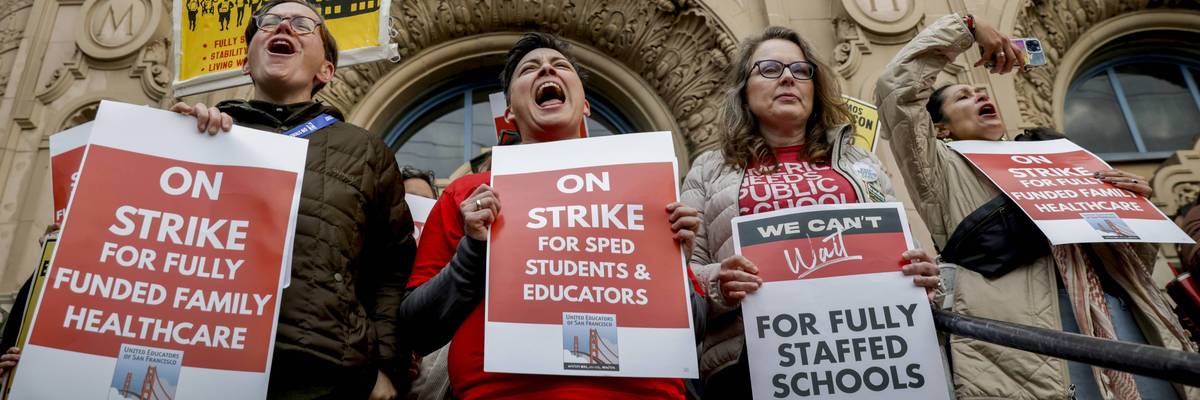
San Francisco teachers and allies rally for a fair contract that includes fully funded family healthcare outside Mission High School on February 9, 2026.
“This historic strike built an unbreakable solidarity across our city, among families, students, educators, and community," said San Francisco's teachers union.
San Francisco public school teachers and their union celebrated Friday after negotiating a tentative agreement for a new contract with higher pay and fully funded family healthcare, ending a four-day walkout that was the city's first educator strike in nearly half a century.
United Educators of San Francisco (UESF) said its bargaining team reached a two-year tentative deal with the San Francisco Unified School District (SFUSD) at around 5:30 am local time Friday. The 120 public schools that were closed due to the walkout by around 6,000 teachers are set to reopen for classes next Wednesday.
"This historic strike built an unbreakable solidarity across our city, among families, students, educators, and community," UESF said in a statement. "This strike has made it clear what is possible when we join together and fight for the stability in our schools that many have said was out of our reach."
The tentative agreement, which follows 11 months of bargaining, includes the union's main demand for fully funded health coverage for dependents; raises of between 5-8.5%; caseload reductions for special educators; sanctuary protections for students and staff; limits on the use of artificial intelligence; preservation and expansion of the Stay Over program for unhoused students and their families; and better working conditions for librarians, substitute teachers, counselors, and other staff.
“By forcing SFUSD to invest in fully funded family healthcare, special education workloads, improved wages, sanctuary and housing protections for San Francisco families, we’ve made important progress towards the schools our students deserve,” said UESF president Cassondra Curiel “This contract is a strong foundation for us to continue to build the safe and stable learning environments our students deserve.”
SFUSD Superintendent Maria Su said in a statement: "I recognize that this past week has been challenging. Thank you to the SFUSD staff, community-based partners, and faith and city leaders who partnered with us to continue centering our students in our work every day."
"I am so proud of the resilience and strength of our community," Su added. "This is a new beginning, and I want to celebrate our diverse community of educators, administrators, parents, and students as we come together and heal."
However, Su also warned that “we do not have enough funds to pay for this year and the next two years," citing SFUSD's over $100 million budget deficit.
The striking teachers enjoyed widespread support and solidarity across the city, including at a massive rally outside City Hall on Monday.
San Francisco’s first public school teachers strike in 47 years started today with picket lines across the city and a rally at Civic Center. Schools will remain closed on Tuesday. Read live updates: https://t.co/5iRAt8eWdu
📝: Ezra Wallach, @low___impact, @allaboutgeorge pic.twitter.com/KMylN2L3fU
— The San Francisco Standard (@sfstandard) February 10, 2026
San Francisco teachers cheered the tentative agreement—especially its coverage of 100% of premiums on family health plans, which run about $1,500 per month, beginning next January.
“That amount of money is life-changing to us,” Balboa High School English teacher Ryan Alias said during a Thursday press conference.
“If we had that in our pocket, we would be able to save for retirement,” added Alias, who has two children in SFUSD schools. "We would be able to save for college funds. We’d be able to save for student loans. We’d be able to pay for art classes for our kids. This is the thing that is going to keep educators in the city.”
Dear Common Dreams reader, It’s been nearly 30 years since I co-founded Common Dreams with my late wife, Lina Newhouser. We had the radical notion that journalism should serve the public good, not corporate profits. It was clear to us from the outset what it would take to build such a project. No paid advertisements. No corporate sponsors. No millionaire publisher telling us what to think or do. Many people said we wouldn't last a year, but we proved those doubters wrong. Together with a tremendous team of journalists and dedicated staff, we built an independent media outlet free from the constraints of profits and corporate control. Our mission has always been simple: To inform. To inspire. To ignite change for the common good. Building Common Dreams was not easy. Our survival was never guaranteed. When you take on the most powerful forces—Wall Street greed, fossil fuel industry destruction, Big Tech lobbyists, and uber-rich oligarchs who have spent billions upon billions rigging the economy and democracy in their favor—the only bulwark you have is supporters who believe in your work. But here’s the urgent message from me today. It's never been this bad out there. And it's never been this hard to keep us going. At the very moment Common Dreams is most needed, the threats we face are intensifying. We need your support now more than ever. We don't accept corporate advertising and never will. We don't have a paywall because we don't think people should be blocked from critical news based on their ability to pay. Everything we do is funded by the donations of readers like you. When everyone does the little they can afford, we are strong. But if that support retreats or dries up, so do we. Will you donate now to make sure Common Dreams not only survives but thrives? —Craig Brown, Co-founder |
San Francisco public school teachers and their union celebrated Friday after negotiating a tentative agreement for a new contract with higher pay and fully funded family healthcare, ending a four-day walkout that was the city's first educator strike in nearly half a century.
United Educators of San Francisco (UESF) said its bargaining team reached a two-year tentative deal with the San Francisco Unified School District (SFUSD) at around 5:30 am local time Friday. The 120 public schools that were closed due to the walkout by around 6,000 teachers are set to reopen for classes next Wednesday.
"This historic strike built an unbreakable solidarity across our city, among families, students, educators, and community," UESF said in a statement. "This strike has made it clear what is possible when we join together and fight for the stability in our schools that many have said was out of our reach."
The tentative agreement, which follows 11 months of bargaining, includes the union's main demand for fully funded health coverage for dependents; raises of between 5-8.5%; caseload reductions for special educators; sanctuary protections for students and staff; limits on the use of artificial intelligence; preservation and expansion of the Stay Over program for unhoused students and their families; and better working conditions for librarians, substitute teachers, counselors, and other staff.
“By forcing SFUSD to invest in fully funded family healthcare, special education workloads, improved wages, sanctuary and housing protections for San Francisco families, we’ve made important progress towards the schools our students deserve,” said UESF president Cassondra Curiel “This contract is a strong foundation for us to continue to build the safe and stable learning environments our students deserve.”
SFUSD Superintendent Maria Su said in a statement: "I recognize that this past week has been challenging. Thank you to the SFUSD staff, community-based partners, and faith and city leaders who partnered with us to continue centering our students in our work every day."
"I am so proud of the resilience and strength of our community," Su added. "This is a new beginning, and I want to celebrate our diverse community of educators, administrators, parents, and students as we come together and heal."
However, Su also warned that “we do not have enough funds to pay for this year and the next two years," citing SFUSD's over $100 million budget deficit.
The striking teachers enjoyed widespread support and solidarity across the city, including at a massive rally outside City Hall on Monday.
San Francisco’s first public school teachers strike in 47 years started today with picket lines across the city and a rally at Civic Center. Schools will remain closed on Tuesday. Read live updates: https://t.co/5iRAt8eWdu
📝: Ezra Wallach, @low___impact, @allaboutgeorge pic.twitter.com/KMylN2L3fU
— The San Francisco Standard (@sfstandard) February 10, 2026
San Francisco teachers cheered the tentative agreement—especially its coverage of 100% of premiums on family health plans, which run about $1,500 per month, beginning next January.
“That amount of money is life-changing to us,” Balboa High School English teacher Ryan Alias said during a Thursday press conference.
“If we had that in our pocket, we would be able to save for retirement,” added Alias, who has two children in SFUSD schools. "We would be able to save for college funds. We’d be able to save for student loans. We’d be able to pay for art classes for our kids. This is the thing that is going to keep educators in the city.”
San Francisco public school teachers and their union celebrated Friday after negotiating a tentative agreement for a new contract with higher pay and fully funded family healthcare, ending a four-day walkout that was the city's first educator strike in nearly half a century.
United Educators of San Francisco (UESF) said its bargaining team reached a two-year tentative deal with the San Francisco Unified School District (SFUSD) at around 5:30 am local time Friday. The 120 public schools that were closed due to the walkout by around 6,000 teachers are set to reopen for classes next Wednesday.
"This historic strike built an unbreakable solidarity across our city, among families, students, educators, and community," UESF said in a statement. "This strike has made it clear what is possible when we join together and fight for the stability in our schools that many have said was out of our reach."
The tentative agreement, which follows 11 months of bargaining, includes the union's main demand for fully funded health coverage for dependents; raises of between 5-8.5%; caseload reductions for special educators; sanctuary protections for students and staff; limits on the use of artificial intelligence; preservation and expansion of the Stay Over program for unhoused students and their families; and better working conditions for librarians, substitute teachers, counselors, and other staff.
“By forcing SFUSD to invest in fully funded family healthcare, special education workloads, improved wages, sanctuary and housing protections for San Francisco families, we’ve made important progress towards the schools our students deserve,” said UESF president Cassondra Curiel “This contract is a strong foundation for us to continue to build the safe and stable learning environments our students deserve.”
SFUSD Superintendent Maria Su said in a statement: "I recognize that this past week has been challenging. Thank you to the SFUSD staff, community-based partners, and faith and city leaders who partnered with us to continue centering our students in our work every day."
"I am so proud of the resilience and strength of our community," Su added. "This is a new beginning, and I want to celebrate our diverse community of educators, administrators, parents, and students as we come together and heal."
However, Su also warned that “we do not have enough funds to pay for this year and the next two years," citing SFUSD's over $100 million budget deficit.
The striking teachers enjoyed widespread support and solidarity across the city, including at a massive rally outside City Hall on Monday.
San Francisco’s first public school teachers strike in 47 years started today with picket lines across the city and a rally at Civic Center. Schools will remain closed on Tuesday. Read live updates: https://t.co/5iRAt8eWdu
📝: Ezra Wallach, @low___impact, @allaboutgeorge pic.twitter.com/KMylN2L3fU
— The San Francisco Standard (@sfstandard) February 10, 2026
San Francisco teachers cheered the tentative agreement—especially its coverage of 100% of premiums on family health plans, which run about $1,500 per month, beginning next January.
“That amount of money is life-changing to us,” Balboa High School English teacher Ryan Alias said during a Thursday press conference.
“If we had that in our pocket, we would be able to save for retirement,” added Alias, who has two children in SFUSD schools. "We would be able to save for college funds. We’d be able to save for student loans. We’d be able to pay for art classes for our kids. This is the thing that is going to keep educators in the city.”