
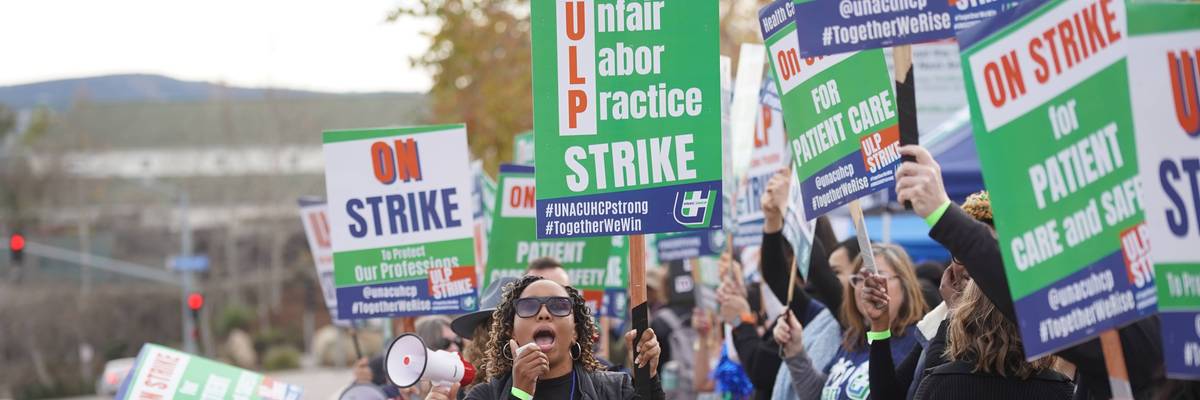
Striking Kaiser Permanente nurses and healthcare professionals in San Diego County gather protest unfair labor practices, on January 26, 2026.
31,000 Kaiser Nurses Strike as Their Union Says Employer Puts 'Profit Over Patients'
The head of the striking nurses' union says Kaiser Permanente would "rather protect an enormous financial cushion than protect patients and the people who care for them."
More than 30,000 Kaiser Permanente nurses and other healthcare professionals walked off the job Monday in two western states, accusing their employer of caring more about profits than patients and highlighting what they say are KP's unfair labor practices.
United Nurses Associations of California/Union of Health Care Professionals (UNAC/UHCP)—a member of the Alliance of Healthcare Unions (AHCU)—said that 31,000 frontline registered nurses and other medical workers at more than two dozen KP hospitals and hundreds of clinics in California and Hawaii went on an Unfair Labor Practice (ULP) strike that would continue indefinitely until they get a fair contract.
"On the picket lines, healthcare workers will call attention to what’s at stake in settling a fair contract: the growing crisis caused by Kaiser’s failure to invest in safe staffing levels, timely access to quality care, and fair wages for frontline caregivers," UNAC/UHCP said in a statement Monday.
Registered nurse and UNAC/UHCP president Charmaine Morales said: “We’re not going on strike to make noise. We’re striking because Kaiser has committed serious unfair labor practices and because Kaiser refuses to bargain in good faith over staffing that protects patients, workload standards that stop moral injury, and the respect and dignity that Kaiser caregivers have been denied for far too long."
“Striking is the lawful power of working people, and we are prepared to use it on behalf of our profession and patients," Morales added.
ON STRIKE: The UNAC/UHCP Unfair Labor Practice strike starts TODAY! 31,000+ Kaiser Permanente nurses and health care workers in CA and Hawai'i are holding the line for quality patient care and a fair contract! #TogetherWeWin #SafeStaffingSavesLives #PatientsOverProfits
[image or embed]
— AFSCME (@afscme.bsky.social) January 26, 2026 at 9:57 AM
The new strike follows last October's walk-off by over 75,000 nurses and allied healthcare workers at KP facilities in California, Oregon, Washington, and Hawaii over stalled contract negotiations and other issues including pay, staffing levels, and working conditions.
UNAC/UHCP had been negotiating with KP since last May. After KP management left the bargaining table last month, the union filed an unfair labor practices complaint with the National Labor Relations Board, which has cited KP for numerous violations in recent years.
KP is the nation's largest integrated managed care consortium of nonprofit and for-profit entities. According to a 2025 investigation by Matthew Cunningham-Cook for the Center for Media and Democracy in conjunction with the American Prospect, KP "is sitting on $67.4 billion in reserves, up from $40 billion just four years ago."
Kaiser collected $12.9 billion in net income in 2024 and $7.9 billion through the third quarter of 2025.
A new UNAC/UHCP report, "Profits Over Patients," details how KP "has strayed from its founding mission and moved towards profit, expansion, and Wall Street-style asset accumulation that has created real consequences for patient care and caregiver well-being."
Morales said that “when Kaiser says it doesn’t have resources to fix staffing, what we hear is that a nonprofit health care organization would rather protect an enormous financial cushion than protect patients and the people who care for them."
UFW in solidarity with the 31,000 nurses and health care workers who are on strike in California and Hawaii.#UnionStrong #1U
[image or embed]
— United Farm Workers (@ufw.bsky.social) January 26, 2026 at 10:47 AM
Zach Pritchett, an emergency room nurse at Kaiser Permanente Medical Center in Los Angeles, told LA Progressive, “I see the end result of the poor staffing every single day."
“What I’m seeing in the ER are Kaiser members who can’t get appointments for months at a time with their own primary care physicians—so they wind up here," he added.
Some strikers drew attention to the killing by Trump administration immigration enforcers of intensive care registered nurse Alex Pretti in Minneapolis on Saturday.
"He is one of us." "He was trying to help a woman stand up and he was assassinated. He did what nurses do, take care of others." "There's so many people here that will do the same."
Kaiser nurses on strike in California speak against ICE murder of nurse Alex Pretti pic.twitter.com/2k54Ojuqn9
— World Socialist Web Site (@WSWS_Updates) January 26, 2026
KP responded to the new strike in a statement declaring, "Our focus remains on reaching agreements that recognize the vital contributions of our employees while ensuring high-quality, affordable care."
"We have proposed 21.5% wage increases—our strongest national bargaining offer ever—and we are prepared to close agreements at local tables now," it addded. "Employees deserve their raises, and patients deserve our full attention, not prolonged disputes."
On a picket line outside KP's Oakland Medical Center, San Francisco nurse anesthetist Jessica Servin told KQED that “we’re fighting for our livelihoods, we’re fighting for patient care."
“I believed their values and their mission statement,” Servin said of KP, where she's worked for 20 years. “It feels like they’re deviating from the foundation of why Kaiser was built. It feels kind of sad to be here and realize that Kaiser is choosing profit over patients.”
National figures supporting the strike include Sen. Bernie Sanders (I-Vt.), who posted on Bluesky, "I stand in solidarity with the more than 31,000 Kaiser nurses and healthcare workers on strike in California and Hawaii."
"It’s well past time for Kaiser to return to the table with a fair offer for their workers that includes safer staffing ratios and higher wages," he added.
We are at a crossroads
This country and this world are at a monumental crossroads. In a few short weeks, US voters will have an opportunity to beat back the forces of fascism and confront the billionaires who are rigging the economy, our media system, and our democracy, making it increasingly impossible for ordinary people to get by. We’re not just talking about the election. We’re talking about what must be done once these fascist elements are vanquished from power. We need a bolder set of solutions than what either major party has so far been willing to offer and a working-class movement ready to fight like hell for it. Trump didn't emerge from nowhere. The conditions that fueled MAGA authoritarianism were created by decades of radical neoliberal economic policies and a corrupt political system dominated by corporate interests. They slashed taxes on the super-rich, promising that the benefits would trickle down. They said giveaways to the corporate titans would make life more affordable for the rest of us. It was all bullshit. And when a bitter, betrayed populace searches for someone to blame, right-wing demagogues have little trouble finding scapegoats. People know when they're being lied to, but you won't hear any of this from the corporate media. Only independent journalism—powered and funded by people who believe in building a better world—can deliver truly trustworthy daily news. Our Fall Campaign is underway, and we need your help. To power our newsroom through the rest of the year, we need to raise $125,000 by midnight on October 31. So if you share our vision, please contribute whatever you can to sustain our work. |
More than 30,000 Kaiser Permanente nurses and other healthcare professionals walked off the job Monday in two western states, accusing their employer of caring more about profits than patients and highlighting what they say are KP's unfair labor practices.
United Nurses Associations of California/Union of Health Care Professionals (UNAC/UHCP)—a member of the Alliance of Healthcare Unions (AHCU)—said that 31,000 frontline registered nurses and other medical workers at more than two dozen KP hospitals and hundreds of clinics in California and Hawaii went on an Unfair Labor Practice (ULP) strike that would continue indefinitely until they get a fair contract.
"On the picket lines, healthcare workers will call attention to what’s at stake in settling a fair contract: the growing crisis caused by Kaiser’s failure to invest in safe staffing levels, timely access to quality care, and fair wages for frontline caregivers," UNAC/UHCP said in a statement Monday.
Registered nurse and UNAC/UHCP president Charmaine Morales said: “We’re not going on strike to make noise. We’re striking because Kaiser has committed serious unfair labor practices and because Kaiser refuses to bargain in good faith over staffing that protects patients, workload standards that stop moral injury, and the respect and dignity that Kaiser caregivers have been denied for far too long."
“Striking is the lawful power of working people, and we are prepared to use it on behalf of our profession and patients," Morales added.
ON STRIKE: The UNAC/UHCP Unfair Labor Practice strike starts TODAY! 31,000+ Kaiser Permanente nurses and health care workers in CA and Hawai'i are holding the line for quality patient care and a fair contract! #TogetherWeWin #SafeStaffingSavesLives #PatientsOverProfits
[image or embed]
— AFSCME (@afscme.bsky.social) January 26, 2026 at 9:57 AM
The new strike follows last October's walk-off by over 75,000 nurses and allied healthcare workers at KP facilities in California, Oregon, Washington, and Hawaii over stalled contract negotiations and other issues including pay, staffing levels, and working conditions.
UNAC/UHCP had been negotiating with KP since last May. After KP management left the bargaining table last month, the union filed an unfair labor practices complaint with the National Labor Relations Board, which has cited KP for numerous violations in recent years.
KP is the nation's largest integrated managed care consortium of nonprofit and for-profit entities. According to a 2025 investigation by Matthew Cunningham-Cook for the Center for Media and Democracy in conjunction with the American Prospect, KP "is sitting on $67.4 billion in reserves, up from $40 billion just four years ago."
Kaiser collected $12.9 billion in net income in 2024 and $7.9 billion through the third quarter of 2025.
A new UNAC/UHCP report, "Profits Over Patients," details how KP "has strayed from its founding mission and moved towards profit, expansion, and Wall Street-style asset accumulation that has created real consequences for patient care and caregiver well-being."
Morales said that “when Kaiser says it doesn’t have resources to fix staffing, what we hear is that a nonprofit health care organization would rather protect an enormous financial cushion than protect patients and the people who care for them."
UFW in solidarity with the 31,000 nurses and health care workers who are on strike in California and Hawaii.#UnionStrong #1U
[image or embed]
— United Farm Workers (@ufw.bsky.social) January 26, 2026 at 10:47 AM
Zach Pritchett, an emergency room nurse at Kaiser Permanente Medical Center in Los Angeles, told LA Progressive, “I see the end result of the poor staffing every single day."
“What I’m seeing in the ER are Kaiser members who can’t get appointments for months at a time with their own primary care physicians—so they wind up here," he added.
Some strikers drew attention to the killing by Trump administration immigration enforcers of intensive care registered nurse Alex Pretti in Minneapolis on Saturday.
"He is one of us." "He was trying to help a woman stand up and he was assassinated. He did what nurses do, take care of others." "There's so many people here that will do the same."
Kaiser nurses on strike in California speak against ICE murder of nurse Alex Pretti pic.twitter.com/2k54Ojuqn9
— World Socialist Web Site (@WSWS_Updates) January 26, 2026
KP responded to the new strike in a statement declaring, "Our focus remains on reaching agreements that recognize the vital contributions of our employees while ensuring high-quality, affordable care."
"We have proposed 21.5% wage increases—our strongest national bargaining offer ever—and we are prepared to close agreements at local tables now," it addded. "Employees deserve their raises, and patients deserve our full attention, not prolonged disputes."
On a picket line outside KP's Oakland Medical Center, San Francisco nurse anesthetist Jessica Servin told KQED that “we’re fighting for our livelihoods, we’re fighting for patient care."
“I believed their values and their mission statement,” Servin said of KP, where she's worked for 20 years. “It feels like they’re deviating from the foundation of why Kaiser was built. It feels kind of sad to be here and realize that Kaiser is choosing profit over patients.”
National figures supporting the strike include Sen. Bernie Sanders (I-Vt.), who posted on Bluesky, "I stand in solidarity with the more than 31,000 Kaiser nurses and healthcare workers on strike in California and Hawaii."
"It’s well past time for Kaiser to return to the table with a fair offer for their workers that includes safer staffing ratios and higher wages," he added.
More than 30,000 Kaiser Permanente nurses and other healthcare professionals walked off the job Monday in two western states, accusing their employer of caring more about profits than patients and highlighting what they say are KP's unfair labor practices.
United Nurses Associations of California/Union of Health Care Professionals (UNAC/UHCP)—a member of the Alliance of Healthcare Unions (AHCU)—said that 31,000 frontline registered nurses and other medical workers at more than two dozen KP hospitals and hundreds of clinics in California and Hawaii went on an Unfair Labor Practice (ULP) strike that would continue indefinitely until they get a fair contract.
"On the picket lines, healthcare workers will call attention to what’s at stake in settling a fair contract: the growing crisis caused by Kaiser’s failure to invest in safe staffing levels, timely access to quality care, and fair wages for frontline caregivers," UNAC/UHCP said in a statement Monday.
Registered nurse and UNAC/UHCP president Charmaine Morales said: “We’re not going on strike to make noise. We’re striking because Kaiser has committed serious unfair labor practices and because Kaiser refuses to bargain in good faith over staffing that protects patients, workload standards that stop moral injury, and the respect and dignity that Kaiser caregivers have been denied for far too long."
“Striking is the lawful power of working people, and we are prepared to use it on behalf of our profession and patients," Morales added.
ON STRIKE: The UNAC/UHCP Unfair Labor Practice strike starts TODAY! 31,000+ Kaiser Permanente nurses and health care workers in CA and Hawai'i are holding the line for quality patient care and a fair contract! #TogetherWeWin #SafeStaffingSavesLives #PatientsOverProfits
[image or embed]
— AFSCME (@afscme.bsky.social) January 26, 2026 at 9:57 AM
The new strike follows last October's walk-off by over 75,000 nurses and allied healthcare workers at KP facilities in California, Oregon, Washington, and Hawaii over stalled contract negotiations and other issues including pay, staffing levels, and working conditions.
UNAC/UHCP had been negotiating with KP since last May. After KP management left the bargaining table last month, the union filed an unfair labor practices complaint with the National Labor Relations Board, which has cited KP for numerous violations in recent years.
KP is the nation's largest integrated managed care consortium of nonprofit and for-profit entities. According to a 2025 investigation by Matthew Cunningham-Cook for the Center for Media and Democracy in conjunction with the American Prospect, KP "is sitting on $67.4 billion in reserves, up from $40 billion just four years ago."
Kaiser collected $12.9 billion in net income in 2024 and $7.9 billion through the third quarter of 2025.
A new UNAC/UHCP report, "Profits Over Patients," details how KP "has strayed from its founding mission and moved towards profit, expansion, and Wall Street-style asset accumulation that has created real consequences for patient care and caregiver well-being."
Morales said that “when Kaiser says it doesn’t have resources to fix staffing, what we hear is that a nonprofit health care organization would rather protect an enormous financial cushion than protect patients and the people who care for them."
UFW in solidarity with the 31,000 nurses and health care workers who are on strike in California and Hawaii.#UnionStrong #1U
[image or embed]
— United Farm Workers (@ufw.bsky.social) January 26, 2026 at 10:47 AM
Zach Pritchett, an emergency room nurse at Kaiser Permanente Medical Center in Los Angeles, told LA Progressive, “I see the end result of the poor staffing every single day."
“What I’m seeing in the ER are Kaiser members who can’t get appointments for months at a time with their own primary care physicians—so they wind up here," he added.
Some strikers drew attention to the killing by Trump administration immigration enforcers of intensive care registered nurse Alex Pretti in Minneapolis on Saturday.
"He is one of us." "He was trying to help a woman stand up and he was assassinated. He did what nurses do, take care of others." "There's so many people here that will do the same."
Kaiser nurses on strike in California speak against ICE murder of nurse Alex Pretti pic.twitter.com/2k54Ojuqn9
— World Socialist Web Site (@WSWS_Updates) January 26, 2026
KP responded to the new strike in a statement declaring, "Our focus remains on reaching agreements that recognize the vital contributions of our employees while ensuring high-quality, affordable care."
"We have proposed 21.5% wage increases—our strongest national bargaining offer ever—and we are prepared to close agreements at local tables now," it addded. "Employees deserve their raises, and patients deserve our full attention, not prolonged disputes."
On a picket line outside KP's Oakland Medical Center, San Francisco nurse anesthetist Jessica Servin told KQED that “we’re fighting for our livelihoods, we’re fighting for patient care."
“I believed their values and their mission statement,” Servin said of KP, where she's worked for 20 years. “It feels like they’re deviating from the foundation of why Kaiser was built. It feels kind of sad to be here and realize that Kaiser is choosing profit over patients.”
National figures supporting the strike include Sen. Bernie Sanders (I-Vt.), who posted on Bluesky, "I stand in solidarity with the more than 31,000 Kaiser nurses and healthcare workers on strike in California and Hawaii."
"It’s well past time for Kaiser to return to the table with a fair offer for their workers that includes safer staffing ratios and higher wages," he added.