SUBSCRIBE TO OUR FREE NEWSLETTER
Daily news & progressive opinion—funded by the people, not the corporations—delivered straight to your inbox.
5
#000000
#FFFFFF
To donate by check, phone, or other method, see our More Ways to Give page.
Daily news & progressive opinion—funded by the people, not the corporations—delivered straight to your inbox.
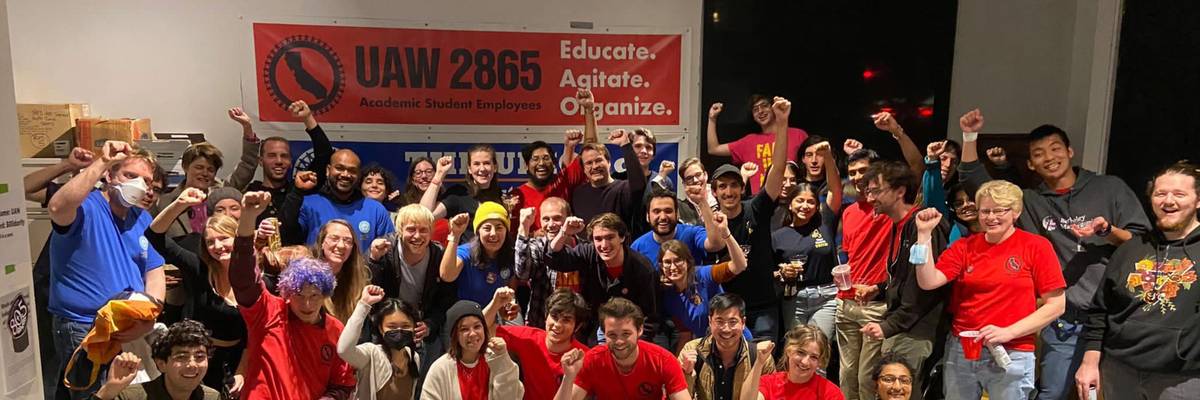
University of California academic student workers, members of UAW 2865, voted overwhelmingly to authorize a strike for better pay and working conditions on November 2, 2022. (Photo: Sarah Arveson/Twitter)
Tens of thousands of employees at the University of California system voted Wednesday night to authorize what would be the biggest U.S. strike this year and the nation's largest ever by academic workers.
"Our teaching assistants do the vast majority of the teaching work for UC, and we do basically all of the research."
In a vote of 35,654 to 904, 98% of the three-quarters of UC academic workers at 10 campuses across the state elected to strike over pay and what they say are the system's unfair labor practices. Absent a resolution, the workers could start striking as soon as November 14.
"We are taking this step because the university's unlawful bargaining practices are preventing us from reaching agreements on fair pay, affordable housing, and workplace equity for international scholars and working parents," Connor Jackson, a UC Berkeley doctoral student and head steward of United Auto Workers (UAW) 2865, one of the unions representing the academic student employees (ASEs), told The Daily Californian ahead of the vote.
"We do the majority of teaching and research at UC, yet most of us are severely rent-burdened because we are so underpaid," he added.
Wednesday's vote came as the UC system's nearly 50,000 academic workers--who include graduate students, postdoctoral researchers, and student researchers--are negotiating contracts with university officials.
UAW 2865, which represents more than 19,000 ASEs across the UC system, says its members are paid around 30% less than similar workers at competing institutions, and that "a considerable gap remains between UC's average net stipend and growing living costs in California."
According to the union:
On average, ASEs spend over half of our income on rent, including those of us who reside in university housing. And ASEs are not alone. Postdocs, student researchers, and academic researchers also face high rents and low pay. Now is the time to address compensation and the cost-of-living crisis to ensure an equitable access to opportunity at UC Without the work of ASEs, postdocs, student researchers, and academic researchers, the UC would not be one of the country's leading public universities.
UAW 2865 published 13 key demands, including living wage compensation and a diverse workforce, eliminating rent burdens for ASEs, free tuition and fees, limiting class sizes and workloads, and greater job security.
"We don't make more than $30,000 a year," Ximena Anleu Gil, a graduate molecular biology researcher at UC Davis who also works as a teaching assistant, told The Sacramento Bee.
UAW 2865, Student Researchers United-UAW, and UAW 5810--all of which represent UC ASEs--are demanding a $54,000 salary for graduate student workers and $70,000 for postdocs, along with annual cost-of-living increases and experienced-based adjustments.
As the Bee notes:
The last UC union to go on strike won its demands without having to walk off the job. About 6,500 UC lecturers voted to go on strike in November 2021, but called off it off after university management agreed to raise salaries by nearly 30% over five years. Workers also won greater job security with guaranteed multiyear appointments as well as four weeks of paid family leave.
Around 10% of all postdoctoral workers in the U.S. are employed by the UC system, according to the California Labor Federation.
"Our teaching assistants do the vast majority of the teaching work for UC, and we do basically all of the research," Tanzil Chowdhury, a graduate student researcher at Lawrence Berkeley National Laboratory who serves on one of four union bargaining committees, told the San Francisco Chronicle. "If these two things stop, the university can't really function."
Chowdhury--who earns $40,000 a year to oversee experiments on semiconducting nanomaterials, analyze data, prepare and deliver presentations, and maintain laboratory equipment--said that "our work benefits the university in a huge way. It's critical to bringing in billions of dollars in research funding."
UC spokesperson Ryan King told the Chronicle that the university is offering "fair pay and good health benefits, in a supportive and respectful work environment."
"Our primary goal in these negotiations," added King, "is achieving multiyear agreements that recognize these employees' important and highly valued contributions to the university's teaching and research mission."
Dear Common Dreams reader, It’s been nearly 30 years since I co-founded Common Dreams with my late wife, Lina Newhouser. We had the radical notion that journalism should serve the public good, not corporate profits. It was clear to us from the outset what it would take to build such a project. No paid advertisements. No corporate sponsors. No millionaire publisher telling us what to think or do. Many people said we wouldn't last a year, but we proved those doubters wrong. Together with a tremendous team of journalists and dedicated staff, we built an independent media outlet free from the constraints of profits and corporate control. Our mission has always been simple: To inform. To inspire. To ignite change for the common good. Building Common Dreams was not easy. Our survival was never guaranteed. When you take on the most powerful forces—Wall Street greed, fossil fuel industry destruction, Big Tech lobbyists, and uber-rich oligarchs who have spent billions upon billions rigging the economy and democracy in their favor—the only bulwark you have is supporters who believe in your work. But here’s the urgent message from me today. It's never been this bad out there. And it's never been this hard to keep us going. At the very moment Common Dreams is most needed, the threats we face are intensifying. We need your support now more than ever. We don't accept corporate advertising and never will. We don't have a paywall because we don't think people should be blocked from critical news based on their ability to pay. Everything we do is funded by the donations of readers like you. When everyone does the little they can afford, we are strong. But if that support retreats or dries up, so do we. Will you donate now to make sure Common Dreams not only survives but thrives? —Craig Brown, Co-founder |
Tens of thousands of employees at the University of California system voted Wednesday night to authorize what would be the biggest U.S. strike this year and the nation's largest ever by academic workers.
"Our teaching assistants do the vast majority of the teaching work for UC, and we do basically all of the research."
In a vote of 35,654 to 904, 98% of the three-quarters of UC academic workers at 10 campuses across the state elected to strike over pay and what they say are the system's unfair labor practices. Absent a resolution, the workers could start striking as soon as November 14.
"We are taking this step because the university's unlawful bargaining practices are preventing us from reaching agreements on fair pay, affordable housing, and workplace equity for international scholars and working parents," Connor Jackson, a UC Berkeley doctoral student and head steward of United Auto Workers (UAW) 2865, one of the unions representing the academic student employees (ASEs), told The Daily Californian ahead of the vote.
"We do the majority of teaching and research at UC, yet most of us are severely rent-burdened because we are so underpaid," he added.
Wednesday's vote came as the UC system's nearly 50,000 academic workers--who include graduate students, postdoctoral researchers, and student researchers--are negotiating contracts with university officials.
UAW 2865, which represents more than 19,000 ASEs across the UC system, says its members are paid around 30% less than similar workers at competing institutions, and that "a considerable gap remains between UC's average net stipend and growing living costs in California."
According to the union:
On average, ASEs spend over half of our income on rent, including those of us who reside in university housing. And ASEs are not alone. Postdocs, student researchers, and academic researchers also face high rents and low pay. Now is the time to address compensation and the cost-of-living crisis to ensure an equitable access to opportunity at UC Without the work of ASEs, postdocs, student researchers, and academic researchers, the UC would not be one of the country's leading public universities.
UAW 2865 published 13 key demands, including living wage compensation and a diverse workforce, eliminating rent burdens for ASEs, free tuition and fees, limiting class sizes and workloads, and greater job security.
"We don't make more than $30,000 a year," Ximena Anleu Gil, a graduate molecular biology researcher at UC Davis who also works as a teaching assistant, told The Sacramento Bee.
UAW 2865, Student Researchers United-UAW, and UAW 5810--all of which represent UC ASEs--are demanding a $54,000 salary for graduate student workers and $70,000 for postdocs, along with annual cost-of-living increases and experienced-based adjustments.
As the Bee notes:
The last UC union to go on strike won its demands without having to walk off the job. About 6,500 UC lecturers voted to go on strike in November 2021, but called off it off after university management agreed to raise salaries by nearly 30% over five years. Workers also won greater job security with guaranteed multiyear appointments as well as four weeks of paid family leave.
Around 10% of all postdoctoral workers in the U.S. are employed by the UC system, according to the California Labor Federation.
"Our teaching assistants do the vast majority of the teaching work for UC, and we do basically all of the research," Tanzil Chowdhury, a graduate student researcher at Lawrence Berkeley National Laboratory who serves on one of four union bargaining committees, told the San Francisco Chronicle. "If these two things stop, the university can't really function."
Chowdhury--who earns $40,000 a year to oversee experiments on semiconducting nanomaterials, analyze data, prepare and deliver presentations, and maintain laboratory equipment--said that "our work benefits the university in a huge way. It's critical to bringing in billions of dollars in research funding."
UC spokesperson Ryan King told the Chronicle that the university is offering "fair pay and good health benefits, in a supportive and respectful work environment."
"Our primary goal in these negotiations," added King, "is achieving multiyear agreements that recognize these employees' important and highly valued contributions to the university's teaching and research mission."
Tens of thousands of employees at the University of California system voted Wednesday night to authorize what would be the biggest U.S. strike this year and the nation's largest ever by academic workers.
"Our teaching assistants do the vast majority of the teaching work for UC, and we do basically all of the research."
In a vote of 35,654 to 904, 98% of the three-quarters of UC academic workers at 10 campuses across the state elected to strike over pay and what they say are the system's unfair labor practices. Absent a resolution, the workers could start striking as soon as November 14.
"We are taking this step because the university's unlawful bargaining practices are preventing us from reaching agreements on fair pay, affordable housing, and workplace equity for international scholars and working parents," Connor Jackson, a UC Berkeley doctoral student and head steward of United Auto Workers (UAW) 2865, one of the unions representing the academic student employees (ASEs), told The Daily Californian ahead of the vote.
"We do the majority of teaching and research at UC, yet most of us are severely rent-burdened because we are so underpaid," he added.
Wednesday's vote came as the UC system's nearly 50,000 academic workers--who include graduate students, postdoctoral researchers, and student researchers--are negotiating contracts with university officials.
UAW 2865, which represents more than 19,000 ASEs across the UC system, says its members are paid around 30% less than similar workers at competing institutions, and that "a considerable gap remains between UC's average net stipend and growing living costs in California."
According to the union:
On average, ASEs spend over half of our income on rent, including those of us who reside in university housing. And ASEs are not alone. Postdocs, student researchers, and academic researchers also face high rents and low pay. Now is the time to address compensation and the cost-of-living crisis to ensure an equitable access to opportunity at UC Without the work of ASEs, postdocs, student researchers, and academic researchers, the UC would not be one of the country's leading public universities.
UAW 2865 published 13 key demands, including living wage compensation and a diverse workforce, eliminating rent burdens for ASEs, free tuition and fees, limiting class sizes and workloads, and greater job security.
"We don't make more than $30,000 a year," Ximena Anleu Gil, a graduate molecular biology researcher at UC Davis who also works as a teaching assistant, told The Sacramento Bee.
UAW 2865, Student Researchers United-UAW, and UAW 5810--all of which represent UC ASEs--are demanding a $54,000 salary for graduate student workers and $70,000 for postdocs, along with annual cost-of-living increases and experienced-based adjustments.
As the Bee notes:
The last UC union to go on strike won its demands without having to walk off the job. About 6,500 UC lecturers voted to go on strike in November 2021, but called off it off after university management agreed to raise salaries by nearly 30% over five years. Workers also won greater job security with guaranteed multiyear appointments as well as four weeks of paid family leave.
Around 10% of all postdoctoral workers in the U.S. are employed by the UC system, according to the California Labor Federation.
"Our teaching assistants do the vast majority of the teaching work for UC, and we do basically all of the research," Tanzil Chowdhury, a graduate student researcher at Lawrence Berkeley National Laboratory who serves on one of four union bargaining committees, told the San Francisco Chronicle. "If these two things stop, the university can't really function."
Chowdhury--who earns $40,000 a year to oversee experiments on semiconducting nanomaterials, analyze data, prepare and deliver presentations, and maintain laboratory equipment--said that "our work benefits the university in a huge way. It's critical to bringing in billions of dollars in research funding."
UC spokesperson Ryan King told the Chronicle that the university is offering "fair pay and good health benefits, in a supportive and respectful work environment."
"Our primary goal in these negotiations," added King, "is achieving multiyear agreements that recognize these employees' important and highly valued contributions to the university's teaching and research mission."