

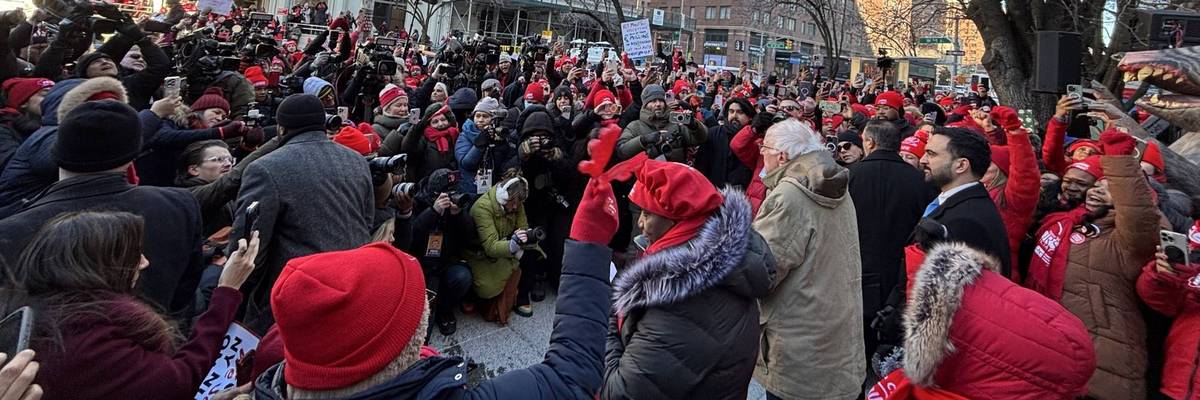
New York City Mayor Zohran Mamdani and Sen. Bernie Sanders (I-Vt.) join hundreds of striking nurses outside Mount Sinai West hospital in New York City on January 20, 2026.
'Now Is Your Time of Need': Bernie Sanders, Mayor Mamdani Join Striking Nurses in NYC
"Don't tell me you can't provide a good nurse-staff ratio when you're paying your CEO at New York Presbyterian $26 million a year, the CEO at Montefiore $16 million a year, Mount Sinai $5 million a year," said Sen. Bernie Sanders.
As the largest nurses strike in the history of New York City marched into its second week with no resolution in sight, US Sen. Bernie Sanders (I-Vt.) and Mayor Zohran Mamdani joined hundreds of picketers in the bitter cold on Tuesday to support their fight for better pay and workplace protections.
Last week, the New York State Nurses Association (NYSNA) announced that nearly 15,000 NewYork-Presbyterian, Mount Sinai, and Montefiore hospital employees had "no choice" but to go on strike after the hospitals failed to meet their demands for safe staffing, workplace violence protections, safeguards against the use of artificial intelligence in healthcare, and to maintain 100% of their healthcare benefits.
Outside Mount Sinai West on 10th Avenue, Mamdani, attending his second picket, called for a "swift and urgent resolution" to the workers' demands after negotiations with the hospitals stalled last week and the chains began hiring replacement workers.
"This is about safe working conditions. This is about a fair contract. This is about dignity. And today is day nine—day nine—of those demands, and I want you to know that wherever I go in New York City, I hear about the plight of our nurses," the democratic socialist mayor said. "Now is your time of need, where we can ensure that this is a city that you don't just work in but a city that you can also live in."
In comments to CBS News New York, the hospital chains have scoffed at the NYSNA's demands for a 25% pay increase, especially in the wake of massive healthcare funding cuts from President Donald Trump's One Big Beautiful Bill Act last year.
A spokesperson for NewYork-Presbyterian said its nurses—who it said earn $163,000 on average—are among the highest-paid in the city, calling demands for a pay increase "unrealistic." A Montefiore spokesperson told the network that progress on negotiations will be impossible until the nurses "back away from their reckless and dangerous $3.6 billion demands."
But New York is also one of the most expensive cities in the world to live in. According to the Massachusetts Institute of Technology’s Living Wage calculator, the nurses' wages are often barely enough to meet a family's basic needs, especially for single parents with children.
NYSNA, meanwhile, has said management "is threatening to discontinue or radically cut nurses’ health benefits" and has done nothing to combat severe understaffing.
"We’re talking an emergency room filled to the brink,” said one of the strikers, staff nurse Morgan Betancourt. “Ninety patients, and we have maybe nine nurses.”
On Tuesday, Sanders (I-Vt.) emphasized that the hospitals' sudden frugality has been of little concern when it comes to compensating hospital executives.
"Don't tell me you can't provide a good nurse-staff ratio when you're paying your CEO at NewYork Presbyterian $26 million a year, the CEO at Montefiore $16 million a year, Mount Sinai $5 million a year," Sanders shouted to applause from the strikers. "Don't tell me you can't treat nurses with dignity when you're spending hundreds of millions of dollars on traveling nurses."
According to the Greater New York Hospital Association, the three hospitals combined had spent approximately $100 million to pay temporary nurses as of the fourth day of the strike. Temporary staffing agencies have required hospitals to pay scabs two to three times as much as they'd pay their regular nurses, Bloomberg reported.
Negotiations remain at a total standstill after breaking down last week. While the hospitals claim the union refused to budge on unreasonable demands, Jonathan Hunter, a negotiator for Mount Sinai nurses, told Spectrum News NY1, "They basically stonewalled us, presented us with nothing, and we left with nothing."
The strike has left the hospital system in a state of upheaval, forcing some patients to be moved and nonemergency surgeries to be canceled. Mamdani said it's all the more reason for the hospitals to reach an agreement with their workers.
"Too often when we see a strike, people forget that that is not where workers want to be," Mamdani said. "A strike is an act of last resort. What workers want is to be back at work. So what this will mean is making that possible. And so we call on every side to come back to that negotiating table. Have a swift and urgent resolution."
We are at a crossroads
This country and this world are at a monumental crossroads. In a few short weeks, US voters will have an opportunity to beat back the forces of fascism and confront the billionaires who are rigging the economy, our media system, and our democracy, making it increasingly impossible for ordinary people to get by. We’re not just talking about the election. We’re talking about what must be done once these fascist elements are vanquished from power. We need a bolder set of solutions than what either major party has so far been willing to offer and a working-class movement ready to fight like hell for it. Trump didn't emerge from nowhere. The conditions that fueled MAGA authoritarianism were created by decades of radical neoliberal economic policies and a corrupt political system dominated by corporate interests. They slashed taxes on the super-rich, promising that the benefits would trickle down. They said giveaways to the corporate titans would make life more affordable for the rest of us. It was all bullshit. And when a bitter, betrayed populace searches for someone to blame, right-wing demagogues have little trouble finding scapegoats. People know when they're being lied to, but you won't hear any of this from the corporate media. Only independent journalism—powered and funded by people who believe in building a better world—can deliver truly trustworthy daily news. Our Fall Campaign is underway, and we need your help. To power our newsroom through the rest of the year, we need to raise $125,000 by midnight on October 31. So if you share our vision, please contribute whatever you can to sustain our work. |
As the largest nurses strike in the history of New York City marched into its second week with no resolution in sight, US Sen. Bernie Sanders (I-Vt.) and Mayor Zohran Mamdani joined hundreds of picketers in the bitter cold on Tuesday to support their fight for better pay and workplace protections.
Last week, the New York State Nurses Association (NYSNA) announced that nearly 15,000 NewYork-Presbyterian, Mount Sinai, and Montefiore hospital employees had "no choice" but to go on strike after the hospitals failed to meet their demands for safe staffing, workplace violence protections, safeguards against the use of artificial intelligence in healthcare, and to maintain 100% of their healthcare benefits.
Outside Mount Sinai West on 10th Avenue, Mamdani, attending his second picket, called for a "swift and urgent resolution" to the workers' demands after negotiations with the hospitals stalled last week and the chains began hiring replacement workers.
"This is about safe working conditions. This is about a fair contract. This is about dignity. And today is day nine—day nine—of those demands, and I want you to know that wherever I go in New York City, I hear about the plight of our nurses," the democratic socialist mayor said. "Now is your time of need, where we can ensure that this is a city that you don't just work in but a city that you can also live in."
In comments to CBS News New York, the hospital chains have scoffed at the NYSNA's demands for a 25% pay increase, especially in the wake of massive healthcare funding cuts from President Donald Trump's One Big Beautiful Bill Act last year.
A spokesperson for NewYork-Presbyterian said its nurses—who it said earn $163,000 on average—are among the highest-paid in the city, calling demands for a pay increase "unrealistic." A Montefiore spokesperson told the network that progress on negotiations will be impossible until the nurses "back away from their reckless and dangerous $3.6 billion demands."
But New York is also one of the most expensive cities in the world to live in. According to the Massachusetts Institute of Technology’s Living Wage calculator, the nurses' wages are often barely enough to meet a family's basic needs, especially for single parents with children.
NYSNA, meanwhile, has said management "is threatening to discontinue or radically cut nurses’ health benefits" and has done nothing to combat severe understaffing.
"We’re talking an emergency room filled to the brink,” said one of the strikers, staff nurse Morgan Betancourt. “Ninety patients, and we have maybe nine nurses.”
On Tuesday, Sanders (I-Vt.) emphasized that the hospitals' sudden frugality has been of little concern when it comes to compensating hospital executives.
"Don't tell me you can't provide a good nurse-staff ratio when you're paying your CEO at NewYork Presbyterian $26 million a year, the CEO at Montefiore $16 million a year, Mount Sinai $5 million a year," Sanders shouted to applause from the strikers. "Don't tell me you can't treat nurses with dignity when you're spending hundreds of millions of dollars on traveling nurses."
According to the Greater New York Hospital Association, the three hospitals combined had spent approximately $100 million to pay temporary nurses as of the fourth day of the strike. Temporary staffing agencies have required hospitals to pay scabs two to three times as much as they'd pay their regular nurses, Bloomberg reported.
Negotiations remain at a total standstill after breaking down last week. While the hospitals claim the union refused to budge on unreasonable demands, Jonathan Hunter, a negotiator for Mount Sinai nurses, told Spectrum News NY1, "They basically stonewalled us, presented us with nothing, and we left with nothing."
The strike has left the hospital system in a state of upheaval, forcing some patients to be moved and nonemergency surgeries to be canceled. Mamdani said it's all the more reason for the hospitals to reach an agreement with their workers.
"Too often when we see a strike, people forget that that is not where workers want to be," Mamdani said. "A strike is an act of last resort. What workers want is to be back at work. So what this will mean is making that possible. And so we call on every side to come back to that negotiating table. Have a swift and urgent resolution."
As the largest nurses strike in the history of New York City marched into its second week with no resolution in sight, US Sen. Bernie Sanders (I-Vt.) and Mayor Zohran Mamdani joined hundreds of picketers in the bitter cold on Tuesday to support their fight for better pay and workplace protections.
Last week, the New York State Nurses Association (NYSNA) announced that nearly 15,000 NewYork-Presbyterian, Mount Sinai, and Montefiore hospital employees had "no choice" but to go on strike after the hospitals failed to meet their demands for safe staffing, workplace violence protections, safeguards against the use of artificial intelligence in healthcare, and to maintain 100% of their healthcare benefits.
Outside Mount Sinai West on 10th Avenue, Mamdani, attending his second picket, called for a "swift and urgent resolution" to the workers' demands after negotiations with the hospitals stalled last week and the chains began hiring replacement workers.
"This is about safe working conditions. This is about a fair contract. This is about dignity. And today is day nine—day nine—of those demands, and I want you to know that wherever I go in New York City, I hear about the plight of our nurses," the democratic socialist mayor said. "Now is your time of need, where we can ensure that this is a city that you don't just work in but a city that you can also live in."
In comments to CBS News New York, the hospital chains have scoffed at the NYSNA's demands for a 25% pay increase, especially in the wake of massive healthcare funding cuts from President Donald Trump's One Big Beautiful Bill Act last year.
A spokesperson for NewYork-Presbyterian said its nurses—who it said earn $163,000 on average—are among the highest-paid in the city, calling demands for a pay increase "unrealistic." A Montefiore spokesperson told the network that progress on negotiations will be impossible until the nurses "back away from their reckless and dangerous $3.6 billion demands."
But New York is also one of the most expensive cities in the world to live in. According to the Massachusetts Institute of Technology’s Living Wage calculator, the nurses' wages are often barely enough to meet a family's basic needs, especially for single parents with children.
NYSNA, meanwhile, has said management "is threatening to discontinue or radically cut nurses’ health benefits" and has done nothing to combat severe understaffing.
"We’re talking an emergency room filled to the brink,” said one of the strikers, staff nurse Morgan Betancourt. “Ninety patients, and we have maybe nine nurses.”
On Tuesday, Sanders (I-Vt.) emphasized that the hospitals' sudden frugality has been of little concern when it comes to compensating hospital executives.
"Don't tell me you can't provide a good nurse-staff ratio when you're paying your CEO at NewYork Presbyterian $26 million a year, the CEO at Montefiore $16 million a year, Mount Sinai $5 million a year," Sanders shouted to applause from the strikers. "Don't tell me you can't treat nurses with dignity when you're spending hundreds of millions of dollars on traveling nurses."
According to the Greater New York Hospital Association, the three hospitals combined had spent approximately $100 million to pay temporary nurses as of the fourth day of the strike. Temporary staffing agencies have required hospitals to pay scabs two to three times as much as they'd pay their regular nurses, Bloomberg reported.
Negotiations remain at a total standstill after breaking down last week. While the hospitals claim the union refused to budge on unreasonable demands, Jonathan Hunter, a negotiator for Mount Sinai nurses, told Spectrum News NY1, "They basically stonewalled us, presented us with nothing, and we left with nothing."
The strike has left the hospital system in a state of upheaval, forcing some patients to be moved and nonemergency surgeries to be canceled. Mamdani said it's all the more reason for the hospitals to reach an agreement with their workers.
"Too often when we see a strike, people forget that that is not where workers want to be," Mamdani said. "A strike is an act of last resort. What workers want is to be back at work. So what this will mean is making that possible. And so we call on every side to come back to that negotiating table. Have a swift and urgent resolution."