SUBSCRIBE TO OUR FREE NEWSLETTER
Daily news & progressive opinion—funded by the people, not the corporations—delivered straight to your inbox.
5
#000000
#FFFFFF
To donate by check, phone, or other method, see our More Ways to Give page.
Daily news & progressive opinion—funded by the people, not the corporations—delivered straight to your inbox.
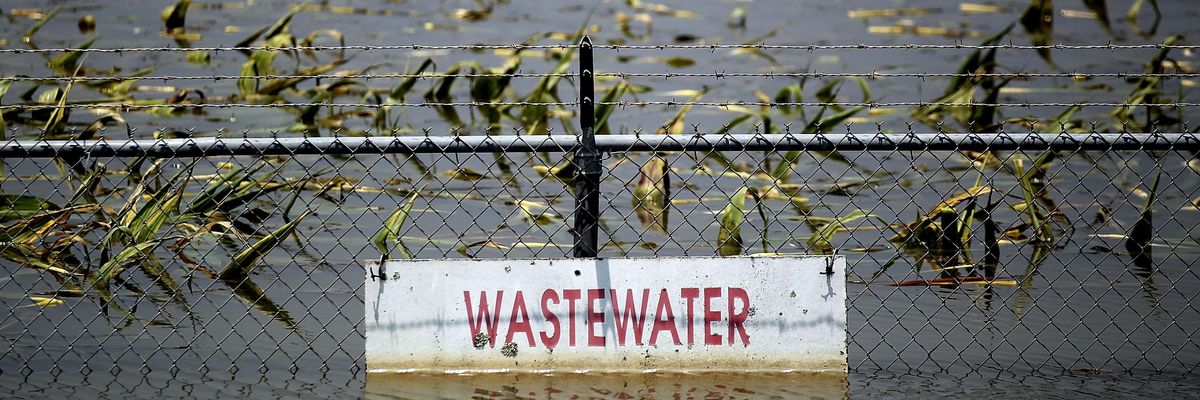
A wastewater treatment plant is inundated by the Yazoo River floodwaters on May 22, 2011 in Yazoo County, Mississippi.
"Plastics plants are poisoning our waters and contaminating our bodies—and EPA needs to do its job and protect our waterways and downstream communities," said one watchdog leader.
Amid fears over President-elect Donald Trump's pick to lead the Environmental Protection Agency, a government watchdog on Thursday called out the EPA for letting the plastics industry pollute U.S. waterways with about half a billion gallons of wastewater every day.
The new report—Plastic's Toxic River: EPA's Failure to Regulate the Petrochemical Plants That Make Plastic—is based on an Environmental Integrity Project (EIP) analysis of records for "70 petrochemical plants that manufacture the most common plastics and their primary chemical ingredients and discharge wastewater directly into rivers, lakes, and other water bodies."
The publication provides just a snapshot of the industry's pollution of U.S. waters. The group focused on plants "that make raw or pure plastics, sometimes referred to as resins, pellets, or nurdles, that are eventually turned into plastic products, like plastic bottles," and did not examine oil refineries or facilities that only make the end-use or consumer products.
"Federal regulations on the wastewater from plastics manufacturing plants have not been updated in over 30 years, are grossly outdated, and fail to protect waterways and downstream communities."
The document explains that "many harmful chemicals released by plastics manufacturers are completely unregulated" by the federal agency, including "dioxins, which are known cancer-causing agents that are highly toxic and persist in the environment; and 1,4-dioxane, a likely carcinogen that EPA scientists recently indicated is threatening drinking water sources."
"Nitrogen and phosphorus pollution discharged from plastics and petrochemical plants—which cause algal blooms and fish-killing low-oxygen zones—are also not controlled by EPA's industrial wastewater rules," it continues. "Although state agencies can set limits for these pollutants in individual wastewater discharge permits, practices vary across states and the limits are inadequate and inconsistent."
EIP found that last year, the 70 plants collectively released nearly 10 million pounds of nitrogen and 1.9 million pounds of phosphorus into waterways. The previous year, eight facilities released an estimated 74,285 pounds of 1,4-dioxane, and 10 of the 17 plants manufacturing polyvinyl chloride (PVC) or its ingredients released 1,374 grams of dioxins and dioxin-like compounds.
The watchdog also found that "although absolute numbers are not known," releases of nurdles into waterways "appear to be common," enforcement of existing regulations is "rare," 58 of 70 plants violated the weak limits "by releasing more pollution than allowed at least once from 2021 to 2023," and 28 facilities are operating with outdated water permits.
"In addition to all these problems, petrochemical plants have been recognized by EPA as potential sources of per- and polyfluoroalkyl substances or PFAS, the 'forever chemicals' that persist in waterways and have been linked to increased cancer risk, hormone disruption, reduced ability of the body to fight infections, and reproductive harms, including low birth weight in babies and developmental delays," the publication notes.
U.S. Geological Survey scientists last month published a study on forever chemicals in the journal Science and released an interactive, online map for the Lower 48 states. They estimated that "71 to 95 million people in the conterminous United States potentially rely on groundwater with detectable concentrations of PFAS for their drinking water supplies prior to any treatment."
EIP's new report highlights that "federal regulations on the wastewater from plastics manufacturing plants have not been updated in over 30 years, are grossly outdated, and fail to protect waterways and downstream communities," despite the Clean Water Act's requirement that the EPA "set wastewater discharge limits (called 'effluent limitation guidelines') for harmful pollutants based on the best available technology economically achievable."
"Because treatment technologies improve over time, EPA is supposed to review existing limits every five years and strengthen them when data show treatment options have improved," the document details. "EPA has failed to comply with this mandate, resulting in an excessive amount of potentially dangerous water pollution pouring from plastics manufacturers into America's waterways."
The group's recommendations are to mandate the use of modern wastewater pollution controls, prohibit plastic discharges into waterways, increase accountability at the state and federal level, enhance monitoring requirements in permitting, and improve permit transparency and recordkeeping.
"It is inexcusable that EPA is not following the Clean Water Act and failing to require the multibillion-dollar plastics industry to install modern pollution control systems," EIP executive director Jen Duggan said in a statement. "Plastics plants are poisoning our waters and contaminating our bodies—and EPA needs to do its job and protect our waterways and downstream communities."
Local groups in Lousiana, South Carolina, Texas, and West Virginia also responded to the report with calls for action.
"Decades of unchecked pollution have transformed the Calcasieu River into a dumping ground for toxic chemicals, with little accountability for the companies responsible," said James Hiatt, executive director of the Louisiana-based For a Better Bayou. "It's unacceptable that these plastics plants, profiting from our natural resources, are allowed to continue to release carcinogens like dioxins into our waterways. We need to hold these polluters accountable—and make them clean up the damage they've caused."
Despite such demands for action, environmental advocates have grave concerns about the EPA's future under Trump, including over his pick of Lee Zeldin, a former Republican member of Congress, to head the agency.
During Trump's first term, his administration rolled back over 100 environmental rules. Although Zeldin, as a congressman, was sometimes "willing and even eager to address environmental problems at home on coastal Long Island," as The New York Times noted Tuesday, his voting record and fealty to Trump have green groups fearful for the future.
As Common Dreams reported earlier this week, Sierra Club executive director Ben Jealous declared that choosing a candidate "who opposes efforts to safeguard our clean air and water lays bare Donald Trump's intentions to, once again, sell our health, our communities, our jobs, and our future out to corporate polluters."
Dear Common Dreams reader, It’s been nearly 30 years since I co-founded Common Dreams with my late wife, Lina Newhouser. We had the radical notion that journalism should serve the public good, not corporate profits. It was clear to us from the outset what it would take to build such a project. No paid advertisements. No corporate sponsors. No millionaire publisher telling us what to think or do. Many people said we wouldn't last a year, but we proved those doubters wrong. Together with a tremendous team of journalists and dedicated staff, we built an independent media outlet free from the constraints of profits and corporate control. Our mission has always been simple: To inform. To inspire. To ignite change for the common good. Building Common Dreams was not easy. Our survival was never guaranteed. When you take on the most powerful forces—Wall Street greed, fossil fuel industry destruction, Big Tech lobbyists, and uber-rich oligarchs who have spent billions upon billions rigging the economy and democracy in their favor—the only bulwark you have is supporters who believe in your work. But here’s the urgent message from me today. It's never been this bad out there. And it's never been this hard to keep us going. At the very moment Common Dreams is most needed, the threats we face are intensifying. We need your support now more than ever. We don't accept corporate advertising and never will. We don't have a paywall because we don't think people should be blocked from critical news based on their ability to pay. Everything we do is funded by the donations of readers like you. When everyone does the little they can afford, we are strong. But if that support retreats or dries up, so do we. Will you donate now to make sure Common Dreams not only survives but thrives? —Craig Brown, Co-founder |
Amid fears over President-elect Donald Trump's pick to lead the Environmental Protection Agency, a government watchdog on Thursday called out the EPA for letting the plastics industry pollute U.S. waterways with about half a billion gallons of wastewater every day.
The new report—Plastic's Toxic River: EPA's Failure to Regulate the Petrochemical Plants That Make Plastic—is based on an Environmental Integrity Project (EIP) analysis of records for "70 petrochemical plants that manufacture the most common plastics and their primary chemical ingredients and discharge wastewater directly into rivers, lakes, and other water bodies."
The publication provides just a snapshot of the industry's pollution of U.S. waters. The group focused on plants "that make raw or pure plastics, sometimes referred to as resins, pellets, or nurdles, that are eventually turned into plastic products, like plastic bottles," and did not examine oil refineries or facilities that only make the end-use or consumer products.
"Federal regulations on the wastewater from plastics manufacturing plants have not been updated in over 30 years, are grossly outdated, and fail to protect waterways and downstream communities."
The document explains that "many harmful chemicals released by plastics manufacturers are completely unregulated" by the federal agency, including "dioxins, which are known cancer-causing agents that are highly toxic and persist in the environment; and 1,4-dioxane, a likely carcinogen that EPA scientists recently indicated is threatening drinking water sources."
"Nitrogen and phosphorus pollution discharged from plastics and petrochemical plants—which cause algal blooms and fish-killing low-oxygen zones—are also not controlled by EPA's industrial wastewater rules," it continues. "Although state agencies can set limits for these pollutants in individual wastewater discharge permits, practices vary across states and the limits are inadequate and inconsistent."
EIP found that last year, the 70 plants collectively released nearly 10 million pounds of nitrogen and 1.9 million pounds of phosphorus into waterways. The previous year, eight facilities released an estimated 74,285 pounds of 1,4-dioxane, and 10 of the 17 plants manufacturing polyvinyl chloride (PVC) or its ingredients released 1,374 grams of dioxins and dioxin-like compounds.
The watchdog also found that "although absolute numbers are not known," releases of nurdles into waterways "appear to be common," enforcement of existing regulations is "rare," 58 of 70 plants violated the weak limits "by releasing more pollution than allowed at least once from 2021 to 2023," and 28 facilities are operating with outdated water permits.
"In addition to all these problems, petrochemical plants have been recognized by EPA as potential sources of per- and polyfluoroalkyl substances or PFAS, the 'forever chemicals' that persist in waterways and have been linked to increased cancer risk, hormone disruption, reduced ability of the body to fight infections, and reproductive harms, including low birth weight in babies and developmental delays," the publication notes.
U.S. Geological Survey scientists last month published a study on forever chemicals in the journal Science and released an interactive, online map for the Lower 48 states. They estimated that "71 to 95 million people in the conterminous United States potentially rely on groundwater with detectable concentrations of PFAS for their drinking water supplies prior to any treatment."
EIP's new report highlights that "federal regulations on the wastewater from plastics manufacturing plants have not been updated in over 30 years, are grossly outdated, and fail to protect waterways and downstream communities," despite the Clean Water Act's requirement that the EPA "set wastewater discharge limits (called 'effluent limitation guidelines') for harmful pollutants based on the best available technology economically achievable."
"Because treatment technologies improve over time, EPA is supposed to review existing limits every five years and strengthen them when data show treatment options have improved," the document details. "EPA has failed to comply with this mandate, resulting in an excessive amount of potentially dangerous water pollution pouring from plastics manufacturers into America's waterways."
The group's recommendations are to mandate the use of modern wastewater pollution controls, prohibit plastic discharges into waterways, increase accountability at the state and federal level, enhance monitoring requirements in permitting, and improve permit transparency and recordkeeping.
"It is inexcusable that EPA is not following the Clean Water Act and failing to require the multibillion-dollar plastics industry to install modern pollution control systems," EIP executive director Jen Duggan said in a statement. "Plastics plants are poisoning our waters and contaminating our bodies—and EPA needs to do its job and protect our waterways and downstream communities."
Local groups in Lousiana, South Carolina, Texas, and West Virginia also responded to the report with calls for action.
"Decades of unchecked pollution have transformed the Calcasieu River into a dumping ground for toxic chemicals, with little accountability for the companies responsible," said James Hiatt, executive director of the Louisiana-based For a Better Bayou. "It's unacceptable that these plastics plants, profiting from our natural resources, are allowed to continue to release carcinogens like dioxins into our waterways. We need to hold these polluters accountable—and make them clean up the damage they've caused."
Despite such demands for action, environmental advocates have grave concerns about the EPA's future under Trump, including over his pick of Lee Zeldin, a former Republican member of Congress, to head the agency.
During Trump's first term, his administration rolled back over 100 environmental rules. Although Zeldin, as a congressman, was sometimes "willing and even eager to address environmental problems at home on coastal Long Island," as The New York Times noted Tuesday, his voting record and fealty to Trump have green groups fearful for the future.
As Common Dreams reported earlier this week, Sierra Club executive director Ben Jealous declared that choosing a candidate "who opposes efforts to safeguard our clean air and water lays bare Donald Trump's intentions to, once again, sell our health, our communities, our jobs, and our future out to corporate polluters."
Amid fears over President-elect Donald Trump's pick to lead the Environmental Protection Agency, a government watchdog on Thursday called out the EPA for letting the plastics industry pollute U.S. waterways with about half a billion gallons of wastewater every day.
The new report—Plastic's Toxic River: EPA's Failure to Regulate the Petrochemical Plants That Make Plastic—is based on an Environmental Integrity Project (EIP) analysis of records for "70 petrochemical plants that manufacture the most common plastics and their primary chemical ingredients and discharge wastewater directly into rivers, lakes, and other water bodies."
The publication provides just a snapshot of the industry's pollution of U.S. waters. The group focused on plants "that make raw or pure plastics, sometimes referred to as resins, pellets, or nurdles, that are eventually turned into plastic products, like plastic bottles," and did not examine oil refineries or facilities that only make the end-use or consumer products.
"Federal regulations on the wastewater from plastics manufacturing plants have not been updated in over 30 years, are grossly outdated, and fail to protect waterways and downstream communities."
The document explains that "many harmful chemicals released by plastics manufacturers are completely unregulated" by the federal agency, including "dioxins, which are known cancer-causing agents that are highly toxic and persist in the environment; and 1,4-dioxane, a likely carcinogen that EPA scientists recently indicated is threatening drinking water sources."
"Nitrogen and phosphorus pollution discharged from plastics and petrochemical plants—which cause algal blooms and fish-killing low-oxygen zones—are also not controlled by EPA's industrial wastewater rules," it continues. "Although state agencies can set limits for these pollutants in individual wastewater discharge permits, practices vary across states and the limits are inadequate and inconsistent."
EIP found that last year, the 70 plants collectively released nearly 10 million pounds of nitrogen and 1.9 million pounds of phosphorus into waterways. The previous year, eight facilities released an estimated 74,285 pounds of 1,4-dioxane, and 10 of the 17 plants manufacturing polyvinyl chloride (PVC) or its ingredients released 1,374 grams of dioxins and dioxin-like compounds.
The watchdog also found that "although absolute numbers are not known," releases of nurdles into waterways "appear to be common," enforcement of existing regulations is "rare," 58 of 70 plants violated the weak limits "by releasing more pollution than allowed at least once from 2021 to 2023," and 28 facilities are operating with outdated water permits.
"In addition to all these problems, petrochemical plants have been recognized by EPA as potential sources of per- and polyfluoroalkyl substances or PFAS, the 'forever chemicals' that persist in waterways and have been linked to increased cancer risk, hormone disruption, reduced ability of the body to fight infections, and reproductive harms, including low birth weight in babies and developmental delays," the publication notes.
U.S. Geological Survey scientists last month published a study on forever chemicals in the journal Science and released an interactive, online map for the Lower 48 states. They estimated that "71 to 95 million people in the conterminous United States potentially rely on groundwater with detectable concentrations of PFAS for their drinking water supplies prior to any treatment."
EIP's new report highlights that "federal regulations on the wastewater from plastics manufacturing plants have not been updated in over 30 years, are grossly outdated, and fail to protect waterways and downstream communities," despite the Clean Water Act's requirement that the EPA "set wastewater discharge limits (called 'effluent limitation guidelines') for harmful pollutants based on the best available technology economically achievable."
"Because treatment technologies improve over time, EPA is supposed to review existing limits every five years and strengthen them when data show treatment options have improved," the document details. "EPA has failed to comply with this mandate, resulting in an excessive amount of potentially dangerous water pollution pouring from plastics manufacturers into America's waterways."
The group's recommendations are to mandate the use of modern wastewater pollution controls, prohibit plastic discharges into waterways, increase accountability at the state and federal level, enhance monitoring requirements in permitting, and improve permit transparency and recordkeeping.
"It is inexcusable that EPA is not following the Clean Water Act and failing to require the multibillion-dollar plastics industry to install modern pollution control systems," EIP executive director Jen Duggan said in a statement. "Plastics plants are poisoning our waters and contaminating our bodies—and EPA needs to do its job and protect our waterways and downstream communities."
Local groups in Lousiana, South Carolina, Texas, and West Virginia also responded to the report with calls for action.
"Decades of unchecked pollution have transformed the Calcasieu River into a dumping ground for toxic chemicals, with little accountability for the companies responsible," said James Hiatt, executive director of the Louisiana-based For a Better Bayou. "It's unacceptable that these plastics plants, profiting from our natural resources, are allowed to continue to release carcinogens like dioxins into our waterways. We need to hold these polluters accountable—and make them clean up the damage they've caused."
Despite such demands for action, environmental advocates have grave concerns about the EPA's future under Trump, including over his pick of Lee Zeldin, a former Republican member of Congress, to head the agency.
During Trump's first term, his administration rolled back over 100 environmental rules. Although Zeldin, as a congressman, was sometimes "willing and even eager to address environmental problems at home on coastal Long Island," as The New York Times noted Tuesday, his voting record and fealty to Trump have green groups fearful for the future.
As Common Dreams reported earlier this week, Sierra Club executive director Ben Jealous declared that choosing a candidate "who opposes efforts to safeguard our clean air and water lays bare Donald Trump's intentions to, once again, sell our health, our communities, our jobs, and our future out to corporate polluters."