

SUBSCRIBE TO OUR FREE NEWSLETTER
Daily news & progressive opinion—funded by the people, not the corporations—delivered straight to your inbox.
5
#000000
#FFFFFF
To donate by check, phone, or other method, see our More Ways to Give page.
Daily news & progressive opinion—funded by the people, not the corporations—delivered straight to your inbox.
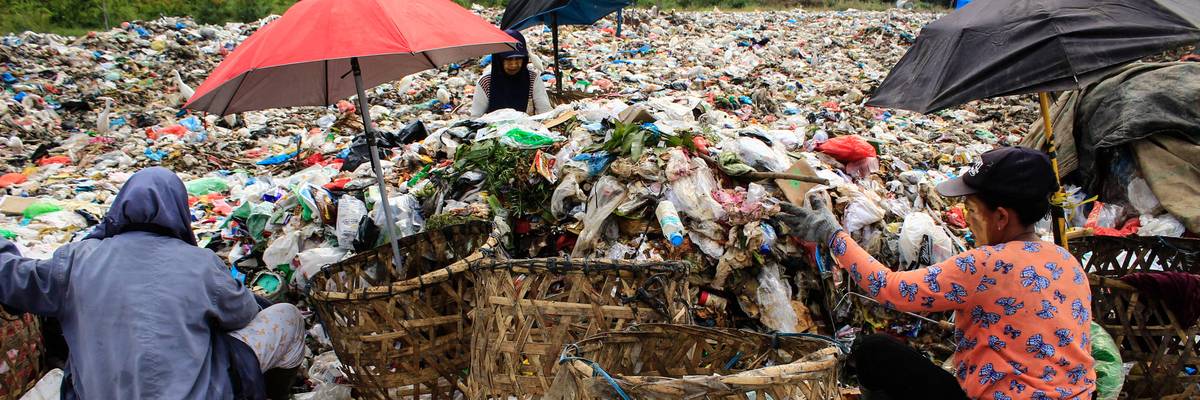
People collect plastic waste at a landfill in North Sumatra, Indonesia on March 27, 2024.
"The question for every government now is this—will you negotiate a treaty to protect the health of your people; or will you negotiate a treaty to protect the profits of the fossil fuel industry?"
A report released Thursday estimates that countries worldwide are on pace to generate 220 million tonnes of total plastic waste this year, a finding that comes as governments are set to convene in Ottawa, Canada later this month to hash out a binding global treaty to limit the toxic pollution that is inundating waterways and communities across the planet.
The new report from EA – Earth Action (EA) projects that Plastic Overshoot Day—the point at which the amount of plastic waste produced exceeds the capacity of global management systems—will arrive on September 5 this year. Over a third of the total plastic waste created this year will end up in nature, according to the analysis.
On average, each person globally contributes 28 kilograms of plastic pollution per year. Previous research has shown that just 20 companies are responsible for more than half of the world's total single-use plastic waste.
"The findings are unequivocal; improvements in waste management capacity are outpaced by rising plastic production, making progress almost invisible," EA co-CEO Sarah Perreard said in a statement Thursday, criticizing the "assumption that recycling and waste management capacity will solve the plastics crisis."
That assumption has been peddled for decades by the fossil fuel industry, which has a major interest in thwarting attempts to curb the production, use, and waste of plastics. Nearly all plastic is made from chemicals sourced from fossil fuels.
Sian Sutherland, co-founder of A Plastic Planet, said the new report underscores that "plastic pollution has set humanity on the road to ecological and humanitarian disaster."
"We have a narrow window of opportunity this year to create a global plastics treaty that will protect not only our ocean, our air, our soil but our own children," said Sutherland. "The question for every government now is this—will you negotiate a treaty to protect the health of your people; or will you negotiate a treaty to protect the profits of the fossil fuel industry? Viable solutions are already available at scale, giving us materials and systems that work in harmony with nature, not against it."
"Close to 50% of the world's population currently lives in areas where waste generated has already exceeded the capacity to manage it."
Late last year, the third round of U.N. plastics treaty talks ended without a breakthrough as major oil-producing countries such as Saudi Arabia obstructed the proceedings, the fossil fuel industry worked to sabotage the negotiations, and the U.S. declined to forcefully push for a global pact that meaningfully curtails plastics production.
The U.S. is among the world's leading generators of plastic waste, producing nearly 100 kilograms per capita each year. The U.S. and other rich nations also export tremendous amounts of plastic waste around the world, undercutting efforts to tackle the pollution crisis.
A Greenpeace International survey released earlier this month found that two-thirds of the U.S. public wants a global plastics treaty that bans single-use plastic packaging. A separate poll commissioned by WWF and the Plastic Free Foundation showed that 88% of global citizens support banning "unnecessary single-use plastic products" such as shopping bags.
In an op-ed for Euronews Green on Thursday, Perreard of EA wrote that "whilst policy has been mooted, schemes devised, and initiatives launched, plastic has continued to rise, and our planet and its people have sat under an ever-darkening cloud of pollution that showers its toxic consequences upon us."
"Close to 50% of the world's population currently lives in areas where waste generated has already exceeded the capacity to manage it, with the figure projected to rise to 66% by 5 September," Perreard noted. "With the fourth round of negotiations in Ottawa at the end of this month, we can no longer ignore the facts, we can no longer afford to resist the change that should be set in motion through the treaty."
Dear Common Dreams reader, It’s been nearly 30 years since I co-founded Common Dreams with my late wife, Lina Newhouser. We had the radical notion that journalism should serve the public good, not corporate profits. It was clear to us from the outset what it would take to build such a project. No paid advertisements. No corporate sponsors. No millionaire publisher telling us what to think or do. Many people said we wouldn't last a year, but we proved those doubters wrong. Together with a tremendous team of journalists and dedicated staff, we built an independent media outlet free from the constraints of profits and corporate control. Our mission has always been simple: To inform. To inspire. To ignite change for the common good. Building Common Dreams was not easy. Our survival was never guaranteed. When you take on the most powerful forces—Wall Street greed, fossil fuel industry destruction, Big Tech lobbyists, and uber-rich oligarchs who have spent billions upon billions rigging the economy and democracy in their favor—the only bulwark you have is supporters who believe in your work. But here’s the urgent message from me today. It's never been this bad out there. And it's never been this hard to keep us going. At the very moment Common Dreams is most needed, the threats we face are intensifying. We need your support now more than ever. We don't accept corporate advertising and never will. We don't have a paywall because we don't think people should be blocked from critical news based on their ability to pay. Everything we do is funded by the donations of readers like you. When everyone does the little they can afford, we are strong. But if that support retreats or dries up, so do we. Will you donate now to make sure Common Dreams not only survives but thrives? —Craig Brown, Co-founder |
A report released Thursday estimates that countries worldwide are on pace to generate 220 million tonnes of total plastic waste this year, a finding that comes as governments are set to convene in Ottawa, Canada later this month to hash out a binding global treaty to limit the toxic pollution that is inundating waterways and communities across the planet.
The new report from EA – Earth Action (EA) projects that Plastic Overshoot Day—the point at which the amount of plastic waste produced exceeds the capacity of global management systems—will arrive on September 5 this year. Over a third of the total plastic waste created this year will end up in nature, according to the analysis.
On average, each person globally contributes 28 kilograms of plastic pollution per year. Previous research has shown that just 20 companies are responsible for more than half of the world's total single-use plastic waste.
"The findings are unequivocal; improvements in waste management capacity are outpaced by rising plastic production, making progress almost invisible," EA co-CEO Sarah Perreard said in a statement Thursday, criticizing the "assumption that recycling and waste management capacity will solve the plastics crisis."
That assumption has been peddled for decades by the fossil fuel industry, which has a major interest in thwarting attempts to curb the production, use, and waste of plastics. Nearly all plastic is made from chemicals sourced from fossil fuels.
Sian Sutherland, co-founder of A Plastic Planet, said the new report underscores that "plastic pollution has set humanity on the road to ecological and humanitarian disaster."
"We have a narrow window of opportunity this year to create a global plastics treaty that will protect not only our ocean, our air, our soil but our own children," said Sutherland. "The question for every government now is this—will you negotiate a treaty to protect the health of your people; or will you negotiate a treaty to protect the profits of the fossil fuel industry? Viable solutions are already available at scale, giving us materials and systems that work in harmony with nature, not against it."
"Close to 50% of the world's population currently lives in areas where waste generated has already exceeded the capacity to manage it."
Late last year, the third round of U.N. plastics treaty talks ended without a breakthrough as major oil-producing countries such as Saudi Arabia obstructed the proceedings, the fossil fuel industry worked to sabotage the negotiations, and the U.S. declined to forcefully push for a global pact that meaningfully curtails plastics production.
The U.S. is among the world's leading generators of plastic waste, producing nearly 100 kilograms per capita each year. The U.S. and other rich nations also export tremendous amounts of plastic waste around the world, undercutting efforts to tackle the pollution crisis.
A Greenpeace International survey released earlier this month found that two-thirds of the U.S. public wants a global plastics treaty that bans single-use plastic packaging. A separate poll commissioned by WWF and the Plastic Free Foundation showed that 88% of global citizens support banning "unnecessary single-use plastic products" such as shopping bags.
In an op-ed for Euronews Green on Thursday, Perreard of EA wrote that "whilst policy has been mooted, schemes devised, and initiatives launched, plastic has continued to rise, and our planet and its people have sat under an ever-darkening cloud of pollution that showers its toxic consequences upon us."
"Close to 50% of the world's population currently lives in areas where waste generated has already exceeded the capacity to manage it, with the figure projected to rise to 66% by 5 September," Perreard noted. "With the fourth round of negotiations in Ottawa at the end of this month, we can no longer ignore the facts, we can no longer afford to resist the change that should be set in motion through the treaty."
A report released Thursday estimates that countries worldwide are on pace to generate 220 million tonnes of total plastic waste this year, a finding that comes as governments are set to convene in Ottawa, Canada later this month to hash out a binding global treaty to limit the toxic pollution that is inundating waterways and communities across the planet.
The new report from EA – Earth Action (EA) projects that Plastic Overshoot Day—the point at which the amount of plastic waste produced exceeds the capacity of global management systems—will arrive on September 5 this year. Over a third of the total plastic waste created this year will end up in nature, according to the analysis.
On average, each person globally contributes 28 kilograms of plastic pollution per year. Previous research has shown that just 20 companies are responsible for more than half of the world's total single-use plastic waste.
"The findings are unequivocal; improvements in waste management capacity are outpaced by rising plastic production, making progress almost invisible," EA co-CEO Sarah Perreard said in a statement Thursday, criticizing the "assumption that recycling and waste management capacity will solve the plastics crisis."
That assumption has been peddled for decades by the fossil fuel industry, which has a major interest in thwarting attempts to curb the production, use, and waste of plastics. Nearly all plastic is made from chemicals sourced from fossil fuels.
Sian Sutherland, co-founder of A Plastic Planet, said the new report underscores that "plastic pollution has set humanity on the road to ecological and humanitarian disaster."
"We have a narrow window of opportunity this year to create a global plastics treaty that will protect not only our ocean, our air, our soil but our own children," said Sutherland. "The question for every government now is this—will you negotiate a treaty to protect the health of your people; or will you negotiate a treaty to protect the profits of the fossil fuel industry? Viable solutions are already available at scale, giving us materials and systems that work in harmony with nature, not against it."
"Close to 50% of the world's population currently lives in areas where waste generated has already exceeded the capacity to manage it."
Late last year, the third round of U.N. plastics treaty talks ended without a breakthrough as major oil-producing countries such as Saudi Arabia obstructed the proceedings, the fossil fuel industry worked to sabotage the negotiations, and the U.S. declined to forcefully push for a global pact that meaningfully curtails plastics production.
The U.S. is among the world's leading generators of plastic waste, producing nearly 100 kilograms per capita each year. The U.S. and other rich nations also export tremendous amounts of plastic waste around the world, undercutting efforts to tackle the pollution crisis.
A Greenpeace International survey released earlier this month found that two-thirds of the U.S. public wants a global plastics treaty that bans single-use plastic packaging. A separate poll commissioned by WWF and the Plastic Free Foundation showed that 88% of global citizens support banning "unnecessary single-use plastic products" such as shopping bags.
In an op-ed for Euronews Green on Thursday, Perreard of EA wrote that "whilst policy has been mooted, schemes devised, and initiatives launched, plastic has continued to rise, and our planet and its people have sat under an ever-darkening cloud of pollution that showers its toxic consequences upon us."
"Close to 50% of the world's population currently lives in areas where waste generated has already exceeded the capacity to manage it, with the figure projected to rise to 66% by 5 September," Perreard noted. "With the fourth round of negotiations in Ottawa at the end of this month, we can no longer ignore the facts, we can no longer afford to resist the change that should be set in motion through the treaty."

