5
#000000
#FFFFFF
To donate by check, phone, or other method, see our More Ways to Give page.
Daily news & progressive opinion—funded by the people, not the corporations—delivered straight to your inbox.
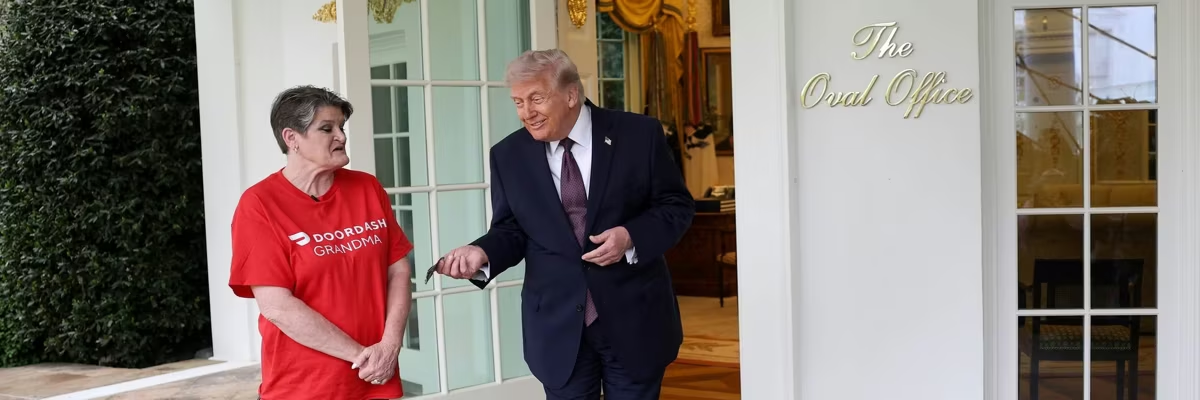
US President Donald Trump tips Sharon Simmons after receiving a DoorDash delivery of McDonald's at the Oval Office of the White House in Washington, DC on April 13, 2026.
"The fact that a term like 'DoorDash grandma' exists should be a wake-up call," said the head of One Fair Wage. "It should never exist in the first place."
While "DoorDash Grandma" made the company's first food delivery to the White House on Monday to promote President Donald Trump's "no tax on tips" policy, the awkward encounter outside the Oval Office not only highlighted critiques of that provision of the GOP budget package but also sparked calls for a living wage and universal healthcare.
"A perfect image of the Trump era: A grandmother has to work at DoorDash in order to get by, while the president decorates his office in gold accent pieces," said Democratic strategist Max Burns, sharing a photo of the delivery on social media.
Saru Jayaraman, president of worker advocacy group One Fair Wage, told Common Dreams that "it's sad, and it's a sign of a failing society—not something to celebrate or turn into a photo op. We've normalized an economy where older people are pushed into gig work just to survive. The fact that a term like 'DoorDash grandma' exists should be a wake-up call. It should never exist in the first place."
"Corporations are paying poverty wages while policymakers offer Band-Aid solutions like 'no tax on tips' instead of paying a living wage," Jayaraman continued. "At the same time, cuts to Medicaid and food assistance are stripping away the safety net workers rely on to get by. This is all pushing people into greater dependence on tips and unstable income. Workers don't need gimmicks—they need living wages, corporate accountability, and real economic security."
Trump and then-Vice President Kamala Harris latched on to the no tax on tips policy during the 2024 campaign, despite warnings from economists and others that it is a "deceptive ploy," as the Economic Policy Institute's David Cooper and Nina Mast put it last year.
"It does nothing to address the low wages, income instability, wage theft, and abuse tipped workers already face," the pair reiterated in February. "Instead, it may undermine efforts to raise tipped minimum wages, push more workers into tipped jobs, increase workloads, and prompt customers to tip less if they believe tipped workers receive special tax treatment."
After related legislation passed the US Senate last year, Jayaraman said that "for all the bipartisan celebration, this bill is a distraction from the real fight... If Democrats want to offer a true alternative, they need to say it loud and clear: It's time to raise the minimum wage and end the subminimum wage once and for all."
A no tax on tips policy was ultimately included in Republicans' so-called One Big Beautiful Bill Act—which, as a recent Institute on Taxation and Economic Policy analysis details, featured tax breaks that primarily benefited wealthy individuals and corporations while cutting programs that serve working families, such as Medicaid and the Supplemental Nutrition Assistance Program.
Specifically, last year's GOP budget package established a temporary federal income tax deduction for tips, capped at $25,000 per year, through 2028. In a February report, the libertarian Cato Institute estimated that "the roughly 3% of tax returns projected to claim the tips deduction in 2026 will receive an average tax cut of about $1,370," and "as a share of after-tax income, the tips deduction broadly benefits those in the middle of the income distribution."
"These provisions also add to the already large number of tax deductions and credits that shield vastly uneven amounts of income from taxation based on family size and childcare arrangements," the Cato report notes. "In addition to the income limits, the tips deduction is only available to occupations that 'customarily and regularly received tips' before 2025."
Sharon Simmons, who wore a red shirt that read "DoorDash Grandma" while delivering McDonald's bags at the White House on Monday, told Trump that she benefited from the policy. In a statement, the company identified her as an Arkansas-based grandmother of 10 who "started dashing in 2022 to earn income while keeping control of her schedule."
During the delivery, the president asked Simmons whether she voted for him—"uh, maybe," she said—and about banning transgender women from competing in sports in line with their gender identity, on which she said she did not have an opinion.
Labor reporter Michael Sainato pointed out that Simmons previously lived in Nevada and advocated for the no tax on tips policy to the US House Ways and Means Committee last year. He also questioned her comments to Trump about having saved over $11,000 on her most recent tax bill.
The dasher claims "$11,000 in savings by not having to claim." You still have to claim tipsYou can only deduct up to $25k in tips, so $11k in savings off of one year didn't happenThe tax savings are actually minimal taxpolicycenter.org/fiscal-facts...
[image or embed]
— Michael Sainato (@msainato.bsky.social) April 13, 2026 at 3:39 PM
While Trump staff and congressional Republicans shared footage of Simmons' delivery to Trump to promote the budget package provision in the lead-up to tax day, US Rep. Dina Titus (D-Nev.) stressed on social media Monday that the president's "policy is severely limited and sunsets in 2028."
"We must make it permanent and increase the minimum wage to support our nontipped workers like childcare, fast food, and retail. We can do both by passing my LIFT Act," said Titus, whose Labor Income Fairness and Transparency Act is backed by One Fair Wage.
"Cutting taxes on tips might make for a good sound bite, but on its own, it's a hollow fix that ignores the real crisis: Wages so low that two-thirds of restaurant workers don't even earn enough to pay federal income taxes," Jayaraman said last year, when Titus introduced the bill. "In a time of skyrocketing costs, workers are drowning and need more than political gimmicks—they need a raise."
"Tips should be a bonus, not a substitute for a living wage," she argued. "By ending all subminimum wages and requiring that all workers be paid a full livable wage with tips on top, the LIFT Act addresses what working people need most: a fair wage, a level playing field, and the dignity that comes with being able to provide for their families."
Some observers on Monday also noted Simmons' appearance on Fox News, during which she acknowledged the financial burden of her husband's 2025 cancer diagnosis.
"Grandma shouldn't have to rely on DoorDash tips to make up for Republicans doubling the cost of healthcare," declared Democrats on the House Ways and Means Committee, sharing a clip of the interview on social media.
Melanie D'Arrigo, executive director of Campaign for New York Health, which advocates for universal, single-payer healthcare, emphasized that "'no tax on tips' does not make up for the fact that no one can afford healthcare."
Historian Timothy Snyder said, "So let’s have universal healthcare and help people live in dignity."
Dear Common Dreams reader, The U.S. is on a fast track to authoritarianism like nothing I've ever seen. Meanwhile, corporate news outlets are utterly capitulating to Trump, twisting their coverage to avoid drawing his ire while lining up to stuff cash in his pockets. That's why I believe that Common Dreams is doing the best and most consequential reporting that we've ever done. Our small but mighty team is a progressive reporting powerhouse, covering the news every day that the corporate media never will. Our mission has always been simple: To inform. To inspire. And to ignite change for the common good. Now here's the key piece that I want all our readers to understand: None of this would be possible without your financial support. That's not just some fundraising cliche. It's the absolute and literal truth. We don't accept corporate advertising and never will. We don't have a paywall because we don't think people should be blocked from critical news based on their ability to pay. Everything we do is funded by the donations of readers like you. Will you donate now to help power the nonprofit, independent reporting of Common Dreams? Thank you for being a vital member of our community. Together, we can keep independent journalism alive when it’s needed most. - Craig Brown, Co-founder |
While "DoorDash Grandma" made the company's first food delivery to the White House on Monday to promote President Donald Trump's "no tax on tips" policy, the awkward encounter outside the Oval Office not only highlighted critiques of that provision of the GOP budget package but also sparked calls for a living wage and universal healthcare.
"A perfect image of the Trump era: A grandmother has to work at DoorDash in order to get by, while the president decorates his office in gold accent pieces," said Democratic strategist Max Burns, sharing a photo of the delivery on social media.
Saru Jayaraman, president of worker advocacy group One Fair Wage, told Common Dreams that "it's sad, and it's a sign of a failing society—not something to celebrate or turn into a photo op. We've normalized an economy where older people are pushed into gig work just to survive. The fact that a term like 'DoorDash grandma' exists should be a wake-up call. It should never exist in the first place."
"Corporations are paying poverty wages while policymakers offer Band-Aid solutions like 'no tax on tips' instead of paying a living wage," Jayaraman continued. "At the same time, cuts to Medicaid and food assistance are stripping away the safety net workers rely on to get by. This is all pushing people into greater dependence on tips and unstable income. Workers don't need gimmicks—they need living wages, corporate accountability, and real economic security."
Trump and then-Vice President Kamala Harris latched on to the no tax on tips policy during the 2024 campaign, despite warnings from economists and others that it is a "deceptive ploy," as the Economic Policy Institute's David Cooper and Nina Mast put it last year.
"It does nothing to address the low wages, income instability, wage theft, and abuse tipped workers already face," the pair reiterated in February. "Instead, it may undermine efforts to raise tipped minimum wages, push more workers into tipped jobs, increase workloads, and prompt customers to tip less if they believe tipped workers receive special tax treatment."
After related legislation passed the US Senate last year, Jayaraman said that "for all the bipartisan celebration, this bill is a distraction from the real fight... If Democrats want to offer a true alternative, they need to say it loud and clear: It's time to raise the minimum wage and end the subminimum wage once and for all."
A no tax on tips policy was ultimately included in Republicans' so-called One Big Beautiful Bill Act—which, as a recent Institute on Taxation and Economic Policy analysis details, featured tax breaks that primarily benefited wealthy individuals and corporations while cutting programs that serve working families, such as Medicaid and the Supplemental Nutrition Assistance Program.
Specifically, last year's GOP budget package established a temporary federal income tax deduction for tips, capped at $25,000 per year, through 2028. In a February report, the libertarian Cato Institute estimated that "the roughly 3% of tax returns projected to claim the tips deduction in 2026 will receive an average tax cut of about $1,370," and "as a share of after-tax income, the tips deduction broadly benefits those in the middle of the income distribution."
"These provisions also add to the already large number of tax deductions and credits that shield vastly uneven amounts of income from taxation based on family size and childcare arrangements," the Cato report notes. "In addition to the income limits, the tips deduction is only available to occupations that 'customarily and regularly received tips' before 2025."
Sharon Simmons, who wore a red shirt that read "DoorDash Grandma" while delivering McDonald's bags at the White House on Monday, told Trump that she benefited from the policy. In a statement, the company identified her as an Arkansas-based grandmother of 10 who "started dashing in 2022 to earn income while keeping control of her schedule."
During the delivery, the president asked Simmons whether she voted for him—"uh, maybe," she said—and about banning transgender women from competing in sports in line with their gender identity, on which she said she did not have an opinion.
Labor reporter Michael Sainato pointed out that Simmons previously lived in Nevada and advocated for the no tax on tips policy to the US House Ways and Means Committee last year. He also questioned her comments to Trump about having saved over $11,000 on her most recent tax bill.
The dasher claims "$11,000 in savings by not having to claim." You still have to claim tipsYou can only deduct up to $25k in tips, so $11k in savings off of one year didn't happenThe tax savings are actually minimal taxpolicycenter.org/fiscal-facts...
[image or embed]
— Michael Sainato (@msainato.bsky.social) April 13, 2026 at 3:39 PM
While Trump staff and congressional Republicans shared footage of Simmons' delivery to Trump to promote the budget package provision in the lead-up to tax day, US Rep. Dina Titus (D-Nev.) stressed on social media Monday that the president's "policy is severely limited and sunsets in 2028."
"We must make it permanent and increase the minimum wage to support our nontipped workers like childcare, fast food, and retail. We can do both by passing my LIFT Act," said Titus, whose Labor Income Fairness and Transparency Act is backed by One Fair Wage.
"Cutting taxes on tips might make for a good sound bite, but on its own, it's a hollow fix that ignores the real crisis: Wages so low that two-thirds of restaurant workers don't even earn enough to pay federal income taxes," Jayaraman said last year, when Titus introduced the bill. "In a time of skyrocketing costs, workers are drowning and need more than political gimmicks—they need a raise."
"Tips should be a bonus, not a substitute for a living wage," she argued. "By ending all subminimum wages and requiring that all workers be paid a full livable wage with tips on top, the LIFT Act addresses what working people need most: a fair wage, a level playing field, and the dignity that comes with being able to provide for their families."
Some observers on Monday also noted Simmons' appearance on Fox News, during which she acknowledged the financial burden of her husband's 2025 cancer diagnosis.
"Grandma shouldn't have to rely on DoorDash tips to make up for Republicans doubling the cost of healthcare," declared Democrats on the House Ways and Means Committee, sharing a clip of the interview on social media.
Melanie D'Arrigo, executive director of Campaign for New York Health, which advocates for universal, single-payer healthcare, emphasized that "'no tax on tips' does not make up for the fact that no one can afford healthcare."
Historian Timothy Snyder said, "So let’s have universal healthcare and help people live in dignity."
While "DoorDash Grandma" made the company's first food delivery to the White House on Monday to promote President Donald Trump's "no tax on tips" policy, the awkward encounter outside the Oval Office not only highlighted critiques of that provision of the GOP budget package but also sparked calls for a living wage and universal healthcare.
"A perfect image of the Trump era: A grandmother has to work at DoorDash in order to get by, while the president decorates his office in gold accent pieces," said Democratic strategist Max Burns, sharing a photo of the delivery on social media.
Saru Jayaraman, president of worker advocacy group One Fair Wage, told Common Dreams that "it's sad, and it's a sign of a failing society—not something to celebrate or turn into a photo op. We've normalized an economy where older people are pushed into gig work just to survive. The fact that a term like 'DoorDash grandma' exists should be a wake-up call. It should never exist in the first place."
"Corporations are paying poverty wages while policymakers offer Band-Aid solutions like 'no tax on tips' instead of paying a living wage," Jayaraman continued. "At the same time, cuts to Medicaid and food assistance are stripping away the safety net workers rely on to get by. This is all pushing people into greater dependence on tips and unstable income. Workers don't need gimmicks—they need living wages, corporate accountability, and real economic security."
Trump and then-Vice President Kamala Harris latched on to the no tax on tips policy during the 2024 campaign, despite warnings from economists and others that it is a "deceptive ploy," as the Economic Policy Institute's David Cooper and Nina Mast put it last year.
"It does nothing to address the low wages, income instability, wage theft, and abuse tipped workers already face," the pair reiterated in February. "Instead, it may undermine efforts to raise tipped minimum wages, push more workers into tipped jobs, increase workloads, and prompt customers to tip less if they believe tipped workers receive special tax treatment."
After related legislation passed the US Senate last year, Jayaraman said that "for all the bipartisan celebration, this bill is a distraction from the real fight... If Democrats want to offer a true alternative, they need to say it loud and clear: It's time to raise the minimum wage and end the subminimum wage once and for all."
A no tax on tips policy was ultimately included in Republicans' so-called One Big Beautiful Bill Act—which, as a recent Institute on Taxation and Economic Policy analysis details, featured tax breaks that primarily benefited wealthy individuals and corporations while cutting programs that serve working families, such as Medicaid and the Supplemental Nutrition Assistance Program.
Specifically, last year's GOP budget package established a temporary federal income tax deduction for tips, capped at $25,000 per year, through 2028. In a February report, the libertarian Cato Institute estimated that "the roughly 3% of tax returns projected to claim the tips deduction in 2026 will receive an average tax cut of about $1,370," and "as a share of after-tax income, the tips deduction broadly benefits those in the middle of the income distribution."
"These provisions also add to the already large number of tax deductions and credits that shield vastly uneven amounts of income from taxation based on family size and childcare arrangements," the Cato report notes. "In addition to the income limits, the tips deduction is only available to occupations that 'customarily and regularly received tips' before 2025."
Sharon Simmons, who wore a red shirt that read "DoorDash Grandma" while delivering McDonald's bags at the White House on Monday, told Trump that she benefited from the policy. In a statement, the company identified her as an Arkansas-based grandmother of 10 who "started dashing in 2022 to earn income while keeping control of her schedule."
During the delivery, the president asked Simmons whether she voted for him—"uh, maybe," she said—and about banning transgender women from competing in sports in line with their gender identity, on which she said she did not have an opinion.
Labor reporter Michael Sainato pointed out that Simmons previously lived in Nevada and advocated for the no tax on tips policy to the US House Ways and Means Committee last year. He also questioned her comments to Trump about having saved over $11,000 on her most recent tax bill.
The dasher claims "$11,000 in savings by not having to claim." You still have to claim tipsYou can only deduct up to $25k in tips, so $11k in savings off of one year didn't happenThe tax savings are actually minimal taxpolicycenter.org/fiscal-facts...
[image or embed]
— Michael Sainato (@msainato.bsky.social) April 13, 2026 at 3:39 PM
While Trump staff and congressional Republicans shared footage of Simmons' delivery to Trump to promote the budget package provision in the lead-up to tax day, US Rep. Dina Titus (D-Nev.) stressed on social media Monday that the president's "policy is severely limited and sunsets in 2028."
"We must make it permanent and increase the minimum wage to support our nontipped workers like childcare, fast food, and retail. We can do both by passing my LIFT Act," said Titus, whose Labor Income Fairness and Transparency Act is backed by One Fair Wage.
"Cutting taxes on tips might make for a good sound bite, but on its own, it's a hollow fix that ignores the real crisis: Wages so low that two-thirds of restaurant workers don't even earn enough to pay federal income taxes," Jayaraman said last year, when Titus introduced the bill. "In a time of skyrocketing costs, workers are drowning and need more than political gimmicks—they need a raise."
"Tips should be a bonus, not a substitute for a living wage," she argued. "By ending all subminimum wages and requiring that all workers be paid a full livable wage with tips on top, the LIFT Act addresses what working people need most: a fair wage, a level playing field, and the dignity that comes with being able to provide for their families."
Some observers on Monday also noted Simmons' appearance on Fox News, during which she acknowledged the financial burden of her husband's 2025 cancer diagnosis.
"Grandma shouldn't have to rely on DoorDash tips to make up for Republicans doubling the cost of healthcare," declared Democrats on the House Ways and Means Committee, sharing a clip of the interview on social media.
Melanie D'Arrigo, executive director of Campaign for New York Health, which advocates for universal, single-payer healthcare, emphasized that "'no tax on tips' does not make up for the fact that no one can afford healthcare."
Historian Timothy Snyder said, "So let’s have universal healthcare and help people live in dignity."