SUBSCRIBE TO OUR FREE NEWSLETTER
Daily news & progressive opinion—funded by the people, not the corporations—delivered straight to your inbox.
5
#000000
#FFFFFF
To donate by check, phone, or other method, see our More Ways to Give page.
Daily news & progressive opinion—funded by the people, not the corporations—delivered straight to your inbox.
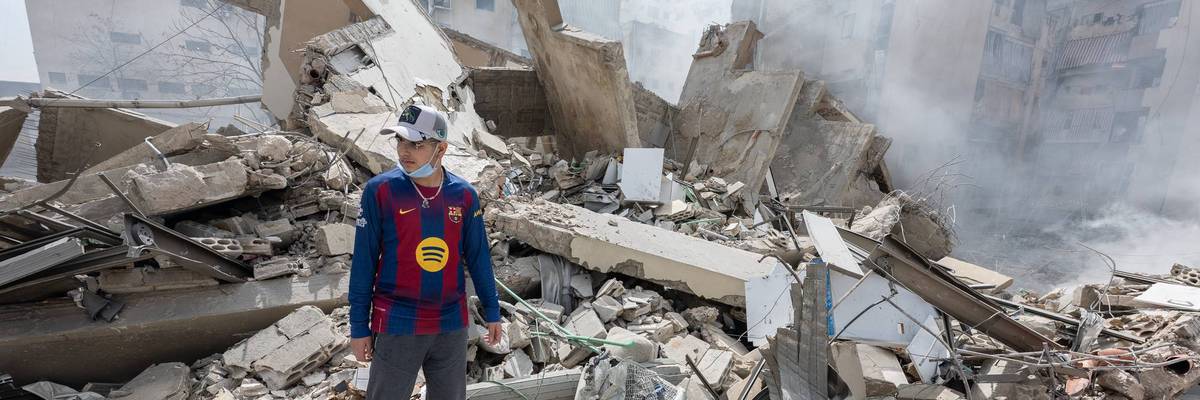
The remains of the residential Ahmad Abass Building in the Bachoura neighbourhood of central Beirut after it was destroyed at 5:30 am by the Israeli air force following an evacuation order around 4 am on March 18, 2026, in Beirut, Lebanon.
"All of Beirut shook," said one resident who was forced to take shelter in the city after an Israeli displacement order forced her from her home in the suburbs.
An Israeli airstrike totally demolished a large apartment building in central Beirut on Wednesday, following a night of attacks on densely populated residential areas, several of which reportedly came without warning.
Videos shared to social media and by local media outlets show the 10-story building, located in the Bachoura neighbourhood in central Beirut, suddenly collapsing into rubble in the early hours of the morning after being struck with a missile.
Israeli authorities issued a forced displacement order to residents of the building over social media around 4 am local time, roughly an hour before the strike. It warned residents of buildings in the Bachoura area that they were "located near Hezbollah facilities" and needed to move at least 300 meters away.
Israel has claimed the building was used by the militant group Hezbollah to stash large sums of money, but has provided no evidence publicly.
Citing Lebanon's Health Ministry, the Associated Press reported that at least four people were wounded in the attack, which sent emergency teams rushing to the scene through a plume of black smoke.
Residents of the collapsed apartment building have taken to social media to describe their horror at seeing their home suddenly destroyed.
"I am a US citizen and surgeon who took care of the Boston Marathon bombing victims in 2013," said Haytham Kaafarani, a professor of surgery at Harvard Medical School. "I paid for seven years to own a small apartment in downtown Beirut for my three kids to enjoy summers there. Today, Israel reduced my dream home to rubble, with American weapons, paid by my taxes."
Another professor, Bilal R. Kaafarani, who teaches chemistry at the American University of Beirut, said something similar.
"Israel demolished the building I have an apartment in. It took 22 years of my work here and 20 years of my wife’s work to own this apartment," he said. "This madness has to stop."
The attack came after a night of intense airstrikes upon civilian areas in Lebanon's capital, which reportedly came without warning in the middle of the night and into the early morning.
According to Lebanese authorities, at least 20 people were killed in a series of attacks on Beirut and the southern and eastern parts of the country, while dozens more were injured.
Lebanon's health ministry reported that more than 900 people have been killed and 2,200 injured in Israel's latest round of attacks in Lebanon, which began on March 2 after Hezbollah retaliated against the US-Israeli war in Iran.
The attacks beginning Tuesday night came less than a day after Volker Türk, the United Nations High Commissioner for Human Rights, warned that "deliberately attacking civilians or civilian objects amounts to a war crime,” noting that hundreds of homes and other civilian infrastructure, including health facilities, had been destroyed by prior Israeli attacks in Beirut.
Israel has issued evacuation orders that have forced more than 1 million Lebanese people from their homes as part of an expanding ground invasion into southern Lebanon.
Sara Saleh, a 29-year-old taking shelter in a nearby school after being forced from her home in Beirut's southern suburbs, told the Agence France-Presse that she and her family "were asleep" when Israel's warning came down early Wednesday morning. She said they were left to flee for safety in their pajamas.
She said the attack on the apartment "was terrifying... all of Beirut shook." Speaking with a face mask to protect herself from dust kicked up by the demolished building, she said her sister's children "started crying and panicking, it was heartbreaking."
The mass displacement of civilians in Lebanon and Iran has been met with increasing criticism from UN experts and human rights organizations.
As reports of the apartment bombing rolled in, Philippe Lazzarini, the commissioner-general of the UN agency for Palestinian Refugees (UNRWA), said that "international law is being openly ignored" and that "impunity reigns and disproportionate actions are being normalized amid the escalating conflicts in the Middle East."
"It is a vicious circle," he said. "The more violations, the stronger the culture of impunity becomes."
Dear Common Dreams reader, It’s been nearly 30 years since I co-founded Common Dreams with my late wife, Lina Newhouser. We had the radical notion that journalism should serve the public good, not corporate profits. It was clear to us from the outset what it would take to build such a project. No paid advertisements. No corporate sponsors. No millionaire publisher telling us what to think or do. Many people said we wouldn't last a year, but we proved those doubters wrong. Together with a tremendous team of journalists and dedicated staff, we built an independent media outlet free from the constraints of profits and corporate control. Our mission has always been simple: To inform. To inspire. To ignite change for the common good. Building Common Dreams was not easy. Our survival was never guaranteed. When you take on the most powerful forces—Wall Street greed, fossil fuel industry destruction, Big Tech lobbyists, and uber-rich oligarchs who have spent billions upon billions rigging the economy and democracy in their favor—the only bulwark you have is supporters who believe in your work. But here’s the urgent message from me today. It's never been this bad out there. And it's never been this hard to keep us going. At the very moment Common Dreams is most needed, the threats we face are intensifying. We need your support now more than ever. We don't accept corporate advertising and never will. We don't have a paywall because we don't think people should be blocked from critical news based on their ability to pay. Everything we do is funded by the donations of readers like you. When everyone does the little they can afford, we are strong. But if that support retreats or dries up, so do we. Will you donate now to make sure Common Dreams not only survives but thrives? —Craig Brown, Co-founder |
An Israeli airstrike totally demolished a large apartment building in central Beirut on Wednesday, following a night of attacks on densely populated residential areas, several of which reportedly came without warning.
Videos shared to social media and by local media outlets show the 10-story building, located in the Bachoura neighbourhood in central Beirut, suddenly collapsing into rubble in the early hours of the morning after being struck with a missile.
Israeli authorities issued a forced displacement order to residents of the building over social media around 4 am local time, roughly an hour before the strike. It warned residents of buildings in the Bachoura area that they were "located near Hezbollah facilities" and needed to move at least 300 meters away.
Israel has claimed the building was used by the militant group Hezbollah to stash large sums of money, but has provided no evidence publicly.
Citing Lebanon's Health Ministry, the Associated Press reported that at least four people were wounded in the attack, which sent emergency teams rushing to the scene through a plume of black smoke.
Residents of the collapsed apartment building have taken to social media to describe their horror at seeing their home suddenly destroyed.
"I am a US citizen and surgeon who took care of the Boston Marathon bombing victims in 2013," said Haytham Kaafarani, a professor of surgery at Harvard Medical School. "I paid for seven years to own a small apartment in downtown Beirut for my three kids to enjoy summers there. Today, Israel reduced my dream home to rubble, with American weapons, paid by my taxes."
Another professor, Bilal R. Kaafarani, who teaches chemistry at the American University of Beirut, said something similar.
"Israel demolished the building I have an apartment in. It took 22 years of my work here and 20 years of my wife’s work to own this apartment," he said. "This madness has to stop."
The attack came after a night of intense airstrikes upon civilian areas in Lebanon's capital, which reportedly came without warning in the middle of the night and into the early morning.
According to Lebanese authorities, at least 20 people were killed in a series of attacks on Beirut and the southern and eastern parts of the country, while dozens more were injured.
Lebanon's health ministry reported that more than 900 people have been killed and 2,200 injured in Israel's latest round of attacks in Lebanon, which began on March 2 after Hezbollah retaliated against the US-Israeli war in Iran.
The attacks beginning Tuesday night came less than a day after Volker Türk, the United Nations High Commissioner for Human Rights, warned that "deliberately attacking civilians or civilian objects amounts to a war crime,” noting that hundreds of homes and other civilian infrastructure, including health facilities, had been destroyed by prior Israeli attacks in Beirut.
Israel has issued evacuation orders that have forced more than 1 million Lebanese people from their homes as part of an expanding ground invasion into southern Lebanon.
Sara Saleh, a 29-year-old taking shelter in a nearby school after being forced from her home in Beirut's southern suburbs, told the Agence France-Presse that she and her family "were asleep" when Israel's warning came down early Wednesday morning. She said they were left to flee for safety in their pajamas.
She said the attack on the apartment "was terrifying... all of Beirut shook." Speaking with a face mask to protect herself from dust kicked up by the demolished building, she said her sister's children "started crying and panicking, it was heartbreaking."
The mass displacement of civilians in Lebanon and Iran has been met with increasing criticism from UN experts and human rights organizations.
As reports of the apartment bombing rolled in, Philippe Lazzarini, the commissioner-general of the UN agency for Palestinian Refugees (UNRWA), said that "international law is being openly ignored" and that "impunity reigns and disproportionate actions are being normalized amid the escalating conflicts in the Middle East."
"It is a vicious circle," he said. "The more violations, the stronger the culture of impunity becomes."
An Israeli airstrike totally demolished a large apartment building in central Beirut on Wednesday, following a night of attacks on densely populated residential areas, several of which reportedly came without warning.
Videos shared to social media and by local media outlets show the 10-story building, located in the Bachoura neighbourhood in central Beirut, suddenly collapsing into rubble in the early hours of the morning after being struck with a missile.
Israeli authorities issued a forced displacement order to residents of the building over social media around 4 am local time, roughly an hour before the strike. It warned residents of buildings in the Bachoura area that they were "located near Hezbollah facilities" and needed to move at least 300 meters away.
Israel has claimed the building was used by the militant group Hezbollah to stash large sums of money, but has provided no evidence publicly.
Citing Lebanon's Health Ministry, the Associated Press reported that at least four people were wounded in the attack, which sent emergency teams rushing to the scene through a plume of black smoke.
Residents of the collapsed apartment building have taken to social media to describe their horror at seeing their home suddenly destroyed.
"I am a US citizen and surgeon who took care of the Boston Marathon bombing victims in 2013," said Haytham Kaafarani, a professor of surgery at Harvard Medical School. "I paid for seven years to own a small apartment in downtown Beirut for my three kids to enjoy summers there. Today, Israel reduced my dream home to rubble, with American weapons, paid by my taxes."
Another professor, Bilal R. Kaafarani, who teaches chemistry at the American University of Beirut, said something similar.
"Israel demolished the building I have an apartment in. It took 22 years of my work here and 20 years of my wife’s work to own this apartment," he said. "This madness has to stop."
The attack came after a night of intense airstrikes upon civilian areas in Lebanon's capital, which reportedly came without warning in the middle of the night and into the early morning.
According to Lebanese authorities, at least 20 people were killed in a series of attacks on Beirut and the southern and eastern parts of the country, while dozens more were injured.
Lebanon's health ministry reported that more than 900 people have been killed and 2,200 injured in Israel's latest round of attacks in Lebanon, which began on March 2 after Hezbollah retaliated against the US-Israeli war in Iran.
The attacks beginning Tuesday night came less than a day after Volker Türk, the United Nations High Commissioner for Human Rights, warned that "deliberately attacking civilians or civilian objects amounts to a war crime,” noting that hundreds of homes and other civilian infrastructure, including health facilities, had been destroyed by prior Israeli attacks in Beirut.
Israel has issued evacuation orders that have forced more than 1 million Lebanese people from their homes as part of an expanding ground invasion into southern Lebanon.
Sara Saleh, a 29-year-old taking shelter in a nearby school after being forced from her home in Beirut's southern suburbs, told the Agence France-Presse that she and her family "were asleep" when Israel's warning came down early Wednesday morning. She said they were left to flee for safety in their pajamas.
She said the attack on the apartment "was terrifying... all of Beirut shook." Speaking with a face mask to protect herself from dust kicked up by the demolished building, she said her sister's children "started crying and panicking, it was heartbreaking."
The mass displacement of civilians in Lebanon and Iran has been met with increasing criticism from UN experts and human rights organizations.
As reports of the apartment bombing rolled in, Philippe Lazzarini, the commissioner-general of the UN agency for Palestinian Refugees (UNRWA), said that "international law is being openly ignored" and that "impunity reigns and disproportionate actions are being normalized amid the escalating conflicts in the Middle East."
"It is a vicious circle," he said. "The more violations, the stronger the culture of impunity becomes."