
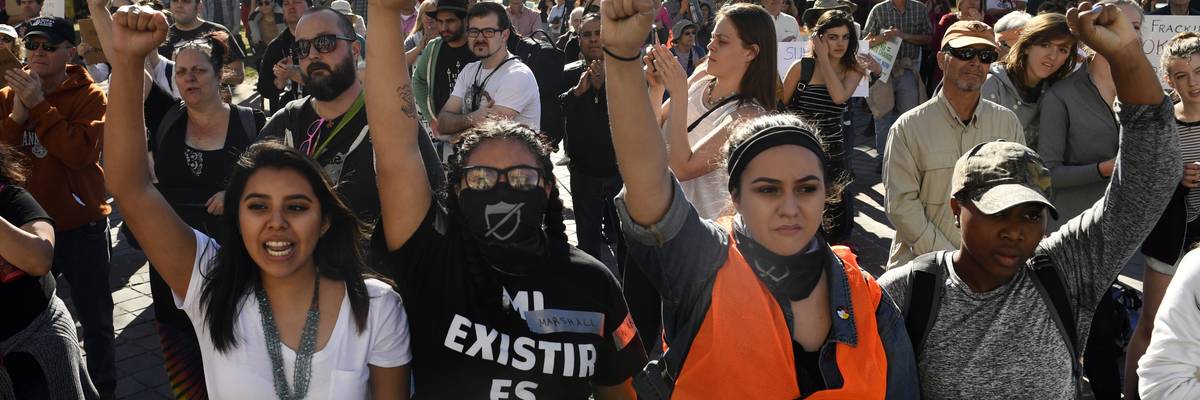
Youth protesters put up their fists as they participate in a rally on the west steps of the Colorado Capitol Building on February 20, 2017 in Denver, Colorado.
UN Affirms Climate Crisis Threatens Children's Rights, Potentially Bolstering Youth-Led Lawsuits
"States should take positive measures to ensure that children are protected from foreseeable premature or unnatural death and threats to their lives," reads the updated document
A group of children in Portugal who are expected to present arguments in a climate case at the European Court of Human Rights next month may have a stronger legal standing following a formal opinion issued Monday by a United Nations committee, which affirms that the climate, biodiversity, and pollution crises present "an urgent and systemic threat to children's rights globally."
After consulting with more than 16,000 children in more than 120 countries, the U.N. Committee on the Rights of the Child updated the 1989 Convention on children's rights to say that there is an urgent need to address the "triple planetary crisis" and to explain "how children's rights under the Convention on the Rights of the Child apply to environmental protection, and confirms that children have a right to a clean, healthy and sustainable environment."
"The right to life is threatened by environmental degradation, including climate change, pollution, and biodiversity loss, which are closely linked to other fundamental challenges impeding the realization of this right, including poverty, inequality, and conflict," reads the document, which was updated after a two-year period of gathering input from children around the world. "States should take positive measures to ensure that children are protected from foreseeable premature or unnatural death and threats to their lives that may be caused by acts and omissions, as well as the activities of business actors, and enjoy their right to life with dignity."
The formal opinion—called General Comment No. 26—and updated document were released four weeks before the Portuguese case is set to go to court, where six children are preparing to argue that the 33 member-states of the European Union have failed to fight the climate crisis and to seek a legally binding decision requiring the countries to make immediate, deeper cuts to their fossil fuel emissions.
At least 19 other cases filed by youths in countries including Brazil, the United States, and Indonesia make similar arguments, and legal analysts said Monday that the updated treaty may help the young people in court.
"This could definitely strengthen their hand because now there's a fully articulated set of guidance that pulls everything together in one place," lawyer Ann Skelton, who chairs the U.N. Committee on the Rights of the Child, told Reuters.
Noam Peleg, a law professor at the University of New South Wales in Australia, wrote at The Conversation that the changes offer "a practical guide to help children" fight their government's continued support of planet-heating fossil fuels and clarifies that governments have an obligation to protect children from the climate emergency as part of their duty to defend human rights.
"The general comment also identifies children as agents in their own lives," said Peleg. "By extension, this means children have a right to participate in the drafting of environmental policies or laws that will affect them."
As Common Dreams reported last month, climate litigation has emerged in recent years as a key driver of climate justice.
The committee's changes were announced two weeks after a state judge in Montana ruled that the state violated the constitutional rights of 16 young residents by promoting fossil fuel extraction.
"Children worldwide have been leading the fight against climate change; calling on their governments and corporations to take action to protect the planet and their future," said David Boyd, U.N. special rapporteur on human rights and the environment. "With its General Comment No. 26, the Committee on the Rights of the Child not only echoes and amplifies children's voices, but also clearly defines the rights of children in relation to the environment that state parties should respect, protect and fulfill collectively and urgently."
Some young people and advocates who were consulted by the committee had pushed the panel to put the world's children in an even stronger legal position by calling on countries to take action beyond that which is demanded by the 2015 Paris climate agreement, which calls for emissions cuts that would limit planetary heating to 1.5°C above preindustrial temperatures.
Kelly Matheson, deputy director of global climate litigation at Our Children's Trust—which represented the children in the Montana case—told Reuters that the new document represents "such a missed opportunity."
"It's an exercise in incrementalism instead of taking quantum leap forward," Matheson said.
Committee member Philip Jaffé told Reuters that climate leader Greta Thunberg, who at 15 began a protest outside the Swedish Parliament that grew into the global school strike demanding climate action, had called on the panel "to be more vigorous and somewhat bolder."
We are at a crossroads
This country and this world are at a monumental crossroads. In a few short weeks, US voters will have an opportunity to beat back the forces of fascism and confront the billionaires who are rigging the economy, our media system, and our democracy, making it increasingly impossible for ordinary people to get by. We’re not just talking about the election. We’re talking about what must be done once these fascist elements are vanquished from power. We need a bolder set of solutions than what either major party has so far been willing to offer and a working-class movement ready to fight like hell for it. Trump didn't emerge from nowhere. The conditions that fueled MAGA authoritarianism were created by decades of radical neoliberal economic policies and a corrupt political system dominated by corporate interests. They slashed taxes on the super-rich, promising that the benefits would trickle down. They said giveaways to the corporate titans would make life more affordable for the rest of us. It was all bullshit. And when a bitter, betrayed populace searches for someone to blame, right-wing demagogues have little trouble finding scapegoats. People know when they're being lied to, but you won't hear any of this from the corporate media. Only independent journalism—powered and funded by people who believe in building a better world—can deliver truly trustworthy daily news. Our Fall Campaign is underway, and we need your help. To power our newsroom through the rest of the year, we need to raise $125,000 by midnight on October 31. So if you share our vision, please contribute whatever you can to sustain our work. |
A group of children in Portugal who are expected to present arguments in a climate case at the European Court of Human Rights next month may have a stronger legal standing following a formal opinion issued Monday by a United Nations committee, which affirms that the climate, biodiversity, and pollution crises present "an urgent and systemic threat to children's rights globally."
After consulting with more than 16,000 children in more than 120 countries, the U.N. Committee on the Rights of the Child updated the 1989 Convention on children's rights to say that there is an urgent need to address the "triple planetary crisis" and to explain "how children's rights under the Convention on the Rights of the Child apply to environmental protection, and confirms that children have a right to a clean, healthy and sustainable environment."
"The right to life is threatened by environmental degradation, including climate change, pollution, and biodiversity loss, which are closely linked to other fundamental challenges impeding the realization of this right, including poverty, inequality, and conflict," reads the document, which was updated after a two-year period of gathering input from children around the world. "States should take positive measures to ensure that children are protected from foreseeable premature or unnatural death and threats to their lives that may be caused by acts and omissions, as well as the activities of business actors, and enjoy their right to life with dignity."
The formal opinion—called General Comment No. 26—and updated document were released four weeks before the Portuguese case is set to go to court, where six children are preparing to argue that the 33 member-states of the European Union have failed to fight the climate crisis and to seek a legally binding decision requiring the countries to make immediate, deeper cuts to their fossil fuel emissions.
At least 19 other cases filed by youths in countries including Brazil, the United States, and Indonesia make similar arguments, and legal analysts said Monday that the updated treaty may help the young people in court.
"This could definitely strengthen their hand because now there's a fully articulated set of guidance that pulls everything together in one place," lawyer Ann Skelton, who chairs the U.N. Committee on the Rights of the Child, told Reuters.
Noam Peleg, a law professor at the University of New South Wales in Australia, wrote at The Conversation that the changes offer "a practical guide to help children" fight their government's continued support of planet-heating fossil fuels and clarifies that governments have an obligation to protect children from the climate emergency as part of their duty to defend human rights.
"The general comment also identifies children as agents in their own lives," said Peleg. "By extension, this means children have a right to participate in the drafting of environmental policies or laws that will affect them."
As Common Dreams reported last month, climate litigation has emerged in recent years as a key driver of climate justice.
The committee's changes were announced two weeks after a state judge in Montana ruled that the state violated the constitutional rights of 16 young residents by promoting fossil fuel extraction.
"Children worldwide have been leading the fight against climate change; calling on their governments and corporations to take action to protect the planet and their future," said David Boyd, U.N. special rapporteur on human rights and the environment. "With its General Comment No. 26, the Committee on the Rights of the Child not only echoes and amplifies children's voices, but also clearly defines the rights of children in relation to the environment that state parties should respect, protect and fulfill collectively and urgently."
Some young people and advocates who were consulted by the committee had pushed the panel to put the world's children in an even stronger legal position by calling on countries to take action beyond that which is demanded by the 2015 Paris climate agreement, which calls for emissions cuts that would limit planetary heating to 1.5°C above preindustrial temperatures.
Kelly Matheson, deputy director of global climate litigation at Our Children's Trust—which represented the children in the Montana case—told Reuters that the new document represents "such a missed opportunity."
"It's an exercise in incrementalism instead of taking quantum leap forward," Matheson said.
Committee member Philip Jaffé told Reuters that climate leader Greta Thunberg, who at 15 began a protest outside the Swedish Parliament that grew into the global school strike demanding climate action, had called on the panel "to be more vigorous and somewhat bolder."
- 'This Is Huge': Judge Sides With Montana Youths in Historic Climate Ruling ›
- 'How Dare You!': Greta Thunberg Rages at 'Fairytales of Eternal Economic Growth' at UN Climate Summit ›
- Right-Wing Think Tank's Climate 'Battle Plan' Wages 'War Against Our Children's Future' ›
- 'Truly Historic' Youth-Led Climate Case Arrives at European Human Rights Court ›
- 'Earth Needs Our Help': California Kids Sue EPA Over Climate Pollution ›
A group of children in Portugal who are expected to present arguments in a climate case at the European Court of Human Rights next month may have a stronger legal standing following a formal opinion issued Monday by a United Nations committee, which affirms that the climate, biodiversity, and pollution crises present "an urgent and systemic threat to children's rights globally."
After consulting with more than 16,000 children in more than 120 countries, the U.N. Committee on the Rights of the Child updated the 1989 Convention on children's rights to say that there is an urgent need to address the "triple planetary crisis" and to explain "how children's rights under the Convention on the Rights of the Child apply to environmental protection, and confirms that children have a right to a clean, healthy and sustainable environment."
"The right to life is threatened by environmental degradation, including climate change, pollution, and biodiversity loss, which are closely linked to other fundamental challenges impeding the realization of this right, including poverty, inequality, and conflict," reads the document, which was updated after a two-year period of gathering input from children around the world. "States should take positive measures to ensure that children are protected from foreseeable premature or unnatural death and threats to their lives that may be caused by acts and omissions, as well as the activities of business actors, and enjoy their right to life with dignity."
The formal opinion—called General Comment No. 26—and updated document were released four weeks before the Portuguese case is set to go to court, where six children are preparing to argue that the 33 member-states of the European Union have failed to fight the climate crisis and to seek a legally binding decision requiring the countries to make immediate, deeper cuts to their fossil fuel emissions.
At least 19 other cases filed by youths in countries including Brazil, the United States, and Indonesia make similar arguments, and legal analysts said Monday that the updated treaty may help the young people in court.
"This could definitely strengthen their hand because now there's a fully articulated set of guidance that pulls everything together in one place," lawyer Ann Skelton, who chairs the U.N. Committee on the Rights of the Child, told Reuters.
Noam Peleg, a law professor at the University of New South Wales in Australia, wrote at The Conversation that the changes offer "a practical guide to help children" fight their government's continued support of planet-heating fossil fuels and clarifies that governments have an obligation to protect children from the climate emergency as part of their duty to defend human rights.
"The general comment also identifies children as agents in their own lives," said Peleg. "By extension, this means children have a right to participate in the drafting of environmental policies or laws that will affect them."
As Common Dreams reported last month, climate litigation has emerged in recent years as a key driver of climate justice.
The committee's changes were announced two weeks after a state judge in Montana ruled that the state violated the constitutional rights of 16 young residents by promoting fossil fuel extraction.
"Children worldwide have been leading the fight against climate change; calling on their governments and corporations to take action to protect the planet and their future," said David Boyd, U.N. special rapporteur on human rights and the environment. "With its General Comment No. 26, the Committee on the Rights of the Child not only echoes and amplifies children's voices, but also clearly defines the rights of children in relation to the environment that state parties should respect, protect and fulfill collectively and urgently."
Some young people and advocates who were consulted by the committee had pushed the panel to put the world's children in an even stronger legal position by calling on countries to take action beyond that which is demanded by the 2015 Paris climate agreement, which calls for emissions cuts that would limit planetary heating to 1.5°C above preindustrial temperatures.
Kelly Matheson, deputy director of global climate litigation at Our Children's Trust—which represented the children in the Montana case—told Reuters that the new document represents "such a missed opportunity."
"It's an exercise in incrementalism instead of taking quantum leap forward," Matheson said.
Committee member Philip Jaffé told Reuters that climate leader Greta Thunberg, who at 15 began a protest outside the Swedish Parliament that grew into the global school strike demanding climate action, had called on the panel "to be more vigorous and somewhat bolder."
- 'This Is Huge': Judge Sides With Montana Youths in Historic Climate Ruling ›
- 'How Dare You!': Greta Thunberg Rages at 'Fairytales of Eternal Economic Growth' at UN Climate Summit ›
- Right-Wing Think Tank's Climate 'Battle Plan' Wages 'War Against Our Children's Future' ›
- 'Truly Historic' Youth-Led Climate Case Arrives at European Human Rights Court ›
- 'Earth Needs Our Help': California Kids Sue EPA Over Climate Pollution ›