SUBSCRIBE TO OUR FREE NEWSLETTER
Daily news & progressive opinion—funded by the people, not the corporations—delivered straight to your inbox.
5
#000000
#FFFFFF
To donate by check, phone, or other method, see our More Ways to Give page.
Daily news & progressive opinion—funded by the people, not the corporations—delivered straight to your inbox.
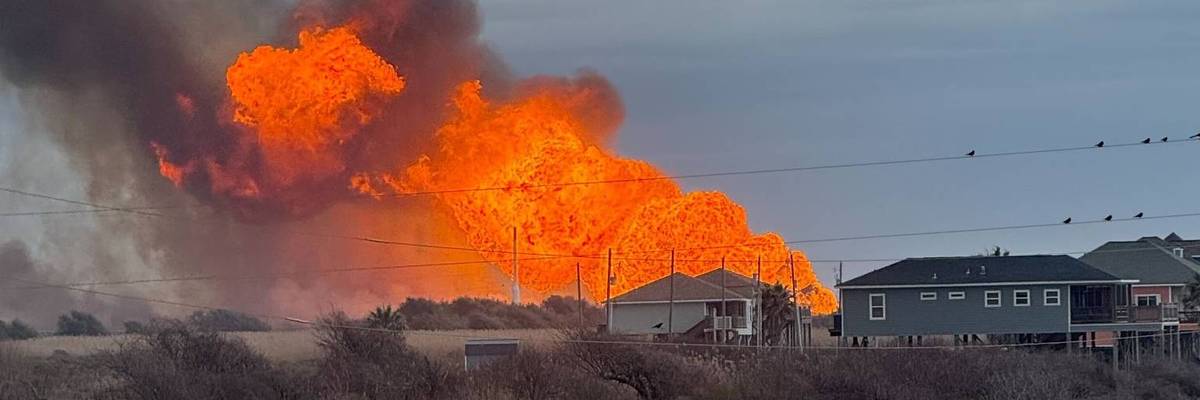
Delfin Pipeline explodes on February 3, 2026 in Cameron Parish, Louisiana.
The explosion "starkly illustrates the dangers of fossil fuel infrastructure, particularly its impact on vulnerable communities," one environmental justice leader said.
A pipeline explosion in Cameron Parish, Louisiana—a coastal community in the epicenter of the liquefied natural gas buildout—offers an object lesson in the immediate dangers posed by oil and gas expansion, frontline advocates warned.
The explosion occurred at around 11:00 am Central time on Tuesday on the Delfin LNG pipeline, injuring one worker, forcing nearby Johnson Bayou High School to shelter in place, and sending a wall of smoke and flame into the sky.
Community activist Roishetta Ozane of the Vessel Project of Louisiana said the blast "starkly illustrates the dangers of fossil fuel infrastructure, particularly its impact on vulnerable communities. This incident is a chilling reminder of the environmental injustice that disproportionately affects people of color, low-income populations, and especially fishermen."
Environmental justice campaigners and local residents, including fishers, have been pushing back in recent years against an LNG export boom in the Gulf South that threatens their local ecosystems, health, and livelihoods—not to mention the stability of the global climate.
"Today’s explosion and ongoing fire are a stark reminder that what they’re selling is highly combustible methane gas—a volatile fossil fuel.”
"This is a prime example of why we are fighting against this," Fisherman Involved in Sustaining Our Heritage (FISH) wrote in a post on Facebook in response to the news.
Cameron Parish is home to the largest LNG terminal in the country—Cheniere Energy's Sabine Pass—as well as Venture Global's controversial Calcasieu Pass terminal, which violated its air permits more than 2,000 times during its first year of operation. Residents say the pollution is harming their health and that dredging and export tankers are destroying habitat for local fisheries. The situation is only set to deteriorate, as last year the Trump administration approved construction of a second Venture Global terminal and allowed the company to increase exports from its first as part of its push to ramp up fossil energy production.
Delfin is part of the LNG expansion. It is constructing an offshore terminal consisting of three vessels connected to preexisting pipelines which will eventually be able to produce 4 million tons of methane gas. Preliminary actions were being performed on the line when it exploded Tuesday, Ashley Buller, assistant director of Cameron Parish's emergency preparedness department, told The Advocate.
The cause of the explosion is not yet known, though the Louisiana State Police have promised an investigation, but for watchdog groups documenting fossil fuel expansion in the state, it does not come as a surprise.
“Every minute of every day, countless corporations pump oil, gas, and chemicals across Louisiana via pipeline. That means at any given moment, a Louisiana community could be faced with a leak; an explosion; or contamination of their air, land, or water," said Anne Rolfes of the Louisiana Bucket Brigade. "The industry likes to use marketing terms like 'natural gas' to make their products seem benign, but today’s explosion and ongoing fire are a stark reminder that what they’re selling is highly combustible methane gas—a volatile fossil fuel.”
Ozane noted: "Fossil fuel pipelines pose significant risks due to leaks and explosions, exposing nearby residents to hazardous pollutants linked to severe health issues, including respiratory disorders and cancer. Often, these pipelines are placed in marginalized neighborhoods, a product of systemic inequities that prioritize corporate profit over community safety. The cumulative effects of pollution exacerbate existing health disparities, leaving these communities more vulnerable to chronic illnesses."
"The dangers extend beyond immediate incidents," she continued. "The entire lifecycle of fossil fuel extraction and consumption contributes to environmental degradation and climate change, disproportionately impacting marginalized groups. Furthermore, the rise of energy-intensive data centers, often powered by fossil fuels, adds another layer of pollution, perpetuating a cycle of harm."
"They don't only export the gas, they export the profits too."
FISH also pointed to the lingering effects of fossil fuel pollution, and criticized the official line reported in local media that there were "no off-site impacts from the explosion," calling it "one of the most disturbing industry lies."
"The air, the water, and our wetlands are impacted far beyond their chain link fences," the group wrote. "The people are not protected by chain link fences and concrete barriers."
FISH executive director Robyn Thigpen also emphasized to The Advocate that Cameron Parish's hospital had not reopened since it was damaged by Hurricane Laura in 2020, increasing the potential danger of pipeline explosions.
"It's really important that people understand they never reopened a hospital," she said.
The worker who was injured was transported to a facility in Port Arthur, Texas.
The climate crisis increases the chances of powerful storms like Laura and Rita, a 2005 hurricane which devastated the area and started a trend of long-term population decline, providing an example of how the fossil fuel industry threatens the people of Cameron Parish in multiple ways. Yet while it increases risks, the LNG boom has not brought greater prosperity to ordinary citizens of the parish.
"We are the largest exporter of natural gas in the world, and to look around this place, you would not know the wealth," For a Better Bayou Director James Hiatt told The Advocate. "Because they don't only export the gas, they export the profits too."
Community activists called on local and national leaders to reassess their reliance on fossil fuel energy sources and move toward safer renewable alternatives.
“Before approving the next pipeline, LNG export terminal, or [carbon, capture, and storage] project, Gov. [Jeff] Landry and state regulators should remember today’s incident and what these projects cost our communities," Rolfe said.
Ozane concluded: "Each explosion not only results in loss of life and property but also inflicts lasting trauma on families and communities. It is imperative to advocate for the cessation of new fossil fuel projects and demand clean energy alternatives. We must address the systemic inequalities that put vulnerable populations at risk, ensuring that no community is sacrificed for corporate gain."
Dear Common Dreams reader, It’s been nearly 30 years since I co-founded Common Dreams with my late wife, Lina Newhouser. We had the radical notion that journalism should serve the public good, not corporate profits. It was clear to us from the outset what it would take to build such a project. No paid advertisements. No corporate sponsors. No millionaire publisher telling us what to think or do. Many people said we wouldn't last a year, but we proved those doubters wrong. Together with a tremendous team of journalists and dedicated staff, we built an independent media outlet free from the constraints of profits and corporate control. Our mission has always been simple: To inform. To inspire. To ignite change for the common good. Building Common Dreams was not easy. Our survival was never guaranteed. When you take on the most powerful forces—Wall Street greed, fossil fuel industry destruction, Big Tech lobbyists, and uber-rich oligarchs who have spent billions upon billions rigging the economy and democracy in their favor—the only bulwark you have is supporters who believe in your work. But here’s the urgent message from me today. It's never been this bad out there. And it's never been this hard to keep us going. At the very moment Common Dreams is most needed, the threats we face are intensifying. We need your support now more than ever. We don't accept corporate advertising and never will. We don't have a paywall because we don't think people should be blocked from critical news based on their ability to pay. Everything we do is funded by the donations of readers like you. When everyone does the little they can afford, we are strong. But if that support retreats or dries up, so do we. Will you donate now to make sure Common Dreams not only survives but thrives? —Craig Brown, Co-founder |
A pipeline explosion in Cameron Parish, Louisiana—a coastal community in the epicenter of the liquefied natural gas buildout—offers an object lesson in the immediate dangers posed by oil and gas expansion, frontline advocates warned.
The explosion occurred at around 11:00 am Central time on Tuesday on the Delfin LNG pipeline, injuring one worker, forcing nearby Johnson Bayou High School to shelter in place, and sending a wall of smoke and flame into the sky.
Community activist Roishetta Ozane of the Vessel Project of Louisiana said the blast "starkly illustrates the dangers of fossil fuel infrastructure, particularly its impact on vulnerable communities. This incident is a chilling reminder of the environmental injustice that disproportionately affects people of color, low-income populations, and especially fishermen."
Environmental justice campaigners and local residents, including fishers, have been pushing back in recent years against an LNG export boom in the Gulf South that threatens their local ecosystems, health, and livelihoods—not to mention the stability of the global climate.
"Today’s explosion and ongoing fire are a stark reminder that what they’re selling is highly combustible methane gas—a volatile fossil fuel.”
"This is a prime example of why we are fighting against this," Fisherman Involved in Sustaining Our Heritage (FISH) wrote in a post on Facebook in response to the news.
Cameron Parish is home to the largest LNG terminal in the country—Cheniere Energy's Sabine Pass—as well as Venture Global's controversial Calcasieu Pass terminal, which violated its air permits more than 2,000 times during its first year of operation. Residents say the pollution is harming their health and that dredging and export tankers are destroying habitat for local fisheries. The situation is only set to deteriorate, as last year the Trump administration approved construction of a second Venture Global terminal and allowed the company to increase exports from its first as part of its push to ramp up fossil energy production.
Delfin is part of the LNG expansion. It is constructing an offshore terminal consisting of three vessels connected to preexisting pipelines which will eventually be able to produce 4 million tons of methane gas. Preliminary actions were being performed on the line when it exploded Tuesday, Ashley Buller, assistant director of Cameron Parish's emergency preparedness department, told The Advocate.
The cause of the explosion is not yet known, though the Louisiana State Police have promised an investigation, but for watchdog groups documenting fossil fuel expansion in the state, it does not come as a surprise.
“Every minute of every day, countless corporations pump oil, gas, and chemicals across Louisiana via pipeline. That means at any given moment, a Louisiana community could be faced with a leak; an explosion; or contamination of their air, land, or water," said Anne Rolfes of the Louisiana Bucket Brigade. "The industry likes to use marketing terms like 'natural gas' to make their products seem benign, but today’s explosion and ongoing fire are a stark reminder that what they’re selling is highly combustible methane gas—a volatile fossil fuel.”
Ozane noted: "Fossil fuel pipelines pose significant risks due to leaks and explosions, exposing nearby residents to hazardous pollutants linked to severe health issues, including respiratory disorders and cancer. Often, these pipelines are placed in marginalized neighborhoods, a product of systemic inequities that prioritize corporate profit over community safety. The cumulative effects of pollution exacerbate existing health disparities, leaving these communities more vulnerable to chronic illnesses."
"The dangers extend beyond immediate incidents," she continued. "The entire lifecycle of fossil fuel extraction and consumption contributes to environmental degradation and climate change, disproportionately impacting marginalized groups. Furthermore, the rise of energy-intensive data centers, often powered by fossil fuels, adds another layer of pollution, perpetuating a cycle of harm."
"They don't only export the gas, they export the profits too."
FISH also pointed to the lingering effects of fossil fuel pollution, and criticized the official line reported in local media that there were "no off-site impacts from the explosion," calling it "one of the most disturbing industry lies."
"The air, the water, and our wetlands are impacted far beyond their chain link fences," the group wrote. "The people are not protected by chain link fences and concrete barriers."
FISH executive director Robyn Thigpen also emphasized to The Advocate that Cameron Parish's hospital had not reopened since it was damaged by Hurricane Laura in 2020, increasing the potential danger of pipeline explosions.
"It's really important that people understand they never reopened a hospital," she said.
The worker who was injured was transported to a facility in Port Arthur, Texas.
The climate crisis increases the chances of powerful storms like Laura and Rita, a 2005 hurricane which devastated the area and started a trend of long-term population decline, providing an example of how the fossil fuel industry threatens the people of Cameron Parish in multiple ways. Yet while it increases risks, the LNG boom has not brought greater prosperity to ordinary citizens of the parish.
"We are the largest exporter of natural gas in the world, and to look around this place, you would not know the wealth," For a Better Bayou Director James Hiatt told The Advocate. "Because they don't only export the gas, they export the profits too."
Community activists called on local and national leaders to reassess their reliance on fossil fuel energy sources and move toward safer renewable alternatives.
“Before approving the next pipeline, LNG export terminal, or [carbon, capture, and storage] project, Gov. [Jeff] Landry and state regulators should remember today’s incident and what these projects cost our communities," Rolfe said.
Ozane concluded: "Each explosion not only results in loss of life and property but also inflicts lasting trauma on families and communities. It is imperative to advocate for the cessation of new fossil fuel projects and demand clean energy alternatives. We must address the systemic inequalities that put vulnerable populations at risk, ensuring that no community is sacrificed for corporate gain."
A pipeline explosion in Cameron Parish, Louisiana—a coastal community in the epicenter of the liquefied natural gas buildout—offers an object lesson in the immediate dangers posed by oil and gas expansion, frontline advocates warned.
The explosion occurred at around 11:00 am Central time on Tuesday on the Delfin LNG pipeline, injuring one worker, forcing nearby Johnson Bayou High School to shelter in place, and sending a wall of smoke and flame into the sky.
Community activist Roishetta Ozane of the Vessel Project of Louisiana said the blast "starkly illustrates the dangers of fossil fuel infrastructure, particularly its impact on vulnerable communities. This incident is a chilling reminder of the environmental injustice that disproportionately affects people of color, low-income populations, and especially fishermen."
Environmental justice campaigners and local residents, including fishers, have been pushing back in recent years against an LNG export boom in the Gulf South that threatens their local ecosystems, health, and livelihoods—not to mention the stability of the global climate.
"Today’s explosion and ongoing fire are a stark reminder that what they’re selling is highly combustible methane gas—a volatile fossil fuel.”
"This is a prime example of why we are fighting against this," Fisherman Involved in Sustaining Our Heritage (FISH) wrote in a post on Facebook in response to the news.
Cameron Parish is home to the largest LNG terminal in the country—Cheniere Energy's Sabine Pass—as well as Venture Global's controversial Calcasieu Pass terminal, which violated its air permits more than 2,000 times during its first year of operation. Residents say the pollution is harming their health and that dredging and export tankers are destroying habitat for local fisheries. The situation is only set to deteriorate, as last year the Trump administration approved construction of a second Venture Global terminal and allowed the company to increase exports from its first as part of its push to ramp up fossil energy production.
Delfin is part of the LNG expansion. It is constructing an offshore terminal consisting of three vessels connected to preexisting pipelines which will eventually be able to produce 4 million tons of methane gas. Preliminary actions were being performed on the line when it exploded Tuesday, Ashley Buller, assistant director of Cameron Parish's emergency preparedness department, told The Advocate.
The cause of the explosion is not yet known, though the Louisiana State Police have promised an investigation, but for watchdog groups documenting fossil fuel expansion in the state, it does not come as a surprise.
“Every minute of every day, countless corporations pump oil, gas, and chemicals across Louisiana via pipeline. That means at any given moment, a Louisiana community could be faced with a leak; an explosion; or contamination of their air, land, or water," said Anne Rolfes of the Louisiana Bucket Brigade. "The industry likes to use marketing terms like 'natural gas' to make their products seem benign, but today’s explosion and ongoing fire are a stark reminder that what they’re selling is highly combustible methane gas—a volatile fossil fuel.”
Ozane noted: "Fossil fuel pipelines pose significant risks due to leaks and explosions, exposing nearby residents to hazardous pollutants linked to severe health issues, including respiratory disorders and cancer. Often, these pipelines are placed in marginalized neighborhoods, a product of systemic inequities that prioritize corporate profit over community safety. The cumulative effects of pollution exacerbate existing health disparities, leaving these communities more vulnerable to chronic illnesses."
"The dangers extend beyond immediate incidents," she continued. "The entire lifecycle of fossil fuel extraction and consumption contributes to environmental degradation and climate change, disproportionately impacting marginalized groups. Furthermore, the rise of energy-intensive data centers, often powered by fossil fuels, adds another layer of pollution, perpetuating a cycle of harm."
"They don't only export the gas, they export the profits too."
FISH also pointed to the lingering effects of fossil fuel pollution, and criticized the official line reported in local media that there were "no off-site impacts from the explosion," calling it "one of the most disturbing industry lies."
"The air, the water, and our wetlands are impacted far beyond their chain link fences," the group wrote. "The people are not protected by chain link fences and concrete barriers."
FISH executive director Robyn Thigpen also emphasized to The Advocate that Cameron Parish's hospital had not reopened since it was damaged by Hurricane Laura in 2020, increasing the potential danger of pipeline explosions.
"It's really important that people understand they never reopened a hospital," she said.
The worker who was injured was transported to a facility in Port Arthur, Texas.
The climate crisis increases the chances of powerful storms like Laura and Rita, a 2005 hurricane which devastated the area and started a trend of long-term population decline, providing an example of how the fossil fuel industry threatens the people of Cameron Parish in multiple ways. Yet while it increases risks, the LNG boom has not brought greater prosperity to ordinary citizens of the parish.
"We are the largest exporter of natural gas in the world, and to look around this place, you would not know the wealth," For a Better Bayou Director James Hiatt told The Advocate. "Because they don't only export the gas, they export the profits too."
Community activists called on local and national leaders to reassess their reliance on fossil fuel energy sources and move toward safer renewable alternatives.
“Before approving the next pipeline, LNG export terminal, or [carbon, capture, and storage] project, Gov. [Jeff] Landry and state regulators should remember today’s incident and what these projects cost our communities," Rolfe said.
Ozane concluded: "Each explosion not only results in loss of life and property but also inflicts lasting trauma on families and communities. It is imperative to advocate for the cessation of new fossil fuel projects and demand clean energy alternatives. We must address the systemic inequalities that put vulnerable populations at risk, ensuring that no community is sacrificed for corporate gain."