SUBSCRIBE TO OUR FREE NEWSLETTER
Daily news & progressive opinion—funded by the people, not the corporations—delivered straight to your inbox.
5
#000000
#FFFFFF
To donate by check, phone, or other method, see our More Ways to Give page.
Daily news & progressive opinion—funded by the people, not the corporations—delivered straight to your inbox.
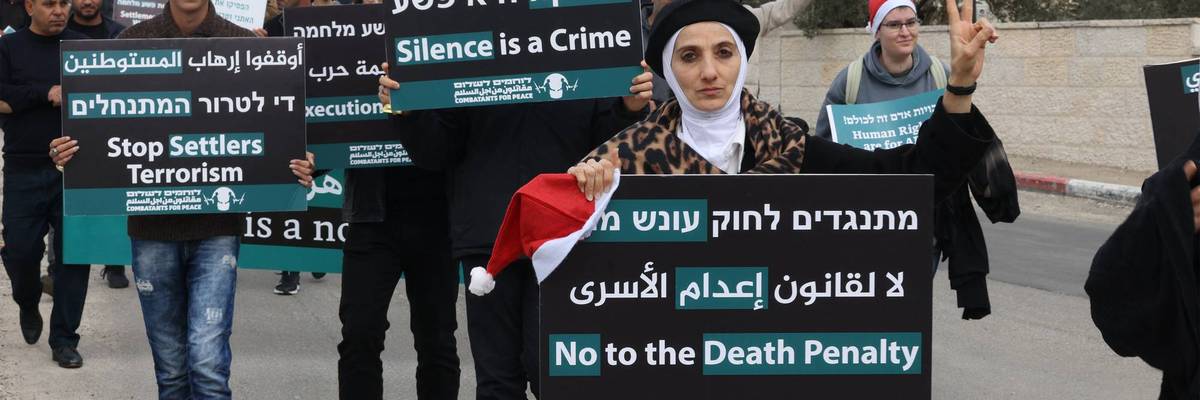
Israelis, Palestinians, and others demonstrate in Beit Jala village in the occupied West Bank city of Bethlehem on December 19, 2025, against a bill proposing the death penalty for Palestinians who kill Israelis.
“It seems the criminal apartheid state of Israel has grown impatient with slowly torturing, starving, and beating Palestinian hostages to death,” said one observer.
Israeli lawmakers on Tuesday voted to advance a bill legalizing execution by hanging of Palestinians convicted of "terrorism"-related killings, a move that prompted opponents to warn of mass executions under what one prominent human rights group called "apartheid" legislation.
The Knesset National Security Committee voted to send the bill for its final two readings before the Knesset General Assembly, which are expected to take place next week.
Bill sponsor Limor Son Har-Melech of the far-right Jewish Power Party called the bill's advancement a "moral and necessary step."
“The law sets out a clear and unequivocal message: Those who choose to murder Jews because they are Jews lose their right to live,” added Har-Melech.
The bill passed its first reading at the full Knesset last November, drawing widespread condemnation for provisions including mandatory death sentences without judicial discretion or possibility of pardons, to be carried out within 90 days.
Since then, amendments have been proposed to avoid accusations of discrimination amid the filing of around 2,000 proposed revisions by opposition lawmakers. Language under which Jewish Israelis who kill Palestinians are not subjected to the legislation has been softened; however, critics contend that in practice, the bill would apply predominantly to Palestinian perpetrators.
The bill also retains what critics say is a discriminatory two-track legal regime; one for military courts which have jurisdiction over Palestinians—but not Israeli settlers—in the illegally occupied West Bank, and another for civilian courts inside Israel and East Jerusalem, which, like wider West Bank, has been unlawfully occupied by Israel for nearly 59 years.
Israeli Prime Minister Benjamin Netanyahu had reportedly pushed for the changes, which also include allowing judicial discretion in sentencing and removing a requirement for trials to take place in military courts. Netanyahu—who is wanted by the International Criminal Court for alleged crimes against humanity and war crimes in Gaza—is said to be wary of more global backlash against a country already facing a genocide case at the International Court of Justice.
Israeli National Security Minister Itamar Ben-Gvir—who was ordered last week to remove a video promoting the bill, in which he stands by a gallows at a memorial to Jews executed in the 1930s and '40s for resisting British occupation—called Tuesday's vote "a historic moment of justice for the state of Israel."
"No more revolving door of attacks, imprisonments, and releases," he added. "This law restores deterrence, restores justice, and sends a clear and unambiguous message to our enemies: Jewish blood is not cheap. We will continue to lead an uncompromising policy against terror until victory.”
Studies in the United States—the only Western democracy that actively executes people—have repeatedly shown that the death penalty does not deter crime.
Knesset members opposing the legislation—who are believed to be outnumbered by more than 2 to 1—condemned Tuesday's vote.
Rabbi Gilad Kariv, who represents the left-wing Democrats, slammed what he called "an extreme bill that does not exist in any democratic country, with serious moral flaws and profound security recklessness.”
Har-Melech, Ben-Gvir, and other backers of the bill have repeatedly worn noose-shaped lapel pins to show their support for legislation. Ben-Gvir handed out sweets to Knesset colleagues after the bill passed its first reading. Har-Melech recently dressed as an executioner replete with noose and syringe for the Purim holiday, while her husband donned a costume representing what he called the themes of "occupation, expulsion, settlement"—or the conquest, ethnic cleansing, and settler-colonization of Palestine.
"With God's help, on next Purim we will need far more than a single breath to read the names of all the terrorists who were hanged," Har-Melech said in a video message marking the festive holiday. "And to the Jews there was light and joy and gladness."
Palestinians and their defenders warn that, if passed, the bill could open the door to mass executions.
Hamas, which still rules Gaza despite nearly 29 months of Israeli war and siege, called the bill “a dangerous terrorist step that paves the way for carrying out murder and liquidation crimes against our prisoners."
The Palestinian Prisoners Media Office said Wednesday in a statement: "This dangerous development constitutes an unprecedented escalation in the enemy's policies against our prisoners and represents a flagrant violation of all international laws and conventions. It reveals premeditated intentions to commit an organized crime against the prisoner movement."
The bill has sparked widespread condemnation around the world. United Nations experts have implored Israel to withdraw the bill, arguing it “would violate the right to life and discriminate against Palestinians in the occupied Palestinian territory."
The European Union Diplomatic Service said Tuesday that the EU "opposes capital punishment in all cases and under all circumstances."
"Israel has long upheld a de facto moratorium on both executions and capital punishment sentencing, thereby leading by example in the region despite a complex security environment," the agency added. "Approving this bill would represent a grave step backward from this important practice and from positions Israel has itself expressed in the past."
Israel abolished the death penalty for murder in 1954; currently, its only capital offenses are crimes against humanity and treason. The only execution in Israeli history occurred in 1962 when Holocaust architect Adolf Eichmann was hanged for genocide and crimes against humanity.
One senior Amnesty International official called the bill "yet another tool within Israel’s institutionalized system of apartheid against all Palestinians whose rights it controls."
Some critics noted that around 100 Palestinian prisoners have died in Israeli custody since the Hamas-led attack of October 2023, including some who were allegedly tortured or raped to death.
“Israel is already killing Palestinians on a regular basis—in detention facilities, and in the field, where lethal force is widely used by Israeli settlers and by the military with close to zero accountability,” Yuli Novak, executive director of the Israeli human rights group B'Tselem, told The Guardian on Wednesday, adding, "This law is another tool in this toolbox.’’
Dear Common Dreams reader, It’s been nearly 30 years since I co-founded Common Dreams with my late wife, Lina Newhouser. We had the radical notion that journalism should serve the public good, not corporate profits. It was clear to us from the outset what it would take to build such a project. No paid advertisements. No corporate sponsors. No millionaire publisher telling us what to think or do. Many people said we wouldn't last a year, but we proved those doubters wrong. Together with a tremendous team of journalists and dedicated staff, we built an independent media outlet free from the constraints of profits and corporate control. Our mission has always been simple: To inform. To inspire. To ignite change for the common good. Building Common Dreams was not easy. Our survival was never guaranteed. When you take on the most powerful forces—Wall Street greed, fossil fuel industry destruction, Big Tech lobbyists, and uber-rich oligarchs who have spent billions upon billions rigging the economy and democracy in their favor—the only bulwark you have is supporters who believe in your work. But here’s the urgent message from me today. It's never been this bad out there. And it's never been this hard to keep us going. At the very moment Common Dreams is most needed, the threats we face are intensifying. We need your support now more than ever. We don't accept corporate advertising and never will. We don't have a paywall because we don't think people should be blocked from critical news based on their ability to pay. Everything we do is funded by the donations of readers like you. When everyone does the little they can afford, we are strong. But if that support retreats or dries up, so do we. Will you donate now to make sure Common Dreams not only survives but thrives? —Craig Brown, Co-founder |
Israeli lawmakers on Tuesday voted to advance a bill legalizing execution by hanging of Palestinians convicted of "terrorism"-related killings, a move that prompted opponents to warn of mass executions under what one prominent human rights group called "apartheid" legislation.
The Knesset National Security Committee voted to send the bill for its final two readings before the Knesset General Assembly, which are expected to take place next week.
Bill sponsor Limor Son Har-Melech of the far-right Jewish Power Party called the bill's advancement a "moral and necessary step."
“The law sets out a clear and unequivocal message: Those who choose to murder Jews because they are Jews lose their right to live,” added Har-Melech.
The bill passed its first reading at the full Knesset last November, drawing widespread condemnation for provisions including mandatory death sentences without judicial discretion or possibility of pardons, to be carried out within 90 days.
Since then, amendments have been proposed to avoid accusations of discrimination amid the filing of around 2,000 proposed revisions by opposition lawmakers. Language under which Jewish Israelis who kill Palestinians are not subjected to the legislation has been softened; however, critics contend that in practice, the bill would apply predominantly to Palestinian perpetrators.
The bill also retains what critics say is a discriminatory two-track legal regime; one for military courts which have jurisdiction over Palestinians—but not Israeli settlers—in the illegally occupied West Bank, and another for civilian courts inside Israel and East Jerusalem, which, like wider West Bank, has been unlawfully occupied by Israel for nearly 59 years.
Israeli Prime Minister Benjamin Netanyahu had reportedly pushed for the changes, which also include allowing judicial discretion in sentencing and removing a requirement for trials to take place in military courts. Netanyahu—who is wanted by the International Criminal Court for alleged crimes against humanity and war crimes in Gaza—is said to be wary of more global backlash against a country already facing a genocide case at the International Court of Justice.
Israeli National Security Minister Itamar Ben-Gvir—who was ordered last week to remove a video promoting the bill, in which he stands by a gallows at a memorial to Jews executed in the 1930s and '40s for resisting British occupation—called Tuesday's vote "a historic moment of justice for the state of Israel."
"No more revolving door of attacks, imprisonments, and releases," he added. "This law restores deterrence, restores justice, and sends a clear and unambiguous message to our enemies: Jewish blood is not cheap. We will continue to lead an uncompromising policy against terror until victory.”
Studies in the United States—the only Western democracy that actively executes people—have repeatedly shown that the death penalty does not deter crime.
Knesset members opposing the legislation—who are believed to be outnumbered by more than 2 to 1—condemned Tuesday's vote.
Rabbi Gilad Kariv, who represents the left-wing Democrats, slammed what he called "an extreme bill that does not exist in any democratic country, with serious moral flaws and profound security recklessness.”
Har-Melech, Ben-Gvir, and other backers of the bill have repeatedly worn noose-shaped lapel pins to show their support for legislation. Ben-Gvir handed out sweets to Knesset colleagues after the bill passed its first reading. Har-Melech recently dressed as an executioner replete with noose and syringe for the Purim holiday, while her husband donned a costume representing what he called the themes of "occupation, expulsion, settlement"—or the conquest, ethnic cleansing, and settler-colonization of Palestine.
"With God's help, on next Purim we will need far more than a single breath to read the names of all the terrorists who were hanged," Har-Melech said in a video message marking the festive holiday. "And to the Jews there was light and joy and gladness."
Palestinians and their defenders warn that, if passed, the bill could open the door to mass executions.
Hamas, which still rules Gaza despite nearly 29 months of Israeli war and siege, called the bill “a dangerous terrorist step that paves the way for carrying out murder and liquidation crimes against our prisoners."
The Palestinian Prisoners Media Office said Wednesday in a statement: "This dangerous development constitutes an unprecedented escalation in the enemy's policies against our prisoners and represents a flagrant violation of all international laws and conventions. It reveals premeditated intentions to commit an organized crime against the prisoner movement."
The bill has sparked widespread condemnation around the world. United Nations experts have implored Israel to withdraw the bill, arguing it “would violate the right to life and discriminate against Palestinians in the occupied Palestinian territory."
The European Union Diplomatic Service said Tuesday that the EU "opposes capital punishment in all cases and under all circumstances."
"Israel has long upheld a de facto moratorium on both executions and capital punishment sentencing, thereby leading by example in the region despite a complex security environment," the agency added. "Approving this bill would represent a grave step backward from this important practice and from positions Israel has itself expressed in the past."
Israel abolished the death penalty for murder in 1954; currently, its only capital offenses are crimes against humanity and treason. The only execution in Israeli history occurred in 1962 when Holocaust architect Adolf Eichmann was hanged for genocide and crimes against humanity.
One senior Amnesty International official called the bill "yet another tool within Israel’s institutionalized system of apartheid against all Palestinians whose rights it controls."
Some critics noted that around 100 Palestinian prisoners have died in Israeli custody since the Hamas-led attack of October 2023, including some who were allegedly tortured or raped to death.
“Israel is already killing Palestinians on a regular basis—in detention facilities, and in the field, where lethal force is widely used by Israeli settlers and by the military with close to zero accountability,” Yuli Novak, executive director of the Israeli human rights group B'Tselem, told The Guardian on Wednesday, adding, "This law is another tool in this toolbox.’’
Israeli lawmakers on Tuesday voted to advance a bill legalizing execution by hanging of Palestinians convicted of "terrorism"-related killings, a move that prompted opponents to warn of mass executions under what one prominent human rights group called "apartheid" legislation.
The Knesset National Security Committee voted to send the bill for its final two readings before the Knesset General Assembly, which are expected to take place next week.
Bill sponsor Limor Son Har-Melech of the far-right Jewish Power Party called the bill's advancement a "moral and necessary step."
“The law sets out a clear and unequivocal message: Those who choose to murder Jews because they are Jews lose their right to live,” added Har-Melech.
The bill passed its first reading at the full Knesset last November, drawing widespread condemnation for provisions including mandatory death sentences without judicial discretion or possibility of pardons, to be carried out within 90 days.
Since then, amendments have been proposed to avoid accusations of discrimination amid the filing of around 2,000 proposed revisions by opposition lawmakers. Language under which Jewish Israelis who kill Palestinians are not subjected to the legislation has been softened; however, critics contend that in practice, the bill would apply predominantly to Palestinian perpetrators.
The bill also retains what critics say is a discriminatory two-track legal regime; one for military courts which have jurisdiction over Palestinians—but not Israeli settlers—in the illegally occupied West Bank, and another for civilian courts inside Israel and East Jerusalem, which, like wider West Bank, has been unlawfully occupied by Israel for nearly 59 years.
Israeli Prime Minister Benjamin Netanyahu had reportedly pushed for the changes, which also include allowing judicial discretion in sentencing and removing a requirement for trials to take place in military courts. Netanyahu—who is wanted by the International Criminal Court for alleged crimes against humanity and war crimes in Gaza—is said to be wary of more global backlash against a country already facing a genocide case at the International Court of Justice.
Israeli National Security Minister Itamar Ben-Gvir—who was ordered last week to remove a video promoting the bill, in which he stands by a gallows at a memorial to Jews executed in the 1930s and '40s for resisting British occupation—called Tuesday's vote "a historic moment of justice for the state of Israel."
"No more revolving door of attacks, imprisonments, and releases," he added. "This law restores deterrence, restores justice, and sends a clear and unambiguous message to our enemies: Jewish blood is not cheap. We will continue to lead an uncompromising policy against terror until victory.”
Studies in the United States—the only Western democracy that actively executes people—have repeatedly shown that the death penalty does not deter crime.
Knesset members opposing the legislation—who are believed to be outnumbered by more than 2 to 1—condemned Tuesday's vote.
Rabbi Gilad Kariv, who represents the left-wing Democrats, slammed what he called "an extreme bill that does not exist in any democratic country, with serious moral flaws and profound security recklessness.”
Har-Melech, Ben-Gvir, and other backers of the bill have repeatedly worn noose-shaped lapel pins to show their support for legislation. Ben-Gvir handed out sweets to Knesset colleagues after the bill passed its first reading. Har-Melech recently dressed as an executioner replete with noose and syringe for the Purim holiday, while her husband donned a costume representing what he called the themes of "occupation, expulsion, settlement"—or the conquest, ethnic cleansing, and settler-colonization of Palestine.
"With God's help, on next Purim we will need far more than a single breath to read the names of all the terrorists who were hanged," Har-Melech said in a video message marking the festive holiday. "And to the Jews there was light and joy and gladness."
Palestinians and their defenders warn that, if passed, the bill could open the door to mass executions.
Hamas, which still rules Gaza despite nearly 29 months of Israeli war and siege, called the bill “a dangerous terrorist step that paves the way for carrying out murder and liquidation crimes against our prisoners."
The Palestinian Prisoners Media Office said Wednesday in a statement: "This dangerous development constitutes an unprecedented escalation in the enemy's policies against our prisoners and represents a flagrant violation of all international laws and conventions. It reveals premeditated intentions to commit an organized crime against the prisoner movement."
The bill has sparked widespread condemnation around the world. United Nations experts have implored Israel to withdraw the bill, arguing it “would violate the right to life and discriminate against Palestinians in the occupied Palestinian territory."
The European Union Diplomatic Service said Tuesday that the EU "opposes capital punishment in all cases and under all circumstances."
"Israel has long upheld a de facto moratorium on both executions and capital punishment sentencing, thereby leading by example in the region despite a complex security environment," the agency added. "Approving this bill would represent a grave step backward from this important practice and from positions Israel has itself expressed in the past."
Israel abolished the death penalty for murder in 1954; currently, its only capital offenses are crimes against humanity and treason. The only execution in Israeli history occurred in 1962 when Holocaust architect Adolf Eichmann was hanged for genocide and crimes against humanity.
One senior Amnesty International official called the bill "yet another tool within Israel’s institutionalized system of apartheid against all Palestinians whose rights it controls."
Some critics noted that around 100 Palestinian prisoners have died in Israeli custody since the Hamas-led attack of October 2023, including some who were allegedly tortured or raped to death.
“Israel is already killing Palestinians on a regular basis—in detention facilities, and in the field, where lethal force is widely used by Israeli settlers and by the military with close to zero accountability,” Yuli Novak, executive director of the Israeli human rights group B'Tselem, told The Guardian on Wednesday, adding, "This law is another tool in this toolbox.’’