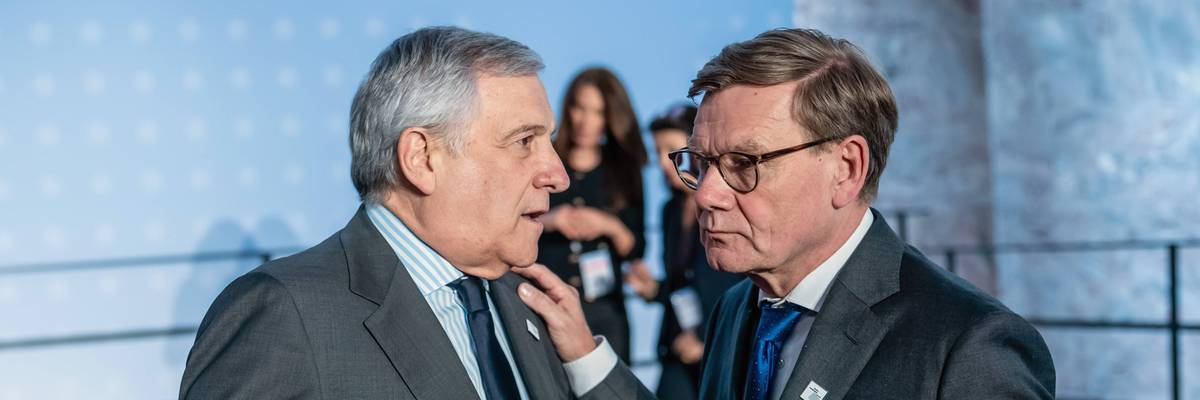
German Foreign Minister Johann Wadephul (R) speaks with Antonio Tajani, foreign minister of Italy (L), at the International Sudan Conference in Berlin on April 15, 2026.
'Shame!': Germany, Italy Block Effort to Suspend EU-Israel Trade Pact Over Gaza Genocide, West Bank Attacks
“The European Union can no longer remain on the sidelines,” said three foreign ministers who called for a suspension of the deal.
Calls have steadily intensified in recent weeks for the European Union to suspend a trade agreement with Israel as the country's right-wing government has ignored growing condemnation over its anti-Palestinian policies and its assaults on Gaza, the West Bank, and Lebanon—but on Tuesday, German and Italian officials blocked an effort to pause the trade deal, with Germany's foreign minister saying the move would be "inappropriate."
The foreign minister, Johann Wadephul, suggested that world governments have not yet appealed enough to Israel in an attempt to stop it from attacking civilian infrastructure in Lebanon and Gaza; backing settlers who wage violence on Palestinians as Prime Minister Benjamin Netanyahu's government seeks to illegally annex the territory; and passing a death penalty law that makes death by hanging the default punishment for Palestinians convicted of killing Israelis.
“We have to talk with Israel about the critical issues,” Wadephul said at a meeting of EU foreign ministers in Luxembourg, which was called by his counterparts from Ireland, Slovenia, and Spain. “That has to be done in a critical, constructive dialogue with Israel.”
Italian Foreign Minister Antonio Tajani added that "no decision will be taken today" and said that "other possible initiatives will be discussed at the next ministerial meeting on May 11."
Critics, however, blasted the decision.
Erika Guevara-Rosas, a senior director for Amnesty International, called the move by Italy and Germany "a moral failure" that "illustrates brazen contempt for civilian lives" in Gaza, the Occupied Palestinian Territory (OPT), and in Lebanon.
Failure to act in the face of Israel's repeated and ongoing atrocities, said Guevara-Rosas, "will be remembered as another shameful chapter in one of the most disgraceful moments in the EU’s history."
The Irish, Spanish, and Slovenian officials wrote to EU foreign affairs chief Kaja Kallas last week, saying that Israel has breached Article 2 of the EU-Israel Association Agreement, which stipulates that "relations between the parties, as well as all the provisions of the agreement itself, shall be based on respect for human rights and democratic principles."
A European Commission review last year found "indications" that Israel is breaching its human rights obligations under the 1995 agreement.
The death penalty law, said the foreign ministers, is a "grave violation of fundamental human rights," while settlers and Israel Defense Forces soldiers act "with absolute impunity" in the West Bank.
“The European Union can no longer remain on the sidelines,” they said.
Ahead of Tuesday's meeting in Luxembourg, Spanish Foreign Minister Jose Manuel Albares called on every European country "to uphold what the International Court of Justice and the UN say on human rights and the defense of international law" and that failing to do so regarding Israel "would be a defeat for the European Union."
Irish Foreign Minister Helen McEntee called on the EU to "move in unison" to pressure Israel to meet its human rights obligations. Suspending the trade agreement requires unanimous support from the bloc's 27 member countries.
McEntee said that she was urging "all of our colleagues today to support our call for the suspension of the overall agreement but, at the very least, if we can't reach that full agreement, that we would have suspension of the overall trade elements of it."
"Where the EU moves together, we have a greater impact."
📽️Watch Minister @HMcEntee's remarks ahead of the Foreign Affairs Council in Luxembourg. pic.twitter.com/c5w9S4qdQp
— Ireland In The EU (@IrelandInEU) April 21, 2026
But Germany and Italy's refusal to back the suspension of the agreement, said Irish author Andrew Madden, suggested "a preference for the ongoing slaughter of innocent people" over angering Israel.
We are at a crossroads
This country and this world are at a monumental crossroads. In a few short weeks, US voters will have an opportunity to beat back the forces of fascism and confront the billionaires who are rigging the economy, our media system, and our democracy, making it increasingly impossible for ordinary people to get by. We’re not just talking about the election. We’re talking about what must be done once these fascist elements are vanquished from power. We need a bolder set of solutions than what either major party has so far been willing to offer and a working-class movement ready to fight like hell for it. Trump didn't emerge from nowhere. The conditions that fueled MAGA authoritarianism were created by decades of radical neoliberal economic policies and a corrupt political system dominated by corporate interests. They slashed taxes on the super-rich, promising that the benefits would trickle down. They said giveaways to the corporate titans would make life more affordable for the rest of us. It was all bullshit. And when a bitter, betrayed populace searches for someone to blame, right-wing demagogues have little trouble finding scapegoats. People know when they're being lied to, but you won't hear any of this from the corporate media. Only independent journalism—powered and funded by people who believe in building a better world—can deliver truly trustworthy daily news. Our Fall Campaign is underway, and we need your help. To power our newsroom through the rest of the year, we need to raise $125,000 by midnight on October 31. So if you share our vision, please contribute whatever you can to sustain our work. |
Calls have steadily intensified in recent weeks for the European Union to suspend a trade agreement with Israel as the country's right-wing government has ignored growing condemnation over its anti-Palestinian policies and its assaults on Gaza, the West Bank, and Lebanon—but on Tuesday, German and Italian officials blocked an effort to pause the trade deal, with Germany's foreign minister saying the move would be "inappropriate."
The foreign minister, Johann Wadephul, suggested that world governments have not yet appealed enough to Israel in an attempt to stop it from attacking civilian infrastructure in Lebanon and Gaza; backing settlers who wage violence on Palestinians as Prime Minister Benjamin Netanyahu's government seeks to illegally annex the territory; and passing a death penalty law that makes death by hanging the default punishment for Palestinians convicted of killing Israelis.
“We have to talk with Israel about the critical issues,” Wadephul said at a meeting of EU foreign ministers in Luxembourg, which was called by his counterparts from Ireland, Slovenia, and Spain. “That has to be done in a critical, constructive dialogue with Israel.”
Italian Foreign Minister Antonio Tajani added that "no decision will be taken today" and said that "other possible initiatives will be discussed at the next ministerial meeting on May 11."
Critics, however, blasted the decision.
Erika Guevara-Rosas, a senior director for Amnesty International, called the move by Italy and Germany "a moral failure" that "illustrates brazen contempt for civilian lives" in Gaza, the Occupied Palestinian Territory (OPT), and in Lebanon.
Failure to act in the face of Israel's repeated and ongoing atrocities, said Guevara-Rosas, "will be remembered as another shameful chapter in one of the most disgraceful moments in the EU’s history."
The Irish, Spanish, and Slovenian officials wrote to EU foreign affairs chief Kaja Kallas last week, saying that Israel has breached Article 2 of the EU-Israel Association Agreement, which stipulates that "relations between the parties, as well as all the provisions of the agreement itself, shall be based on respect for human rights and democratic principles."
A European Commission review last year found "indications" that Israel is breaching its human rights obligations under the 1995 agreement.
The death penalty law, said the foreign ministers, is a "grave violation of fundamental human rights," while settlers and Israel Defense Forces soldiers act "with absolute impunity" in the West Bank.
“The European Union can no longer remain on the sidelines,” they said.
Ahead of Tuesday's meeting in Luxembourg, Spanish Foreign Minister Jose Manuel Albares called on every European country "to uphold what the International Court of Justice and the UN say on human rights and the defense of international law" and that failing to do so regarding Israel "would be a defeat for the European Union."
Irish Foreign Minister Helen McEntee called on the EU to "move in unison" to pressure Israel to meet its human rights obligations. Suspending the trade agreement requires unanimous support from the bloc's 27 member countries.
McEntee said that she was urging "all of our colleagues today to support our call for the suspension of the overall agreement but, at the very least, if we can't reach that full agreement, that we would have suspension of the overall trade elements of it."
"Where the EU moves together, we have a greater impact."
📽️Watch Minister @HMcEntee's remarks ahead of the Foreign Affairs Council in Luxembourg. pic.twitter.com/c5w9S4qdQp
— Ireland In The EU (@IrelandInEU) April 21, 2026
But Germany and Italy's refusal to back the suspension of the agreement, said Irish author Andrew Madden, suggested "a preference for the ongoing slaughter of innocent people" over angering Israel.
- UN Expert Demands EU Suspend Trade Deal With Israel Over Gaza Genocide ›
- Amnesty Urges Halt to EU-Israel Trade Agreement After Italy Suspends Defense Deal ›
- EU Imposes New Sanctions on Israeli Settlers After Hungary Drops Opposition | Common Dreams ›