SUBSCRIBE TO OUR FREE NEWSLETTER
Daily news & progressive opinion—funded by the people, not the corporations—delivered straight to your inbox.
5
#000000
#FFFFFF
To donate by check, phone, or other method, see our More Ways to Give page.
Daily news & progressive opinion—funded by the people, not the corporations—delivered straight to your inbox.
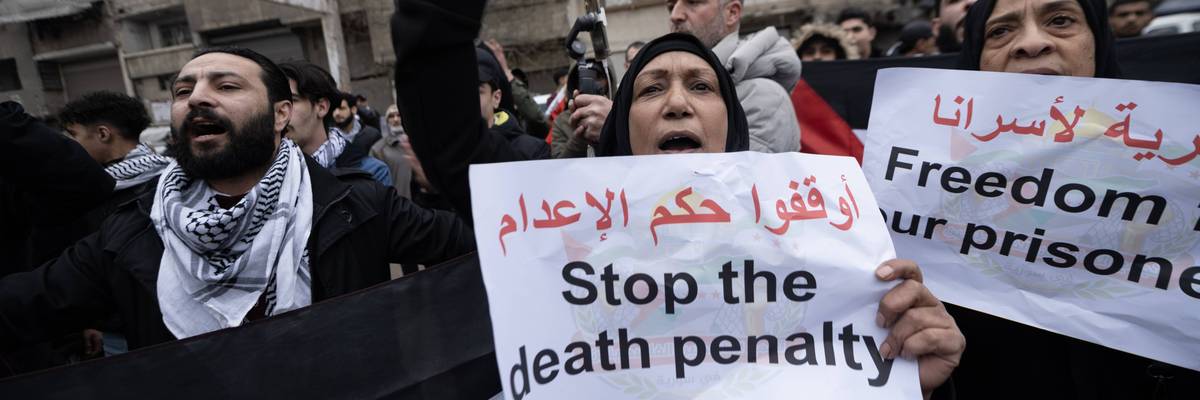
Demonstrators gather in the Yarmouk and Tadamon areas to protest a new Israeli death penalty law targeting Palestinians in Damascus, Syria on April 1, 2026.
A political group in the European Parliament and dozens of human rights groups have called for suspending the EU-Israel Association Agreement.
Global criticism has mounted since Israeli lawmakers approved a death penalty law targeting Palestinians earlier this week, including fresh calls for the European Union to suspend a key political and trade deal, the EU-Israel Association Agreement.
On Thursday, 31 groups, including Amnesty International, Human Rights Watch, and Oxfam, said in a joint statement that "we are appalled by the Israeli Knesset's decision to approve a bill that makes death penalty effectively mandatory in the West Bank and which will de facto apply exclusively to Palestinians."
The coalition also specifically put pressure on the EU, noting that the bloc "has consistently held that capital punishment is cruel, inhuman, and incompatible with human dignity under all circumstances," and that the Israeli law violates "the right to life and protections enshrined in international humanitarian and human rights law, such as the Fourth Geneva Convention, the Hague Regulations, the International Covenant on Civil and Political Rights, and the Convention Against Torture."
"Diplomatic engagement by the EU and its member states urging Israel to reverse course has so far proven ineffective. This appalling development occurs amid an ongoing manmade humanitarian catastrophe in Gaza, which a UN Commission of Inquiry, multiple Palestinian, Israeli, and international organizations, and independent experts have characterized as constituting genocide, and against the backdrop of an accelerating de facto annexation of the West Bank," the coalition wrote, pointing to the July 2024 advisory opinion from the International Court of Justice. "The adoption of the death penalty law is thus part of a pattern of discriminatory policies and practices against Palestinians."
The coalition continued:
In furtherance of these policies, Israel has already crossed established EU red lines: the advancement of settlement construction in the E1 area, which breaks the territorial contiguity of the West Bank, with the intent to prevent a future Palestinian state; the ban on [the United Nations Relief and Works Agency for Palestine Refugees in the Near East] and attacks on its facilities, including schools and clinics built and run with EU contributions; the expulsion of international NGOs through restrictive registration procedures; forced evictions of Palestinian residents in East Jerusalem; forced displacement of tens of thousands of Palestinians and widespread demolitions of Palestinian homes and infrastructure in the West Bank, including EU-funded projects; persistent impunity for abuses by Israeli security forces and state-backed settler violence; reports of widespread and systemic torture and mistreatment of Palestinian prisoners; restrictions on religious freedoms; attacks on journalists; and denial of access to EU officials.
As also recalled by the EU High Representative for Foreign Affairs Kallas in her statement... the EU-Israel Association Agreement establishes respect for democratic principles as an essential element of EU-Israel relations. A review conducted by the EU in June 2025 based on Article 2 of the agreement found Israel in breach of its human rights obligations for serious abuses against Palestinians and violations of the laws of war, both in Gaza and the West Bank, including East Jerusalem.
When the bloc refused to halt the trade deal over Gaza last year, Amnesty International secretary general Agnès Callamard called the decision "a cruel and unlawful betrayal—of the European project and vision, predicated on upholding international law and fighting authoritarian practices, of the European Union's own rules, and of the human rights of Palestinians."
The coalition concluded Thursday: "Nine months on, the time for action is long overdue. The European Union must uphold its stated principles and legal obligations by finally suspending, as a minimum immediate measure, the trade component of the EU-Israel Association Agreement and adopting other measures."
One political group in the European Parliament, the Progressive Alliance of Socialists and Democrats (S&D Group), also expressed "deep concern following the Israeli Knesset's approval of legislation introducing the death penalty for Palestinians convicted of terrorism," and put pressure on the European Council, which is made up of the bloc's heads of state or government.
"The S&D Group is calling on the European Council to urgently suspend the EU-Israel Association Agreement in light of Israel's continuous and grave violations of Article 2 of the Agreement on human rights, which is central to the partnership," the group said in a Tuesday statement, the day after the law passed.
Yannis Maniatis, S&D Group vice president for foreign affairs, said that "reintroducing the death penalty is a step back into the past and yet another blow to the values that underpin our partnership with Israel. We cannot and will not remain silent."
"When a partner repeatedly ignores the warnings from its friends and civil society alike, there must be consequences," added Maniatis, a Greek politician. "It is high time the Council suspended the EU-Israel Association Agreement. The time to act is now."
The S&D Group's statement came not only after the death penalty law's passage but also amid a European citizens' initiative collecting signatures to demand the suspension in response to Israel's "unprecedented level of killing and injury of civilians, a large-scale displacement of population, and the systematic destruction of hospitals and medical facilities" in the Gaza Strip. So far, over 645,000 people from EU member states, of the necessary 1 million, have signed on to that call.
The Council of the European Union—which is composed of national ministers from each member state—this week issued a statement reiterating the EU's "principled position against the death penalty in all cases and in all circumstances," condemning the Israeli law as "a grave regression," and highlighting deep concerns about its "de facto discriminatory character."
"Consistent with our global efforts towards universal abolition of the death penalty, the EU urges Israel to abide by its previous principled position and with its obligations under international law, as well as its commitment to democratic principles, as reflected also in the provisions of the EU-Israel Association Agreement," the council said.
However, there have been no signals from EU leadership about progress toward suspending the agreement in light of the law's passage.
Dear Common Dreams reader, It’s been nearly 30 years since I co-founded Common Dreams with my late wife, Lina Newhouser. We had the radical notion that journalism should serve the public good, not corporate profits. It was clear to us from the outset what it would take to build such a project. No paid advertisements. No corporate sponsors. No millionaire publisher telling us what to think or do. Many people said we wouldn't last a year, but we proved those doubters wrong. Together with a tremendous team of journalists and dedicated staff, we built an independent media outlet free from the constraints of profits and corporate control. Our mission has always been simple: To inform. To inspire. To ignite change for the common good. Building Common Dreams was not easy. Our survival was never guaranteed. When you take on the most powerful forces—Wall Street greed, fossil fuel industry destruction, Big Tech lobbyists, and uber-rich oligarchs who have spent billions upon billions rigging the economy and democracy in their favor—the only bulwark you have is supporters who believe in your work. But here’s the urgent message from me today. It's never been this bad out there. And it's never been this hard to keep us going. At the very moment Common Dreams is most needed, the threats we face are intensifying. We need your support now more than ever. We don't accept corporate advertising and never will. We don't have a paywall because we don't think people should be blocked from critical news based on their ability to pay. Everything we do is funded by the donations of readers like you. When everyone does the little they can afford, we are strong. But if that support retreats or dries up, so do we. Will you donate now to make sure Common Dreams not only survives but thrives? —Craig Brown, Co-founder |
Global criticism has mounted since Israeli lawmakers approved a death penalty law targeting Palestinians earlier this week, including fresh calls for the European Union to suspend a key political and trade deal, the EU-Israel Association Agreement.
On Thursday, 31 groups, including Amnesty International, Human Rights Watch, and Oxfam, said in a joint statement that "we are appalled by the Israeli Knesset's decision to approve a bill that makes death penalty effectively mandatory in the West Bank and which will de facto apply exclusively to Palestinians."
The coalition also specifically put pressure on the EU, noting that the bloc "has consistently held that capital punishment is cruel, inhuman, and incompatible with human dignity under all circumstances," and that the Israeli law violates "the right to life and protections enshrined in international humanitarian and human rights law, such as the Fourth Geneva Convention, the Hague Regulations, the International Covenant on Civil and Political Rights, and the Convention Against Torture."
"Diplomatic engagement by the EU and its member states urging Israel to reverse course has so far proven ineffective. This appalling development occurs amid an ongoing manmade humanitarian catastrophe in Gaza, which a UN Commission of Inquiry, multiple Palestinian, Israeli, and international organizations, and independent experts have characterized as constituting genocide, and against the backdrop of an accelerating de facto annexation of the West Bank," the coalition wrote, pointing to the July 2024 advisory opinion from the International Court of Justice. "The adoption of the death penalty law is thus part of a pattern of discriminatory policies and practices against Palestinians."
The coalition continued:
In furtherance of these policies, Israel has already crossed established EU red lines: the advancement of settlement construction in the E1 area, which breaks the territorial contiguity of the West Bank, with the intent to prevent a future Palestinian state; the ban on [the United Nations Relief and Works Agency for Palestine Refugees in the Near East] and attacks on its facilities, including schools and clinics built and run with EU contributions; the expulsion of international NGOs through restrictive registration procedures; forced evictions of Palestinian residents in East Jerusalem; forced displacement of tens of thousands of Palestinians and widespread demolitions of Palestinian homes and infrastructure in the West Bank, including EU-funded projects; persistent impunity for abuses by Israeli security forces and state-backed settler violence; reports of widespread and systemic torture and mistreatment of Palestinian prisoners; restrictions on religious freedoms; attacks on journalists; and denial of access to EU officials.
As also recalled by the EU High Representative for Foreign Affairs Kallas in her statement... the EU-Israel Association Agreement establishes respect for democratic principles as an essential element of EU-Israel relations. A review conducted by the EU in June 2025 based on Article 2 of the agreement found Israel in breach of its human rights obligations for serious abuses against Palestinians and violations of the laws of war, both in Gaza and the West Bank, including East Jerusalem.
When the bloc refused to halt the trade deal over Gaza last year, Amnesty International secretary general Agnès Callamard called the decision "a cruel and unlawful betrayal—of the European project and vision, predicated on upholding international law and fighting authoritarian practices, of the European Union's own rules, and of the human rights of Palestinians."
The coalition concluded Thursday: "Nine months on, the time for action is long overdue. The European Union must uphold its stated principles and legal obligations by finally suspending, as a minimum immediate measure, the trade component of the EU-Israel Association Agreement and adopting other measures."
One political group in the European Parliament, the Progressive Alliance of Socialists and Democrats (S&D Group), also expressed "deep concern following the Israeli Knesset's approval of legislation introducing the death penalty for Palestinians convicted of terrorism," and put pressure on the European Council, which is made up of the bloc's heads of state or government.
"The S&D Group is calling on the European Council to urgently suspend the EU-Israel Association Agreement in light of Israel's continuous and grave violations of Article 2 of the Agreement on human rights, which is central to the partnership," the group said in a Tuesday statement, the day after the law passed.
Yannis Maniatis, S&D Group vice president for foreign affairs, said that "reintroducing the death penalty is a step back into the past and yet another blow to the values that underpin our partnership with Israel. We cannot and will not remain silent."
"When a partner repeatedly ignores the warnings from its friends and civil society alike, there must be consequences," added Maniatis, a Greek politician. "It is high time the Council suspended the EU-Israel Association Agreement. The time to act is now."
The S&D Group's statement came not only after the death penalty law's passage but also amid a European citizens' initiative collecting signatures to demand the suspension in response to Israel's "unprecedented level of killing and injury of civilians, a large-scale displacement of population, and the systematic destruction of hospitals and medical facilities" in the Gaza Strip. So far, over 645,000 people from EU member states, of the necessary 1 million, have signed on to that call.
The Council of the European Union—which is composed of national ministers from each member state—this week issued a statement reiterating the EU's "principled position against the death penalty in all cases and in all circumstances," condemning the Israeli law as "a grave regression," and highlighting deep concerns about its "de facto discriminatory character."
"Consistent with our global efforts towards universal abolition of the death penalty, the EU urges Israel to abide by its previous principled position and with its obligations under international law, as well as its commitment to democratic principles, as reflected also in the provisions of the EU-Israel Association Agreement," the council said.
However, there have been no signals from EU leadership about progress toward suspending the agreement in light of the law's passage.
Global criticism has mounted since Israeli lawmakers approved a death penalty law targeting Palestinians earlier this week, including fresh calls for the European Union to suspend a key political and trade deal, the EU-Israel Association Agreement.
On Thursday, 31 groups, including Amnesty International, Human Rights Watch, and Oxfam, said in a joint statement that "we are appalled by the Israeli Knesset's decision to approve a bill that makes death penalty effectively mandatory in the West Bank and which will de facto apply exclusively to Palestinians."
The coalition also specifically put pressure on the EU, noting that the bloc "has consistently held that capital punishment is cruel, inhuman, and incompatible with human dignity under all circumstances," and that the Israeli law violates "the right to life and protections enshrined in international humanitarian and human rights law, such as the Fourth Geneva Convention, the Hague Regulations, the International Covenant on Civil and Political Rights, and the Convention Against Torture."
"Diplomatic engagement by the EU and its member states urging Israel to reverse course has so far proven ineffective. This appalling development occurs amid an ongoing manmade humanitarian catastrophe in Gaza, which a UN Commission of Inquiry, multiple Palestinian, Israeli, and international organizations, and independent experts have characterized as constituting genocide, and against the backdrop of an accelerating de facto annexation of the West Bank," the coalition wrote, pointing to the July 2024 advisory opinion from the International Court of Justice. "The adoption of the death penalty law is thus part of a pattern of discriminatory policies and practices against Palestinians."
The coalition continued:
In furtherance of these policies, Israel has already crossed established EU red lines: the advancement of settlement construction in the E1 area, which breaks the territorial contiguity of the West Bank, with the intent to prevent a future Palestinian state; the ban on [the United Nations Relief and Works Agency for Palestine Refugees in the Near East] and attacks on its facilities, including schools and clinics built and run with EU contributions; the expulsion of international NGOs through restrictive registration procedures; forced evictions of Palestinian residents in East Jerusalem; forced displacement of tens of thousands of Palestinians and widespread demolitions of Palestinian homes and infrastructure in the West Bank, including EU-funded projects; persistent impunity for abuses by Israeli security forces and state-backed settler violence; reports of widespread and systemic torture and mistreatment of Palestinian prisoners; restrictions on religious freedoms; attacks on journalists; and denial of access to EU officials.
As also recalled by the EU High Representative for Foreign Affairs Kallas in her statement... the EU-Israel Association Agreement establishes respect for democratic principles as an essential element of EU-Israel relations. A review conducted by the EU in June 2025 based on Article 2 of the agreement found Israel in breach of its human rights obligations for serious abuses against Palestinians and violations of the laws of war, both in Gaza and the West Bank, including East Jerusalem.
When the bloc refused to halt the trade deal over Gaza last year, Amnesty International secretary general Agnès Callamard called the decision "a cruel and unlawful betrayal—of the European project and vision, predicated on upholding international law and fighting authoritarian practices, of the European Union's own rules, and of the human rights of Palestinians."
The coalition concluded Thursday: "Nine months on, the time for action is long overdue. The European Union must uphold its stated principles and legal obligations by finally suspending, as a minimum immediate measure, the trade component of the EU-Israel Association Agreement and adopting other measures."
One political group in the European Parliament, the Progressive Alliance of Socialists and Democrats (S&D Group), also expressed "deep concern following the Israeli Knesset's approval of legislation introducing the death penalty for Palestinians convicted of terrorism," and put pressure on the European Council, which is made up of the bloc's heads of state or government.
"The S&D Group is calling on the European Council to urgently suspend the EU-Israel Association Agreement in light of Israel's continuous and grave violations of Article 2 of the Agreement on human rights, which is central to the partnership," the group said in a Tuesday statement, the day after the law passed.
Yannis Maniatis, S&D Group vice president for foreign affairs, said that "reintroducing the death penalty is a step back into the past and yet another blow to the values that underpin our partnership with Israel. We cannot and will not remain silent."
"When a partner repeatedly ignores the warnings from its friends and civil society alike, there must be consequences," added Maniatis, a Greek politician. "It is high time the Council suspended the EU-Israel Association Agreement. The time to act is now."
The S&D Group's statement came not only after the death penalty law's passage but also amid a European citizens' initiative collecting signatures to demand the suspension in response to Israel's "unprecedented level of killing and injury of civilians, a large-scale displacement of population, and the systematic destruction of hospitals and medical facilities" in the Gaza Strip. So far, over 645,000 people from EU member states, of the necessary 1 million, have signed on to that call.
The Council of the European Union—which is composed of national ministers from each member state—this week issued a statement reiterating the EU's "principled position against the death penalty in all cases and in all circumstances," condemning the Israeli law as "a grave regression," and highlighting deep concerns about its "de facto discriminatory character."
"Consistent with our global efforts towards universal abolition of the death penalty, the EU urges Israel to abide by its previous principled position and with its obligations under international law, as well as its commitment to democratic principles, as reflected also in the provisions of the EU-Israel Association Agreement," the council said.
However, there have been no signals from EU leadership about progress toward suspending the agreement in light of the law's passage.