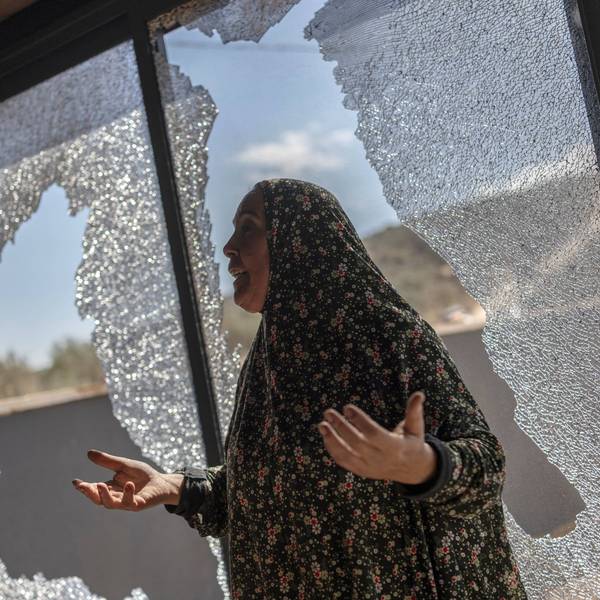
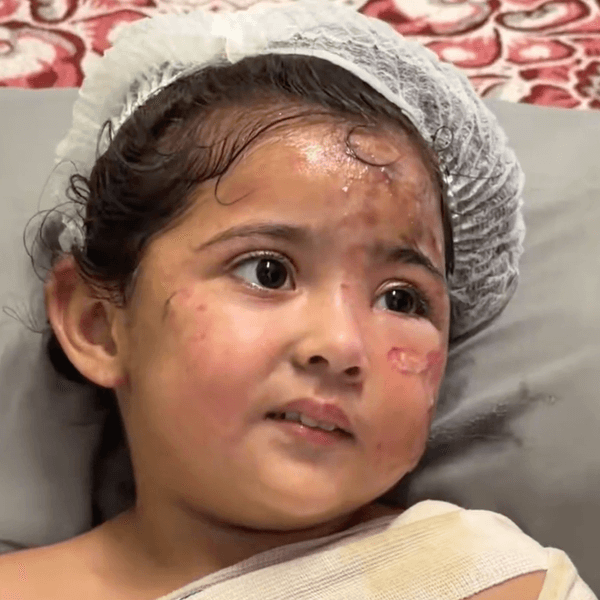
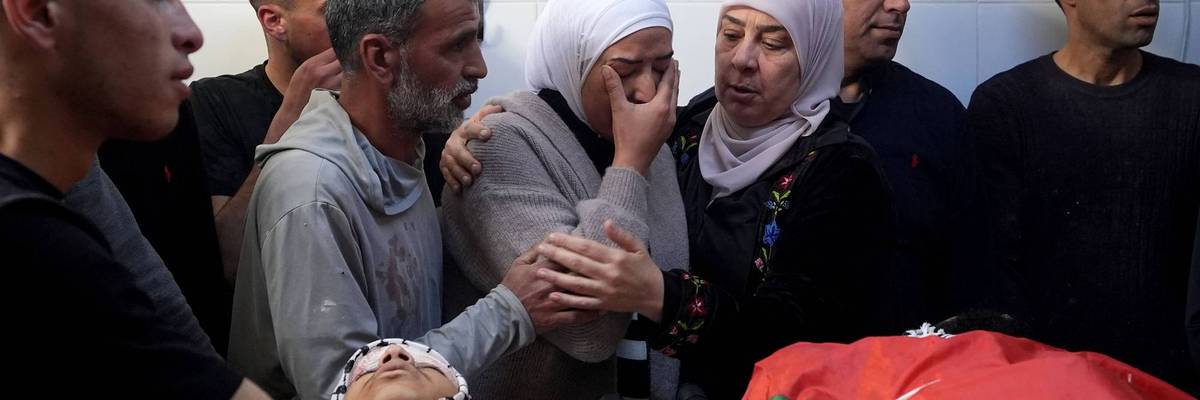
Palestinians mourn for 14-year-old Aws Hamdi al-Naasan and 32-year-old Marzouq Abu Naim, who were killed in an armed attack by Israeli settlers and soldiers on a school in Al-Mughayyir village in the illegaly occupied West Bank of Palestine, on April 21, 2026.
'Day of Ordinary Terror': Israeli Attack on West Bank School Kills Man, Child
"It does feel like if a group of Palestinians with machine guns broke into an Israeli school and shot a bunch of children, it would be breaking news in every outlet on Earth," said one reporter.
Israeli soldiers and settlers opened fire on a school in a West Bank village Tuesday, killing a Palestinian man and child and wounding at least four other people amid their escalating ethnic cleansing efforts in the illegally occupied territory.
The Palestinian Ministry of Health and Palestine Red Crescent Society (PRCS) said settlers attacked a school in the village of al-Mughayyir, east of Ramallah, on Tuesday morning.
Amin Abu Ulaya, head of the local council, told Reuters that settlers and Israel Defense Forces (IDF) soldiers entered the village and then shot at students at the school and other Palestinians who rushed to the scene.
PRCS said that 14-year-old Aws Hamdi Al-Naasan and 32-year-old Marzouq Abu Naim were shot and killed by the attackers.
An IDF spokesperson claimed that troops were deployed to the area following reports of stones being thrown at a military vehicle, and that a reservist then opened fire at "suspects."
The IDF also said the reservist, who has not been identified, has been suspended pending an investigation. Most Israelis who harm Palestinians are never punished. Meanwhile, Israel last month passed legislation legalizing the hanging of terrorists convicted killing of Israelis—a law critics contend will not apply to Israelis who commit similar crimes against Palestinians.
Kathem Al-Haj-Ahmed, a 57-year-old al-Mughayyir resident, told Reuters on Tuesday that settlers arrived first and began attacking the school. Parents and others who came to pick up their children came under fire. Al-Haj-Ahmed said that's when the man and child were killed.
Drop Site News reported:
A paramedic at the scene said at least three settlers deliberately fired at children attempting to escape from classrooms from a position approximately 50 meters away, with a level of accuracy he described as close to sniping. An eyewitness said shooting was directed at classroom windows and balconies still full of children as residents attempted to evacuate the school by crawling.
Israeli forces arrived during the attack and, according to witnesses, provided protection to the settlers rather than stopping them. A 63-year-old man, Attallah Abu Aliya, said he was shot in the leg by an Israeli soldier without warning as he walked toward the school after hearing it was under attack.
IDF troops often protect, and sometimes join, settlers attacking Palestinians.
Another 14-year-old, Mohammed Naasan, was killed by IDF troops in al-Mughayyir in January. The slain boy's father was also killed by settlers in 2019.
Tuesday's shooting occurred about 15 miles from where a Palestinian family—a mother, father, and two young children—were massacred by Israeli troops while traveling in their car in Tammum in March. The two children, ages 7 and 5, were shot in the head; two of their siblings were wounded but survived.
Two other West Bank Palestinians died Tuesday as a result of encounters with Israelis. Sixteen-year-old Mohammad Majdi al-Jaabir of Hebron was struck and killed by a vehicle in a convoy sent to secure Israeli Settlement Minister Orit Strock, while a woman, 49-year-old Raja' Fadl Bitawi, succumbed to injuries sustained from Israeli army gunfire in Jenin nearly two years ago, according to local media reports.
"This is our reality in al-Mughayyir village; they aim to displace us, and both the army and the settlers are exchanging roles among them," Al-Haj-Ahmed said.
Both Israel’s occupation of Palestine and the colonization of Palestinian lands by Jewish settlers are illegal under international law. Article 49 of the Fourth Geneva Convention states that an “occupying power shall not deport or transfer parts of its own civilian population into the territory it occupies.”
In July 2024, the International Court of Justice—where Israel is currently facing a genocide case related to the Gaza war, which has left more than 250,000 Palestinians dead or wounded—found the occupation of Palestine to be an illegal form of apartheid that must be ended as soon as possible. The ICJ also ruled that Israeli settler colonization of the West Bank amounts to annexation, also a crime under international law.
As the world’s attention focused on Gaza after the October 7, 2023 Hamas-led attack and, later, the US-Israeli war on Iran and Israel's assault on Lebanon, Israeli soldiers and settlers have killed at least 1,079 Palestinians—at least 235 of them children—in the West Bank, according to the United Nations agency for Palestinian refugees.
Numerous US citizens—most but not all of them Palestinians—have been killed by Israeli soldiers and settlers in recent years.
Settler pogroms have been compared to the Nakba, during which more than 750,000 Palestinians were ethnically cleansed to make way for the modern state of Israel.
On Monday, the West Bank Protection Consortium—which is led by the Norwegian Refugee Council and funded by donors including 13 European nations—published a report detailing sexual violence committed by Israeli soldiers and settlers in the West Bank. Crimes including sexual assaults have facilitated Israel's ongoing ethnic cleansing of Palestine.
We are at a crossroads
This country and this world are at a monumental crossroads. In a few short weeks, US voters will have an opportunity to beat back the forces of fascism and confront the billionaires who are rigging the economy, our media system, and our democracy, making it increasingly impossible for ordinary people to get by. We’re not just talking about the election. We’re talking about what must be done once these fascist elements are vanquished from power. We need a bolder set of solutions than what either major party has so far been willing to offer and a working-class movement ready to fight like hell for it. Trump didn't emerge from nowhere. The conditions that fueled MAGA authoritarianism were created by decades of radical neoliberal economic policies and a corrupt political system dominated by corporate interests. They slashed taxes on the super-rich, promising that the benefits would trickle down. They said giveaways to the corporate titans would make life more affordable for the rest of us. It was all bullshit. And when a bitter, betrayed populace searches for someone to blame, right-wing demagogues have little trouble finding scapegoats. People know when they're being lied to, but you won't hear any of this from the corporate media. Only independent journalism—powered and funded by people who believe in building a better world—can deliver truly trustworthy daily news. Our Fall Campaign is underway, and we need your help. To power our newsroom through the rest of the year, we need to raise $125,000 by midnight on October 31. So if you share our vision, please contribute whatever you can to sustain our work. |
Israeli soldiers and settlers opened fire on a school in a West Bank village Tuesday, killing a Palestinian man and child and wounding at least four other people amid their escalating ethnic cleansing efforts in the illegally occupied territory.
The Palestinian Ministry of Health and Palestine Red Crescent Society (PRCS) said settlers attacked a school in the village of al-Mughayyir, east of Ramallah, on Tuesday morning.
Amin Abu Ulaya, head of the local council, told Reuters that settlers and Israel Defense Forces (IDF) soldiers entered the village and then shot at students at the school and other Palestinians who rushed to the scene.
PRCS said that 14-year-old Aws Hamdi Al-Naasan and 32-year-old Marzouq Abu Naim were shot and killed by the attackers.
An IDF spokesperson claimed that troops were deployed to the area following reports of stones being thrown at a military vehicle, and that a reservist then opened fire at "suspects."
The IDF also said the reservist, who has not been identified, has been suspended pending an investigation. Most Israelis who harm Palestinians are never punished. Meanwhile, Israel last month passed legislation legalizing the hanging of terrorists convicted killing of Israelis—a law critics contend will not apply to Israelis who commit similar crimes against Palestinians.
Kathem Al-Haj-Ahmed, a 57-year-old al-Mughayyir resident, told Reuters on Tuesday that settlers arrived first and began attacking the school. Parents and others who came to pick up their children came under fire. Al-Haj-Ahmed said that's when the man and child were killed.
Drop Site News reported:
A paramedic at the scene said at least three settlers deliberately fired at children attempting to escape from classrooms from a position approximately 50 meters away, with a level of accuracy he described as close to sniping. An eyewitness said shooting was directed at classroom windows and balconies still full of children as residents attempted to evacuate the school by crawling.
Israeli forces arrived during the attack and, according to witnesses, provided protection to the settlers rather than stopping them. A 63-year-old man, Attallah Abu Aliya, said he was shot in the leg by an Israeli soldier without warning as he walked toward the school after hearing it was under attack.
IDF troops often protect, and sometimes join, settlers attacking Palestinians.
Another 14-year-old, Mohammed Naasan, was killed by IDF troops in al-Mughayyir in January. The slain boy's father was also killed by settlers in 2019.
Tuesday's shooting occurred about 15 miles from where a Palestinian family—a mother, father, and two young children—were massacred by Israeli troops while traveling in their car in Tammum in March. The two children, ages 7 and 5, were shot in the head; two of their siblings were wounded but survived.
Two other West Bank Palestinians died Tuesday as a result of encounters with Israelis. Sixteen-year-old Mohammad Majdi al-Jaabir of Hebron was struck and killed by a vehicle in a convoy sent to secure Israeli Settlement Minister Orit Strock, while a woman, 49-year-old Raja' Fadl Bitawi, succumbed to injuries sustained from Israeli army gunfire in Jenin nearly two years ago, according to local media reports.
"This is our reality in al-Mughayyir village; they aim to displace us, and both the army and the settlers are exchanging roles among them," Al-Haj-Ahmed said.
Both Israel’s occupation of Palestine and the colonization of Palestinian lands by Jewish settlers are illegal under international law. Article 49 of the Fourth Geneva Convention states that an “occupying power shall not deport or transfer parts of its own civilian population into the territory it occupies.”
In July 2024, the International Court of Justice—where Israel is currently facing a genocide case related to the Gaza war, which has left more than 250,000 Palestinians dead or wounded—found the occupation of Palestine to be an illegal form of apartheid that must be ended as soon as possible. The ICJ also ruled that Israeli settler colonization of the West Bank amounts to annexation, also a crime under international law.
As the world’s attention focused on Gaza after the October 7, 2023 Hamas-led attack and, later, the US-Israeli war on Iran and Israel's assault on Lebanon, Israeli soldiers and settlers have killed at least 1,079 Palestinians—at least 235 of them children—in the West Bank, according to the United Nations agency for Palestinian refugees.
Numerous US citizens—most but not all of them Palestinians—have been killed by Israeli soldiers and settlers in recent years.
Settler pogroms have been compared to the Nakba, during which more than 750,000 Palestinians were ethnically cleansed to make way for the modern state of Israel.
On Monday, the West Bank Protection Consortium—which is led by the Norwegian Refugee Council and funded by donors including 13 European nations—published a report detailing sexual violence committed by Israeli soldiers and settlers in the West Bank. Crimes including sexual assaults have facilitated Israel's ongoing ethnic cleansing of Palestine.
Israeli soldiers and settlers opened fire on a school in a West Bank village Tuesday, killing a Palestinian man and child and wounding at least four other people amid their escalating ethnic cleansing efforts in the illegally occupied territory.
The Palestinian Ministry of Health and Palestine Red Crescent Society (PRCS) said settlers attacked a school in the village of al-Mughayyir, east of Ramallah, on Tuesday morning.
Amin Abu Ulaya, head of the local council, told Reuters that settlers and Israel Defense Forces (IDF) soldiers entered the village and then shot at students at the school and other Palestinians who rushed to the scene.
PRCS said that 14-year-old Aws Hamdi Al-Naasan and 32-year-old Marzouq Abu Naim were shot and killed by the attackers.
An IDF spokesperson claimed that troops were deployed to the area following reports of stones being thrown at a military vehicle, and that a reservist then opened fire at "suspects."
The IDF also said the reservist, who has not been identified, has been suspended pending an investigation. Most Israelis who harm Palestinians are never punished. Meanwhile, Israel last month passed legislation legalizing the hanging of terrorists convicted killing of Israelis—a law critics contend will not apply to Israelis who commit similar crimes against Palestinians.
Kathem Al-Haj-Ahmed, a 57-year-old al-Mughayyir resident, told Reuters on Tuesday that settlers arrived first and began attacking the school. Parents and others who came to pick up their children came under fire. Al-Haj-Ahmed said that's when the man and child were killed.
Drop Site News reported:
A paramedic at the scene said at least three settlers deliberately fired at children attempting to escape from classrooms from a position approximately 50 meters away, with a level of accuracy he described as close to sniping. An eyewitness said shooting was directed at classroom windows and balconies still full of children as residents attempted to evacuate the school by crawling.
Israeli forces arrived during the attack and, according to witnesses, provided protection to the settlers rather than stopping them. A 63-year-old man, Attallah Abu Aliya, said he was shot in the leg by an Israeli soldier without warning as he walked toward the school after hearing it was under attack.
IDF troops often protect, and sometimes join, settlers attacking Palestinians.
Another 14-year-old, Mohammed Naasan, was killed by IDF troops in al-Mughayyir in January. The slain boy's father was also killed by settlers in 2019.
Tuesday's shooting occurred about 15 miles from where a Palestinian family—a mother, father, and two young children—were massacred by Israeli troops while traveling in their car in Tammum in March. The two children, ages 7 and 5, were shot in the head; two of their siblings were wounded but survived.
Two other West Bank Palestinians died Tuesday as a result of encounters with Israelis. Sixteen-year-old Mohammad Majdi al-Jaabir of Hebron was struck and killed by a vehicle in a convoy sent to secure Israeli Settlement Minister Orit Strock, while a woman, 49-year-old Raja' Fadl Bitawi, succumbed to injuries sustained from Israeli army gunfire in Jenin nearly two years ago, according to local media reports.
"This is our reality in al-Mughayyir village; they aim to displace us, and both the army and the settlers are exchanging roles among them," Al-Haj-Ahmed said.
Both Israel’s occupation of Palestine and the colonization of Palestinian lands by Jewish settlers are illegal under international law. Article 49 of the Fourth Geneva Convention states that an “occupying power shall not deport or transfer parts of its own civilian population into the territory it occupies.”
In July 2024, the International Court of Justice—where Israel is currently facing a genocide case related to the Gaza war, which has left more than 250,000 Palestinians dead or wounded—found the occupation of Palestine to be an illegal form of apartheid that must be ended as soon as possible. The ICJ also ruled that Israeli settler colonization of the West Bank amounts to annexation, also a crime under international law.
As the world’s attention focused on Gaza after the October 7, 2023 Hamas-led attack and, later, the US-Israeli war on Iran and Israel's assault on Lebanon, Israeli soldiers and settlers have killed at least 1,079 Palestinians—at least 235 of them children—in the West Bank, according to the United Nations agency for Palestinian refugees.
Numerous US citizens—most but not all of them Palestinians—have been killed by Israeli soldiers and settlers in recent years.
Settler pogroms have been compared to the Nakba, during which more than 750,000 Palestinians were ethnically cleansed to make way for the modern state of Israel.
On Monday, the West Bank Protection Consortium—which is led by the Norwegian Refugee Council and funded by donors including 13 European nations—published a report detailing sexual violence committed by Israeli soldiers and settlers in the West Bank. Crimes including sexual assaults have facilitated Israel's ongoing ethnic cleansing of Palestine.