

SUBSCRIBE TO OUR FREE NEWSLETTER
Daily news & progressive opinion—funded by the people, not the corporations—delivered straight to your inbox.
5
#000000
#FFFFFF
To donate by check, phone, or other method, see our More Ways to Give page.
Daily news & progressive opinion—funded by the people, not the corporations—delivered straight to your inbox.
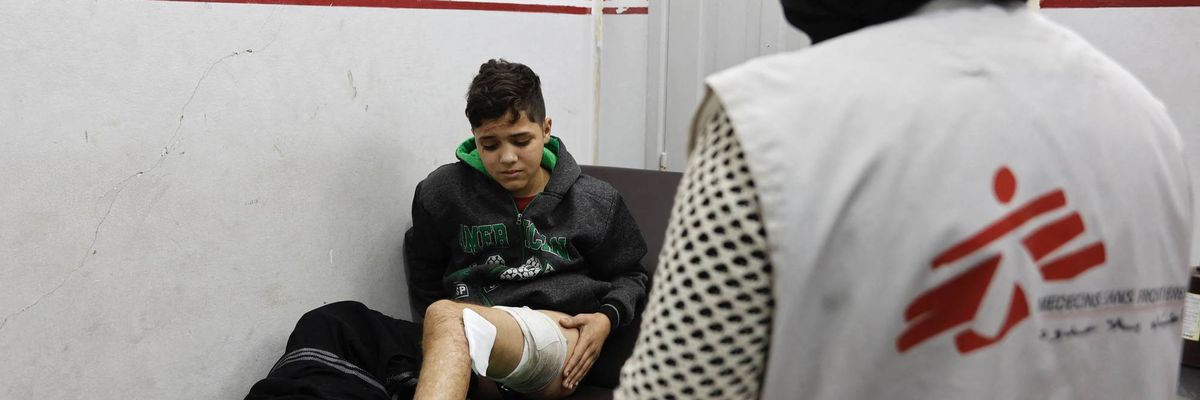
An injured Palestinian boy is seen by a member of Doctors Without Borders at a clinic in the al-Rimal neighborhood of Gaza City, Palestine on December 31, 2025.
"Such arbitrary suspensions make an already intolerable situation worse for the people of Gaza," said the United Nations human rights chief.
Human rights defenders warned Wednesday that a new Israeli ban on dozens of international humanitarian groups from operating in Gaza will have a "catastrophic" impact on Palestinians already reeling from more than two years of Israel's genocidal war and siege.
The government of fugitive Israeli Prime Minister Benjamin Netanyahu—who is wanted by the International Criminal Court (ICC) for alleged war crimes and crimes against humanity in Gaza—announced Tuesday that 25 humanitarian groups would be suspended from operating in Gaza starting January 1 if they did not comply with new requirements including providing detailed information on their staff, funding, and operations.
Israeli authorities say, largely without evidence, that the new rules are needed because some humanitarian workers are terrorists, and because Hamas is diverting aid—a claim refuted by Israeli military officials.
By Wednesday, the number of banned groups increased to 37. Targeted groups include ActionAid, Handicap International, Doctors Without Borders sections from six European countries, two Oxfam chapters, International Rescue Committee, American Friends Service Committee, World Vision International, Norwegian Refugee Council, Mercy Corps, Defense for Children International, two Caritas branches, and CARE.
"Israel’s suspension of numerous aid agencies from Gaza is outrageous," United Nations human rights chief Volker Türk said Wednesday in Geneva. "This is the latest in a pattern of unlawful restrictions on humanitarian access, including Israel’s ban on UNRWA, the UN Relief and Works Agency for Palestinian Refugees in the Near East, as well as attacks on Israeli and Palestinian NGOs amid broader access issues faced by the UN and other humanitarians."
"I urge all states, in particular those with influence, to take urgent steps and insist that Israel immediately allows aid to get into Gaza unhindered," Türk continued. "Such arbitrary suspensions make an already intolerable situation even worse for the people of Gaza."
"I remind the Israeli authorities of their obligation under international law to ensure the essential supplies of daily life in Gaza, including by allowing and facilitating humanitarian relief," he added.
European Commissioner for Equality, Preparedness, and Crisis Management Hadja Lahbib said Wednesday that Israel's move "means blocking life-saving aid."
"The [European Union] has been clear: The NGO registration law can not be implemented in its current form," Lahbib added. "All barriers to humanitarian access must be lifted."
British Member of Parliament Andrew Pakes (Labour-Peterborough) said on social media that "the Israeli government banning desperately needed aid from Gaza is not a sign of a working ceasefire."
"This, at a time of extreme weather and lack of shelter," he added. "We need accountability more than ever. And immediate help to save lives."
Doctors Without Borders—which also goes by its French acronym, MSF—told Reuters Tuesday that "if MSF is prevented from working in Gaza, it will deprive hundreds of thousands of people from accessing medical care."
Norwegian Refugee Council spokesperson Shaina Low said, "At a time when needs in Gaza far exceed the available aid and services, Israel has and will continue to block life-saving aid from entering."
British emergency physician Dr. James Smith—a health activist with Medact and the People's Health Movement and member of the Global Sumud Flotilla—told Al Jazeera Wednesday that many of the proscribed groups "have been working in Gaza for decades."
Smith noted that Doctors Without Borders this year "managed more than 22,000 operations," adding that "if international NGOs were de-registered, then approximately a third of healthcare facilities" in Gaza "would be forced to immediately close."
This, after Gaza's healthcare infrastructure has been systematically obliterated by Israel's assault and siege.
"It's going to be catastrophic," warned Smith. "A situation that is already horrific will be made more horrific. The changes will be immediate, and they will be ruthless."
Smith called the aid group ban "an extension of Israel's longstanding strategy of titrating humanitarian access and humanitarian services as a core pillar of the occupation and of the genocide."
Since 2007, Israel has maintained a blockade of Gaza, severely limiting the entry and exit of people and goods into the Palestinian exclave. The blockade was tightened even further when Israel imposed a "complete siege" on the strip following the Hamas-led attack of October 7, 2023.
According to UN data, Israeli forces have killed at least 579 aid workers—including nearly 400 UNRWA staffers—since October 2023. Israeli bombs and bullets have also killed over 1,700 health and medical workers, upward of 140 civil defense personnel, and more than 250 journalists.
Overall, Israel's war and siege have left more than 250,000 Palestinians dead, wounded, or missing in Gaza, and most Gazans forcibly displaced, starved, or sickened.
In recent weeks, more than a dozen Palestinians, including numerous children and infants, have died of hypothermia.
On Tuesday, Red Crescent Society in Gaza warned of a growing outbreak of hepatitis A and gastroenteritis caused by contaminated drinking water.
The International Court of Justice—which is currently weighing a genocide case against Israel filed by South Africa—last year issued a provisional ruling ordering Israel to allow humanitarian aid into Gaza and affirming an earlier order to prevent genocidal acts. Israel has been accused of ignoring these and other ICJ orders.
Responding to the Israeli ban, Refugees International vice president for programs and policy Hardin Lang said in a statement Tuesday that "this action will cost the lives of Palestinians."
"Gaza is in the heart of winter, with hundreds of thousands of people living in makeshift shelters, damaged buildings, or the open air after repeated displacement," Lang noted. "Removing these humanitarian organizations now will deepen exposure, illness, and preventable deaths. The targeted organizations provide much of the core relief capacity in Gaza, particularly on healthcare services."
"The suspension is not motivated by a sincere desire to prevent diversion of aid; it is a pretext to further restrict aid to Gaza while silencing independent aid organizations," he continued. "The Israeli government’s broad claims about systemic aid diversion have never been backed up with credible evidence—as even senior US government officials have publicly acknowledged."
"Under US and international law, parties to a conflict must allow and facilitate the rapid and unimpeded passage of impartial humanitarian relief," Lang added.
Dear Common Dreams reader, It’s been nearly 30 years since I co-founded Common Dreams with my late wife, Lina Newhouser. We had the radical notion that journalism should serve the public good, not corporate profits. It was clear to us from the outset what it would take to build such a project. No paid advertisements. No corporate sponsors. No millionaire publisher telling us what to think or do. Many people said we wouldn't last a year, but we proved those doubters wrong. Together with a tremendous team of journalists and dedicated staff, we built an independent media outlet free from the constraints of profits and corporate control. Our mission has always been simple: To inform. To inspire. To ignite change for the common good. Building Common Dreams was not easy. Our survival was never guaranteed. When you take on the most powerful forces—Wall Street greed, fossil fuel industry destruction, Big Tech lobbyists, and uber-rich oligarchs who have spent billions upon billions rigging the economy and democracy in their favor—the only bulwark you have is supporters who believe in your work. But here’s the urgent message from me today. It's never been this bad out there. And it's never been this hard to keep us going. At the very moment Common Dreams is most needed, the threats we face are intensifying. We need your support now more than ever. We don't accept corporate advertising and never will. We don't have a paywall because we don't think people should be blocked from critical news based on their ability to pay. Everything we do is funded by the donations of readers like you. When everyone does the little they can afford, we are strong. But if that support retreats or dries up, so do we. Will you donate now to make sure Common Dreams not only survives but thrives? —Craig Brown, Co-founder |
Human rights defenders warned Wednesday that a new Israeli ban on dozens of international humanitarian groups from operating in Gaza will have a "catastrophic" impact on Palestinians already reeling from more than two years of Israel's genocidal war and siege.
The government of fugitive Israeli Prime Minister Benjamin Netanyahu—who is wanted by the International Criminal Court (ICC) for alleged war crimes and crimes against humanity in Gaza—announced Tuesday that 25 humanitarian groups would be suspended from operating in Gaza starting January 1 if they did not comply with new requirements including providing detailed information on their staff, funding, and operations.
Israeli authorities say, largely without evidence, that the new rules are needed because some humanitarian workers are terrorists, and because Hamas is diverting aid—a claim refuted by Israeli military officials.
By Wednesday, the number of banned groups increased to 37. Targeted groups include ActionAid, Handicap International, Doctors Without Borders sections from six European countries, two Oxfam chapters, International Rescue Committee, American Friends Service Committee, World Vision International, Norwegian Refugee Council, Mercy Corps, Defense for Children International, two Caritas branches, and CARE.
"Israel’s suspension of numerous aid agencies from Gaza is outrageous," United Nations human rights chief Volker Türk said Wednesday in Geneva. "This is the latest in a pattern of unlawful restrictions on humanitarian access, including Israel’s ban on UNRWA, the UN Relief and Works Agency for Palestinian Refugees in the Near East, as well as attacks on Israeli and Palestinian NGOs amid broader access issues faced by the UN and other humanitarians."
"I urge all states, in particular those with influence, to take urgent steps and insist that Israel immediately allows aid to get into Gaza unhindered," Türk continued. "Such arbitrary suspensions make an already intolerable situation even worse for the people of Gaza."
"I remind the Israeli authorities of their obligation under international law to ensure the essential supplies of daily life in Gaza, including by allowing and facilitating humanitarian relief," he added.
European Commissioner for Equality, Preparedness, and Crisis Management Hadja Lahbib said Wednesday that Israel's move "means blocking life-saving aid."
"The [European Union] has been clear: The NGO registration law can not be implemented in its current form," Lahbib added. "All barriers to humanitarian access must be lifted."
British Member of Parliament Andrew Pakes (Labour-Peterborough) said on social media that "the Israeli government banning desperately needed aid from Gaza is not a sign of a working ceasefire."
"This, at a time of extreme weather and lack of shelter," he added. "We need accountability more than ever. And immediate help to save lives."
Doctors Without Borders—which also goes by its French acronym, MSF—told Reuters Tuesday that "if MSF is prevented from working in Gaza, it will deprive hundreds of thousands of people from accessing medical care."
Norwegian Refugee Council spokesperson Shaina Low said, "At a time when needs in Gaza far exceed the available aid and services, Israel has and will continue to block life-saving aid from entering."
British emergency physician Dr. James Smith—a health activist with Medact and the People's Health Movement and member of the Global Sumud Flotilla—told Al Jazeera Wednesday that many of the proscribed groups "have been working in Gaza for decades."
Smith noted that Doctors Without Borders this year "managed more than 22,000 operations," adding that "if international NGOs were de-registered, then approximately a third of healthcare facilities" in Gaza "would be forced to immediately close."
This, after Gaza's healthcare infrastructure has been systematically obliterated by Israel's assault and siege.
"It's going to be catastrophic," warned Smith. "A situation that is already horrific will be made more horrific. The changes will be immediate, and they will be ruthless."
Smith called the aid group ban "an extension of Israel's longstanding strategy of titrating humanitarian access and humanitarian services as a core pillar of the occupation and of the genocide."
Since 2007, Israel has maintained a blockade of Gaza, severely limiting the entry and exit of people and goods into the Palestinian exclave. The blockade was tightened even further when Israel imposed a "complete siege" on the strip following the Hamas-led attack of October 7, 2023.
According to UN data, Israeli forces have killed at least 579 aid workers—including nearly 400 UNRWA staffers—since October 2023. Israeli bombs and bullets have also killed over 1,700 health and medical workers, upward of 140 civil defense personnel, and more than 250 journalists.
Overall, Israel's war and siege have left more than 250,000 Palestinians dead, wounded, or missing in Gaza, and most Gazans forcibly displaced, starved, or sickened.
In recent weeks, more than a dozen Palestinians, including numerous children and infants, have died of hypothermia.
On Tuesday, Red Crescent Society in Gaza warned of a growing outbreak of hepatitis A and gastroenteritis caused by contaminated drinking water.
The International Court of Justice—which is currently weighing a genocide case against Israel filed by South Africa—last year issued a provisional ruling ordering Israel to allow humanitarian aid into Gaza and affirming an earlier order to prevent genocidal acts. Israel has been accused of ignoring these and other ICJ orders.
Responding to the Israeli ban, Refugees International vice president for programs and policy Hardin Lang said in a statement Tuesday that "this action will cost the lives of Palestinians."
"Gaza is in the heart of winter, with hundreds of thousands of people living in makeshift shelters, damaged buildings, or the open air after repeated displacement," Lang noted. "Removing these humanitarian organizations now will deepen exposure, illness, and preventable deaths. The targeted organizations provide much of the core relief capacity in Gaza, particularly on healthcare services."
"The suspension is not motivated by a sincere desire to prevent diversion of aid; it is a pretext to further restrict aid to Gaza while silencing independent aid organizations," he continued. "The Israeli government’s broad claims about systemic aid diversion have never been backed up with credible evidence—as even senior US government officials have publicly acknowledged."
"Under US and international law, parties to a conflict must allow and facilitate the rapid and unimpeded passage of impartial humanitarian relief," Lang added.
Human rights defenders warned Wednesday that a new Israeli ban on dozens of international humanitarian groups from operating in Gaza will have a "catastrophic" impact on Palestinians already reeling from more than two years of Israel's genocidal war and siege.
The government of fugitive Israeli Prime Minister Benjamin Netanyahu—who is wanted by the International Criminal Court (ICC) for alleged war crimes and crimes against humanity in Gaza—announced Tuesday that 25 humanitarian groups would be suspended from operating in Gaza starting January 1 if they did not comply with new requirements including providing detailed information on their staff, funding, and operations.
Israeli authorities say, largely without evidence, that the new rules are needed because some humanitarian workers are terrorists, and because Hamas is diverting aid—a claim refuted by Israeli military officials.
By Wednesday, the number of banned groups increased to 37. Targeted groups include ActionAid, Handicap International, Doctors Without Borders sections from six European countries, two Oxfam chapters, International Rescue Committee, American Friends Service Committee, World Vision International, Norwegian Refugee Council, Mercy Corps, Defense for Children International, two Caritas branches, and CARE.
"Israel’s suspension of numerous aid agencies from Gaza is outrageous," United Nations human rights chief Volker Türk said Wednesday in Geneva. "This is the latest in a pattern of unlawful restrictions on humanitarian access, including Israel’s ban on UNRWA, the UN Relief and Works Agency for Palestinian Refugees in the Near East, as well as attacks on Israeli and Palestinian NGOs amid broader access issues faced by the UN and other humanitarians."
"I urge all states, in particular those with influence, to take urgent steps and insist that Israel immediately allows aid to get into Gaza unhindered," Türk continued. "Such arbitrary suspensions make an already intolerable situation even worse for the people of Gaza."
"I remind the Israeli authorities of their obligation under international law to ensure the essential supplies of daily life in Gaza, including by allowing and facilitating humanitarian relief," he added.
European Commissioner for Equality, Preparedness, and Crisis Management Hadja Lahbib said Wednesday that Israel's move "means blocking life-saving aid."
"The [European Union] has been clear: The NGO registration law can not be implemented in its current form," Lahbib added. "All barriers to humanitarian access must be lifted."
British Member of Parliament Andrew Pakes (Labour-Peterborough) said on social media that "the Israeli government banning desperately needed aid from Gaza is not a sign of a working ceasefire."
"This, at a time of extreme weather and lack of shelter," he added. "We need accountability more than ever. And immediate help to save lives."
Doctors Without Borders—which also goes by its French acronym, MSF—told Reuters Tuesday that "if MSF is prevented from working in Gaza, it will deprive hundreds of thousands of people from accessing medical care."
Norwegian Refugee Council spokesperson Shaina Low said, "At a time when needs in Gaza far exceed the available aid and services, Israel has and will continue to block life-saving aid from entering."
British emergency physician Dr. James Smith—a health activist with Medact and the People's Health Movement and member of the Global Sumud Flotilla—told Al Jazeera Wednesday that many of the proscribed groups "have been working in Gaza for decades."
Smith noted that Doctors Without Borders this year "managed more than 22,000 operations," adding that "if international NGOs were de-registered, then approximately a third of healthcare facilities" in Gaza "would be forced to immediately close."
This, after Gaza's healthcare infrastructure has been systematically obliterated by Israel's assault and siege.
"It's going to be catastrophic," warned Smith. "A situation that is already horrific will be made more horrific. The changes will be immediate, and they will be ruthless."
Smith called the aid group ban "an extension of Israel's longstanding strategy of titrating humanitarian access and humanitarian services as a core pillar of the occupation and of the genocide."
Since 2007, Israel has maintained a blockade of Gaza, severely limiting the entry and exit of people and goods into the Palestinian exclave. The blockade was tightened even further when Israel imposed a "complete siege" on the strip following the Hamas-led attack of October 7, 2023.
According to UN data, Israeli forces have killed at least 579 aid workers—including nearly 400 UNRWA staffers—since October 2023. Israeli bombs and bullets have also killed over 1,700 health and medical workers, upward of 140 civil defense personnel, and more than 250 journalists.
Overall, Israel's war and siege have left more than 250,000 Palestinians dead, wounded, or missing in Gaza, and most Gazans forcibly displaced, starved, or sickened.
In recent weeks, more than a dozen Palestinians, including numerous children and infants, have died of hypothermia.
On Tuesday, Red Crescent Society in Gaza warned of a growing outbreak of hepatitis A and gastroenteritis caused by contaminated drinking water.
The International Court of Justice—which is currently weighing a genocide case against Israel filed by South Africa—last year issued a provisional ruling ordering Israel to allow humanitarian aid into Gaza and affirming an earlier order to prevent genocidal acts. Israel has been accused of ignoring these and other ICJ orders.
Responding to the Israeli ban, Refugees International vice president for programs and policy Hardin Lang said in a statement Tuesday that "this action will cost the lives of Palestinians."
"Gaza is in the heart of winter, with hundreds of thousands of people living in makeshift shelters, damaged buildings, or the open air after repeated displacement," Lang noted. "Removing these humanitarian organizations now will deepen exposure, illness, and preventable deaths. The targeted organizations provide much of the core relief capacity in Gaza, particularly on healthcare services."
"The suspension is not motivated by a sincere desire to prevent diversion of aid; it is a pretext to further restrict aid to Gaza while silencing independent aid organizations," he continued. "The Israeli government’s broad claims about systemic aid diversion have never been backed up with credible evidence—as even senior US government officials have publicly acknowledged."
"Under US and international law, parties to a conflict must allow and facilitate the rapid and unimpeded passage of impartial humanitarian relief," Lang added.

