SUBSCRIBE TO OUR FREE NEWSLETTER
Daily news & progressive opinion—funded by the people, not the corporations—delivered straight to your inbox.
5
#000000
#FFFFFF
To donate by check, phone, or other method, see our More Ways to Give page.
Daily news & progressive opinion—funded by the people, not the corporations—delivered straight to your inbox.
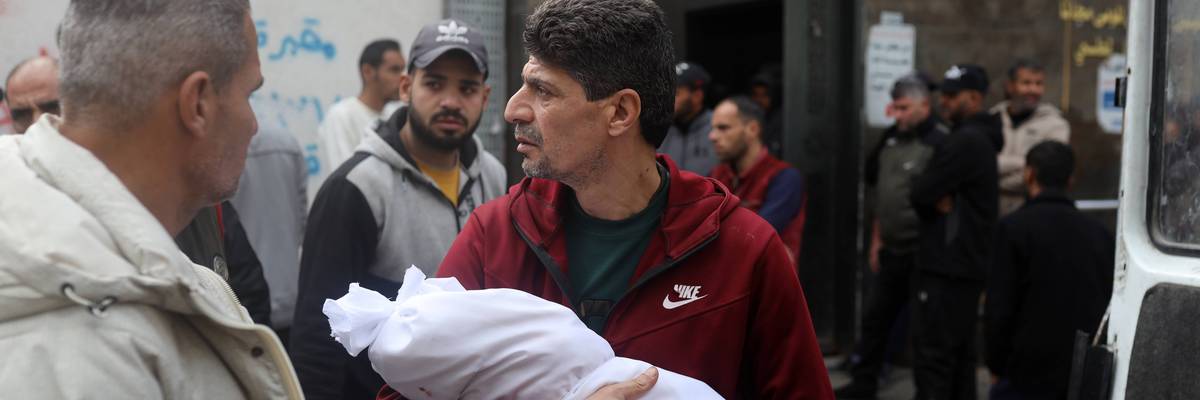
Mourners react following the death of Palestinians killed by an Israeli strike at Al-Shifa Hospital in Gaza City, on February 4, 2026.
It comes as nearly 20,000 Palestinians are being denied the ability to leave Gaza for medical treatment, in what activist Muhammad Shehada called "a slow-motion massacre."
Israeli bombings across Gaza have killed at least 23 Palestinians since dawn on Wednesday, including at least two infants, according to hospital officials and other health authorities.
“Where is the ceasefire? Where are the mediators?” asked Dr. Mohamed Abu Salmiya, director of Gaza City’s Shifa Hospital, which received the bodies of 11 people—mostly from the same family—who were killed after Israeli soldiers fired upon a building in northern Gaza.
Israel said the attack was in retaliation after Hamas militants fired at an Israeli soldier, badly wounding him. The Associated Press reports that among the Palestinians killed were "two parents, their 10-day-old girl Wateen Khabbaz, her 5-month-old cousin, Mira Khabbaz, and the children’s grandmother."
Another attack on a tent in the southern city of Khan Younis killed three more people: Nasser Hospital, which received the bodies, said they included a 12-year-old boy. Another strike killed five more people, including a paramedic named Hussein Hassan Hussein al-Semieri, who was on duty at the time.
A total of 38 Palestinians were wounded in the series of attacks, according to the Gaza Health Ministry.
Since a "ceasefire" agreement went into effect on October 10 last year, the Gaza Government Media Office says Israel has committed at least 1,520 violations, killing at least 556 people—including 288 children, women, and elderly people—and wounding 1,500 others.
In comments to Al Jazeera, the Palestinian human rights advocate Muhammad Shehada said a ceasefire that is violated so consistently “is no ceasefire at all”.
“At most, [the deal] can be just described as some sort of mild diplomatic restraint,” Shehada said. “Whenever the world’s attention is elsewhere, Israel escalates dramatically.”
Since its genocidal war in Gaza began in October 2023, nearly 72,000 Palestinians have been killed and 171,000 injured, according to the Gaza Health Ministry, whose figures the Israel Defense Forces (IDF) recently conceded are accurate after more than two years of denial. Independent estimates suggest the true death toll is much higher.
Wednesday's onslaught came as Israel began to slowly open the Rafah crossing—the main point of entry and exit from the strip—for those in severe need of medical attention to leave.
Gaza's hospitals have been rendered largely inoperable by two years of relentless bombing and a lengthy blockade on medical supplies entering the strip, which has left more than half the population without medical treatment.
The World Health Organization said last week that 18,500 Palestinians are in need of medical treatment abroad, including hundreds in need of immediate treatment.
According to Egyptian officials, 50 patients were expected to enter through the crossing each day. However, on Monday, just five Palestinians were allowed to leave Gaza for treatment, followed by 16 on Tuesday, according to Al Jazeera reporters on the ground.
Around 4,000 of those awaiting treatment are children. According to health officials, one of them, 7-year-old Anwar al-Ashi, died of kidney failure on Wednesday while on a waitlist.
Meanwhile, those attempting to cross have been met with treatment described as "humiliating" by reporters who witnessed it. Israeli troops have subjected patients to strip searches and interrogations—some were blindfolded and had their hands tied.
"The Rafah crossing continues to be a cruel and severely restricted 'passage' of pain and humiliation," said the Palestinian politician and activist Hana Ashrawi. "This continues to be a multifaceted war of aggression, based on the deliberate manipulation of the pain of a captive people."
Salmiya said that at the rate Israel is allowing them to leave, "it will take about five years on average for all patients to be discharged." He referred to Israel's actions as "crisis management, not a solution to the crisis."
On Tuesday, United Nations Secretary-General António Guterres called for "the facilitation of rapid and unimpeded passage of humanitarian relief at scale—including through the Rafah crossing."
He added that Israel's recent suspension of dozens of aid organizations—including Doctors Without Borders, Oxfam, and Save the Children—defies humanitarian principles, undermines fragile progress, and worsens the suffering of civilians."
Shehada, who said he and his family were eagerly awaiting the end of travel restrictions, told Al Jazeera that "Israel hollowed [it] out of any substance or meaning." Instead, he said, "it’s basically a slow-motion massacre."
Dear Common Dreams reader, It’s been nearly 30 years since I co-founded Common Dreams with my late wife, Lina Newhouser. We had the radical notion that journalism should serve the public good, not corporate profits. It was clear to us from the outset what it would take to build such a project. No paid advertisements. No corporate sponsors. No millionaire publisher telling us what to think or do. Many people said we wouldn't last a year, but we proved those doubters wrong. Together with a tremendous team of journalists and dedicated staff, we built an independent media outlet free from the constraints of profits and corporate control. Our mission has always been simple: To inform. To inspire. To ignite change for the common good. Building Common Dreams was not easy. Our survival was never guaranteed. When you take on the most powerful forces—Wall Street greed, fossil fuel industry destruction, Big Tech lobbyists, and uber-rich oligarchs who have spent billions upon billions rigging the economy and democracy in their favor—the only bulwark you have is supporters who believe in your work. But here’s the urgent message from me today. It's never been this bad out there. And it's never been this hard to keep us going. At the very moment Common Dreams is most needed, the threats we face are intensifying. We need your support now more than ever. We don't accept corporate advertising and never will. We don't have a paywall because we don't think people should be blocked from critical news based on their ability to pay. Everything we do is funded by the donations of readers like you. When everyone does the little they can afford, we are strong. But if that support retreats or dries up, so do we. Will you donate now to make sure Common Dreams not only survives but thrives? —Craig Brown, Co-founder |
Israeli bombings across Gaza have killed at least 23 Palestinians since dawn on Wednesday, including at least two infants, according to hospital officials and other health authorities.
“Where is the ceasefire? Where are the mediators?” asked Dr. Mohamed Abu Salmiya, director of Gaza City’s Shifa Hospital, which received the bodies of 11 people—mostly from the same family—who were killed after Israeli soldiers fired upon a building in northern Gaza.
Israel said the attack was in retaliation after Hamas militants fired at an Israeli soldier, badly wounding him. The Associated Press reports that among the Palestinians killed were "two parents, their 10-day-old girl Wateen Khabbaz, her 5-month-old cousin, Mira Khabbaz, and the children’s grandmother."
Another attack on a tent in the southern city of Khan Younis killed three more people: Nasser Hospital, which received the bodies, said they included a 12-year-old boy. Another strike killed five more people, including a paramedic named Hussein Hassan Hussein al-Semieri, who was on duty at the time.
A total of 38 Palestinians were wounded in the series of attacks, according to the Gaza Health Ministry.
Since a "ceasefire" agreement went into effect on October 10 last year, the Gaza Government Media Office says Israel has committed at least 1,520 violations, killing at least 556 people—including 288 children, women, and elderly people—and wounding 1,500 others.
In comments to Al Jazeera, the Palestinian human rights advocate Muhammad Shehada said a ceasefire that is violated so consistently “is no ceasefire at all”.
“At most, [the deal] can be just described as some sort of mild diplomatic restraint,” Shehada said. “Whenever the world’s attention is elsewhere, Israel escalates dramatically.”
Since its genocidal war in Gaza began in October 2023, nearly 72,000 Palestinians have been killed and 171,000 injured, according to the Gaza Health Ministry, whose figures the Israel Defense Forces (IDF) recently conceded are accurate after more than two years of denial. Independent estimates suggest the true death toll is much higher.
Wednesday's onslaught came as Israel began to slowly open the Rafah crossing—the main point of entry and exit from the strip—for those in severe need of medical attention to leave.
Gaza's hospitals have been rendered largely inoperable by two years of relentless bombing and a lengthy blockade on medical supplies entering the strip, which has left more than half the population without medical treatment.
The World Health Organization said last week that 18,500 Palestinians are in need of medical treatment abroad, including hundreds in need of immediate treatment.
According to Egyptian officials, 50 patients were expected to enter through the crossing each day. However, on Monday, just five Palestinians were allowed to leave Gaza for treatment, followed by 16 on Tuesday, according to Al Jazeera reporters on the ground.
Around 4,000 of those awaiting treatment are children. According to health officials, one of them, 7-year-old Anwar al-Ashi, died of kidney failure on Wednesday while on a waitlist.
Meanwhile, those attempting to cross have been met with treatment described as "humiliating" by reporters who witnessed it. Israeli troops have subjected patients to strip searches and interrogations—some were blindfolded and had their hands tied.
"The Rafah crossing continues to be a cruel and severely restricted 'passage' of pain and humiliation," said the Palestinian politician and activist Hana Ashrawi. "This continues to be a multifaceted war of aggression, based on the deliberate manipulation of the pain of a captive people."
Salmiya said that at the rate Israel is allowing them to leave, "it will take about five years on average for all patients to be discharged." He referred to Israel's actions as "crisis management, not a solution to the crisis."
On Tuesday, United Nations Secretary-General António Guterres called for "the facilitation of rapid and unimpeded passage of humanitarian relief at scale—including through the Rafah crossing."
He added that Israel's recent suspension of dozens of aid organizations—including Doctors Without Borders, Oxfam, and Save the Children—defies humanitarian principles, undermines fragile progress, and worsens the suffering of civilians."
Shehada, who said he and his family were eagerly awaiting the end of travel restrictions, told Al Jazeera that "Israel hollowed [it] out of any substance or meaning." Instead, he said, "it’s basically a slow-motion massacre."
Israeli bombings across Gaza have killed at least 23 Palestinians since dawn on Wednesday, including at least two infants, according to hospital officials and other health authorities.
“Where is the ceasefire? Where are the mediators?” asked Dr. Mohamed Abu Salmiya, director of Gaza City’s Shifa Hospital, which received the bodies of 11 people—mostly from the same family—who were killed after Israeli soldiers fired upon a building in northern Gaza.
Israel said the attack was in retaliation after Hamas militants fired at an Israeli soldier, badly wounding him. The Associated Press reports that among the Palestinians killed were "two parents, their 10-day-old girl Wateen Khabbaz, her 5-month-old cousin, Mira Khabbaz, and the children’s grandmother."
Another attack on a tent in the southern city of Khan Younis killed three more people: Nasser Hospital, which received the bodies, said they included a 12-year-old boy. Another strike killed five more people, including a paramedic named Hussein Hassan Hussein al-Semieri, who was on duty at the time.
A total of 38 Palestinians were wounded in the series of attacks, according to the Gaza Health Ministry.
Since a "ceasefire" agreement went into effect on October 10 last year, the Gaza Government Media Office says Israel has committed at least 1,520 violations, killing at least 556 people—including 288 children, women, and elderly people—and wounding 1,500 others.
In comments to Al Jazeera, the Palestinian human rights advocate Muhammad Shehada said a ceasefire that is violated so consistently “is no ceasefire at all”.
“At most, [the deal] can be just described as some sort of mild diplomatic restraint,” Shehada said. “Whenever the world’s attention is elsewhere, Israel escalates dramatically.”
Since its genocidal war in Gaza began in October 2023, nearly 72,000 Palestinians have been killed and 171,000 injured, according to the Gaza Health Ministry, whose figures the Israel Defense Forces (IDF) recently conceded are accurate after more than two years of denial. Independent estimates suggest the true death toll is much higher.
Wednesday's onslaught came as Israel began to slowly open the Rafah crossing—the main point of entry and exit from the strip—for those in severe need of medical attention to leave.
Gaza's hospitals have been rendered largely inoperable by two years of relentless bombing and a lengthy blockade on medical supplies entering the strip, which has left more than half the population without medical treatment.
The World Health Organization said last week that 18,500 Palestinians are in need of medical treatment abroad, including hundreds in need of immediate treatment.
According to Egyptian officials, 50 patients were expected to enter through the crossing each day. However, on Monday, just five Palestinians were allowed to leave Gaza for treatment, followed by 16 on Tuesday, according to Al Jazeera reporters on the ground.
Around 4,000 of those awaiting treatment are children. According to health officials, one of them, 7-year-old Anwar al-Ashi, died of kidney failure on Wednesday while on a waitlist.
Meanwhile, those attempting to cross have been met with treatment described as "humiliating" by reporters who witnessed it. Israeli troops have subjected patients to strip searches and interrogations—some were blindfolded and had their hands tied.
"The Rafah crossing continues to be a cruel and severely restricted 'passage' of pain and humiliation," said the Palestinian politician and activist Hana Ashrawi. "This continues to be a multifaceted war of aggression, based on the deliberate manipulation of the pain of a captive people."
Salmiya said that at the rate Israel is allowing them to leave, "it will take about five years on average for all patients to be discharged." He referred to Israel's actions as "crisis management, not a solution to the crisis."
On Tuesday, United Nations Secretary-General António Guterres called for "the facilitation of rapid and unimpeded passage of humanitarian relief at scale—including through the Rafah crossing."
He added that Israel's recent suspension of dozens of aid organizations—including Doctors Without Borders, Oxfam, and Save the Children—defies humanitarian principles, undermines fragile progress, and worsens the suffering of civilians."
Shehada, who said he and his family were eagerly awaiting the end of travel restrictions, told Al Jazeera that "Israel hollowed [it] out of any substance or meaning." Instead, he said, "it’s basically a slow-motion massacre."