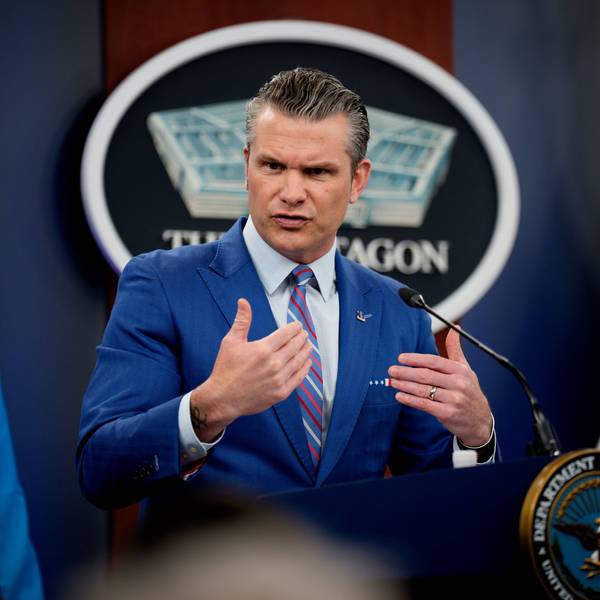
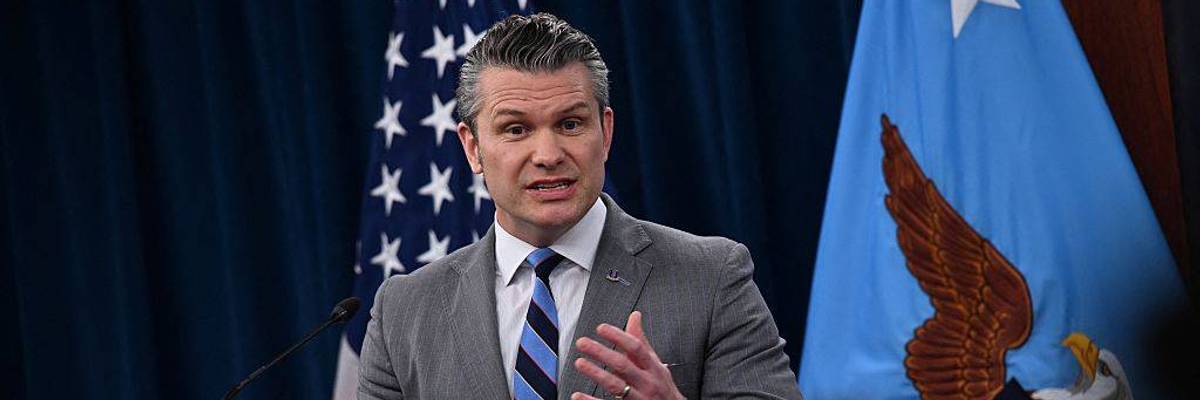
US Defense Secretary Pete Hegseth speaks during a press briefing at the Pentagon in Washington, DC, on April 24, 2026.
Hegseth Calls Iran War 'Gift to the World' Despite Economic Calamity, Food Shortages
Hegseth once again chided US allies for not getting involved in the war, which has created severe shortage of jet fuel and forced European airlines to enact mass flight cancelations.
US Defense Secretary Pete Hegseth on Friday once again suggested the international community should show gratitude for President Donald Trump's illegal war with Iran, which has led to a global oil supply shock and created the potential for food shortages in the coming months.
Speaking with reporters at the Pentagon, Hegseth defended the president's decision to launch a war of choice with Iran that so far has cost US taxpayers an estimated $60 billion.
"It's a bold and dangerous mission," said Hegseth. "A gift to the world. Historic. Courtesy of a bold and historic president."
Hegseth: "It's a bold and dangerous mission. A gift to the world. Historic. Courtesy of a bold and historic president." pic.twitter.com/AR0zs6Djd4
— Aaron Rupar (@atrupar) April 24, 2026
Hegseth also chided US allies for not getting involved in the war, which Trump and Israeli Prime Minister Benjamin Netanyahu launched in late February without any consultation or coordination with Europe.
"America and the free world deserve allies who are capable, who are loyal, and who understand being an ally is not a one-way street," he said. "We are not counting on Europe, but they need the Strait of Hormuz much more than we do, and might want to start doing less talking and having less fancy conferences in Europe, and get in a boat. This is much more their fight than ours."
Hegseth: "We are not counting on Europe, but they need the Strait of Hormuz much more than we do, and might want to start doing less talking and having less fancy conferences in Europe and get in a boat. This is much more their fight than ours." pic.twitter.com/OUnt3n9TfV
— Aaron Rupar (@atrupar) April 24, 2026
In reality, there is little reason for the world to feel gratitude to the US and Israel for the war.
As reported by Barron's on Friday, the war has created a global shortage of jet fuel that has led to airlines canceling flights, with Europe being particularly hard hit.
German airline Lufthansa, for instance, has announced it's cutting 20,000 flights through October, and even US airlines such as Delta have been announcing cuts to save money thanks to the increase in jet fuel prices.
South China Morning Post reported on Wednesday that Asian nations are bracing for food shortages, as the Iran War has led to a shortage of fertilizer for crops during the planting season throughout much of the world.
In addition to citing the effects of the Iran War on global food supplies, the South China Morning Post pointed to scientists' warnings of a "super El Niño" that could lead to lower than average rainfall.
“It is very concerning because this year is supposed to be a super El Niño, and you are getting into the planting season,” Gnanasekar Thiagarajan, founder of India-based financial research and advisory firm Commtrendz Research, told South China Morning Post. "This is going to be widespread across South and Southeast Asia. There will be dryness everywhere."
Jorge Moreira da Silva, executive director of the United Nations Office for Project Services (UNOPS), warned on Tuesday that there is a real risk of a global food crisis if the Strait of Hormuz remains closed to shipments of fertilizer.
“The planting season has already started, and in most countries in Africa it will end in May," the UN official explained. "So, if we don’t get some solution immediately, the crisis will be very significant and severe, particularly for the poorest countries and for the poorest citizens."
We are at a crossroads
This country and this world are at a monumental crossroads. In a few short weeks, US voters will have an opportunity to beat back the forces of fascism and confront the billionaires who are rigging the economy, our media system, and our democracy, making it increasingly impossible for ordinary people to get by. We’re not just talking about the election. We’re talking about what must be done once these fascist elements are vanquished from power. We need a bolder set of solutions than what either major party has so far been willing to offer and a working-class movement ready to fight like hell for it. Trump didn't emerge from nowhere. The conditions that fueled MAGA authoritarianism were created by decades of radical neoliberal economic policies and a corrupt political system dominated by corporate interests. They slashed taxes on the super-rich, promising that the benefits would trickle down. They said giveaways to the corporate titans would make life more affordable for the rest of us. It was all bullshit. And when a bitter, betrayed populace searches for someone to blame, right-wing demagogues have little trouble finding scapegoats. People know when they're being lied to, but you won't hear any of this from the corporate media. Only independent journalism—powered and funded by people who believe in building a better world—can deliver truly trustworthy daily news. Our Fall Campaign is underway, and we need your help. To power our newsroom through the rest of the year, we need to raise $125,000 by midnight on October 31. So if you share our vision, please contribute whatever you can to sustain our work. |
US Defense Secretary Pete Hegseth on Friday once again suggested the international community should show gratitude for President Donald Trump's illegal war with Iran, which has led to a global oil supply shock and created the potential for food shortages in the coming months.
Speaking with reporters at the Pentagon, Hegseth defended the president's decision to launch a war of choice with Iran that so far has cost US taxpayers an estimated $60 billion.
"It's a bold and dangerous mission," said Hegseth. "A gift to the world. Historic. Courtesy of a bold and historic president."
Hegseth: "It's a bold and dangerous mission. A gift to the world. Historic. Courtesy of a bold and historic president." pic.twitter.com/AR0zs6Djd4
— Aaron Rupar (@atrupar) April 24, 2026
Hegseth also chided US allies for not getting involved in the war, which Trump and Israeli Prime Minister Benjamin Netanyahu launched in late February without any consultation or coordination with Europe.
"America and the free world deserve allies who are capable, who are loyal, and who understand being an ally is not a one-way street," he said. "We are not counting on Europe, but they need the Strait of Hormuz much more than we do, and might want to start doing less talking and having less fancy conferences in Europe, and get in a boat. This is much more their fight than ours."
Hegseth: "We are not counting on Europe, but they need the Strait of Hormuz much more than we do, and might want to start doing less talking and having less fancy conferences in Europe and get in a boat. This is much more their fight than ours." pic.twitter.com/OUnt3n9TfV
— Aaron Rupar (@atrupar) April 24, 2026
In reality, there is little reason for the world to feel gratitude to the US and Israel for the war.
As reported by Barron's on Friday, the war has created a global shortage of jet fuel that has led to airlines canceling flights, with Europe being particularly hard hit.
German airline Lufthansa, for instance, has announced it's cutting 20,000 flights through October, and even US airlines such as Delta have been announcing cuts to save money thanks to the increase in jet fuel prices.
South China Morning Post reported on Wednesday that Asian nations are bracing for food shortages, as the Iran War has led to a shortage of fertilizer for crops during the planting season throughout much of the world.
In addition to citing the effects of the Iran War on global food supplies, the South China Morning Post pointed to scientists' warnings of a "super El Niño" that could lead to lower than average rainfall.
“It is very concerning because this year is supposed to be a super El Niño, and you are getting into the planting season,” Gnanasekar Thiagarajan, founder of India-based financial research and advisory firm Commtrendz Research, told South China Morning Post. "This is going to be widespread across South and Southeast Asia. There will be dryness everywhere."
Jorge Moreira da Silva, executive director of the United Nations Office for Project Services (UNOPS), warned on Tuesday that there is a real risk of a global food crisis if the Strait of Hormuz remains closed to shipments of fertilizer.
“The planting season has already started, and in most countries in Africa it will end in May," the UN official explained. "So, if we don’t get some solution immediately, the crisis will be very significant and severe, particularly for the poorest countries and for the poorest citizens."
- 'Heretical and Batshit Crazy': Hegseth Rebuked for Bloodthirsty Prayer Asking God to Bless Iran War ›
- Better Uses for the Money Pete Hegseth Wants to Throw at Trump's Illegal Iran War ›
US Defense Secretary Pete Hegseth on Friday once again suggested the international community should show gratitude for President Donald Trump's illegal war with Iran, which has led to a global oil supply shock and created the potential for food shortages in the coming months.
Speaking with reporters at the Pentagon, Hegseth defended the president's decision to launch a war of choice with Iran that so far has cost US taxpayers an estimated $60 billion.
"It's a bold and dangerous mission," said Hegseth. "A gift to the world. Historic. Courtesy of a bold and historic president."
Hegseth: "It's a bold and dangerous mission. A gift to the world. Historic. Courtesy of a bold and historic president." pic.twitter.com/AR0zs6Djd4
— Aaron Rupar (@atrupar) April 24, 2026
Hegseth also chided US allies for not getting involved in the war, which Trump and Israeli Prime Minister Benjamin Netanyahu launched in late February without any consultation or coordination with Europe.
"America and the free world deserve allies who are capable, who are loyal, and who understand being an ally is not a one-way street," he said. "We are not counting on Europe, but they need the Strait of Hormuz much more than we do, and might want to start doing less talking and having less fancy conferences in Europe, and get in a boat. This is much more their fight than ours."
Hegseth: "We are not counting on Europe, but they need the Strait of Hormuz much more than we do, and might want to start doing less talking and having less fancy conferences in Europe and get in a boat. This is much more their fight than ours." pic.twitter.com/OUnt3n9TfV
— Aaron Rupar (@atrupar) April 24, 2026
In reality, there is little reason for the world to feel gratitude to the US and Israel for the war.
As reported by Barron's on Friday, the war has created a global shortage of jet fuel that has led to airlines canceling flights, with Europe being particularly hard hit.
German airline Lufthansa, for instance, has announced it's cutting 20,000 flights through October, and even US airlines such as Delta have been announcing cuts to save money thanks to the increase in jet fuel prices.
South China Morning Post reported on Wednesday that Asian nations are bracing for food shortages, as the Iran War has led to a shortage of fertilizer for crops during the planting season throughout much of the world.
In addition to citing the effects of the Iran War on global food supplies, the South China Morning Post pointed to scientists' warnings of a "super El Niño" that could lead to lower than average rainfall.
“It is very concerning because this year is supposed to be a super El Niño, and you are getting into the planting season,” Gnanasekar Thiagarajan, founder of India-based financial research and advisory firm Commtrendz Research, told South China Morning Post. "This is going to be widespread across South and Southeast Asia. There will be dryness everywhere."
Jorge Moreira da Silva, executive director of the United Nations Office for Project Services (UNOPS), warned on Tuesday that there is a real risk of a global food crisis if the Strait of Hormuz remains closed to shipments of fertilizer.
“The planting season has already started, and in most countries in Africa it will end in May," the UN official explained. "So, if we don’t get some solution immediately, the crisis will be very significant and severe, particularly for the poorest countries and for the poorest citizens."
- 'Heretical and Batshit Crazy': Hegseth Rebuked for Bloodthirsty Prayer Asking God to Bless Iran War ›
- Better Uses for the Money Pete Hegseth Wants to Throw at Trump's Illegal Iran War ›