SUBSCRIBE TO OUR FREE NEWSLETTER
Daily news & progressive opinion—funded by the people, not the corporations—delivered straight to your inbox.
5
#000000
#FFFFFF
To donate by check, phone, or other method, see our More Ways to Give page.
Daily news & progressive opinion—funded by the people, not the corporations—delivered straight to your inbox.
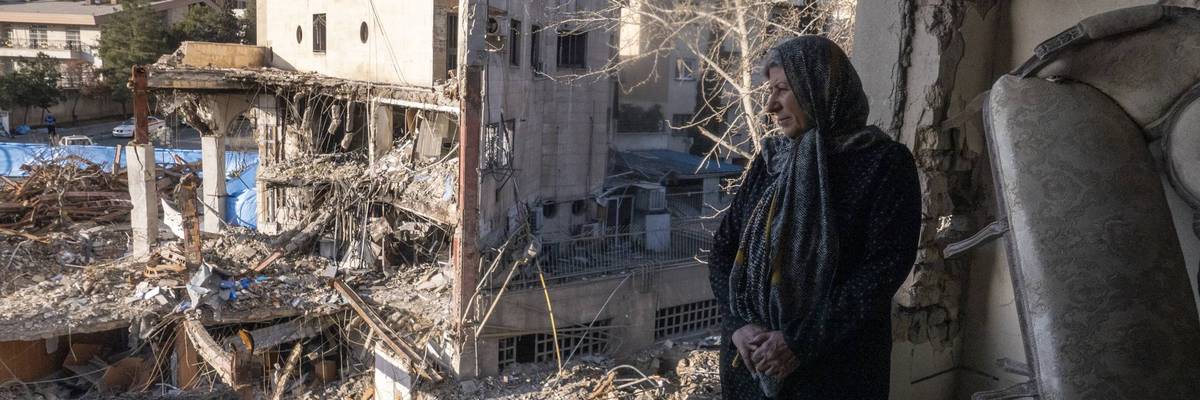
A woman looks out from her destroyed apartment at the remains of a residential and commercial building on March 21, 2026 in the Shahrak-e Gharb neighbourhood of Tehran, Iran.
"This is collective punishment," said the president of the National Iranian American Council. "Targeting power plants, nuclear plants, and desalination plants are war crimes."
Update (7:35 am ET):
US President Donald Trump wrote on social media early Monday that he has instructed the Pentagon to "postpone any and all military strikes against Iranian power plants and energy infrastructure for a five-day period, subject to the success of the ongoing meetings and discussions."
Trump asserted that US and Iranian officials have had "very good and productive conversations" over the past two days "regarding a complete and total resolution of our hostilities in the Middle East."
Iran denied Trump's claim of talks, saying the US president "backed down" after its retaliatory threats against power infrastructure in Gulf nations.
Earlier:
US President Donald Trump's threat over the weekend to bomb Iranian power plants if the Strait of Hormuz is not fully reopened by Monday night sparked horror around the world and inside Iran, a nation of roughly 90 million people.
"As far as I can tell, everyone is extremely worried," a 35-year-old Tehran resident, identified as Ruhollah, told The New York Times via text message late Sunday as the US president's arbitrary deadline approached. "We are sitting and waiting to see what will happen to us in 48 hours. Everyone will suffer: We will lose power, the Arabs will lose power and water."
The Iranian government threatened to retaliate against any US attack on its civilian power infrastructure with a large-scale assault on power plants serving US military installations and other American interests in Gulf nations.
"If you hit electricity, we hit electricity," the Islamic Revolutionary Guard Corps said in response to Trump's threat, which gave Iran until approximately 7:45 pm ET on Monday to reopen the Strait of Hormuz as the global energy crisis sparked by the illegal US-Israeli war intensified.
Mike Waltz, the US ambassador to the United Nations, declined to rule out a strike on nuclear energy plants in Iran, saying in a television appearance on Sunday that he would "never take anything off the table for the president."
"This is absurd and dangerous," responded Kelsey Davenport, director of nonproliferation policy at the Arms Control Association (ACA). "Bombing a nuclear power plant should be off the table. Period."
Daryl Kimball, the ACA's director, added that "bombing a functioning nuclear power reactor is blatantly illegal."
"Any such order from [the US president] would be illegal and should not be executed by military commanders," Kimball wrote on social media. "Trump and Co. are out of control."
The National Iranian American Council (NIAC) warned Sunday that if Trump follows through with his threat to strike Iranian power plants, "it is likely the US, Israel, and Iran enter a full-scale infrastructure warfare, where electricity systems—essential for hospitals, water supply, communications, and daily life—are treated as targets."
"The consequences of such a shift would likely extend far beyond Iran, risking regional blackouts, economic disruption, and large-scale civilian harm for tens of millions of people," the group wrote in a blog post. "Targeting power plants risks severe humanitarian consequences and invites reciprocal attacks across the region. Strikes near nuclear facilities increase the danger of catastrophic escalation, even if unintended."
Jamal Abdi, NIAC's president, said in a statement that "threatening to bomb Iran’s power plants is a threat to millions of civilians—people who rely on electricity for hospitals, water systems, and basic survival."
"This is not a ‘targeted’ strike. This is collective punishment," said Abdi, calling for an urgent diplomatic resolution. "Targeting power plants, nuclear plants, and desalination plants are war crimes. The president’s endorsement of such acts only threatens to escalate the conflict further and provoke attacks on civilian infrastructure across the region."
Early Monday, power outages were reported across Tehran as the Israeli military announced "a wide-scale wave of strikes" on the Iranian capital.
"Al Jazeera Arabic’s correspondent in Tehran, Suhaib al-Asa, reported that the size and volume of the explosions in the Iranian capital were 'unprecedented,' especially in the eastern side of the city," the outlet noted. "The Iranian air defense systems were activated in the eastern part of the city, al-Asa said, which indicated Iran was responding to US-Israeli drones hovering over that part of the city."
Dear Common Dreams reader, It’s been nearly 30 years since I co-founded Common Dreams with my late wife, Lina Newhouser. We had the radical notion that journalism should serve the public good, not corporate profits. It was clear to us from the outset what it would take to build such a project. No paid advertisements. No corporate sponsors. No millionaire publisher telling us what to think or do. Many people said we wouldn't last a year, but we proved those doubters wrong. Together with a tremendous team of journalists and dedicated staff, we built an independent media outlet free from the constraints of profits and corporate control. Our mission has always been simple: To inform. To inspire. To ignite change for the common good. Building Common Dreams was not easy. Our survival was never guaranteed. When you take on the most powerful forces—Wall Street greed, fossil fuel industry destruction, Big Tech lobbyists, and uber-rich oligarchs who have spent billions upon billions rigging the economy and democracy in their favor—the only bulwark you have is supporters who believe in your work. But here’s the urgent message from me today. It's never been this bad out there. And it's never been this hard to keep us going. At the very moment Common Dreams is most needed, the threats we face are intensifying. We need your support now more than ever. We don't accept corporate advertising and never will. We don't have a paywall because we don't think people should be blocked from critical news based on their ability to pay. Everything we do is funded by the donations of readers like you. When everyone does the little they can afford, we are strong. But if that support retreats or dries up, so do we. Will you donate now to make sure Common Dreams not only survives but thrives? —Craig Brown, Co-founder |
Update (7:35 am ET):
US President Donald Trump wrote on social media early Monday that he has instructed the Pentagon to "postpone any and all military strikes against Iranian power plants and energy infrastructure for a five-day period, subject to the success of the ongoing meetings and discussions."
Trump asserted that US and Iranian officials have had "very good and productive conversations" over the past two days "regarding a complete and total resolution of our hostilities in the Middle East."
Iran denied Trump's claim of talks, saying the US president "backed down" after its retaliatory threats against power infrastructure in Gulf nations.
Earlier:
US President Donald Trump's threat over the weekend to bomb Iranian power plants if the Strait of Hormuz is not fully reopened by Monday night sparked horror around the world and inside Iran, a nation of roughly 90 million people.
"As far as I can tell, everyone is extremely worried," a 35-year-old Tehran resident, identified as Ruhollah, told The New York Times via text message late Sunday as the US president's arbitrary deadline approached. "We are sitting and waiting to see what will happen to us in 48 hours. Everyone will suffer: We will lose power, the Arabs will lose power and water."
The Iranian government threatened to retaliate against any US attack on its civilian power infrastructure with a large-scale assault on power plants serving US military installations and other American interests in Gulf nations.
"If you hit electricity, we hit electricity," the Islamic Revolutionary Guard Corps said in response to Trump's threat, which gave Iran until approximately 7:45 pm ET on Monday to reopen the Strait of Hormuz as the global energy crisis sparked by the illegal US-Israeli war intensified.
Mike Waltz, the US ambassador to the United Nations, declined to rule out a strike on nuclear energy plants in Iran, saying in a television appearance on Sunday that he would "never take anything off the table for the president."
"This is absurd and dangerous," responded Kelsey Davenport, director of nonproliferation policy at the Arms Control Association (ACA). "Bombing a nuclear power plant should be off the table. Period."
Daryl Kimball, the ACA's director, added that "bombing a functioning nuclear power reactor is blatantly illegal."
"Any such order from [the US president] would be illegal and should not be executed by military commanders," Kimball wrote on social media. "Trump and Co. are out of control."
The National Iranian American Council (NIAC) warned Sunday that if Trump follows through with his threat to strike Iranian power plants, "it is likely the US, Israel, and Iran enter a full-scale infrastructure warfare, where electricity systems—essential for hospitals, water supply, communications, and daily life—are treated as targets."
"The consequences of such a shift would likely extend far beyond Iran, risking regional blackouts, economic disruption, and large-scale civilian harm for tens of millions of people," the group wrote in a blog post. "Targeting power plants risks severe humanitarian consequences and invites reciprocal attacks across the region. Strikes near nuclear facilities increase the danger of catastrophic escalation, even if unintended."
Jamal Abdi, NIAC's president, said in a statement that "threatening to bomb Iran’s power plants is a threat to millions of civilians—people who rely on electricity for hospitals, water systems, and basic survival."
"This is not a ‘targeted’ strike. This is collective punishment," said Abdi, calling for an urgent diplomatic resolution. "Targeting power plants, nuclear plants, and desalination plants are war crimes. The president’s endorsement of such acts only threatens to escalate the conflict further and provoke attacks on civilian infrastructure across the region."
Early Monday, power outages were reported across Tehran as the Israeli military announced "a wide-scale wave of strikes" on the Iranian capital.
"Al Jazeera Arabic’s correspondent in Tehran, Suhaib al-Asa, reported that the size and volume of the explosions in the Iranian capital were 'unprecedented,' especially in the eastern side of the city," the outlet noted. "The Iranian air defense systems were activated in the eastern part of the city, al-Asa said, which indicated Iran was responding to US-Israeli drones hovering over that part of the city."
Update (7:35 am ET):
US President Donald Trump wrote on social media early Monday that he has instructed the Pentagon to "postpone any and all military strikes against Iranian power plants and energy infrastructure for a five-day period, subject to the success of the ongoing meetings and discussions."
Trump asserted that US and Iranian officials have had "very good and productive conversations" over the past two days "regarding a complete and total resolution of our hostilities in the Middle East."
Iran denied Trump's claim of talks, saying the US president "backed down" after its retaliatory threats against power infrastructure in Gulf nations.
Earlier:
US President Donald Trump's threat over the weekend to bomb Iranian power plants if the Strait of Hormuz is not fully reopened by Monday night sparked horror around the world and inside Iran, a nation of roughly 90 million people.
"As far as I can tell, everyone is extremely worried," a 35-year-old Tehran resident, identified as Ruhollah, told The New York Times via text message late Sunday as the US president's arbitrary deadline approached. "We are sitting and waiting to see what will happen to us in 48 hours. Everyone will suffer: We will lose power, the Arabs will lose power and water."
The Iranian government threatened to retaliate against any US attack on its civilian power infrastructure with a large-scale assault on power plants serving US military installations and other American interests in Gulf nations.
"If you hit electricity, we hit electricity," the Islamic Revolutionary Guard Corps said in response to Trump's threat, which gave Iran until approximately 7:45 pm ET on Monday to reopen the Strait of Hormuz as the global energy crisis sparked by the illegal US-Israeli war intensified.
Mike Waltz, the US ambassador to the United Nations, declined to rule out a strike on nuclear energy plants in Iran, saying in a television appearance on Sunday that he would "never take anything off the table for the president."
"This is absurd and dangerous," responded Kelsey Davenport, director of nonproliferation policy at the Arms Control Association (ACA). "Bombing a nuclear power plant should be off the table. Period."
Daryl Kimball, the ACA's director, added that "bombing a functioning nuclear power reactor is blatantly illegal."
"Any such order from [the US president] would be illegal and should not be executed by military commanders," Kimball wrote on social media. "Trump and Co. are out of control."
The National Iranian American Council (NIAC) warned Sunday that if Trump follows through with his threat to strike Iranian power plants, "it is likely the US, Israel, and Iran enter a full-scale infrastructure warfare, where electricity systems—essential for hospitals, water supply, communications, and daily life—are treated as targets."
"The consequences of such a shift would likely extend far beyond Iran, risking regional blackouts, economic disruption, and large-scale civilian harm for tens of millions of people," the group wrote in a blog post. "Targeting power plants risks severe humanitarian consequences and invites reciprocal attacks across the region. Strikes near nuclear facilities increase the danger of catastrophic escalation, even if unintended."
Jamal Abdi, NIAC's president, said in a statement that "threatening to bomb Iran’s power plants is a threat to millions of civilians—people who rely on electricity for hospitals, water systems, and basic survival."
"This is not a ‘targeted’ strike. This is collective punishment," said Abdi, calling for an urgent diplomatic resolution. "Targeting power plants, nuclear plants, and desalination plants are war crimes. The president’s endorsement of such acts only threatens to escalate the conflict further and provoke attacks on civilian infrastructure across the region."
Early Monday, power outages were reported across Tehran as the Israeli military announced "a wide-scale wave of strikes" on the Iranian capital.
"Al Jazeera Arabic’s correspondent in Tehran, Suhaib al-Asa, reported that the size and volume of the explosions in the Iranian capital were 'unprecedented,' especially in the eastern side of the city," the outlet noted. "The Iranian air defense systems were activated in the eastern part of the city, al-Asa said, which indicated Iran was responding to US-Israeli drones hovering over that part of the city."