SUBSCRIBE TO OUR FREE NEWSLETTER
Daily news & progressive opinion—funded by the people, not the corporations—delivered straight to your inbox.
5
#000000
#FFFFFF
To donate by check, phone, or other method, see our More Ways to Give page.
Daily news & progressive opinion—funded by the people, not the corporations—delivered straight to your inbox.
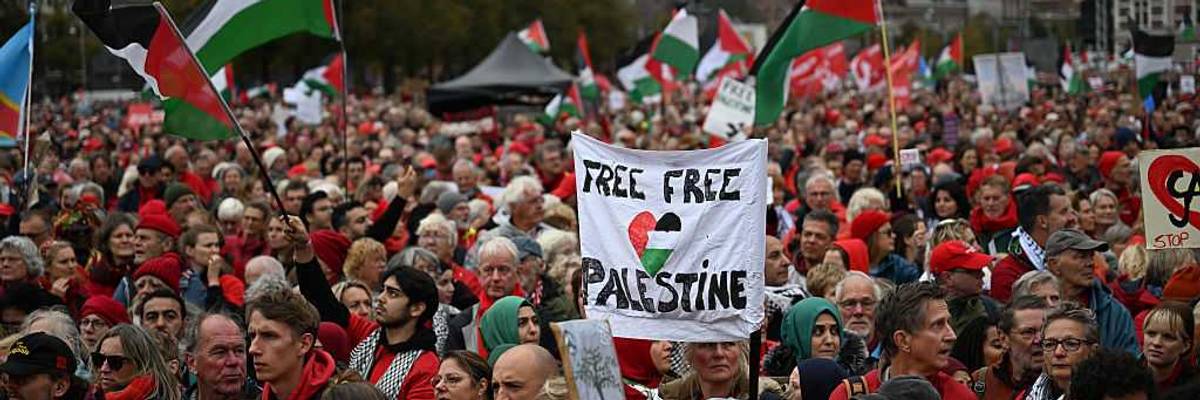
Thousands of demonstrators gather at Museumplein demanding firm government action to stop the Israeli attacks on Gaza, in Amsterdam on October 5, 2025.
An estimated 250,000 people dressed in red crowded into Museum Square in Amsterdam, demanding that the Dutch government end its support for Israel.
Expressing solidarity with Palestinians in Gaza and pressuring Dutch officials to end their longtime support for Israel were the goals of a massive demonstration in Amsterdam Sunday—one of the largest pro-Palestine protests held in Europe over the weekend as the two-year anniversary of Israel's bombardment of the exclave approached.
“The bloodshed must stop—and we unfortunately have to stand here because we have such an incredibly weak government that doesn’t dare to draw a red line. That’s why we are here, in the hope that it helps,” protester Marieke van Zijl told the Associated Press on Sunday in Museum Square in central Amsterdam, where an estimated 250,000 people gathered.
The protests in Amsterdam and across Europe came as Israel garnered global condemnation for its interception of more than 400 humanitarians from around the world who sailed toward Gaza in recent weeks with the Global Sumud Flotilla with the aim of delivering aid to the besieged territory, where a famine was declared in August due to Israel's near-total blockade on food, water, fuel, and other necessities entering Gaza.
In Sofia, Bulgaria, citizens carried signs reading, “Gaza: Starvation Is a Weapon of War,” while in Turkey's capital of Ankara, protesters held up placards condemning Israel's genocide in Gaza, where more than 67,000 Palestinians have been killed since October 2023.
Scholars on genocide and the Holocaust have joined leading human rights organizations—including some in Israel—and United Nations experts in declaring that Israel's bombardment of Gaza is a genocide. The International Court of Justice is also considering an ongoing genocide case brought by South Africa regarding the military assault and starvation policy.
In Amsterdam, most protesters wore red in solidarity with Palestine and many displayed Palestinian flags.
In the Netherlands, the government has long been a staunch supporter of Israel but in recent months has increasingly denounced its attacks on Gaza. In July it banned Israeli Prime Minister Benjamin Netanyahu and National Security Minister Itamar Ben-Gvir from entering the country because they “repeatedly incited violence against the Palestinian population."
On Friday, Dutch Foreign Minister David van Weel said he was "unlikely" to grant an export license to send F-35 fighter jet components to Israel. The country's Supreme Court last week ordered the government to review the currently suspended license to determine whether reinstating it would violate international law. The Netherlands is home to one of three regional warehouses for components of the US-made fighter jets.
Marjon Rozema, a spokesperson for Amnesty International, which helped organize the demonstration, called for the Dutch government to use "all economic and diplomatic means to increase pressure on Israel.”
Mass demonstrations were also held over the weekend in countries including Spain and Italy, where demonstrators demanded the release of organizers who had been aboard the Global Sumud Flotilla.
Hundreds of thousands of people marched in Rome, Madrid, and Barcelona, home of former Mayor Ada Colau, who was among those detained by Israel last week.
Organizers in Rome said 1 million people took part in Saturday's march, which followed Friday's one-day general strike across Italy.
"Governments, especially the Italians, are not taking action against what is happening in Gaza," one university teacher told the BBC on Friday at a rally. "We're here to say that it is time to intervene and solve things."
"The Italian demonstrations for Gaza and the flotilla have been of a rather unprecedented power in recent times," said scholar Bruno Montesano on Monday. "And they have had a global resonance that is equally surprising. And perhaps its strength derived from a sort of widespread spontaneous humanitarianism, as well as from the clashing contradictions between Western liberal-democratic chatter—certainly weakened even further due to the rise of the far right—and the racist and colonial practice of supporting Israeli fascism."
Dear Common Dreams reader, It’s been nearly 30 years since I co-founded Common Dreams with my late wife, Lina Newhouser. We had the radical notion that journalism should serve the public good, not corporate profits. It was clear to us from the outset what it would take to build such a project. No paid advertisements. No corporate sponsors. No millionaire publisher telling us what to think or do. Many people said we wouldn't last a year, but we proved those doubters wrong. Together with a tremendous team of journalists and dedicated staff, we built an independent media outlet free from the constraints of profits and corporate control. Our mission has always been simple: To inform. To inspire. To ignite change for the common good. Building Common Dreams was not easy. Our survival was never guaranteed. When you take on the most powerful forces—Wall Street greed, fossil fuel industry destruction, Big Tech lobbyists, and uber-rich oligarchs who have spent billions upon billions rigging the economy and democracy in their favor—the only bulwark you have is supporters who believe in your work. But here’s the urgent message from me today. It's never been this bad out there. And it's never been this hard to keep us going. At the very moment Common Dreams is most needed, the threats we face are intensifying. We need your support now more than ever. We don't accept corporate advertising and never will. We don't have a paywall because we don't think people should be blocked from critical news based on their ability to pay. Everything we do is funded by the donations of readers like you. When everyone does the little they can afford, we are strong. But if that support retreats or dries up, so do we. Will you donate now to make sure Common Dreams not only survives but thrives? —Craig Brown, Co-founder |
Expressing solidarity with Palestinians in Gaza and pressuring Dutch officials to end their longtime support for Israel were the goals of a massive demonstration in Amsterdam Sunday—one of the largest pro-Palestine protests held in Europe over the weekend as the two-year anniversary of Israel's bombardment of the exclave approached.
“The bloodshed must stop—and we unfortunately have to stand here because we have such an incredibly weak government that doesn’t dare to draw a red line. That’s why we are here, in the hope that it helps,” protester Marieke van Zijl told the Associated Press on Sunday in Museum Square in central Amsterdam, where an estimated 250,000 people gathered.
The protests in Amsterdam and across Europe came as Israel garnered global condemnation for its interception of more than 400 humanitarians from around the world who sailed toward Gaza in recent weeks with the Global Sumud Flotilla with the aim of delivering aid to the besieged territory, where a famine was declared in August due to Israel's near-total blockade on food, water, fuel, and other necessities entering Gaza.
In Sofia, Bulgaria, citizens carried signs reading, “Gaza: Starvation Is a Weapon of War,” while in Turkey's capital of Ankara, protesters held up placards condemning Israel's genocide in Gaza, where more than 67,000 Palestinians have been killed since October 2023.
Scholars on genocide and the Holocaust have joined leading human rights organizations—including some in Israel—and United Nations experts in declaring that Israel's bombardment of Gaza is a genocide. The International Court of Justice is also considering an ongoing genocide case brought by South Africa regarding the military assault and starvation policy.
In Amsterdam, most protesters wore red in solidarity with Palestine and many displayed Palestinian flags.
In the Netherlands, the government has long been a staunch supporter of Israel but in recent months has increasingly denounced its attacks on Gaza. In July it banned Israeli Prime Minister Benjamin Netanyahu and National Security Minister Itamar Ben-Gvir from entering the country because they “repeatedly incited violence against the Palestinian population."
On Friday, Dutch Foreign Minister David van Weel said he was "unlikely" to grant an export license to send F-35 fighter jet components to Israel. The country's Supreme Court last week ordered the government to review the currently suspended license to determine whether reinstating it would violate international law. The Netherlands is home to one of three regional warehouses for components of the US-made fighter jets.
Marjon Rozema, a spokesperson for Amnesty International, which helped organize the demonstration, called for the Dutch government to use "all economic and diplomatic means to increase pressure on Israel.”
Mass demonstrations were also held over the weekend in countries including Spain and Italy, where demonstrators demanded the release of organizers who had been aboard the Global Sumud Flotilla.
Hundreds of thousands of people marched in Rome, Madrid, and Barcelona, home of former Mayor Ada Colau, who was among those detained by Israel last week.
Organizers in Rome said 1 million people took part in Saturday's march, which followed Friday's one-day general strike across Italy.
"Governments, especially the Italians, are not taking action against what is happening in Gaza," one university teacher told the BBC on Friday at a rally. "We're here to say that it is time to intervene and solve things."
"The Italian demonstrations for Gaza and the flotilla have been of a rather unprecedented power in recent times," said scholar Bruno Montesano on Monday. "And they have had a global resonance that is equally surprising. And perhaps its strength derived from a sort of widespread spontaneous humanitarianism, as well as from the clashing contradictions between Western liberal-democratic chatter—certainly weakened even further due to the rise of the far right—and the racist and colonial practice of supporting Israeli fascism."
Expressing solidarity with Palestinians in Gaza and pressuring Dutch officials to end their longtime support for Israel were the goals of a massive demonstration in Amsterdam Sunday—one of the largest pro-Palestine protests held in Europe over the weekend as the two-year anniversary of Israel's bombardment of the exclave approached.
“The bloodshed must stop—and we unfortunately have to stand here because we have such an incredibly weak government that doesn’t dare to draw a red line. That’s why we are here, in the hope that it helps,” protester Marieke van Zijl told the Associated Press on Sunday in Museum Square in central Amsterdam, where an estimated 250,000 people gathered.
The protests in Amsterdam and across Europe came as Israel garnered global condemnation for its interception of more than 400 humanitarians from around the world who sailed toward Gaza in recent weeks with the Global Sumud Flotilla with the aim of delivering aid to the besieged territory, where a famine was declared in August due to Israel's near-total blockade on food, water, fuel, and other necessities entering Gaza.
In Sofia, Bulgaria, citizens carried signs reading, “Gaza: Starvation Is a Weapon of War,” while in Turkey's capital of Ankara, protesters held up placards condemning Israel's genocide in Gaza, where more than 67,000 Palestinians have been killed since October 2023.
Scholars on genocide and the Holocaust have joined leading human rights organizations—including some in Israel—and United Nations experts in declaring that Israel's bombardment of Gaza is a genocide. The International Court of Justice is also considering an ongoing genocide case brought by South Africa regarding the military assault and starvation policy.
In Amsterdam, most protesters wore red in solidarity with Palestine and many displayed Palestinian flags.
In the Netherlands, the government has long been a staunch supporter of Israel but in recent months has increasingly denounced its attacks on Gaza. In July it banned Israeli Prime Minister Benjamin Netanyahu and National Security Minister Itamar Ben-Gvir from entering the country because they “repeatedly incited violence against the Palestinian population."
On Friday, Dutch Foreign Minister David van Weel said he was "unlikely" to grant an export license to send F-35 fighter jet components to Israel. The country's Supreme Court last week ordered the government to review the currently suspended license to determine whether reinstating it would violate international law. The Netherlands is home to one of three regional warehouses for components of the US-made fighter jets.
Marjon Rozema, a spokesperson for Amnesty International, which helped organize the demonstration, called for the Dutch government to use "all economic and diplomatic means to increase pressure on Israel.”
Mass demonstrations were also held over the weekend in countries including Spain and Italy, where demonstrators demanded the release of organizers who had been aboard the Global Sumud Flotilla.
Hundreds of thousands of people marched in Rome, Madrid, and Barcelona, home of former Mayor Ada Colau, who was among those detained by Israel last week.
Organizers in Rome said 1 million people took part in Saturday's march, which followed Friday's one-day general strike across Italy.
"Governments, especially the Italians, are not taking action against what is happening in Gaza," one university teacher told the BBC on Friday at a rally. "We're here to say that it is time to intervene and solve things."
"The Italian demonstrations for Gaza and the flotilla have been of a rather unprecedented power in recent times," said scholar Bruno Montesano on Monday. "And they have had a global resonance that is equally surprising. And perhaps its strength derived from a sort of widespread spontaneous humanitarianism, as well as from the clashing contradictions between Western liberal-democratic chatter—certainly weakened even further due to the rise of the far right—and the racist and colonial practice of supporting Israeli fascism."