SUBSCRIBE TO OUR FREE NEWSLETTER
Daily news & progressive opinion—funded by the people, not the corporations—delivered straight to your inbox.
5
#000000
#FFFFFF
To donate by check, phone, or other method, see our More Ways to Give page.
Daily news & progressive opinion—funded by the people, not the corporations—delivered straight to your inbox.
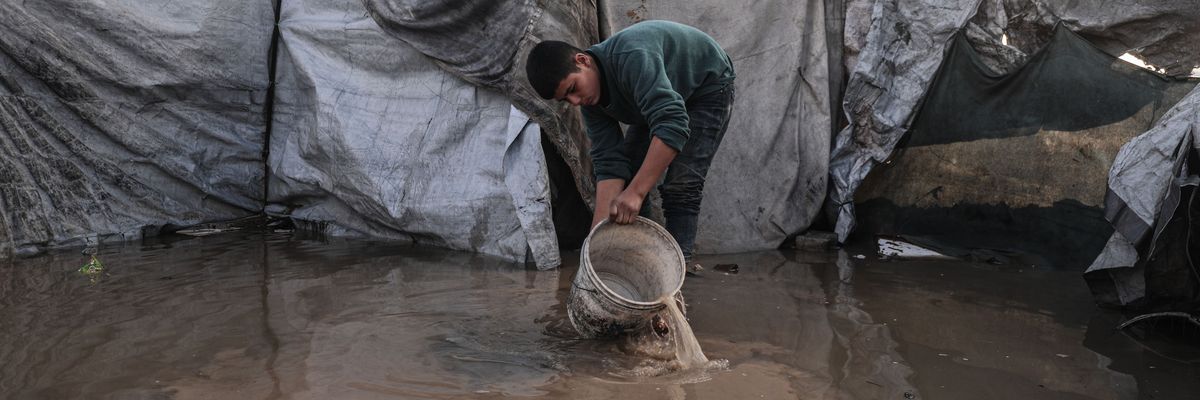
Palestinians struggle with flooding after heavy rain hits the Bureij Refugee Camp in Gaza City, Gaza, on December 16, 2025.
"This suffering is being manufactured by policy, not weather," said a humanitarian aid coordinator for Oxfam.
Makeshift tents billowing furiously in the wind. Children wading through ankle-high water. A young boy futilely beating back an oncoming wave with nothing but a broom.
These are just a few of the scenes that came out of Gaza in recent days as its population of nearly 2 million people was beset by heavy rainfall and punishing winds from Storm Byron, which hit late last week.
According to the United Nations’ Office for the Coordination of Humanitarian Affairs (OCHA) in Jerusalem, more than 1.3 million Palestinians in the territory are without proper shelter following more than two years of relentless Israeli bombing, which destroyed or damaged over 90% of housing units.
"The conditions are catastrophic, I must say," Jonathan Crickx, the chief of communication for the UN Children's Fund, told PBS News. "I've been in many, many tents in the past two days, and the tents are completely flooded. I met with tens of children. Their clothes are wet, the mattresses in the tents are completely soaked. And those children, they are cold."
At least three children, including two infants and a 9-year-old, died from hypothermia or cold exposure within a 24-hour period. Another five were crushed after a house sheltering displaced civilians collapsed due to the storm. As of Friday, at least 14 people were reported dead from the storm, and several more are injured, according to Gaza’s Ministry of Interior and National Security.
"Civilians are now wading through sewage, mud, and debris, with no proper shelter," said Bushra Khalidi, the policy lead for Oxfam in the occupied Palestinian territories. "This is not a failure of preparedness or capacity; it's the direct result of the systematic obstruction of aid."
"The Israeli authorities continue to block the entry of basic shelter materials, fuel, and water infrastructure, leaving people exposed to entirely preventable harm," Khalidi continued. "When access is denied, storms become deadly. This suffering is being manufactured by policy, not weather."
Under the terms of the "ceasefire" agreement signed between Israel and Hamas in October, Israel was required to allow more than 600 trucks carrying humanitarian aid to enter Gaza each day. But according to UN data published earlier this month, just 113 trucks per day on average have been allowed to enter the strip, less than a fifth of the agreed-upon amount.
The Rafah crossing, the largest entry point for aid, still remains almost totally closed after being opened briefly during the first week of the ceasefire. Israel said earlier this month that it may soon reopen the crossing, but only to allow for the exit of Palestinians.
"Without question, the Israelis and their persistent bureaucracy have prevented us from bringing in the necessary shelter that would provide adequate dwellings for the people living in Gaza," said Chris McIntosh, Oxfam's humanitarian response adviser in the territory.
In the crowded coastal area of al-Mawasi, he said, some residents have been left with little to protect themselves from the elements but blankets and flimsy tarpaulin.
"Obviously, a blanket is not going to do much against torrential downpours and winds that are at nearly gale force," he said. "The Israelis have not permitted these tents to enter the Gaza Strip, not for many months... The population is bracing for a very, very tragic situation right now."
Official estimates put the death toll in Gaza at more than 70,600 since October 7, 2023, including more than 300 who have been killed during the ceasefire period across hundreds of attacks by Israel in violation of the agreement. But other independent studies, which take indirect effects of the genocide, like malnutrition and disease, into account, place the death toll much higher.
Dear Common Dreams reader, It’s been nearly 30 years since I co-founded Common Dreams with my late wife, Lina Newhouser. We had the radical notion that journalism should serve the public good, not corporate profits. It was clear to us from the outset what it would take to build such a project. No paid advertisements. No corporate sponsors. No millionaire publisher telling us what to think or do. Many people said we wouldn't last a year, but we proved those doubters wrong. Together with a tremendous team of journalists and dedicated staff, we built an independent media outlet free from the constraints of profits and corporate control. Our mission has always been simple: To inform. To inspire. To ignite change for the common good. Building Common Dreams was not easy. Our survival was never guaranteed. When you take on the most powerful forces—Wall Street greed, fossil fuel industry destruction, Big Tech lobbyists, and uber-rich oligarchs who have spent billions upon billions rigging the economy and democracy in their favor—the only bulwark you have is supporters who believe in your work. But here’s the urgent message from me today. It's never been this bad out there. And it's never been this hard to keep us going. At the very moment Common Dreams is most needed, the threats we face are intensifying. We need your support now more than ever. We don't accept corporate advertising and never will. We don't have a paywall because we don't think people should be blocked from critical news based on their ability to pay. Everything we do is funded by the donations of readers like you. When everyone does the little they can afford, we are strong. But if that support retreats or dries up, so do we. Will you donate now to make sure Common Dreams not only survives but thrives? —Craig Brown, Co-founder |
Makeshift tents billowing furiously in the wind. Children wading through ankle-high water. A young boy futilely beating back an oncoming wave with nothing but a broom.
These are just a few of the scenes that came out of Gaza in recent days as its population of nearly 2 million people was beset by heavy rainfall and punishing winds from Storm Byron, which hit late last week.
According to the United Nations’ Office for the Coordination of Humanitarian Affairs (OCHA) in Jerusalem, more than 1.3 million Palestinians in the territory are without proper shelter following more than two years of relentless Israeli bombing, which destroyed or damaged over 90% of housing units.
"The conditions are catastrophic, I must say," Jonathan Crickx, the chief of communication for the UN Children's Fund, told PBS News. "I've been in many, many tents in the past two days, and the tents are completely flooded. I met with tens of children. Their clothes are wet, the mattresses in the tents are completely soaked. And those children, they are cold."
At least three children, including two infants and a 9-year-old, died from hypothermia or cold exposure within a 24-hour period. Another five were crushed after a house sheltering displaced civilians collapsed due to the storm. As of Friday, at least 14 people were reported dead from the storm, and several more are injured, according to Gaza’s Ministry of Interior and National Security.
"Civilians are now wading through sewage, mud, and debris, with no proper shelter," said Bushra Khalidi, the policy lead for Oxfam in the occupied Palestinian territories. "This is not a failure of preparedness or capacity; it's the direct result of the systematic obstruction of aid."
"The Israeli authorities continue to block the entry of basic shelter materials, fuel, and water infrastructure, leaving people exposed to entirely preventable harm," Khalidi continued. "When access is denied, storms become deadly. This suffering is being manufactured by policy, not weather."
Under the terms of the "ceasefire" agreement signed between Israel and Hamas in October, Israel was required to allow more than 600 trucks carrying humanitarian aid to enter Gaza each day. But according to UN data published earlier this month, just 113 trucks per day on average have been allowed to enter the strip, less than a fifth of the agreed-upon amount.
The Rafah crossing, the largest entry point for aid, still remains almost totally closed after being opened briefly during the first week of the ceasefire. Israel said earlier this month that it may soon reopen the crossing, but only to allow for the exit of Palestinians.
"Without question, the Israelis and their persistent bureaucracy have prevented us from bringing in the necessary shelter that would provide adequate dwellings for the people living in Gaza," said Chris McIntosh, Oxfam's humanitarian response adviser in the territory.
In the crowded coastal area of al-Mawasi, he said, some residents have been left with little to protect themselves from the elements but blankets and flimsy tarpaulin.
"Obviously, a blanket is not going to do much against torrential downpours and winds that are at nearly gale force," he said. "The Israelis have not permitted these tents to enter the Gaza Strip, not for many months... The population is bracing for a very, very tragic situation right now."
Official estimates put the death toll in Gaza at more than 70,600 since October 7, 2023, including more than 300 who have been killed during the ceasefire period across hundreds of attacks by Israel in violation of the agreement. But other independent studies, which take indirect effects of the genocide, like malnutrition and disease, into account, place the death toll much higher.
Makeshift tents billowing furiously in the wind. Children wading through ankle-high water. A young boy futilely beating back an oncoming wave with nothing but a broom.
These are just a few of the scenes that came out of Gaza in recent days as its population of nearly 2 million people was beset by heavy rainfall and punishing winds from Storm Byron, which hit late last week.
According to the United Nations’ Office for the Coordination of Humanitarian Affairs (OCHA) in Jerusalem, more than 1.3 million Palestinians in the territory are without proper shelter following more than two years of relentless Israeli bombing, which destroyed or damaged over 90% of housing units.
"The conditions are catastrophic, I must say," Jonathan Crickx, the chief of communication for the UN Children's Fund, told PBS News. "I've been in many, many tents in the past two days, and the tents are completely flooded. I met with tens of children. Their clothes are wet, the mattresses in the tents are completely soaked. And those children, they are cold."
At least three children, including two infants and a 9-year-old, died from hypothermia or cold exposure within a 24-hour period. Another five were crushed after a house sheltering displaced civilians collapsed due to the storm. As of Friday, at least 14 people were reported dead from the storm, and several more are injured, according to Gaza’s Ministry of Interior and National Security.
"Civilians are now wading through sewage, mud, and debris, with no proper shelter," said Bushra Khalidi, the policy lead for Oxfam in the occupied Palestinian territories. "This is not a failure of preparedness or capacity; it's the direct result of the systematic obstruction of aid."
"The Israeli authorities continue to block the entry of basic shelter materials, fuel, and water infrastructure, leaving people exposed to entirely preventable harm," Khalidi continued. "When access is denied, storms become deadly. This suffering is being manufactured by policy, not weather."
Under the terms of the "ceasefire" agreement signed between Israel and Hamas in October, Israel was required to allow more than 600 trucks carrying humanitarian aid to enter Gaza each day. But according to UN data published earlier this month, just 113 trucks per day on average have been allowed to enter the strip, less than a fifth of the agreed-upon amount.
The Rafah crossing, the largest entry point for aid, still remains almost totally closed after being opened briefly during the first week of the ceasefire. Israel said earlier this month that it may soon reopen the crossing, but only to allow for the exit of Palestinians.
"Without question, the Israelis and their persistent bureaucracy have prevented us from bringing in the necessary shelter that would provide adequate dwellings for the people living in Gaza," said Chris McIntosh, Oxfam's humanitarian response adviser in the territory.
In the crowded coastal area of al-Mawasi, he said, some residents have been left with little to protect themselves from the elements but blankets and flimsy tarpaulin.
"Obviously, a blanket is not going to do much against torrential downpours and winds that are at nearly gale force," he said. "The Israelis have not permitted these tents to enter the Gaza Strip, not for many months... The population is bracing for a very, very tragic situation right now."
Official estimates put the death toll in Gaza at more than 70,600 since October 7, 2023, including more than 300 who have been killed during the ceasefire period across hundreds of attacks by Israel in violation of the agreement. But other independent studies, which take indirect effects of the genocide, like malnutrition and disease, into account, place the death toll much higher.