SUBSCRIBE TO OUR FREE NEWSLETTER
Daily news & progressive opinion—funded by the people, not the corporations—delivered straight to your inbox.
5
#000000
#FFFFFF
To donate by check, phone, or other method, see our More Ways to Give page.
Daily news & progressive opinion—funded by the people, not the corporations—delivered straight to your inbox.
Congress is considering reauthorization of Section 702 of the Foreign Intelligence Surveillance Act.
"The American people do not want the government to bypass the courts and buy our private information in bulk from data brokers."
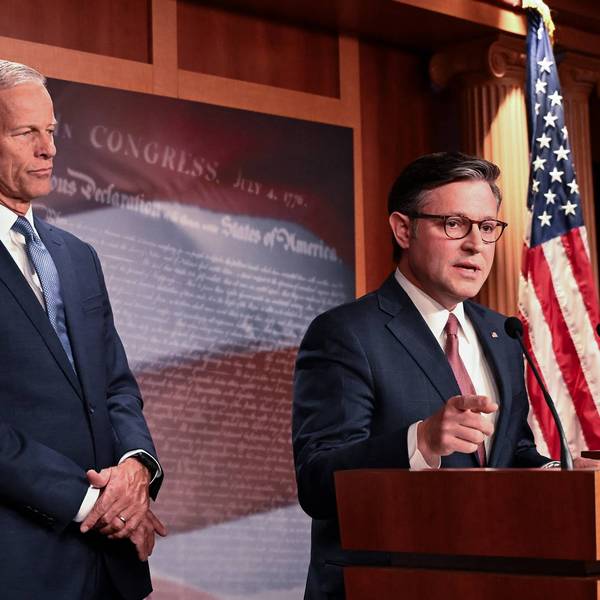
With Republican leadership in the US House of Representatives aiming for "a straightforward extension of Section 702 of the Foreign Intelligence Surveillance Act, or FISA, next week," a diverse coalition on Thursday renewed calls for Congress to impose "much-needed privacy protections against government agencies' warrantless mass surveillance of people in the United States."
Section 702 empowers the US government to spy on electronic communications of noncitizens located outside the United States to acquire foreign intelligence information, without a warrant. However, Americans' data is also collected, and advocates and lawmakers have long demanded reforms to the abused authority, which is set to expire next month unless reauthorized.
As President Donald Trump's White House—including Stephen Miller, his pro-spying deputy chief of staff—pushes for a "clean" reauthorization, 133 artificial intelligence, civil rights, and other progressive groups convened by Demand Progress and the Project On Government Oversight sent a Thursday letter to Republican and Democratic leaders in both chambers of Congress.
The coalition's letter argues that "FISA's sunsets were designed to prompt Congress to consider privacy protections" and calls for "closing the data broker loophole" that intelligence and law enforcement agencies use to buy their way around the Fourth Amendment to the US Constitution, which is supposed to protect Americans against unreasonable searches and seizures.
"Data brokers sell private information about all Americans, often surreptitiously obtaining that data from our phones and other internet-connected devices," the letter explains. "This information paints a mosaic of each and every American's life, which exposes where we sleep, what we believe, whom we vote for, and a staggering amount more."
The loophole "facilitates mass surveillance and circumvents FISA reforms Congress enacted in 2015 to prohibit domestic bulk data collection," the missive continues. Closing it "would ensure government agencies obtain judicial approval before buying information about people in the United States from data brokers if it would otherwise require a court order to seize."
"This would establish a critical legal process to protect privacy before such warrantlessly acquired information is fed into artificial intelligence surveillance systems, and help avert looming and unprecedented threats to Americans' civil liberties," it adds, citing a poll that shows 80% of Americans think the government should have to obtain a warrant before being able to buy such data.
The letter also highlights recent reporting from The New York Times that the US Department of Defense wants AI companies to "allow for the collection and analysis of unclassified, commercial bulk data on Americans, such as geolocation and web browsing data," and appears to have already secured one agreement that could permit any use the government deems lawful.
Demand Progress executive director Sean Vitka warned in a Thursday statement that "by rushing to renew FISA without any reforms, Congress is poised to allow AI companies and government agencies to supercharge mass domestic surveillance systems with our location and web browsing data—all without a warrant or any involvement from the courts."
"The American people do not want the government to bypass the courts and buy our private information in bulk from data brokers," Vitka stressed. "To protect Americans' privacy, our Fourth Amendment rights and the fundamental liberties that privacy protects, Congress must close the data broker loophole before renewing the government's surveillance power."
The letter—whose other signatories include the ACLU, Amnesty International US, Center for Democracy & Technology, Consumer Action, Electronic Privacy Information Center, Fight for the Future, Friends of the Earth US, MoveOn, No Tech for Apartheid, Peace Action, Progressive Democrats of America, Reporters Without Borders, and more—points out that "several already introduced pieces of legislation both reauthorize Section 702 and effectively close the data broker loophole."
Among them is the bipartisan Security and Freedom Enhancement (SAFE) Act, introduced last month by Sens. Dick Durbin (D-Ill.) and Mike Lee (R-Utah), and backed by organizations including Demand Progress.
"Section 702 is a valuable tool to help keep our nation safe," Durbin said at the time. "However, it's being used to conduct thousands of warrantless searches of Americans' private communications. That's unacceptable. Our bipartisan SAFE Act is a commonsense solution to continue protecting our country from foreign threats—while safeguarding Americans' civil liberties and privacy."
Dear Common Dreams reader, It’s been nearly 30 years since I co-founded Common Dreams with my late wife, Lina Newhouser. We had the radical notion that journalism should serve the public good, not corporate profits. It was clear to us from the outset what it would take to build such a project. No paid advertisements. No corporate sponsors. No millionaire publisher telling us what to think or do. Many people said we wouldn't last a year, but we proved those doubters wrong. Together with a tremendous team of journalists and dedicated staff, we built an independent media outlet free from the constraints of profits and corporate control. Our mission has always been simple: To inform. To inspire. To ignite change for the common good. Building Common Dreams was not easy. Our survival was never guaranteed. When you take on the most powerful forces—Wall Street greed, fossil fuel industry destruction, Big Tech lobbyists, and uber-rich oligarchs who have spent billions upon billions rigging the economy and democracy in their favor—the only bulwark you have is supporters who believe in your work. But here’s the urgent message from me today. It's never been this bad out there. And it's never been this hard to keep us going. At the very moment Common Dreams is most needed, the threats we face are intensifying. We need your support now more than ever. We don't accept corporate advertising and never will. We don't have a paywall because we don't think people should be blocked from critical news based on their ability to pay. Everything we do is funded by the donations of readers like you. When everyone does the little they can afford, we are strong. But if that support retreats or dries up, so do we. Will you donate now to make sure Common Dreams not only survives but thrives? —Craig Brown, Co-founder |
With Republican leadership in the US House of Representatives aiming for "a straightforward extension of Section 702 of the Foreign Intelligence Surveillance Act, or FISA, next week," a diverse coalition on Thursday renewed calls for Congress to impose "much-needed privacy protections against government agencies' warrantless mass surveillance of people in the United States."
Section 702 empowers the US government to spy on electronic communications of noncitizens located outside the United States to acquire foreign intelligence information, without a warrant. However, Americans' data is also collected, and advocates and lawmakers have long demanded reforms to the abused authority, which is set to expire next month unless reauthorized.
As President Donald Trump's White House—including Stephen Miller, his pro-spying deputy chief of staff—pushes for a "clean" reauthorization, 133 artificial intelligence, civil rights, and other progressive groups convened by Demand Progress and the Project On Government Oversight sent a Thursday letter to Republican and Democratic leaders in both chambers of Congress.
The coalition's letter argues that "FISA's sunsets were designed to prompt Congress to consider privacy protections" and calls for "closing the data broker loophole" that intelligence and law enforcement agencies use to buy their way around the Fourth Amendment to the US Constitution, which is supposed to protect Americans against unreasonable searches and seizures.
"Data brokers sell private information about all Americans, often surreptitiously obtaining that data from our phones and other internet-connected devices," the letter explains. "This information paints a mosaic of each and every American's life, which exposes where we sleep, what we believe, whom we vote for, and a staggering amount more."
The loophole "facilitates mass surveillance and circumvents FISA reforms Congress enacted in 2015 to prohibit domestic bulk data collection," the missive continues. Closing it "would ensure government agencies obtain judicial approval before buying information about people in the United States from data brokers if it would otherwise require a court order to seize."
"This would establish a critical legal process to protect privacy before such warrantlessly acquired information is fed into artificial intelligence surveillance systems, and help avert looming and unprecedented threats to Americans' civil liberties," it adds, citing a poll that shows 80% of Americans think the government should have to obtain a warrant before being able to buy such data.
The letter also highlights recent reporting from The New York Times that the US Department of Defense wants AI companies to "allow for the collection and analysis of unclassified, commercial bulk data on Americans, such as geolocation and web browsing data," and appears to have already secured one agreement that could permit any use the government deems lawful.
Demand Progress executive director Sean Vitka warned in a Thursday statement that "by rushing to renew FISA without any reforms, Congress is poised to allow AI companies and government agencies to supercharge mass domestic surveillance systems with our location and web browsing data—all without a warrant or any involvement from the courts."
"The American people do not want the government to bypass the courts and buy our private information in bulk from data brokers," Vitka stressed. "To protect Americans' privacy, our Fourth Amendment rights and the fundamental liberties that privacy protects, Congress must close the data broker loophole before renewing the government's surveillance power."
The letter—whose other signatories include the ACLU, Amnesty International US, Center for Democracy & Technology, Consumer Action, Electronic Privacy Information Center, Fight for the Future, Friends of the Earth US, MoveOn, No Tech for Apartheid, Peace Action, Progressive Democrats of America, Reporters Without Borders, and more—points out that "several already introduced pieces of legislation both reauthorize Section 702 and effectively close the data broker loophole."
Among them is the bipartisan Security and Freedom Enhancement (SAFE) Act, introduced last month by Sens. Dick Durbin (D-Ill.) and Mike Lee (R-Utah), and backed by organizations including Demand Progress.
"Section 702 is a valuable tool to help keep our nation safe," Durbin said at the time. "However, it's being used to conduct thousands of warrantless searches of Americans' private communications. That's unacceptable. Our bipartisan SAFE Act is a commonsense solution to continue protecting our country from foreign threats—while safeguarding Americans' civil liberties and privacy."
With Republican leadership in the US House of Representatives aiming for "a straightforward extension of Section 702 of the Foreign Intelligence Surveillance Act, or FISA, next week," a diverse coalition on Thursday renewed calls for Congress to impose "much-needed privacy protections against government agencies' warrantless mass surveillance of people in the United States."
Section 702 empowers the US government to spy on electronic communications of noncitizens located outside the United States to acquire foreign intelligence information, without a warrant. However, Americans' data is also collected, and advocates and lawmakers have long demanded reforms to the abused authority, which is set to expire next month unless reauthorized.
As President Donald Trump's White House—including Stephen Miller, his pro-spying deputy chief of staff—pushes for a "clean" reauthorization, 133 artificial intelligence, civil rights, and other progressive groups convened by Demand Progress and the Project On Government Oversight sent a Thursday letter to Republican and Democratic leaders in both chambers of Congress.
The coalition's letter argues that "FISA's sunsets were designed to prompt Congress to consider privacy protections" and calls for "closing the data broker loophole" that intelligence and law enforcement agencies use to buy their way around the Fourth Amendment to the US Constitution, which is supposed to protect Americans against unreasonable searches and seizures.
"Data brokers sell private information about all Americans, often surreptitiously obtaining that data from our phones and other internet-connected devices," the letter explains. "This information paints a mosaic of each and every American's life, which exposes where we sleep, what we believe, whom we vote for, and a staggering amount more."
The loophole "facilitates mass surveillance and circumvents FISA reforms Congress enacted in 2015 to prohibit domestic bulk data collection," the missive continues. Closing it "would ensure government agencies obtain judicial approval before buying information about people in the United States from data brokers if it would otherwise require a court order to seize."
"This would establish a critical legal process to protect privacy before such warrantlessly acquired information is fed into artificial intelligence surveillance systems, and help avert looming and unprecedented threats to Americans' civil liberties," it adds, citing a poll that shows 80% of Americans think the government should have to obtain a warrant before being able to buy such data.
The letter also highlights recent reporting from The New York Times that the US Department of Defense wants AI companies to "allow for the collection and analysis of unclassified, commercial bulk data on Americans, such as geolocation and web browsing data," and appears to have already secured one agreement that could permit any use the government deems lawful.
Demand Progress executive director Sean Vitka warned in a Thursday statement that "by rushing to renew FISA without any reforms, Congress is poised to allow AI companies and government agencies to supercharge mass domestic surveillance systems with our location and web browsing data—all without a warrant or any involvement from the courts."
"The American people do not want the government to bypass the courts and buy our private information in bulk from data brokers," Vitka stressed. "To protect Americans' privacy, our Fourth Amendment rights and the fundamental liberties that privacy protects, Congress must close the data broker loophole before renewing the government's surveillance power."
The letter—whose other signatories include the ACLU, Amnesty International US, Center for Democracy & Technology, Consumer Action, Electronic Privacy Information Center, Fight for the Future, Friends of the Earth US, MoveOn, No Tech for Apartheid, Peace Action, Progressive Democrats of America, Reporters Without Borders, and more—points out that "several already introduced pieces of legislation both reauthorize Section 702 and effectively close the data broker loophole."
Among them is the bipartisan Security and Freedom Enhancement (SAFE) Act, introduced last month by Sens. Dick Durbin (D-Ill.) and Mike Lee (R-Utah), and backed by organizations including Demand Progress.
"Section 702 is a valuable tool to help keep our nation safe," Durbin said at the time. "However, it's being used to conduct thousands of warrantless searches of Americans' private communications. That's unacceptable. Our bipartisan SAFE Act is a commonsense solution to continue protecting our country from foreign threats—while safeguarding Americans' civil liberties and privacy."