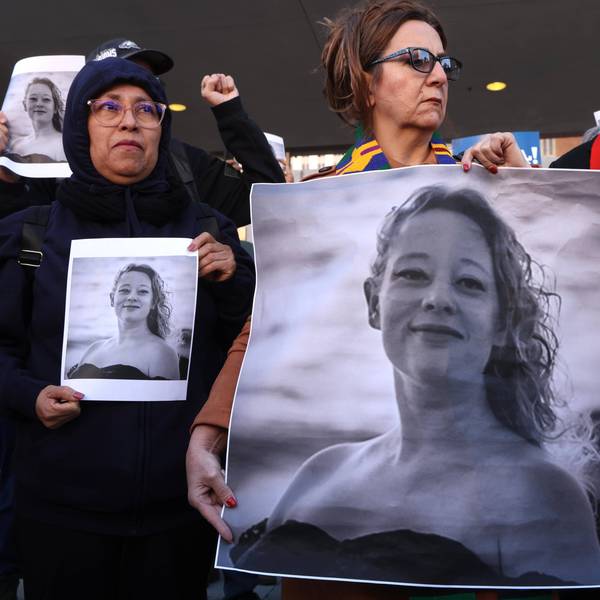
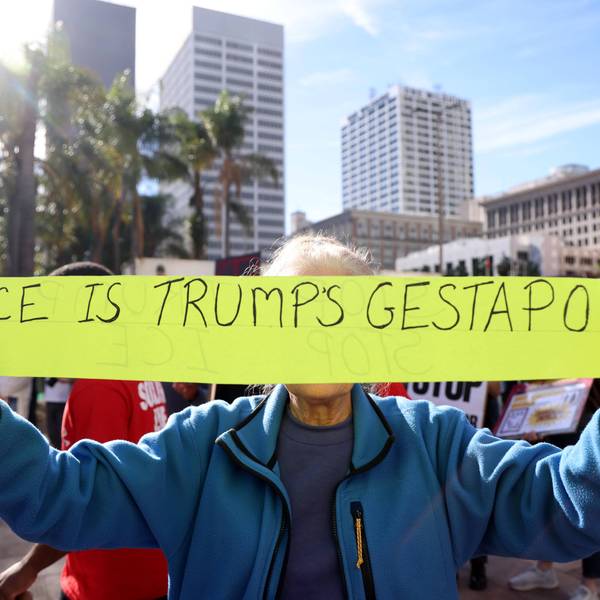
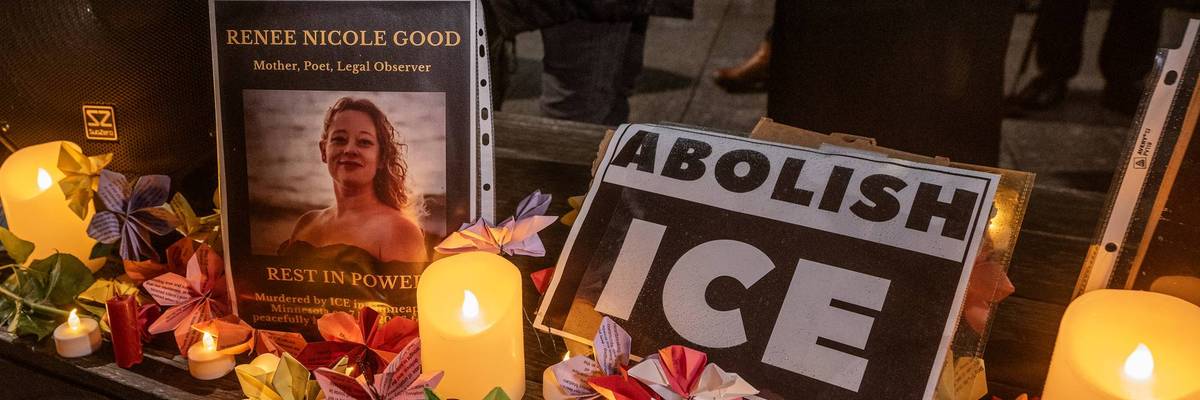
Candles are lit outside the US Embassy in London in memory of Renee Nicole Good, who was shot by Immigration and Customs Enforcement (ICE) agents in the United States.
FBI Agent Resigns in Protest as Trump DOJ Investigates Renee Good—Not the ICE Agent Who Killed Her
The FBI has focused its investigation on Good's ties to activist groups as ICE agents have increasingly threatened people for filming and observing their operations.
A supervisor in the FBI's Minneapolis field office became the latest official to resign over the federal law enforcement agency's handling of the investigation into an immigration agent's fatal shooting of Renee Good in Minneapolis earlier this month.
As the New York Times reported Friday, FBI agent Tracee Mergen, acting supervisor of the office's Public Corruption Squad, resigned after senior FBI officials in Washington pushed her to end a civil rights probe into the killing. The agency is focusing on investigating Good and her wife, who were legally observing US Immigration and Customs Enforcement, instead of determining whether ICE agent Jonathan Ross used excessive force.
An FBI source told CBS News that Mergen "would not bow to pressure" from the agency's leaders.
Starting immediately after Good was shot three times at close range by Ross, who was one of several agents who had approached her vehicle and, according to eyewitnesses, shouted conflicting orders at her, Trump administration officials have described Good and her wife as "domestic terrorists." They have accused her of trying to run over Ross, a claim that has not been supported by detailed analysis of footage of the killing.
Federal prosecutors have refused to allow authorities in Minnesota to conduct a probe into the killing, and Harmeet Dhillon, the Trump administration's assistant attorney general for civil rights, announced days after Good was killed that the US Department of Justice’s (DOJ) Civil Rights Division would not be investigating—which would ordinarily be a standard step in a shooting involving a federal law enforcement agent. That decision led four top officials in Dhillon's office to resign in protest.
Six federal prosecutors in the US attorney's office in Minnesota also stepped down after the DOJ made clear that Becca and Renee Good—not Ross—would be the focus of an investigation.
As NBC News reported Friday, the DOJ also directed the US attorney's office and FBI agents to investigate whether Good could have been criminally liable in her own death. Agents had drafted a search warrant to obtain her car, but they were told by aides to Deputy Attorney General Todd Blanche to redraft the warrant to search the car for evidence of an attack on Ross. A federal judge rejected the warrant.
Like many residents of Minneapolis, Chicago, and Charlotte, North Carolina have in recent months as thousands of ICE agents have descended on US cities and detained immigrants and citizens alike, the Goods were observing and filming ICE operations on January 7 when Renee Good was shot.
Filming ICE is legal as long as doing so does not interfere with agents' operations. Yet officers have increasingly threatened people for observing them and claimed that doing so is an act of domestic terrorism.
One agent in Portland, Maine on Friday told an observer she would be included in a "nice little database" and "considered a domestic terrorist," after she filmed ICE operations.
Volunteers for neighborhood ICE watches in Maine told the Portland Press Herald that ICE agents have shown up at their houses and issued warnings not to follow them.
The threats, and the FBI's insistence on investigating Good's alleged ties to what it calls "activist groups," come months after Attorney General Pam Bondi signed a memo expanding the DOJ's definition of domestic terrorism to include "impeding" law enforcement officers or "doxxing" them.
That memo followed National Security Presidential Memorandum 7, or NSPM-7, a document signed by President Donald Trump shortly after the assassination of right-wing political activist Charlie Kirk, which mandates a “national strategy to investigate and disrupt networks, entities, and organizations that foment political violence so that law enforcement can intervene in criminal conspiracies before they result in violent political acts." The memo exclusively focuses on “anti-fascist” or left-wing activities.
Editor's note: This article has been updated to include details about the DOJ push to investigate Good for criminal liability after her death.
We are at a crossroads
This country and this world are at a monumental crossroads. In a few short weeks, US voters will have an opportunity to beat back the forces of fascism and confront the billionaires who are rigging the economy, our media system, and our democracy, making it increasingly impossible for ordinary people to get by. We’re not just talking about the election. We’re talking about what must be done once these fascist elements are vanquished from power. We need a bolder set of solutions than what either major party has so far been willing to offer and a working-class movement ready to fight like hell for it. Trump didn't emerge from nowhere. The conditions that fueled MAGA authoritarianism were created by decades of radical neoliberal economic policies and a corrupt political system dominated by corporate interests. They slashed taxes on the super-rich, promising that the benefits would trickle down. They said giveaways to the corporate titans would make life more affordable for the rest of us. It was all bullshit. And when a bitter, betrayed populace searches for someone to blame, right-wing demagogues have little trouble finding scapegoats. People know when they're being lied to, but you won't hear any of this from the corporate media. Only independent journalism—powered and funded by people who believe in building a better world—can deliver truly trustworthy daily news. Our Fall Campaign is underway, and we need your help. To power our newsroom through the rest of the year, we need to raise $125,000 by midnight on October 31. So if you share our vision, please contribute whatever you can to sustain our work. |
A supervisor in the FBI's Minneapolis field office became the latest official to resign over the federal law enforcement agency's handling of the investigation into an immigration agent's fatal shooting of Renee Good in Minneapolis earlier this month.
As the New York Times reported Friday, FBI agent Tracee Mergen, acting supervisor of the office's Public Corruption Squad, resigned after senior FBI officials in Washington pushed her to end a civil rights probe into the killing. The agency is focusing on investigating Good and her wife, who were legally observing US Immigration and Customs Enforcement, instead of determining whether ICE agent Jonathan Ross used excessive force.
An FBI source told CBS News that Mergen "would not bow to pressure" from the agency's leaders.
Starting immediately after Good was shot three times at close range by Ross, who was one of several agents who had approached her vehicle and, according to eyewitnesses, shouted conflicting orders at her, Trump administration officials have described Good and her wife as "domestic terrorists." They have accused her of trying to run over Ross, a claim that has not been supported by detailed analysis of footage of the killing.
Federal prosecutors have refused to allow authorities in Minnesota to conduct a probe into the killing, and Harmeet Dhillon, the Trump administration's assistant attorney general for civil rights, announced days after Good was killed that the US Department of Justice’s (DOJ) Civil Rights Division would not be investigating—which would ordinarily be a standard step in a shooting involving a federal law enforcement agent. That decision led four top officials in Dhillon's office to resign in protest.
Six federal prosecutors in the US attorney's office in Minnesota also stepped down after the DOJ made clear that Becca and Renee Good—not Ross—would be the focus of an investigation.
As NBC News reported Friday, the DOJ also directed the US attorney's office and FBI agents to investigate whether Good could have been criminally liable in her own death. Agents had drafted a search warrant to obtain her car, but they were told by aides to Deputy Attorney General Todd Blanche to redraft the warrant to search the car for evidence of an attack on Ross. A federal judge rejected the warrant.
Like many residents of Minneapolis, Chicago, and Charlotte, North Carolina have in recent months as thousands of ICE agents have descended on US cities and detained immigrants and citizens alike, the Goods were observing and filming ICE operations on January 7 when Renee Good was shot.
Filming ICE is legal as long as doing so does not interfere with agents' operations. Yet officers have increasingly threatened people for observing them and claimed that doing so is an act of domestic terrorism.
One agent in Portland, Maine on Friday told an observer she would be included in a "nice little database" and "considered a domestic terrorist," after she filmed ICE operations.
Volunteers for neighborhood ICE watches in Maine told the Portland Press Herald that ICE agents have shown up at their houses and issued warnings not to follow them.
The threats, and the FBI's insistence on investigating Good's alleged ties to what it calls "activist groups," come months after Attorney General Pam Bondi signed a memo expanding the DOJ's definition of domestic terrorism to include "impeding" law enforcement officers or "doxxing" them.
That memo followed National Security Presidential Memorandum 7, or NSPM-7, a document signed by President Donald Trump shortly after the assassination of right-wing political activist Charlie Kirk, which mandates a “national strategy to investigate and disrupt networks, entities, and organizations that foment political violence so that law enforcement can intervene in criminal conspiracies before they result in violent political acts." The memo exclusively focuses on “anti-fascist” or left-wing activities.
Editor's note: This article has been updated to include details about the DOJ push to investigate Good for criminal liability after her death.
- 6 Federal Prosecutors Resign as Trump DOJ Pushes for Investigation Into Renee Good's Wife ›
- Campaigners Push GoFundMe to Remove Fundraisers for ICE Agent Who Killed Renee Good ›
- Top DOJ Officials Resign After Being Cut Off From Renee Good Killing Probe ›
A supervisor in the FBI's Minneapolis field office became the latest official to resign over the federal law enforcement agency's handling of the investigation into an immigration agent's fatal shooting of Renee Good in Minneapolis earlier this month.
As the New York Times reported Friday, FBI agent Tracee Mergen, acting supervisor of the office's Public Corruption Squad, resigned after senior FBI officials in Washington pushed her to end a civil rights probe into the killing. The agency is focusing on investigating Good and her wife, who were legally observing US Immigration and Customs Enforcement, instead of determining whether ICE agent Jonathan Ross used excessive force.
An FBI source told CBS News that Mergen "would not bow to pressure" from the agency's leaders.
Starting immediately after Good was shot three times at close range by Ross, who was one of several agents who had approached her vehicle and, according to eyewitnesses, shouted conflicting orders at her, Trump administration officials have described Good and her wife as "domestic terrorists." They have accused her of trying to run over Ross, a claim that has not been supported by detailed analysis of footage of the killing.
Federal prosecutors have refused to allow authorities in Minnesota to conduct a probe into the killing, and Harmeet Dhillon, the Trump administration's assistant attorney general for civil rights, announced days after Good was killed that the US Department of Justice’s (DOJ) Civil Rights Division would not be investigating—which would ordinarily be a standard step in a shooting involving a federal law enforcement agent. That decision led four top officials in Dhillon's office to resign in protest.
Six federal prosecutors in the US attorney's office in Minnesota also stepped down after the DOJ made clear that Becca and Renee Good—not Ross—would be the focus of an investigation.
As NBC News reported Friday, the DOJ also directed the US attorney's office and FBI agents to investigate whether Good could have been criminally liable in her own death. Agents had drafted a search warrant to obtain her car, but they were told by aides to Deputy Attorney General Todd Blanche to redraft the warrant to search the car for evidence of an attack on Ross. A federal judge rejected the warrant.
Like many residents of Minneapolis, Chicago, and Charlotte, North Carolina have in recent months as thousands of ICE agents have descended on US cities and detained immigrants and citizens alike, the Goods were observing and filming ICE operations on January 7 when Renee Good was shot.
Filming ICE is legal as long as doing so does not interfere with agents' operations. Yet officers have increasingly threatened people for observing them and claimed that doing so is an act of domestic terrorism.
One agent in Portland, Maine on Friday told an observer she would be included in a "nice little database" and "considered a domestic terrorist," after she filmed ICE operations.
Volunteers for neighborhood ICE watches in Maine told the Portland Press Herald that ICE agents have shown up at their houses and issued warnings not to follow them.
The threats, and the FBI's insistence on investigating Good's alleged ties to what it calls "activist groups," come months after Attorney General Pam Bondi signed a memo expanding the DOJ's definition of domestic terrorism to include "impeding" law enforcement officers or "doxxing" them.
That memo followed National Security Presidential Memorandum 7, or NSPM-7, a document signed by President Donald Trump shortly after the assassination of right-wing political activist Charlie Kirk, which mandates a “national strategy to investigate and disrupt networks, entities, and organizations that foment political violence so that law enforcement can intervene in criminal conspiracies before they result in violent political acts." The memo exclusively focuses on “anti-fascist” or left-wing activities.
Editor's note: This article has been updated to include details about the DOJ push to investigate Good for criminal liability after her death.
- 6 Federal Prosecutors Resign as Trump DOJ Pushes for Investigation Into Renee Good's Wife ›
- Campaigners Push GoFundMe to Remove Fundraisers for ICE Agent Who Killed Renee Good ›
- Top DOJ Officials Resign After Being Cut Off From Renee Good Killing Probe ›