SUBSCRIBE TO OUR FREE NEWSLETTER
Daily news & progressive opinion—funded by the people, not the corporations—delivered straight to your inbox.
5
#000000
#FFFFFF
To donate by check, phone, or other method, see our More Ways to Give page.
Daily news & progressive opinion—funded by the people, not the corporations—delivered straight to your inbox.
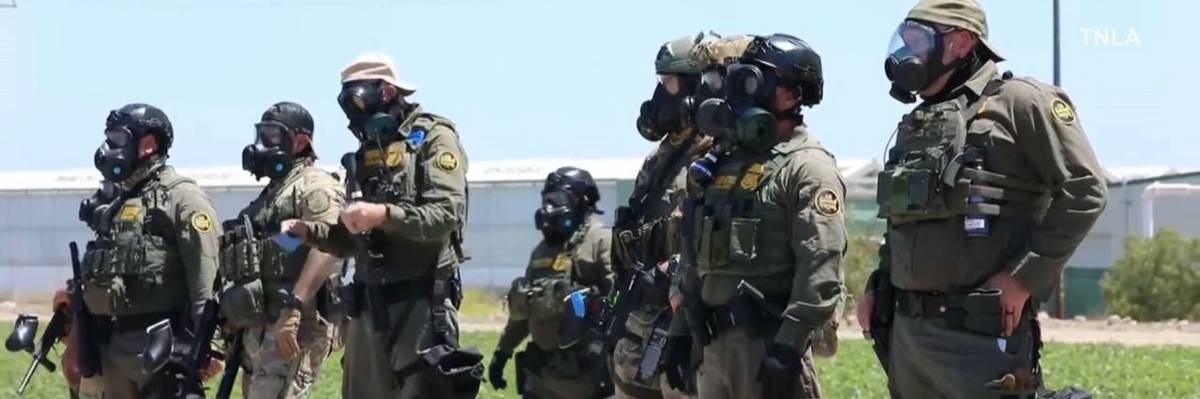
ICE agents stand at a farm in Ventura County, California.
When the state hunts its most essential—and most exploited—workers to meet deportation quotas, the myth of border security collapses.
The targeting of farmworkers by US Immigration and Customs Enforcement lays bare the true intent and interests motivating the Trump administration’s mass deportation policy agenda. It also exposes the fundamental contradictions that shape the US political economy. The nature of the state’s abductions, caging, and deportations of those doing the backbreaking work of harvesting fields, is not only revealed by the fact that those detained are not “criminals.” It is the paradox, in which farm sustainers—pillars of the food system whose livelihoods feed communities within and beyond our borders—are being systematically expelled.
While ICE raids rage on in neighborhoods across the country, they are also notably taking place in the very heart of the food system: in labor camps and homes, fields and orchards, packing sheds, outside of schools and labor centers, and across small towns whose economies depend entirely on the people the state targets. ICE is taking advantage of the fact that farmworker communities are often rural and structurally marginalized.
A state that capitalizes against workers it labels as essential in times of crisis yet simultaneously categorizes as “illegal”—especially the moment deportation quotas prove profitable—shows how racial capitalism depends on legal precarity to function. In the agrifood system in particular, the precarity of farmworkers has underpinned how corporations and landowners increase their margins, while keeping the cost of food artificially low.
As activist and award-winning author, Harsha Walia, argues in Border and Rule, borders function not merely to exclude, but to produce a workforce that can be exploited precisely because its existence has been criminalized. The US government, whose imperialist record of consequential trade policies and debt agreements, exporting dumping under in the name of trade or "aid," imposition of sanctions, and military interventions in or with foreign nations, has made significant contributions to producing crises of migration. At the same time, the state determines the rights and protections those same migrants might have—migrants it requires as a key labor force. For migrant farmworkers in particular, this vulnerability and legal precarity is even more stark given the historical double standards within agriculture. Farmworkers are routinely carved out of basic labor protections, including being denied overtime rights and robust health and safety regulations. Their disposability is not accidental; it is legislated and maintained with the underlying political and economic assumption that those who are forced to look for work across borders can, or even should, remain unprotected and exploited.
To criminalize those who feed you is more than a contradiction. It is an indictment, revealing a society willing to squeeze labor while kidnapping and expelling the people who provide it.
So, even as US farmworkers are those whose skill and sweat stabilizes and maintains US agriculture—a foundation of public health and our economy—under President Donald Trump’s deportation siege, they find themselves under regular threat because of their supposed legal status.
According to US Department of Agriculture data, over 40% of US farmworkers are undocumented migrants. In California, that percentage is even higher, with estimates ranging from nearly half to upwards of 70%. This means that the state that grows approximately half of the US vegetables and over 75% of the country’s fruits and nuts is an easy target for ICE raids. Residents of Kern County, which has the highest concentration of agricultural workers in the state, recently witnessed the opening of California’s newest and largest migrant detention facility this fall. This facility is another signal to farmworkers that the state’s surveillance and criminalization of their community is becoming an inescapable part of daily life.
Additionally, in early October, the Department of Labor announced a new rule that slashes the wages of H-2A workers between $5 to $7 per hour, thereby transferring $2.46 billion dollars in wages from workers to employers each year. Crucially, US agriculture has become increasingly dependent on the H-2A program to address chronic labor shortages, as it permits eligible employers to recruit foreign workers for temporary agricultural jobs. The administration’s decision therefore not only undermines the wage protections intended to make the H-2A program a lawful and regulated alternative to undocumented labor, but also exposes its willingness to undercut the very workforce the program is purported to support. A coalition of California attorneys general led a letter noting the various consequences of the new rule, which they claim “abandons reliable farm-specific data,” and exacerbates "the roots of farmworker poverty for both H-2A workers and domestic farmworkers alike." United Farm Workers (UFW) has also launched a lawsuit intended to reverse the administration’s decision, which they claim reflects, “one of the largest wealth transfers from workers to employers in US agricultural history.”
In essence, the administration’s pursuit of farmworker communities serves no legitimate economic or social goal. Instead, it enacts government scapegoating: the creation of a rhetorical problem (“illegal workers”) and the violent pursuit of that manufactured threat in order to justify the ever-expanding profitability of the border-security apparatus. It is an exercise of racialized state theater, and a manifestation of a food system left to the logic of deregulation and cheap, disposable labor—labor the border itself ensures under the guise of protecting national security or state sovereignty. Reports from the federal Department of Labor indicate that ICE’s siege is already contributing to labor shortages and supply consequences, as farmworkers are too afraid to leave their homes. Farmer organizations have also expressed solidarity with farmworkers, noting their importance in keeping the food economy afloat.
The fear and suffering imposed on farmworkers should neither be reduced to the specter of a labor shortage. It is a fear that fractures community life, determines whether someone seeks medical care, and dictates whether a child goes to school. In the aftermath of raids, it leaves mothers, fathers, children, and their families terrorized and often unaccounted for. It also compounds the daily struggles of working in systems that maintain unsafe labor conditions and unfair wages, such as mounting food insecurity and chronic health issues.
These communities are not peripheral cogs in some vast, anonymous agricultural machine. They are the harvesters of our food. To criminalize those who feed you is more than a contradiction. It is an indictment, revealing a society willing to squeeze labor while kidnapping and expelling the people who provide it. It does not reflect lawfulness or the interests of "public safety."
While the going after farmworker communities in such a concentrated manner might be relatively new to the Trump administration, farmworkers’ long-standing legal precarity and fight for basic protections—while holding up such a huge portion of the food economy—is not. If targeting workers whose status is defined not by the role they play in feeding the nation or sustaining the economy, but by their documentation, does not underscore the structural flaws inherent in our entire economic system, it at least reveals the insincerity of Trump’s war on im/migrants and the choreography of the militarized border project. As ICE raids against farmworkers continue nationwide, the entire pretense of border security reveals itself as utterly transparent.
Dear Common Dreams reader, It’s been nearly 30 years since I co-founded Common Dreams with my late wife, Lina Newhouser. We had the radical notion that journalism should serve the public good, not corporate profits. It was clear to us from the outset what it would take to build such a project. No paid advertisements. No corporate sponsors. No millionaire publisher telling us what to think or do. Many people said we wouldn't last a year, but we proved those doubters wrong. Together with a tremendous team of journalists and dedicated staff, we built an independent media outlet free from the constraints of profits and corporate control. Our mission has always been simple: To inform. To inspire. To ignite change for the common good. Building Common Dreams was not easy. Our survival was never guaranteed. When you take on the most powerful forces—Wall Street greed, fossil fuel industry destruction, Big Tech lobbyists, and uber-rich oligarchs who have spent billions upon billions rigging the economy and democracy in their favor—the only bulwark you have is supporters who believe in your work. But here’s the urgent message from me today. It's never been this bad out there. And it's never been this hard to keep us going. At the very moment Common Dreams is most needed, the threats we face are intensifying. We need your support now more than ever. We don't accept corporate advertising and never will. We don't have a paywall because we don't think people should be blocked from critical news based on their ability to pay. Everything we do is funded by the donations of readers like you. When everyone does the little they can afford, we are strong. But if that support retreats or dries up, so do we. Will you donate now to make sure Common Dreams not only survives but thrives? —Craig Brown, Co-founder |
The targeting of farmworkers by US Immigration and Customs Enforcement lays bare the true intent and interests motivating the Trump administration’s mass deportation policy agenda. It also exposes the fundamental contradictions that shape the US political economy. The nature of the state’s abductions, caging, and deportations of those doing the backbreaking work of harvesting fields, is not only revealed by the fact that those detained are not “criminals.” It is the paradox, in which farm sustainers—pillars of the food system whose livelihoods feed communities within and beyond our borders—are being systematically expelled.
While ICE raids rage on in neighborhoods across the country, they are also notably taking place in the very heart of the food system: in labor camps and homes, fields and orchards, packing sheds, outside of schools and labor centers, and across small towns whose economies depend entirely on the people the state targets. ICE is taking advantage of the fact that farmworker communities are often rural and structurally marginalized.
A state that capitalizes against workers it labels as essential in times of crisis yet simultaneously categorizes as “illegal”—especially the moment deportation quotas prove profitable—shows how racial capitalism depends on legal precarity to function. In the agrifood system in particular, the precarity of farmworkers has underpinned how corporations and landowners increase their margins, while keeping the cost of food artificially low.
As activist and award-winning author, Harsha Walia, argues in Border and Rule, borders function not merely to exclude, but to produce a workforce that can be exploited precisely because its existence has been criminalized. The US government, whose imperialist record of consequential trade policies and debt agreements, exporting dumping under in the name of trade or "aid," imposition of sanctions, and military interventions in or with foreign nations, has made significant contributions to producing crises of migration. At the same time, the state determines the rights and protections those same migrants might have—migrants it requires as a key labor force. For migrant farmworkers in particular, this vulnerability and legal precarity is even more stark given the historical double standards within agriculture. Farmworkers are routinely carved out of basic labor protections, including being denied overtime rights and robust health and safety regulations. Their disposability is not accidental; it is legislated and maintained with the underlying political and economic assumption that those who are forced to look for work across borders can, or even should, remain unprotected and exploited.
To criminalize those who feed you is more than a contradiction. It is an indictment, revealing a society willing to squeeze labor while kidnapping and expelling the people who provide it.
So, even as US farmworkers are those whose skill and sweat stabilizes and maintains US agriculture—a foundation of public health and our economy—under President Donald Trump’s deportation siege, they find themselves under regular threat because of their supposed legal status.
According to US Department of Agriculture data, over 40% of US farmworkers are undocumented migrants. In California, that percentage is even higher, with estimates ranging from nearly half to upwards of 70%. This means that the state that grows approximately half of the US vegetables and over 75% of the country’s fruits and nuts is an easy target for ICE raids. Residents of Kern County, which has the highest concentration of agricultural workers in the state, recently witnessed the opening of California’s newest and largest migrant detention facility this fall. This facility is another signal to farmworkers that the state’s surveillance and criminalization of their community is becoming an inescapable part of daily life.
Additionally, in early October, the Department of Labor announced a new rule that slashes the wages of H-2A workers between $5 to $7 per hour, thereby transferring $2.46 billion dollars in wages from workers to employers each year. Crucially, US agriculture has become increasingly dependent on the H-2A program to address chronic labor shortages, as it permits eligible employers to recruit foreign workers for temporary agricultural jobs. The administration’s decision therefore not only undermines the wage protections intended to make the H-2A program a lawful and regulated alternative to undocumented labor, but also exposes its willingness to undercut the very workforce the program is purported to support. A coalition of California attorneys general led a letter noting the various consequences of the new rule, which they claim “abandons reliable farm-specific data,” and exacerbates "the roots of farmworker poverty for both H-2A workers and domestic farmworkers alike." United Farm Workers (UFW) has also launched a lawsuit intended to reverse the administration’s decision, which they claim reflects, “one of the largest wealth transfers from workers to employers in US agricultural history.”
In essence, the administration’s pursuit of farmworker communities serves no legitimate economic or social goal. Instead, it enacts government scapegoating: the creation of a rhetorical problem (“illegal workers”) and the violent pursuit of that manufactured threat in order to justify the ever-expanding profitability of the border-security apparatus. It is an exercise of racialized state theater, and a manifestation of a food system left to the logic of deregulation and cheap, disposable labor—labor the border itself ensures under the guise of protecting national security or state sovereignty. Reports from the federal Department of Labor indicate that ICE’s siege is already contributing to labor shortages and supply consequences, as farmworkers are too afraid to leave their homes. Farmer organizations have also expressed solidarity with farmworkers, noting their importance in keeping the food economy afloat.
The fear and suffering imposed on farmworkers should neither be reduced to the specter of a labor shortage. It is a fear that fractures community life, determines whether someone seeks medical care, and dictates whether a child goes to school. In the aftermath of raids, it leaves mothers, fathers, children, and their families terrorized and often unaccounted for. It also compounds the daily struggles of working in systems that maintain unsafe labor conditions and unfair wages, such as mounting food insecurity and chronic health issues.
These communities are not peripheral cogs in some vast, anonymous agricultural machine. They are the harvesters of our food. To criminalize those who feed you is more than a contradiction. It is an indictment, revealing a society willing to squeeze labor while kidnapping and expelling the people who provide it. It does not reflect lawfulness or the interests of "public safety."
While the going after farmworker communities in such a concentrated manner might be relatively new to the Trump administration, farmworkers’ long-standing legal precarity and fight for basic protections—while holding up such a huge portion of the food economy—is not. If targeting workers whose status is defined not by the role they play in feeding the nation or sustaining the economy, but by their documentation, does not underscore the structural flaws inherent in our entire economic system, it at least reveals the insincerity of Trump’s war on im/migrants and the choreography of the militarized border project. As ICE raids against farmworkers continue nationwide, the entire pretense of border security reveals itself as utterly transparent.
The targeting of farmworkers by US Immigration and Customs Enforcement lays bare the true intent and interests motivating the Trump administration’s mass deportation policy agenda. It also exposes the fundamental contradictions that shape the US political economy. The nature of the state’s abductions, caging, and deportations of those doing the backbreaking work of harvesting fields, is not only revealed by the fact that those detained are not “criminals.” It is the paradox, in which farm sustainers—pillars of the food system whose livelihoods feed communities within and beyond our borders—are being systematically expelled.
While ICE raids rage on in neighborhoods across the country, they are also notably taking place in the very heart of the food system: in labor camps and homes, fields and orchards, packing sheds, outside of schools and labor centers, and across small towns whose economies depend entirely on the people the state targets. ICE is taking advantage of the fact that farmworker communities are often rural and structurally marginalized.
A state that capitalizes against workers it labels as essential in times of crisis yet simultaneously categorizes as “illegal”—especially the moment deportation quotas prove profitable—shows how racial capitalism depends on legal precarity to function. In the agrifood system in particular, the precarity of farmworkers has underpinned how corporations and landowners increase their margins, while keeping the cost of food artificially low.
As activist and award-winning author, Harsha Walia, argues in Border and Rule, borders function not merely to exclude, but to produce a workforce that can be exploited precisely because its existence has been criminalized. The US government, whose imperialist record of consequential trade policies and debt agreements, exporting dumping under in the name of trade or "aid," imposition of sanctions, and military interventions in or with foreign nations, has made significant contributions to producing crises of migration. At the same time, the state determines the rights and protections those same migrants might have—migrants it requires as a key labor force. For migrant farmworkers in particular, this vulnerability and legal precarity is even more stark given the historical double standards within agriculture. Farmworkers are routinely carved out of basic labor protections, including being denied overtime rights and robust health and safety regulations. Their disposability is not accidental; it is legislated and maintained with the underlying political and economic assumption that those who are forced to look for work across borders can, or even should, remain unprotected and exploited.
To criminalize those who feed you is more than a contradiction. It is an indictment, revealing a society willing to squeeze labor while kidnapping and expelling the people who provide it.
So, even as US farmworkers are those whose skill and sweat stabilizes and maintains US agriculture—a foundation of public health and our economy—under President Donald Trump’s deportation siege, they find themselves under regular threat because of their supposed legal status.
According to US Department of Agriculture data, over 40% of US farmworkers are undocumented migrants. In California, that percentage is even higher, with estimates ranging from nearly half to upwards of 70%. This means that the state that grows approximately half of the US vegetables and over 75% of the country’s fruits and nuts is an easy target for ICE raids. Residents of Kern County, which has the highest concentration of agricultural workers in the state, recently witnessed the opening of California’s newest and largest migrant detention facility this fall. This facility is another signal to farmworkers that the state’s surveillance and criminalization of their community is becoming an inescapable part of daily life.
Additionally, in early October, the Department of Labor announced a new rule that slashes the wages of H-2A workers between $5 to $7 per hour, thereby transferring $2.46 billion dollars in wages from workers to employers each year. Crucially, US agriculture has become increasingly dependent on the H-2A program to address chronic labor shortages, as it permits eligible employers to recruit foreign workers for temporary agricultural jobs. The administration’s decision therefore not only undermines the wage protections intended to make the H-2A program a lawful and regulated alternative to undocumented labor, but also exposes its willingness to undercut the very workforce the program is purported to support. A coalition of California attorneys general led a letter noting the various consequences of the new rule, which they claim “abandons reliable farm-specific data,” and exacerbates "the roots of farmworker poverty for both H-2A workers and domestic farmworkers alike." United Farm Workers (UFW) has also launched a lawsuit intended to reverse the administration’s decision, which they claim reflects, “one of the largest wealth transfers from workers to employers in US agricultural history.”
In essence, the administration’s pursuit of farmworker communities serves no legitimate economic or social goal. Instead, it enacts government scapegoating: the creation of a rhetorical problem (“illegal workers”) and the violent pursuit of that manufactured threat in order to justify the ever-expanding profitability of the border-security apparatus. It is an exercise of racialized state theater, and a manifestation of a food system left to the logic of deregulation and cheap, disposable labor—labor the border itself ensures under the guise of protecting national security or state sovereignty. Reports from the federal Department of Labor indicate that ICE’s siege is already contributing to labor shortages and supply consequences, as farmworkers are too afraid to leave their homes. Farmer organizations have also expressed solidarity with farmworkers, noting their importance in keeping the food economy afloat.
The fear and suffering imposed on farmworkers should neither be reduced to the specter of a labor shortage. It is a fear that fractures community life, determines whether someone seeks medical care, and dictates whether a child goes to school. In the aftermath of raids, it leaves mothers, fathers, children, and their families terrorized and often unaccounted for. It also compounds the daily struggles of working in systems that maintain unsafe labor conditions and unfair wages, such as mounting food insecurity and chronic health issues.
These communities are not peripheral cogs in some vast, anonymous agricultural machine. They are the harvesters of our food. To criminalize those who feed you is more than a contradiction. It is an indictment, revealing a society willing to squeeze labor while kidnapping and expelling the people who provide it. It does not reflect lawfulness or the interests of "public safety."
While the going after farmworker communities in such a concentrated manner might be relatively new to the Trump administration, farmworkers’ long-standing legal precarity and fight for basic protections—while holding up such a huge portion of the food economy—is not. If targeting workers whose status is defined not by the role they play in feeding the nation or sustaining the economy, but by their documentation, does not underscore the structural flaws inherent in our entire economic system, it at least reveals the insincerity of Trump’s war on im/migrants and the choreography of the militarized border project. As ICE raids against farmworkers continue nationwide, the entire pretense of border security reveals itself as utterly transparent.