SUBSCRIBE TO OUR FREE NEWSLETTER
Daily news & progressive opinion—funded by the people, not the corporations—delivered straight to your inbox.
5
#000000
#FFFFFF
To donate by check, phone, or other method, see our More Ways to Give page.
Daily news & progressive opinion—funded by the people, not the corporations—delivered straight to your inbox.
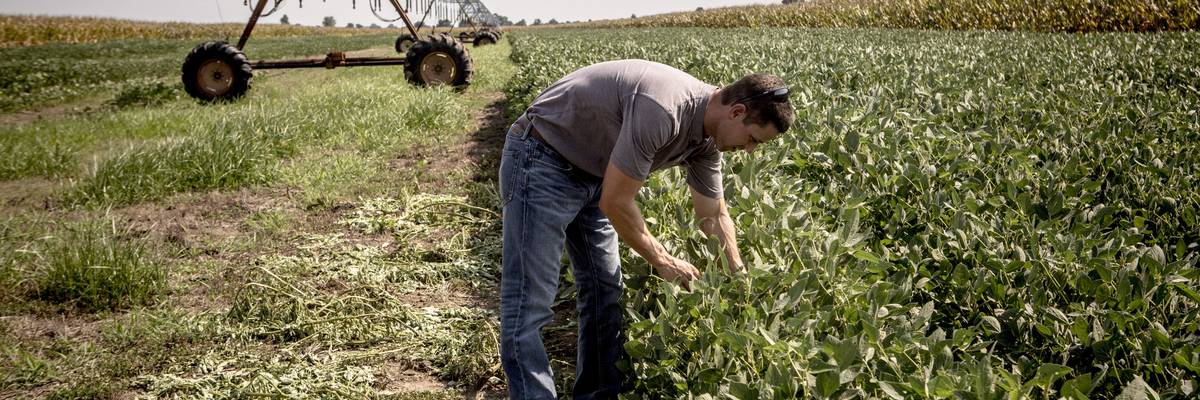
Brad Rose looks at rows of soybean plants that show signs of having been affected by dicamba, which he doesn’t use on his crops, in Mississippi County, Arkansas on August 9, 2017.
“The fact that we’re here again after two failed attempts to fix this broken pesticide shows that Lee Zeldin and his army of industry lobbyists are utterly incapable of protecting the public,” said one expert.
The US Environmental Protection Agency plans to reapprove dicamba despite the pesticide's proven health and environmental risks, the Washington Post reported Friday—a move that would seemingly fly in the face of the Trump administration's pledge to "Make America Healthy Again."
According to a draft statement obtained by the Post, the EPA called the reapproval “the most protective dicamba registration in agency history," while noting “several measures” to head off “ecological risks.”
Two EPA officials told the Post's Amudalat Ajasa on condition of anonymity that the agency would move to reapprove dicamba next week.
It would be the third time the EPA approved the pesticide. On both prior occasions, federal courts blocked the approvals, citing underestimation of the risk of chemical drift that could harm neighboring farms.
“The fact that we’re here again after two failed attempts to fix this broken pesticide shows that Lee Zeldin and his army of industry lobbyists are utterly incapable of protecting the public,” Center for Biological Diversity (CBD) senior scientist Nathan Donley told the Post, referring to the EPA administrator.
One judge ruled in 2024 that since widespread dicamba drift damaged millions of acres of nontolerant crops, some farmers felt "coerced" to purchase expensive, dicamba-resistant seeds to safeguard their own fields, creating a "near-monopoly" for companies selling the products.
Some scientific studies have linked dicamba to increased risk of cancer and hypothyroidism. The European Union classifies dicamba as a category II suspected endocrine disruptor.
In 2021, the Biden administration published an EPA report revealing that during Trump's first term, senior officials intentionally excluded scientific evidence of dicamba-related hazards, including the risk of widespread drift damage, before reapproving the dangerous chemical.
A separate EPA report described the widespread harm to farmers and the environment caused by dicamba during the 2020 growing season.
Writing for the New Lede this week, Donley warned that "much like the greenwashing you see at the grocery store, with terms like 'eco-friendly' or 'green' advertising chemical-laden products on store shelves, Zeldin’s MAHA-washing paints the same rosy picture to distract from decisions that harm public health."
"We all stand to lose if this pesticide gets the green light," he added.
Dear Common Dreams reader, It’s been nearly 30 years since I co-founded Common Dreams with my late wife, Lina Newhouser. We had the radical notion that journalism should serve the public good, not corporate profits. It was clear to us from the outset what it would take to build such a project. No paid advertisements. No corporate sponsors. No millionaire publisher telling us what to think or do. Many people said we wouldn't last a year, but we proved those doubters wrong. Together with a tremendous team of journalists and dedicated staff, we built an independent media outlet free from the constraints of profits and corporate control. Our mission has always been simple: To inform. To inspire. To ignite change for the common good. Building Common Dreams was not easy. Our survival was never guaranteed. When you take on the most powerful forces—Wall Street greed, fossil fuel industry destruction, Big Tech lobbyists, and uber-rich oligarchs who have spent billions upon billions rigging the economy and democracy in their favor—the only bulwark you have is supporters who believe in your work. But here’s the urgent message from me today. It's never been this bad out there. And it's never been this hard to keep us going. At the very moment Common Dreams is most needed, the threats we face are intensifying. We need your support now more than ever. We don't accept corporate advertising and never will. We don't have a paywall because we don't think people should be blocked from critical news based on their ability to pay. Everything we do is funded by the donations of readers like you. When everyone does the little they can afford, we are strong. But if that support retreats or dries up, so do we. Will you donate now to make sure Common Dreams not only survives but thrives? —Craig Brown, Co-founder |
The US Environmental Protection Agency plans to reapprove dicamba despite the pesticide's proven health and environmental risks, the Washington Post reported Friday—a move that would seemingly fly in the face of the Trump administration's pledge to "Make America Healthy Again."
According to a draft statement obtained by the Post, the EPA called the reapproval “the most protective dicamba registration in agency history," while noting “several measures” to head off “ecological risks.”
Two EPA officials told the Post's Amudalat Ajasa on condition of anonymity that the agency would move to reapprove dicamba next week.
It would be the third time the EPA approved the pesticide. On both prior occasions, federal courts blocked the approvals, citing underestimation of the risk of chemical drift that could harm neighboring farms.
“The fact that we’re here again after two failed attempts to fix this broken pesticide shows that Lee Zeldin and his army of industry lobbyists are utterly incapable of protecting the public,” Center for Biological Diversity (CBD) senior scientist Nathan Donley told the Post, referring to the EPA administrator.
One judge ruled in 2024 that since widespread dicamba drift damaged millions of acres of nontolerant crops, some farmers felt "coerced" to purchase expensive, dicamba-resistant seeds to safeguard their own fields, creating a "near-monopoly" for companies selling the products.
Some scientific studies have linked dicamba to increased risk of cancer and hypothyroidism. The European Union classifies dicamba as a category II suspected endocrine disruptor.
In 2021, the Biden administration published an EPA report revealing that during Trump's first term, senior officials intentionally excluded scientific evidence of dicamba-related hazards, including the risk of widespread drift damage, before reapproving the dangerous chemical.
A separate EPA report described the widespread harm to farmers and the environment caused by dicamba during the 2020 growing season.
Writing for the New Lede this week, Donley warned that "much like the greenwashing you see at the grocery store, with terms like 'eco-friendly' or 'green' advertising chemical-laden products on store shelves, Zeldin’s MAHA-washing paints the same rosy picture to distract from decisions that harm public health."
"We all stand to lose if this pesticide gets the green light," he added.
The US Environmental Protection Agency plans to reapprove dicamba despite the pesticide's proven health and environmental risks, the Washington Post reported Friday—a move that would seemingly fly in the face of the Trump administration's pledge to "Make America Healthy Again."
According to a draft statement obtained by the Post, the EPA called the reapproval “the most protective dicamba registration in agency history," while noting “several measures” to head off “ecological risks.”
Two EPA officials told the Post's Amudalat Ajasa on condition of anonymity that the agency would move to reapprove dicamba next week.
It would be the third time the EPA approved the pesticide. On both prior occasions, federal courts blocked the approvals, citing underestimation of the risk of chemical drift that could harm neighboring farms.
“The fact that we’re here again after two failed attempts to fix this broken pesticide shows that Lee Zeldin and his army of industry lobbyists are utterly incapable of protecting the public,” Center for Biological Diversity (CBD) senior scientist Nathan Donley told the Post, referring to the EPA administrator.
One judge ruled in 2024 that since widespread dicamba drift damaged millions of acres of nontolerant crops, some farmers felt "coerced" to purchase expensive, dicamba-resistant seeds to safeguard their own fields, creating a "near-monopoly" for companies selling the products.
Some scientific studies have linked dicamba to increased risk of cancer and hypothyroidism. The European Union classifies dicamba as a category II suspected endocrine disruptor.
In 2021, the Biden administration published an EPA report revealing that during Trump's first term, senior officials intentionally excluded scientific evidence of dicamba-related hazards, including the risk of widespread drift damage, before reapproving the dangerous chemical.
A separate EPA report described the widespread harm to farmers and the environment caused by dicamba during the 2020 growing season.
Writing for the New Lede this week, Donley warned that "much like the greenwashing you see at the grocery store, with terms like 'eco-friendly' or 'green' advertising chemical-laden products on store shelves, Zeldin’s MAHA-washing paints the same rosy picture to distract from decisions that harm public health."
"We all stand to lose if this pesticide gets the green light," he added.