SUBSCRIBE TO OUR FREE NEWSLETTER
Daily news & progressive opinion—funded by the people, not the corporations—delivered straight to your inbox.
5
#000000
#FFFFFF
To donate by check, phone, or other method, see our More Ways to Give page.
Daily news & progressive opinion—funded by the people, not the corporations—delivered straight to your inbox.
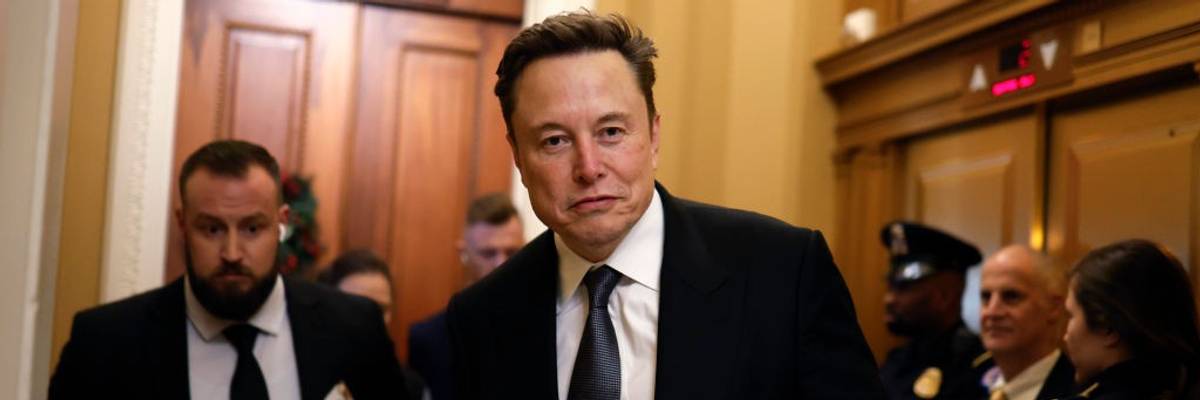
Elon Musk arrives for a meeting on Capitol Hill in Washington, D.C. on December 5, 2024.
"Elon Musk orchestrated a plan to rip off consumers with impunity when he tweeted 'Delete CFPB' and Congress just rubber-stamped it," said one campaigner.
In a move likely to further enrich Elon Musk, the world's richest person, the Republican-controlled U.S. House of Representatives on Wednesday voted to revoke a rule empowering a federal agency to oversee digital payment applications including Apple Pay, CashApp, and Venmo like it monitors banks and credit card companies.
House lawmakers passed S.J. Res. 28 by a party-line vote of 219-211, a move that followed the Senate's vote last month to rescind the Consumer Financial Protect Bureau (CFPB) rule requiring payment apps to be regulated under the agency's supervisory authority.
"The vote," the progressive advocacy group Demand Progress said, "is the latest in a damning and telling chain of events benefiting Elon Musk," chairman of the social media company X.
The group laid out the timeline:
"Musk is now on a glide path to launch X Money this year without the watchdog agency to ensure that he follows federal rules mandating data security standards, disputes for fraudulent payments, consumer protections against debanking, and more," Demand Progress said.
"And through the so-called Department of Government Efficiency, Musk now has access to sensitive information about competitors in the digital payments space like Cash App, PayPal, and Venmo that have been investigated by the CFPB, potentially giving X Money an unfair business advantage," the group added.
BREAKING: Congress just voted to strip the CFPB of its power to make sure payment apps like CashApp protect consumers, just as Elon Musk gears up to turn Twitter into his own payment app.
[image or embed]
— Demand Progress (@demandprogress.bsky.social) April 9, 2025 at 2:03 PM
As Consumer Reports noted Wednesday:
The CFPB's rule (also known as the larger participant rule) applies to digital wallet and payment providers handling more than 50 million transactions per year. The most widely used apps subject to the rule process an estimated 13 billion consumer payment transactions annually, according to the CFPB.
In 2023 alone, consumers reported losing $210 million to scams on peer-to-peer payment apps, a staggering 62% increase from 2021. In addition, users who accidentally send a payment to the wrong person find it nearly impossible to get their money back.
"Elon Musk orchestrated a plan to rip off consumers with impunity when he tweeted 'Delete CFPB' and Congress just rubber-stamped it. Today's shameful vote means that X, an app already swarming with bots and scammers, will be able to connect to your bank account and allow fraudsters to take your money without accountability," Emily Peterson-Cassin, corporate power director at Demand Progress, said Wednesday.
"Thanks to the CFPB's supervision, $120 million was refunded to consumers who were scammed through Cash App," Peterson-Cassin added. "That kind of policing will be significantly harder now that Congress has voted to strip the CFPB of its ability to proactively watch over payment apps. And thanks to DOGE's intrusions into the CFPB's databases, Musk now has access to sensitive financial data from companies investigated by the agency, including virtually all would-be competitors to X Money in the digital payments space."
Other consumer advocates also panned the House vote, with Consumer Reports advocacy program director Chuck Bell arguing that "by voting to repeal the CFPB's rule, Congress is turning a blind eye to the fraud that runs rampant on payment apps and the privacy risks users can face when Big Tech companies collect their sensitive financial data and share it widely with other companies."
"Today's vote weakens the CFPB's ability to stop unfair practices that put consumers who use payment apps at risk and ensure that Big Tech companies are following the law," Bell added.
Dear Common Dreams reader, It’s been nearly 30 years since I co-founded Common Dreams with my late wife, Lina Newhouser. We had the radical notion that journalism should serve the public good, not corporate profits. It was clear to us from the outset what it would take to build such a project. No paid advertisements. No corporate sponsors. No millionaire publisher telling us what to think or do. Many people said we wouldn't last a year, but we proved those doubters wrong. Together with a tremendous team of journalists and dedicated staff, we built an independent media outlet free from the constraints of profits and corporate control. Our mission has always been simple: To inform. To inspire. To ignite change for the common good. Building Common Dreams was not easy. Our survival was never guaranteed. When you take on the most powerful forces—Wall Street greed, fossil fuel industry destruction, Big Tech lobbyists, and uber-rich oligarchs who have spent billions upon billions rigging the economy and democracy in their favor—the only bulwark you have is supporters who believe in your work. But here’s the urgent message from me today. It's never been this bad out there. And it's never been this hard to keep us going. At the very moment Common Dreams is most needed, the threats we face are intensifying. We need your support now more than ever. We don't accept corporate advertising and never will. We don't have a paywall because we don't think people should be blocked from critical news based on their ability to pay. Everything we do is funded by the donations of readers like you. When everyone does the little they can afford, we are strong. But if that support retreats or dries up, so do we. Will you donate now to make sure Common Dreams not only survives but thrives? —Craig Brown, Co-founder |
In a move likely to further enrich Elon Musk, the world's richest person, the Republican-controlled U.S. House of Representatives on Wednesday voted to revoke a rule empowering a federal agency to oversee digital payment applications including Apple Pay, CashApp, and Venmo like it monitors banks and credit card companies.
House lawmakers passed S.J. Res. 28 by a party-line vote of 219-211, a move that followed the Senate's vote last month to rescind the Consumer Financial Protect Bureau (CFPB) rule requiring payment apps to be regulated under the agency's supervisory authority.
"The vote," the progressive advocacy group Demand Progress said, "is the latest in a damning and telling chain of events benefiting Elon Musk," chairman of the social media company X.
The group laid out the timeline:
"Musk is now on a glide path to launch X Money this year without the watchdog agency to ensure that he follows federal rules mandating data security standards, disputes for fraudulent payments, consumer protections against debanking, and more," Demand Progress said.
"And through the so-called Department of Government Efficiency, Musk now has access to sensitive information about competitors in the digital payments space like Cash App, PayPal, and Venmo that have been investigated by the CFPB, potentially giving X Money an unfair business advantage," the group added.
BREAKING: Congress just voted to strip the CFPB of its power to make sure payment apps like CashApp protect consumers, just as Elon Musk gears up to turn Twitter into his own payment app.
[image or embed]
— Demand Progress (@demandprogress.bsky.social) April 9, 2025 at 2:03 PM
As Consumer Reports noted Wednesday:
The CFPB's rule (also known as the larger participant rule) applies to digital wallet and payment providers handling more than 50 million transactions per year. The most widely used apps subject to the rule process an estimated 13 billion consumer payment transactions annually, according to the CFPB.
In 2023 alone, consumers reported losing $210 million to scams on peer-to-peer payment apps, a staggering 62% increase from 2021. In addition, users who accidentally send a payment to the wrong person find it nearly impossible to get their money back.
"Elon Musk orchestrated a plan to rip off consumers with impunity when he tweeted 'Delete CFPB' and Congress just rubber-stamped it. Today's shameful vote means that X, an app already swarming with bots and scammers, will be able to connect to your bank account and allow fraudsters to take your money without accountability," Emily Peterson-Cassin, corporate power director at Demand Progress, said Wednesday.
"Thanks to the CFPB's supervision, $120 million was refunded to consumers who were scammed through Cash App," Peterson-Cassin added. "That kind of policing will be significantly harder now that Congress has voted to strip the CFPB of its ability to proactively watch over payment apps. And thanks to DOGE's intrusions into the CFPB's databases, Musk now has access to sensitive financial data from companies investigated by the agency, including virtually all would-be competitors to X Money in the digital payments space."
Other consumer advocates also panned the House vote, with Consumer Reports advocacy program director Chuck Bell arguing that "by voting to repeal the CFPB's rule, Congress is turning a blind eye to the fraud that runs rampant on payment apps and the privacy risks users can face when Big Tech companies collect their sensitive financial data and share it widely with other companies."
"Today's vote weakens the CFPB's ability to stop unfair practices that put consumers who use payment apps at risk and ensure that Big Tech companies are following the law," Bell added.
In a move likely to further enrich Elon Musk, the world's richest person, the Republican-controlled U.S. House of Representatives on Wednesday voted to revoke a rule empowering a federal agency to oversee digital payment applications including Apple Pay, CashApp, and Venmo like it monitors banks and credit card companies.
House lawmakers passed S.J. Res. 28 by a party-line vote of 219-211, a move that followed the Senate's vote last month to rescind the Consumer Financial Protect Bureau (CFPB) rule requiring payment apps to be regulated under the agency's supervisory authority.
"The vote," the progressive advocacy group Demand Progress said, "is the latest in a damning and telling chain of events benefiting Elon Musk," chairman of the social media company X.
The group laid out the timeline:
"Musk is now on a glide path to launch X Money this year without the watchdog agency to ensure that he follows federal rules mandating data security standards, disputes for fraudulent payments, consumer protections against debanking, and more," Demand Progress said.
"And through the so-called Department of Government Efficiency, Musk now has access to sensitive information about competitors in the digital payments space like Cash App, PayPal, and Venmo that have been investigated by the CFPB, potentially giving X Money an unfair business advantage," the group added.
BREAKING: Congress just voted to strip the CFPB of its power to make sure payment apps like CashApp protect consumers, just as Elon Musk gears up to turn Twitter into his own payment app.
[image or embed]
— Demand Progress (@demandprogress.bsky.social) April 9, 2025 at 2:03 PM
As Consumer Reports noted Wednesday:
The CFPB's rule (also known as the larger participant rule) applies to digital wallet and payment providers handling more than 50 million transactions per year. The most widely used apps subject to the rule process an estimated 13 billion consumer payment transactions annually, according to the CFPB.
In 2023 alone, consumers reported losing $210 million to scams on peer-to-peer payment apps, a staggering 62% increase from 2021. In addition, users who accidentally send a payment to the wrong person find it nearly impossible to get their money back.
"Elon Musk orchestrated a plan to rip off consumers with impunity when he tweeted 'Delete CFPB' and Congress just rubber-stamped it. Today's shameful vote means that X, an app already swarming with bots and scammers, will be able to connect to your bank account and allow fraudsters to take your money without accountability," Emily Peterson-Cassin, corporate power director at Demand Progress, said Wednesday.
"Thanks to the CFPB's supervision, $120 million was refunded to consumers who were scammed through Cash App," Peterson-Cassin added. "That kind of policing will be significantly harder now that Congress has voted to strip the CFPB of its ability to proactively watch over payment apps. And thanks to DOGE's intrusions into the CFPB's databases, Musk now has access to sensitive financial data from companies investigated by the agency, including virtually all would-be competitors to X Money in the digital payments space."
Other consumer advocates also panned the House vote, with Consumer Reports advocacy program director Chuck Bell arguing that "by voting to repeal the CFPB's rule, Congress is turning a blind eye to the fraud that runs rampant on payment apps and the privacy risks users can face when Big Tech companies collect their sensitive financial data and share it widely with other companies."
"Today's vote weakens the CFPB's ability to stop unfair practices that put consumers who use payment apps at risk and ensure that Big Tech companies are following the law," Bell added.