SUBSCRIBE TO OUR FREE NEWSLETTER
Daily news & progressive opinion—funded by the people, not the corporations—delivered straight to your inbox.
5
#000000
#FFFFFF
To donate by check, phone, or other method, see our More Ways to Give page.
Daily news & progressive opinion—funded by the people, not the corporations—delivered straight to your inbox.
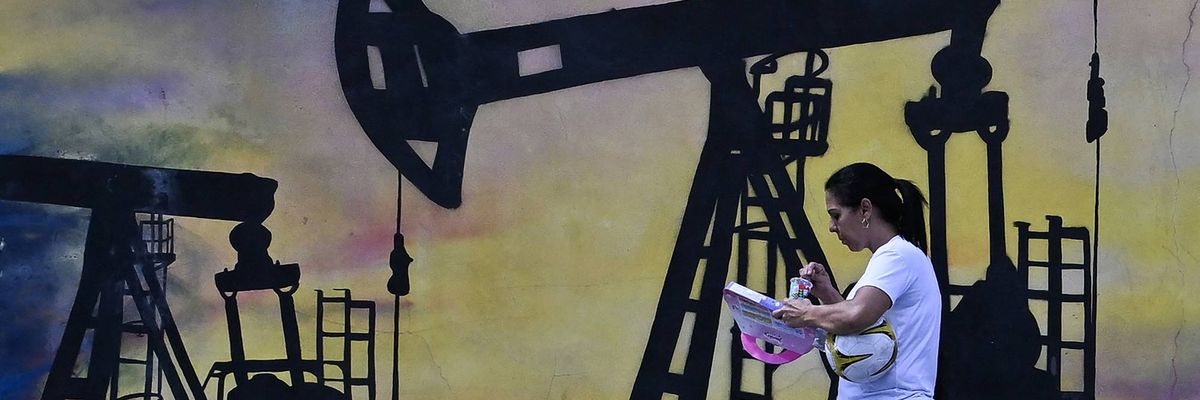
"Oil company executives seem to know more about Trump's secret plan to 'run' Venezuela than the American people," said Sen. Elizabeth Warren. "We need public Senate hearings NOW."
Democrats in the US Senate on Wednesday launched a formal investigation into possible dealings between the Trump administration and oil company executives related to Saturday's military assault on Venezuela, the kidnapping of President Nicolas Maduro, and the effort now underway to seize and control the Latin American nation's vast oil reserves.
Led by Sen. Sheldon Whitehouse (D-R.I.)—ranking member of the Senate Environment and Public Works Committee (EPW)—the Democratic lawmakers, including Sens. Elizabeth Warren (D-Mass.), Ron Wyden (D-Ore.), Bernie Sanders (I-Vt.), and others, want to know more about "communications between major U.S. oil and oilfield services companies and the Trump Administration surrounding last week’s military action in Venezuela and efforts to exploit Venezuelan oil resources."
Following Saturday's strikes on Venezuela and the kidnapping of Maduro and his wife, Cilia Flores—which international law experts have said were clear breaches of both international law and US constitutional law–Trump told reporters aboard Air Force One on Sunday that he had spoken to oil executives both "before and after" the covert military actions.
While other White House officials walked back Trump's statements, the senators behind the investigation say they want to know more about what was discussed, with whom, and when.
According to a statement, the lawmakers are "requesting documents and information regarding the companies’ knowledge of the strikes, discussions with Trump Administration officials before and since the operation, and plans to invest in Venezuela from the CEOs of BP America Inc., Baker Hughes, Chevron, Citgo Petroleum Corporation, ConocoPhillips, Continental Resources, ExxonMobil, Halliburton, SLB, Shell USA, Inc., and Weatherford International."
In a series of letters to the heads of those oil giants, the senators said, “President Trump’s own statements justifying the operation in terms of access to foreign energy resources and benefits to the US oil industry, reported repeated engagement between industry and government, and the suggestion that taxpayers could pay the cost of rebuilding Venezuela’s oil infrastructure raise serious concerns about how the Trump Administration engaged with the oil companies prior to his decision to use military force in Venezuela."
“We would like to know," the letters continue, "the extent to which US oil and gas companies such as yours had either advance knowledge of or the ability to shape American foreign policy decisions—especially given that Congress was kept in the dark concerning the use of force until after the strikes occurred.”
The lawmakers noted that Trump has also suggested that US taxpayer funds would be used to "help companies cover their costs to rebuild Venezuelan oil infrastructure," spend they warned could "cost American taxpayers billions more in the form of subsidies for the fossil fuel industry, which already benefits from over $700 billion annually in subsidies," citing analysis by the International Monetary Fund.
Dear Common Dreams reader, It’s been nearly 30 years since I co-founded Common Dreams with my late wife, Lina Newhouser. We had the radical notion that journalism should serve the public good, not corporate profits. It was clear to us from the outset what it would take to build such a project. No paid advertisements. No corporate sponsors. No millionaire publisher telling us what to think or do. Many people said we wouldn't last a year, but we proved those doubters wrong. Together with a tremendous team of journalists and dedicated staff, we built an independent media outlet free from the constraints of profits and corporate control. Our mission has always been simple: To inform. To inspire. To ignite change for the common good. Building Common Dreams was not easy. Our survival was never guaranteed. When you take on the most powerful forces—Wall Street greed, fossil fuel industry destruction, Big Tech lobbyists, and uber-rich oligarchs who have spent billions upon billions rigging the economy and democracy in their favor—the only bulwark you have is supporters who believe in your work. But here’s the urgent message from me today. It's never been this bad out there. And it's never been this hard to keep us going. At the very moment Common Dreams is most needed, the threats we face are intensifying. We need your support now more than ever. We don't accept corporate advertising and never will. We don't have a paywall because we don't think people should be blocked from critical news based on their ability to pay. Everything we do is funded by the donations of readers like you. When everyone does the little they can afford, we are strong. But if that support retreats or dries up, so do we. Will you donate now to make sure Common Dreams not only survives but thrives? —Craig Brown, Co-founder |
Democrats in the US Senate on Wednesday launched a formal investigation into possible dealings between the Trump administration and oil company executives related to Saturday's military assault on Venezuela, the kidnapping of President Nicolas Maduro, and the effort now underway to seize and control the Latin American nation's vast oil reserves.
Led by Sen. Sheldon Whitehouse (D-R.I.)—ranking member of the Senate Environment and Public Works Committee (EPW)—the Democratic lawmakers, including Sens. Elizabeth Warren (D-Mass.), Ron Wyden (D-Ore.), Bernie Sanders (I-Vt.), and others, want to know more about "communications between major U.S. oil and oilfield services companies and the Trump Administration surrounding last week’s military action in Venezuela and efforts to exploit Venezuelan oil resources."
Following Saturday's strikes on Venezuela and the kidnapping of Maduro and his wife, Cilia Flores—which international law experts have said were clear breaches of both international law and US constitutional law–Trump told reporters aboard Air Force One on Sunday that he had spoken to oil executives both "before and after" the covert military actions.
While other White House officials walked back Trump's statements, the senators behind the investigation say they want to know more about what was discussed, with whom, and when.
According to a statement, the lawmakers are "requesting documents and information regarding the companies’ knowledge of the strikes, discussions with Trump Administration officials before and since the operation, and plans to invest in Venezuela from the CEOs of BP America Inc., Baker Hughes, Chevron, Citgo Petroleum Corporation, ConocoPhillips, Continental Resources, ExxonMobil, Halliburton, SLB, Shell USA, Inc., and Weatherford International."
In a series of letters to the heads of those oil giants, the senators said, “President Trump’s own statements justifying the operation in terms of access to foreign energy resources and benefits to the US oil industry, reported repeated engagement between industry and government, and the suggestion that taxpayers could pay the cost of rebuilding Venezuela’s oil infrastructure raise serious concerns about how the Trump Administration engaged with the oil companies prior to his decision to use military force in Venezuela."
“We would like to know," the letters continue, "the extent to which US oil and gas companies such as yours had either advance knowledge of or the ability to shape American foreign policy decisions—especially given that Congress was kept in the dark concerning the use of force until after the strikes occurred.”
The lawmakers noted that Trump has also suggested that US taxpayer funds would be used to "help companies cover their costs to rebuild Venezuelan oil infrastructure," spend they warned could "cost American taxpayers billions more in the form of subsidies for the fossil fuel industry, which already benefits from over $700 billion annually in subsidies," citing analysis by the International Monetary Fund.
Democrats in the US Senate on Wednesday launched a formal investigation into possible dealings between the Trump administration and oil company executives related to Saturday's military assault on Venezuela, the kidnapping of President Nicolas Maduro, and the effort now underway to seize and control the Latin American nation's vast oil reserves.
Led by Sen. Sheldon Whitehouse (D-R.I.)—ranking member of the Senate Environment and Public Works Committee (EPW)—the Democratic lawmakers, including Sens. Elizabeth Warren (D-Mass.), Ron Wyden (D-Ore.), Bernie Sanders (I-Vt.), and others, want to know more about "communications between major U.S. oil and oilfield services companies and the Trump Administration surrounding last week’s military action in Venezuela and efforts to exploit Venezuelan oil resources."
Following Saturday's strikes on Venezuela and the kidnapping of Maduro and his wife, Cilia Flores—which international law experts have said were clear breaches of both international law and US constitutional law–Trump told reporters aboard Air Force One on Sunday that he had spoken to oil executives both "before and after" the covert military actions.
While other White House officials walked back Trump's statements, the senators behind the investigation say they want to know more about what was discussed, with whom, and when.
According to a statement, the lawmakers are "requesting documents and information regarding the companies’ knowledge of the strikes, discussions with Trump Administration officials before and since the operation, and plans to invest in Venezuela from the CEOs of BP America Inc., Baker Hughes, Chevron, Citgo Petroleum Corporation, ConocoPhillips, Continental Resources, ExxonMobil, Halliburton, SLB, Shell USA, Inc., and Weatherford International."
In a series of letters to the heads of those oil giants, the senators said, “President Trump’s own statements justifying the operation in terms of access to foreign energy resources and benefits to the US oil industry, reported repeated engagement between industry and government, and the suggestion that taxpayers could pay the cost of rebuilding Venezuela’s oil infrastructure raise serious concerns about how the Trump Administration engaged with the oil companies prior to his decision to use military force in Venezuela."
“We would like to know," the letters continue, "the extent to which US oil and gas companies such as yours had either advance knowledge of or the ability to shape American foreign policy decisions—especially given that Congress was kept in the dark concerning the use of force until after the strikes occurred.”
The lawmakers noted that Trump has also suggested that US taxpayer funds would be used to "help companies cover their costs to rebuild Venezuelan oil infrastructure," spend they warned could "cost American taxpayers billions more in the form of subsidies for the fossil fuel industry, which already benefits from over $700 billion annually in subsidies," citing analysis by the International Monetary Fund.