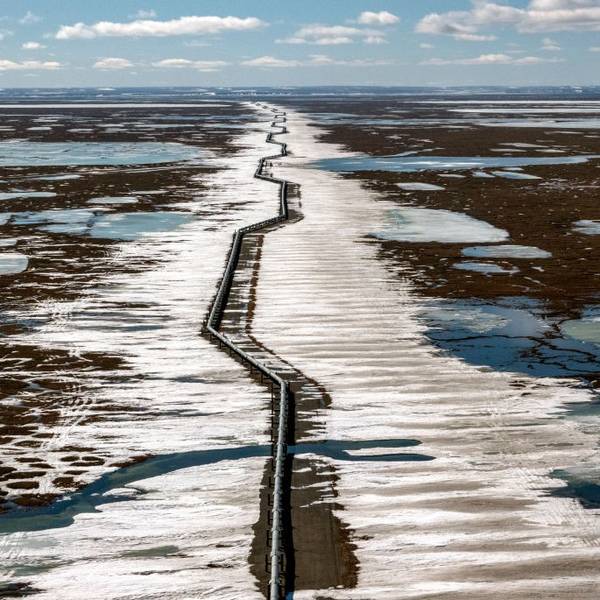
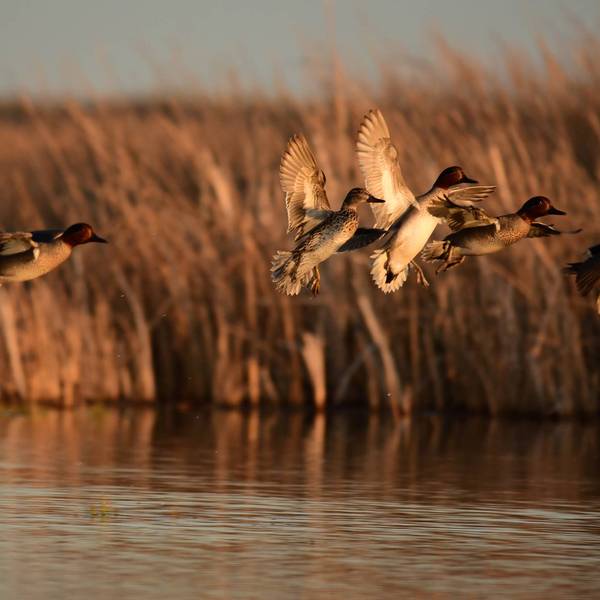
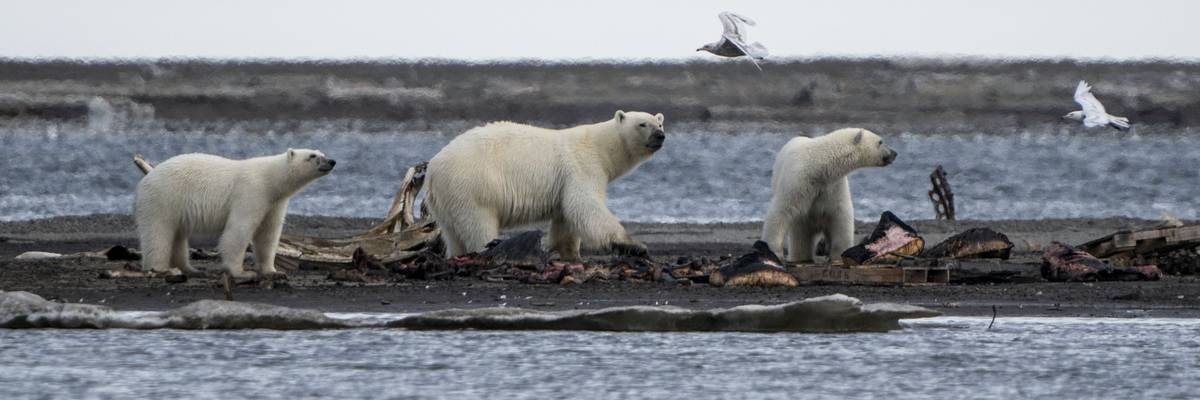
Polar bears feed on whale carcasses in Kaktovik, Alaska on July 1, 2024. The fate of the Arctic National Wildlife Refuge, its wildlife, and the oil reserves within it have been fought over for a half-century.
Senate GOP Sends Trump Bill Handing Over Arctic Refuge to Big Oil
"Once again, oil and gas development is taking precedence over science-based solutions for conserving wildlife and mitigating climate change," said one campaigner.
Climate campaigners, conservationists, and Indigenous people vowed to keep defending the Arctic National Wildlife Refuge after US Senate Republicans on Thursday sent legislation that would restart fossil fuel leasing in ANWR's Coastal Plain to President Donald Trump's desk.
All Republicans present except Sen. Susan Collins of Maine supported House Joint Resolution 131. The 49-45 vote came after three Democrats—Reps. Jim Costa (Calif.), Henry Cuellar (Texas), and Vicente Gonzalez (Texas)—joined all GOP House members but Congressman Brian Fitzpatrick (Pa.) in advancing the bill last month.
If Big Oil-backed Trump signs the joint resolution of disapproval, as expected, it will nullify the Biden administration's December 2024 efforts to protect over 1 million acres of land in Alaska from planet-wrecking oil and gas exploration.
"Simply put, the Arctic refuge is the crown jewel of the American National Wildlife Refuge System," Sen. Martin Heinrich (D-NM) said in a Wednesday floor speech against the measure, noting that the area is "home to hundreds of iconic wildlife species."
"The Arctic refuge is also deeply connected to the traditions and daily life of the people who have lived there for thousands of years," the senator continued, ripping "the Trump administration's relentless attacks on public lands."
Heinrich's speech was welcomed by groups including the Alaska Wilderness League, League of Conservation Voters, and Defenders of Wildlife, whose vice president of government relations, Robert Dewey, also blasted lawmakers' use of the Congressional Review Act (CRA) to repeal the refuge's protections.
"Once again, oil and gas development is taking precedence over science-based solutions for conserving wildlife and mitigating climate change. In these instances, the use of the CRA accomplishes nothing meaningful and instead harms iconic species such as polar bears, caribou, wolves, and migratory birds," Dewey said after the vote. "In addition to threatening wildlife, severe regulatory disruption in Alaska is the inevitable result of targeted rollbacks in one of America's most ecologically critical regions."
Andy Moderow, senior director of policy at Alaska Wilderness League, said Thursday that "while we are deeply disappointed by the final vote, we're grateful to see bipartisan support from lawmakers who stood up for the Refuge and upheld a long-standing, cross-party legacy of protecting this truly incredible place."
"America's public lands—including the iconic Arctic refuge—shouldn't be on the shortlist for a public land selloff to the oil and gas industry," Moderow continued. "We'll continue fighting the management chaos brought by today's vote in favor of actions that respect the Arctic Refuge for what it actually is: a national wildlife refuge, and not an oilfield."
Kristen Moreland, executive director of the Gwich'in Steering Committee, a group formed decades ago by Alaska Natives in response to proposed oil drilling in the Coastal Plain, also spoke out after the Senate vote.
"The Gwich'in Nation views the decision by lawmakers to leverage the Congressional Review Act to advance oil and gas development in the Arctic National Wildlife Refuge as a deliberate attempt to undercut the standards and laws that are designed to protect this sacred landscape," Moreland said.
"This action from DC ignores years of consultation and communication with our Gwich'in communities that rely on this landscape for not only our subsistence and survival, but also our culture and spiritual health and well-being," she added. "We stand united in our opposition to any oil and gas development in the Arctic refuge, and will continue to fight this effort from the Trump administration and decision-makers who ignore our voices."
We are at a crossroads
This country and this world are at a monumental crossroads. In a few short weeks, US voters will have an opportunity to beat back the forces of fascism and confront the billionaires who are rigging the economy, our media system, and our democracy, making it increasingly impossible for ordinary people to get by. We’re not just talking about the election. We’re talking about what must be done once these fascist elements are vanquished from power. We need a bolder set of solutions than what either major party has so far been willing to offer and a working-class movement ready to fight like hell for it. Trump didn't emerge from nowhere. The conditions that fueled MAGA authoritarianism were created by decades of radical neoliberal economic policies and a corrupt political system dominated by corporate interests. They slashed taxes on the super-rich, promising that the benefits would trickle down. They said giveaways to the corporate titans would make life more affordable for the rest of us. It was all bullshit. And when a bitter, betrayed populace searches for someone to blame, right-wing demagogues have little trouble finding scapegoats. People know when they're being lied to, but you won't hear any of this from the corporate media. Only independent journalism—powered and funded by people who believe in building a better world—can deliver truly trustworthy daily news. Our Fall Campaign is underway, and we need your help. To power our newsroom through the rest of the year, we need to raise $125,000 by midnight on October 31. So if you share our vision, please contribute whatever you can to sustain our work. |
Climate campaigners, conservationists, and Indigenous people vowed to keep defending the Arctic National Wildlife Refuge after US Senate Republicans on Thursday sent legislation that would restart fossil fuel leasing in ANWR's Coastal Plain to President Donald Trump's desk.
All Republicans present except Sen. Susan Collins of Maine supported House Joint Resolution 131. The 49-45 vote came after three Democrats—Reps. Jim Costa (Calif.), Henry Cuellar (Texas), and Vicente Gonzalez (Texas)—joined all GOP House members but Congressman Brian Fitzpatrick (Pa.) in advancing the bill last month.
If Big Oil-backed Trump signs the joint resolution of disapproval, as expected, it will nullify the Biden administration's December 2024 efforts to protect over 1 million acres of land in Alaska from planet-wrecking oil and gas exploration.
"Simply put, the Arctic refuge is the crown jewel of the American National Wildlife Refuge System," Sen. Martin Heinrich (D-NM) said in a Wednesday floor speech against the measure, noting that the area is "home to hundreds of iconic wildlife species."
"The Arctic refuge is also deeply connected to the traditions and daily life of the people who have lived there for thousands of years," the senator continued, ripping "the Trump administration's relentless attacks on public lands."
Heinrich's speech was welcomed by groups including the Alaska Wilderness League, League of Conservation Voters, and Defenders of Wildlife, whose vice president of government relations, Robert Dewey, also blasted lawmakers' use of the Congressional Review Act (CRA) to repeal the refuge's protections.
"Once again, oil and gas development is taking precedence over science-based solutions for conserving wildlife and mitigating climate change. In these instances, the use of the CRA accomplishes nothing meaningful and instead harms iconic species such as polar bears, caribou, wolves, and migratory birds," Dewey said after the vote. "In addition to threatening wildlife, severe regulatory disruption in Alaska is the inevitable result of targeted rollbacks in one of America's most ecologically critical regions."
Andy Moderow, senior director of policy at Alaska Wilderness League, said Thursday that "while we are deeply disappointed by the final vote, we're grateful to see bipartisan support from lawmakers who stood up for the Refuge and upheld a long-standing, cross-party legacy of protecting this truly incredible place."
"America's public lands—including the iconic Arctic refuge—shouldn't be on the shortlist for a public land selloff to the oil and gas industry," Moderow continued. "We'll continue fighting the management chaos brought by today's vote in favor of actions that respect the Arctic Refuge for what it actually is: a national wildlife refuge, and not an oilfield."
Kristen Moreland, executive director of the Gwich'in Steering Committee, a group formed decades ago by Alaska Natives in response to proposed oil drilling in the Coastal Plain, also spoke out after the Senate vote.
"The Gwich'in Nation views the decision by lawmakers to leverage the Congressional Review Act to advance oil and gas development in the Arctic National Wildlife Refuge as a deliberate attempt to undercut the standards and laws that are designed to protect this sacred landscape," Moreland said.
"This action from DC ignores years of consultation and communication with our Gwich'in communities that rely on this landscape for not only our subsistence and survival, but also our culture and spiritual health and well-being," she added. "We stand united in our opposition to any oil and gas development in the Arctic refuge, and will continue to fight this effort from the Trump administration and decision-makers who ignore our voices."
- Ignoring Climate Goals, Biden Administration Greenlights Oil Drilling in Alaska ›
- Another Giveaway to Big Oil as Trump Wrenches Open 13 Million Acres of Arctic for Drilling ›
- Groups Welcome Biden Review But Demand Congress Permanently Protect Arctic Refuge From Drilling ›
- Even During Shutdown, Senate GOP Does Big Oil's Bidding With Vote to Gut Arctic Protections ›
- Green, Indigenous Groups Warns Arctic Still at Grave Drilling Risk When Trump Returns ›
- Opinion | Trump and Congress Just Gifted Big Oil a Multimillion Dollar Stocking Stuffer | Common Dreams ›
- Trump Admin Condemned for Pushing Big Oil Leases in Arctic Refuge | Common Dreams ›
Climate campaigners, conservationists, and Indigenous people vowed to keep defending the Arctic National Wildlife Refuge after US Senate Republicans on Thursday sent legislation that would restart fossil fuel leasing in ANWR's Coastal Plain to President Donald Trump's desk.
All Republicans present except Sen. Susan Collins of Maine supported House Joint Resolution 131. The 49-45 vote came after three Democrats—Reps. Jim Costa (Calif.), Henry Cuellar (Texas), and Vicente Gonzalez (Texas)—joined all GOP House members but Congressman Brian Fitzpatrick (Pa.) in advancing the bill last month.
If Big Oil-backed Trump signs the joint resolution of disapproval, as expected, it will nullify the Biden administration's December 2024 efforts to protect over 1 million acres of land in Alaska from planet-wrecking oil and gas exploration.
"Simply put, the Arctic refuge is the crown jewel of the American National Wildlife Refuge System," Sen. Martin Heinrich (D-NM) said in a Wednesday floor speech against the measure, noting that the area is "home to hundreds of iconic wildlife species."
"The Arctic refuge is also deeply connected to the traditions and daily life of the people who have lived there for thousands of years," the senator continued, ripping "the Trump administration's relentless attacks on public lands."
Heinrich's speech was welcomed by groups including the Alaska Wilderness League, League of Conservation Voters, and Defenders of Wildlife, whose vice president of government relations, Robert Dewey, also blasted lawmakers' use of the Congressional Review Act (CRA) to repeal the refuge's protections.
"Once again, oil and gas development is taking precedence over science-based solutions for conserving wildlife and mitigating climate change. In these instances, the use of the CRA accomplishes nothing meaningful and instead harms iconic species such as polar bears, caribou, wolves, and migratory birds," Dewey said after the vote. "In addition to threatening wildlife, severe regulatory disruption in Alaska is the inevitable result of targeted rollbacks in one of America's most ecologically critical regions."
Andy Moderow, senior director of policy at Alaska Wilderness League, said Thursday that "while we are deeply disappointed by the final vote, we're grateful to see bipartisan support from lawmakers who stood up for the Refuge and upheld a long-standing, cross-party legacy of protecting this truly incredible place."
"America's public lands—including the iconic Arctic refuge—shouldn't be on the shortlist for a public land selloff to the oil and gas industry," Moderow continued. "We'll continue fighting the management chaos brought by today's vote in favor of actions that respect the Arctic Refuge for what it actually is: a national wildlife refuge, and not an oilfield."
Kristen Moreland, executive director of the Gwich'in Steering Committee, a group formed decades ago by Alaska Natives in response to proposed oil drilling in the Coastal Plain, also spoke out after the Senate vote.
"The Gwich'in Nation views the decision by lawmakers to leverage the Congressional Review Act to advance oil and gas development in the Arctic National Wildlife Refuge as a deliberate attempt to undercut the standards and laws that are designed to protect this sacred landscape," Moreland said.
"This action from DC ignores years of consultation and communication with our Gwich'in communities that rely on this landscape for not only our subsistence and survival, but also our culture and spiritual health and well-being," she added. "We stand united in our opposition to any oil and gas development in the Arctic refuge, and will continue to fight this effort from the Trump administration and decision-makers who ignore our voices."
- Ignoring Climate Goals, Biden Administration Greenlights Oil Drilling in Alaska ›
- Another Giveaway to Big Oil as Trump Wrenches Open 13 Million Acres of Arctic for Drilling ›
- Groups Welcome Biden Review But Demand Congress Permanently Protect Arctic Refuge From Drilling ›
- Even During Shutdown, Senate GOP Does Big Oil's Bidding With Vote to Gut Arctic Protections ›
- Green, Indigenous Groups Warns Arctic Still at Grave Drilling Risk When Trump Returns ›
- Opinion | Trump and Congress Just Gifted Big Oil a Multimillion Dollar Stocking Stuffer | Common Dreams ›
- Trump Admin Condemned for Pushing Big Oil Leases in Arctic Refuge | Common Dreams ›