5
#000000
#FFFFFF
To donate by check, phone, or other method, see our More Ways to Give page.
Daily news & progressive opinion—funded by the people, not the corporations—delivered straight to your inbox.
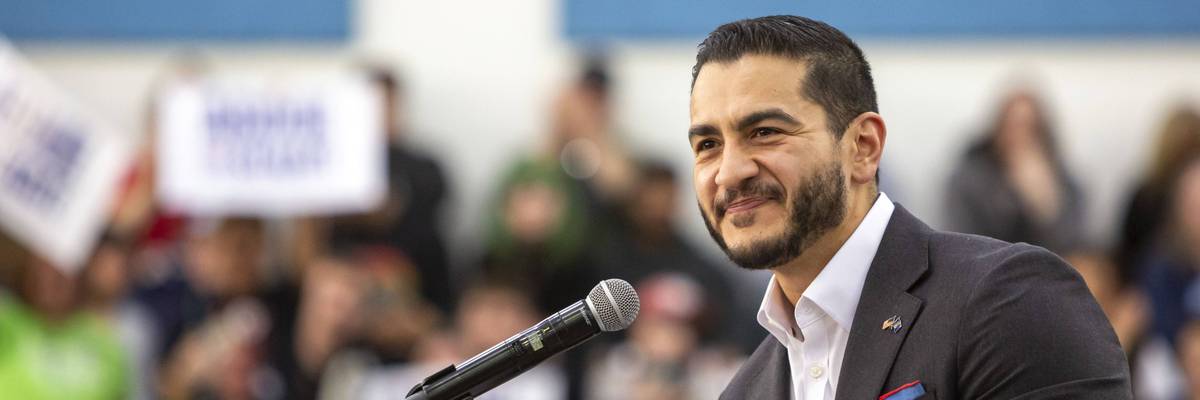
US Senate candidate Dr. Abdul El-Sayed speaks at a rally on May 3, 2026.
"Seems like Third Way jumped into this race and leaned into identity politics in a way that just polarized the electorate further" in El-Sayed’s favor, said one commentator, "given he’s solely focused on healthcare."
In the Democratic US Senate primary race in Michigan, a big swing—particularly among voters aged 18-44—toward former public health official and Medicare for All advocate Dr. Abdul El-Sayed was found Tuesday in the latest poll by a research firm that six months ago had seen the progressive candidate in distant third place.
Twenty-eight percent of primary voters said they were supporting El-Sayed in a poll released by Mitchell Research and Communications, while 18% said they were backing US Rep. Haley Stevens (D-Mich.), who has the support of Democratic leaders and the powerful pro-Israel lobby group American Israel Public Affairs Committee (AIPAC).
Seventeen percent of voters said they were supporting state Sen. Mallory McMorrow (D-8).
The poll showed an inversion of the result found by Mitchell in November, when El-Sayed was trailing his two opponents by eight points and Stevens and McMorrow were separated by just three points.
Mitchell polled 405 likely primary voters between May 1-7, around the time that El-Sayed appeared with US Sen. Bernie Sanders (I-Vt.) at a rally as part of the senator's Fighting Oligarchy Tour. He drew loud applause for condemning AIPAC for its persistent conflation of antisemitism with criticism of Israel, and spoke about his strong support for expanding the Medicare system to everyone in the US.
The poll also came after a weekslong controversy that was promoted by centrist think tank Third Way, with the support of both Stevens and McMorrow, targeting El-Sayed for campaigning with Hasan Piker, a Twitch streamer and commentator who's been outspoken in his condemnation of Israel.
With the controversy largely in the rearview mirror despite some lawmakers' continued fixation on Piker, the new poll suggests the criticism of El-Sayed didn't land in Michigan—particularly among voters in younger demographics arguably more likely to have heard of Piker, who gained notoriety by sharing political commentary while playing video games online.
Among voters under the age of 45, El-Sayed had 80% of the support in the poll released Tuesday.
The other two candidates in the race barely registered among voters in the demographic, with 4% supporting Stevens and 3% backing McMorrow. The primary race has been called a "millennial showdown" by local media, with the three candidates ranging in age from 39-42.
The poll comes after numerous surveys have found that Israel—the issue that Third Way attempted to center in the election—has plummeting support among voters, following its yearslong assault on Gaza. Last October, nearly half of Democratic voters in swing districts, including in Michigan, said in a poll that they would vote against a candidate funded by AIPAC.
Meanwhile, Medicare for All—the proposal that's a key focus of El-Sayed's platform—was supported by 78% of Democratic voters, along with 71% of Independents and 49% of Republicans in a survey by Data for Progress late last year.
Rotimi Adeoye, a contributing opinion writer at The New York Times, said the poll suggested that Third Way had "jumped into this race and leaned into identity politics in a way that just polarized the electorate further in El-Sayed’s favor, given he’s solely focused on healthcare."
"If you are spending any time as a candidate not talking about housing, healthcare, the economy, groceries, and dedicating a second or a millisecond talking about Hasan Piker or the identity politics topic of the day on Twitter, you're losing," said Adeoye.
Jon Favreau, co-host of Pod Save America and a former speechwriter under the Obama administration, summed up the poll results succinctly.
The survey, he said, showed a "Third Way bump" for El-Sayed.
Dear Common Dreams reader, It’s been nearly 30 years since I co-founded Common Dreams with my late wife, Lina Newhouser. We had the radical notion that journalism should serve the public good, not corporate profits. It was clear to us from the outset what it would take to build such a project. No paid advertisements. No corporate sponsors. No millionaire publisher telling us what to think or do. Many people said we wouldn't last a year, but we proved those doubters wrong. Together with a tremendous team of journalists and dedicated staff, we built an independent media outlet free from the constraints of profits and corporate control. Our mission has always been simple: To inform. To inspire. To ignite change for the common good. Building Common Dreams was not easy. Our survival was never guaranteed. When you take on the most powerful forces—Wall Street greed, fossil fuel industry destruction, Big Tech lobbyists, and uber-rich oligarchs who have spent billions upon billions rigging the economy and democracy in their favor—the only bulwark you have is supporters who believe in your work. But here’s the urgent message from me today. It's never been this bad out there. And it's never been this hard to keep us going. At the very moment Common Dreams is most needed, the threats we face are intensifying. We need your support now more than ever. We don't accept corporate advertising and never will. We don't have a paywall because we don't think people should be blocked from critical news based on their ability to pay. Everything we do is funded by the donations of readers like you. When everyone does the little they can afford, we are strong. But if that support retreats or dries up, so do we. Will you donate now to make sure Common Dreams not only survives but thrives? —Craig Brown, Co-founder |
In the Democratic US Senate primary race in Michigan, a big swing—particularly among voters aged 18-44—toward former public health official and Medicare for All advocate Dr. Abdul El-Sayed was found Tuesday in the latest poll by a research firm that six months ago had seen the progressive candidate in distant third place.
Twenty-eight percent of primary voters said they were supporting El-Sayed in a poll released by Mitchell Research and Communications, while 18% said they were backing US Rep. Haley Stevens (D-Mich.), who has the support of Democratic leaders and the powerful pro-Israel lobby group American Israel Public Affairs Committee (AIPAC).
Seventeen percent of voters said they were supporting state Sen. Mallory McMorrow (D-8).
The poll showed an inversion of the result found by Mitchell in November, when El-Sayed was trailing his two opponents by eight points and Stevens and McMorrow were separated by just three points.
Mitchell polled 405 likely primary voters between May 1-7, around the time that El-Sayed appeared with US Sen. Bernie Sanders (I-Vt.) at a rally as part of the senator's Fighting Oligarchy Tour. He drew loud applause for condemning AIPAC for its persistent conflation of antisemitism with criticism of Israel, and spoke about his strong support for expanding the Medicare system to everyone in the US.
The poll also came after a weekslong controversy that was promoted by centrist think tank Third Way, with the support of both Stevens and McMorrow, targeting El-Sayed for campaigning with Hasan Piker, a Twitch streamer and commentator who's been outspoken in his condemnation of Israel.
With the controversy largely in the rearview mirror despite some lawmakers' continued fixation on Piker, the new poll suggests the criticism of El-Sayed didn't land in Michigan—particularly among voters in younger demographics arguably more likely to have heard of Piker, who gained notoriety by sharing political commentary while playing video games online.
Among voters under the age of 45, El-Sayed had 80% of the support in the poll released Tuesday.
The other two candidates in the race barely registered among voters in the demographic, with 4% supporting Stevens and 3% backing McMorrow. The primary race has been called a "millennial showdown" by local media, with the three candidates ranging in age from 39-42.
The poll comes after numerous surveys have found that Israel—the issue that Third Way attempted to center in the election—has plummeting support among voters, following its yearslong assault on Gaza. Last October, nearly half of Democratic voters in swing districts, including in Michigan, said in a poll that they would vote against a candidate funded by AIPAC.
Meanwhile, Medicare for All—the proposal that's a key focus of El-Sayed's platform—was supported by 78% of Democratic voters, along with 71% of Independents and 49% of Republicans in a survey by Data for Progress late last year.
Rotimi Adeoye, a contributing opinion writer at The New York Times, said the poll suggested that Third Way had "jumped into this race and leaned into identity politics in a way that just polarized the electorate further in El-Sayed’s favor, given he’s solely focused on healthcare."
"If you are spending any time as a candidate not talking about housing, healthcare, the economy, groceries, and dedicating a second or a millisecond talking about Hasan Piker or the identity politics topic of the day on Twitter, you're losing," said Adeoye.
Jon Favreau, co-host of Pod Save America and a former speechwriter under the Obama administration, summed up the poll results succinctly.
The survey, he said, showed a "Third Way bump" for El-Sayed.
In the Democratic US Senate primary race in Michigan, a big swing—particularly among voters aged 18-44—toward former public health official and Medicare for All advocate Dr. Abdul El-Sayed was found Tuesday in the latest poll by a research firm that six months ago had seen the progressive candidate in distant third place.
Twenty-eight percent of primary voters said they were supporting El-Sayed in a poll released by Mitchell Research and Communications, while 18% said they were backing US Rep. Haley Stevens (D-Mich.), who has the support of Democratic leaders and the powerful pro-Israel lobby group American Israel Public Affairs Committee (AIPAC).
Seventeen percent of voters said they were supporting state Sen. Mallory McMorrow (D-8).
The poll showed an inversion of the result found by Mitchell in November, when El-Sayed was trailing his two opponents by eight points and Stevens and McMorrow were separated by just three points.
Mitchell polled 405 likely primary voters between May 1-7, around the time that El-Sayed appeared with US Sen. Bernie Sanders (I-Vt.) at a rally as part of the senator's Fighting Oligarchy Tour. He drew loud applause for condemning AIPAC for its persistent conflation of antisemitism with criticism of Israel, and spoke about his strong support for expanding the Medicare system to everyone in the US.
The poll also came after a weekslong controversy that was promoted by centrist think tank Third Way, with the support of both Stevens and McMorrow, targeting El-Sayed for campaigning with Hasan Piker, a Twitch streamer and commentator who's been outspoken in his condemnation of Israel.
With the controversy largely in the rearview mirror despite some lawmakers' continued fixation on Piker, the new poll suggests the criticism of El-Sayed didn't land in Michigan—particularly among voters in younger demographics arguably more likely to have heard of Piker, who gained notoriety by sharing political commentary while playing video games online.
Among voters under the age of 45, El-Sayed had 80% of the support in the poll released Tuesday.
The other two candidates in the race barely registered among voters in the demographic, with 4% supporting Stevens and 3% backing McMorrow. The primary race has been called a "millennial showdown" by local media, with the three candidates ranging in age from 39-42.
The poll comes after numerous surveys have found that Israel—the issue that Third Way attempted to center in the election—has plummeting support among voters, following its yearslong assault on Gaza. Last October, nearly half of Democratic voters in swing districts, including in Michigan, said in a poll that they would vote against a candidate funded by AIPAC.
Meanwhile, Medicare for All—the proposal that's a key focus of El-Sayed's platform—was supported by 78% of Democratic voters, along with 71% of Independents and 49% of Republicans in a survey by Data for Progress late last year.
Rotimi Adeoye, a contributing opinion writer at The New York Times, said the poll suggested that Third Way had "jumped into this race and leaned into identity politics in a way that just polarized the electorate further in El-Sayed’s favor, given he’s solely focused on healthcare."
"If you are spending any time as a candidate not talking about housing, healthcare, the economy, groceries, and dedicating a second or a millisecond talking about Hasan Piker or the identity politics topic of the day on Twitter, you're losing," said Adeoye.
Jon Favreau, co-host of Pod Save America and a former speechwriter under the Obama administration, summed up the poll results succinctly.
The survey, he said, showed a "Third Way bump" for El-Sayed.