SUBSCRIBE TO OUR FREE NEWSLETTER
Daily news & progressive opinion—funded by the people, not the corporations—delivered straight to your inbox.
5
#000000
#FFFFFF
To donate by check, phone, or other method, see our More Ways to Give page.
Daily news & progressive opinion—funded by the people, not the corporations—delivered straight to your inbox.
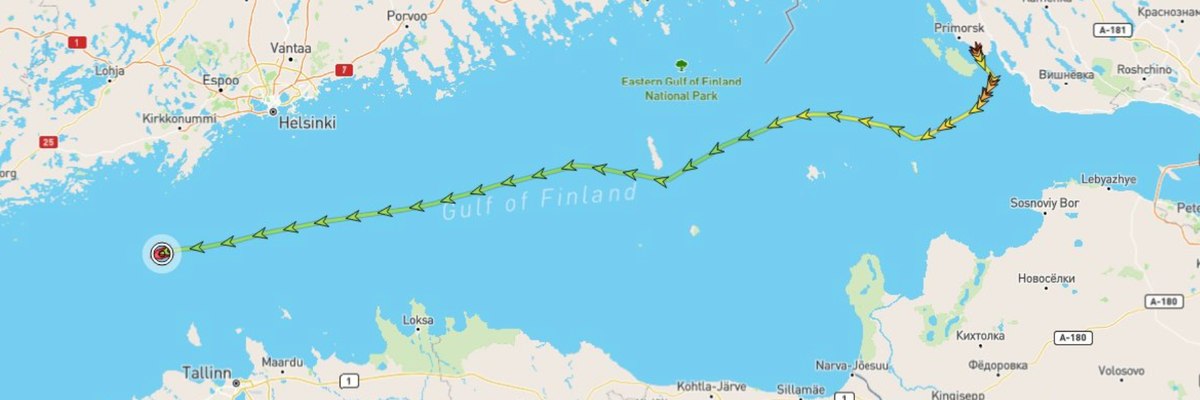
Greenpeace has launched a Russian Tanker Tracker, which publishes the location of Russia-flagged fossil fuel transport ships on Twitter.
Inspired by a Florida teenager who tracks U.S. and Russian oligarchs' private jets, Greenpeace U.K. on Friday began identifying, tracking, and publishing the location of Russia-flagged ships transporting fossil fuels following President Vladimir Putin's invasion of Ukraine.
"Europe is set to spend up to EUR285m per day for Russian oil, which props up his war effort while our bills continue to soar."
The green group says it has identified at least 148 Russian oil and gas supertankers since February 24--when Ukraine was invaded on Putin's orders for the second time since 2014--and has published a "Russian Tanker Tracker" on Twitter.
"The huge number of tankers criss-crossing our seas loaded with Russian oil and gas is a tangible sign of our dependence on fossil fuels and proof that it is the biggest contribution to Putin's war chest," Rosie Rogers, head of energy at Greenpeace U.K., said in a statement.
The group says it was inspired by the efforts of U.S. teenager Jack Sweeney, who first gained widespread attention after he rejected a $5,000 offer from Tesla Motors and SpaceX CEO Elon Musk to delete a Twitter account monitoring the location of the centibillionaire's private jet.
Sweeney has subsequently tracked and published the locations of "Russian Oligarch Jets" following the Ukraine invasion. He has also started a "Russian Yachts" tracker, although it is not yet automated.
To track Russian tankers, Greenpeace U.K. uses MarineTraffic API, a cloud-based solution that determines ship positions from onboard transceiver and port call data.
Russia is the largest source of European Union fossil fuel imports, with the country providing around 40% of the 27-nation bloc's fossil gas, more than a quarter of its crude oil, and nearly half of the coal it imported in 2019.
"Europe is set to spend up to EUR285 million per day for Russian oil, which props up his war effort while our bills continue to soar," Rogers said. "Europe must stand by the people of Ukraine by pulling every stop to finance Putin's war machine and get off gas and oil."
"We need to be getting off gas altogether and we have the technologies to do it."
"We need to be getting off gas altogether and we have the technologies to do it," she asserted. "All we need is the political will of the E.U. to carry out an unprecedented program to free Europe from its gas dependence, no matter where it comes from."
"We need an emergency plan to insulate homes, rapidly transform public transport to run on renewable energy, and boost ever-cheaper solar and wind power," she added. "This will create jobs, lower energy bills, tackle the climate crisis, and cut our dependence on imported gas."
Last week, Greenpeace activists confronted a Russian LNG tanker at sea after union dockworkers refused to unload it at Isle of Grain in the United Kingdom.
Dear Common Dreams reader, It’s been nearly 30 years since I co-founded Common Dreams with my late wife, Lina Newhouser. We had the radical notion that journalism should serve the public good, not corporate profits. It was clear to us from the outset what it would take to build such a project. No paid advertisements. No corporate sponsors. No millionaire publisher telling us what to think or do. Many people said we wouldn't last a year, but we proved those doubters wrong. Together with a tremendous team of journalists and dedicated staff, we built an independent media outlet free from the constraints of profits and corporate control. Our mission has always been simple: To inform. To inspire. To ignite change for the common good. Building Common Dreams was not easy. Our survival was never guaranteed. When you take on the most powerful forces—Wall Street greed, fossil fuel industry destruction, Big Tech lobbyists, and uber-rich oligarchs who have spent billions upon billions rigging the economy and democracy in their favor—the only bulwark you have is supporters who believe in your work. But here’s the urgent message from me today. It's never been this bad out there. And it's never been this hard to keep us going. At the very moment Common Dreams is most needed, the threats we face are intensifying. We need your support now more than ever. We don't accept corporate advertising and never will. We don't have a paywall because we don't think people should be blocked from critical news based on their ability to pay. Everything we do is funded by the donations of readers like you. When everyone does the little they can afford, we are strong. But if that support retreats or dries up, so do we. Will you donate now to make sure Common Dreams not only survives but thrives? —Craig Brown, Co-founder |
Inspired by a Florida teenager who tracks U.S. and Russian oligarchs' private jets, Greenpeace U.K. on Friday began identifying, tracking, and publishing the location of Russia-flagged ships transporting fossil fuels following President Vladimir Putin's invasion of Ukraine.
"Europe is set to spend up to EUR285m per day for Russian oil, which props up his war effort while our bills continue to soar."
The green group says it has identified at least 148 Russian oil and gas supertankers since February 24--when Ukraine was invaded on Putin's orders for the second time since 2014--and has published a "Russian Tanker Tracker" on Twitter.
"The huge number of tankers criss-crossing our seas loaded with Russian oil and gas is a tangible sign of our dependence on fossil fuels and proof that it is the biggest contribution to Putin's war chest," Rosie Rogers, head of energy at Greenpeace U.K., said in a statement.
The group says it was inspired by the efforts of U.S. teenager Jack Sweeney, who first gained widespread attention after he rejected a $5,000 offer from Tesla Motors and SpaceX CEO Elon Musk to delete a Twitter account monitoring the location of the centibillionaire's private jet.
Sweeney has subsequently tracked and published the locations of "Russian Oligarch Jets" following the Ukraine invasion. He has also started a "Russian Yachts" tracker, although it is not yet automated.
To track Russian tankers, Greenpeace U.K. uses MarineTraffic API, a cloud-based solution that determines ship positions from onboard transceiver and port call data.
Russia is the largest source of European Union fossil fuel imports, with the country providing around 40% of the 27-nation bloc's fossil gas, more than a quarter of its crude oil, and nearly half of the coal it imported in 2019.
"Europe is set to spend up to EUR285 million per day for Russian oil, which props up his war effort while our bills continue to soar," Rogers said. "Europe must stand by the people of Ukraine by pulling every stop to finance Putin's war machine and get off gas and oil."
"We need to be getting off gas altogether and we have the technologies to do it."
"We need to be getting off gas altogether and we have the technologies to do it," she asserted. "All we need is the political will of the E.U. to carry out an unprecedented program to free Europe from its gas dependence, no matter where it comes from."
"We need an emergency plan to insulate homes, rapidly transform public transport to run on renewable energy, and boost ever-cheaper solar and wind power," she added. "This will create jobs, lower energy bills, tackle the climate crisis, and cut our dependence on imported gas."
Last week, Greenpeace activists confronted a Russian LNG tanker at sea after union dockworkers refused to unload it at Isle of Grain in the United Kingdom.
Inspired by a Florida teenager who tracks U.S. and Russian oligarchs' private jets, Greenpeace U.K. on Friday began identifying, tracking, and publishing the location of Russia-flagged ships transporting fossil fuels following President Vladimir Putin's invasion of Ukraine.
"Europe is set to spend up to EUR285m per day for Russian oil, which props up his war effort while our bills continue to soar."
The green group says it has identified at least 148 Russian oil and gas supertankers since February 24--when Ukraine was invaded on Putin's orders for the second time since 2014--and has published a "Russian Tanker Tracker" on Twitter.
"The huge number of tankers criss-crossing our seas loaded with Russian oil and gas is a tangible sign of our dependence on fossil fuels and proof that it is the biggest contribution to Putin's war chest," Rosie Rogers, head of energy at Greenpeace U.K., said in a statement.
The group says it was inspired by the efforts of U.S. teenager Jack Sweeney, who first gained widespread attention after he rejected a $5,000 offer from Tesla Motors and SpaceX CEO Elon Musk to delete a Twitter account monitoring the location of the centibillionaire's private jet.
Sweeney has subsequently tracked and published the locations of "Russian Oligarch Jets" following the Ukraine invasion. He has also started a "Russian Yachts" tracker, although it is not yet automated.
To track Russian tankers, Greenpeace U.K. uses MarineTraffic API, a cloud-based solution that determines ship positions from onboard transceiver and port call data.
Russia is the largest source of European Union fossil fuel imports, with the country providing around 40% of the 27-nation bloc's fossil gas, more than a quarter of its crude oil, and nearly half of the coal it imported in 2019.
"Europe is set to spend up to EUR285 million per day for Russian oil, which props up his war effort while our bills continue to soar," Rogers said. "Europe must stand by the people of Ukraine by pulling every stop to finance Putin's war machine and get off gas and oil."
"We need to be getting off gas altogether and we have the technologies to do it."
"We need to be getting off gas altogether and we have the technologies to do it," she asserted. "All we need is the political will of the E.U. to carry out an unprecedented program to free Europe from its gas dependence, no matter where it comes from."
"We need an emergency plan to insulate homes, rapidly transform public transport to run on renewable energy, and boost ever-cheaper solar and wind power," she added. "This will create jobs, lower energy bills, tackle the climate crisis, and cut our dependence on imported gas."
Last week, Greenpeace activists confronted a Russian LNG tanker at sea after union dockworkers refused to unload it at Isle of Grain in the United Kingdom.