SUBSCRIBE TO OUR FREE NEWSLETTER
Daily news & progressive opinion—funded by the people, not the corporations—delivered straight to your inbox.
5
#000000
#FFFFFF
To donate by check, phone, or other method, see our More Ways to Give page.
Daily news & progressive opinion—funded by the people, not the corporations—delivered straight to your inbox.
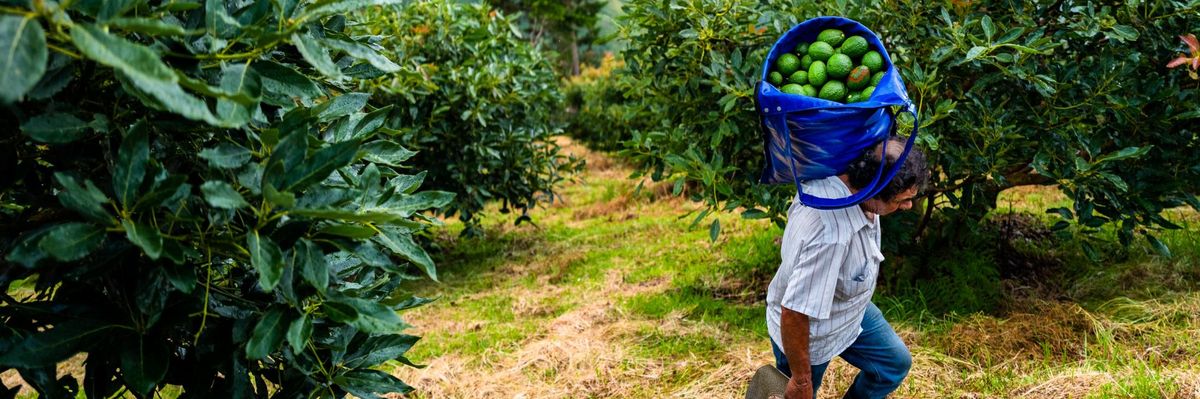
A Colombian farmworker carries a bag of avocados after a harvest on November 21, 2019 near Medellin, Colombia. (Photo: Jan Sochor via Getty Images)
Decrying the "corporate agenda" of the upcoming United Nations Food Systems Summit, thousands of farmworkers and food sovereignty advocates on Tuesday launched a three-day counter-mobilization "to expose and oppose the control of big corporations over food and agriculture."
"Corporations are out to further consolidate their control of land, seeds, agricultural inputs, and markets by embedding themselves even deeper into policymaking processes of the U.N. and its member states."
--Sarojeni Rengam PAN Asia Pacific
The Global People's Summit on Food Systems (GPS)--a series of online and in-person gatherings assembled by an international coalition of 22 civil society groups--is set to run through September 23, when the U.N. Food Systems Summit (UNFSS) is scheduled to take place in New York City.
Pointing to "the key roles given to Bill Gates and other capitalist-controlled institutions in shaping the UNFSS agenda and outcomes," proponents of more just and sustainable food systems have argued for months that the U.N. meeting has been captured by the same "global corporate food empire" actors responsible for causing malnutrition and ecological degradation in the first place.
"The UNFSS, which has been under fire by civil society and people's organizations for its blatant subservience to corporate interests, has tried to repackage itself superficially as a 'People's Summit,'" Razan Zuayter, global co-chairperson of the People's Coalition on Food Sovereignty (PCFS), said in a statement.
"A true and legitimate People's Summit," Zuayter added, "should put the hungry and marginalized--landless farmers, agricultural workers, Indigenous peoples, fisherfolk, rural women, youth, rural people living in occupied areas, and sanctioned peoples--at the helm of agenda-setting in the radical transformation of our food systems."
The GPS aims to bring to the foreground the perspectives of the "exploit[ed] and oppresse[d] small food producers who feed the world," with panels and events that include:
Simultaneous national conferences and workshops are planned in the Philippines, Indonesia, Cambodia, India, Malaysia, Pakistan, and Sri Lanka.
Sarojeni Rengam, executive director of Pesticide Action Network Asia Pacific (PAN Asia Pacific), warned that "corporations are out to further consolidate their control of land, seeds, agricultural inputs, and markets by embedding themselves even deeper into policymaking processes of the U.N. and its member states, as... we are witnessing now with the UNFSS."
"In the guise of helping 'transform' food systems," corporations are "actually peddling discredited market-based 'solutions' and techno-fixes that are responsible for much of the widespread hunger and environmental destruction we are experiencing," said Rengam.
New reporting out Tuesday from Unearthed, Greenpeace U.K.'s journalism team, underscored why opponents of the corporate food regime have been sounding the alarm about the potential domination of the UNFSS by powerful agribusiness interests.
According to the outlet:
In a draft position paper prepared in June for the summit, a group of industry associations including the International Meat Secretariat and International Poultry Council called for the U.N. to support increased meat consumption worldwide, arguing that "advances in intensive livestock systems" would "contribute to the preservation of planetary resources."
The associations--who represent leading corporations that account for much of the global meat supply chain--wrote the paper in their capacity as key members of the summit's "sustainable livestock" cluster, a working group set up to recommend policies for the summit.
A pair of recent analyses has highlighted how industrialized animal agriculture contributes significantly to greenhouse gas pollution and biodiversity destruction.
"Food systems can be transformed through the respect of food sovereignty via the will of landless peasants, small farmers, and fishers."
--Razan Zuayter, PCFS
Last month, in anticipation of the UNFSS, animal welfare and environmental justice advocates urged policymakers to apply carbon pricing to meat and dairy products. In addition, the U.N.'s Intergovernmental Panel on Climate Change has called for reducing meat consumption, especially in wealthy nations, and adopting more sustainable land use patterns to stave off the worst effects of the climate emergency.
According to Zuayter, it is possible to build food systems that eradicate hunger and prioritize human rights and biodiversity over profit-maximization at all costs.
While "we cannot succeed in our efforts without ending the use of food as a weapon in the context of war, militarization, sanctions, and occupation," Zuayter said, "food systems can be transformed through the respect of food sovereignty via the will of landless peasants, small farmers, and fishers. The Global People's Summit is a space to listen to their aspirations."
During the closing plenary of the GPS on Thursday, the coalition is expected to present a People's Declaration for the radical transformation of the corporate food regime toward just, equitable, healthy, and sustainable food systems, as well as People's Action Plans outlining how to get there.
"We are the real People's Summit," Zuayter concluded. "We have shown that the people are hungry for real change, and are willing to do whatever it takes to fight for and reclaim their land, their rights, and the future of food systems."
Dear Common Dreams reader, It’s been nearly 30 years since I co-founded Common Dreams with my late wife, Lina Newhouser. We had the radical notion that journalism should serve the public good, not corporate profits. It was clear to us from the outset what it would take to build such a project. No paid advertisements. No corporate sponsors. No millionaire publisher telling us what to think or do. Many people said we wouldn't last a year, but we proved those doubters wrong. Together with a tremendous team of journalists and dedicated staff, we built an independent media outlet free from the constraints of profits and corporate control. Our mission has always been simple: To inform. To inspire. To ignite change for the common good. Building Common Dreams was not easy. Our survival was never guaranteed. When you take on the most powerful forces—Wall Street greed, fossil fuel industry destruction, Big Tech lobbyists, and uber-rich oligarchs who have spent billions upon billions rigging the economy and democracy in their favor—the only bulwark you have is supporters who believe in your work. But here’s the urgent message from me today. It's never been this bad out there. And it's never been this hard to keep us going. At the very moment Common Dreams is most needed, the threats we face are intensifying. We need your support now more than ever. We don't accept corporate advertising and never will. We don't have a paywall because we don't think people should be blocked from critical news based on their ability to pay. Everything we do is funded by the donations of readers like you. When everyone does the little they can afford, we are strong. But if that support retreats or dries up, so do we. Will you donate now to make sure Common Dreams not only survives but thrives? —Craig Brown, Co-founder |
Decrying the "corporate agenda" of the upcoming United Nations Food Systems Summit, thousands of farmworkers and food sovereignty advocates on Tuesday launched a three-day counter-mobilization "to expose and oppose the control of big corporations over food and agriculture."
"Corporations are out to further consolidate their control of land, seeds, agricultural inputs, and markets by embedding themselves even deeper into policymaking processes of the U.N. and its member states."
--Sarojeni Rengam PAN Asia Pacific
The Global People's Summit on Food Systems (GPS)--a series of online and in-person gatherings assembled by an international coalition of 22 civil society groups--is set to run through September 23, when the U.N. Food Systems Summit (UNFSS) is scheduled to take place in New York City.
Pointing to "the key roles given to Bill Gates and other capitalist-controlled institutions in shaping the UNFSS agenda and outcomes," proponents of more just and sustainable food systems have argued for months that the U.N. meeting has been captured by the same "global corporate food empire" actors responsible for causing malnutrition and ecological degradation in the first place.
"The UNFSS, which has been under fire by civil society and people's organizations for its blatant subservience to corporate interests, has tried to repackage itself superficially as a 'People's Summit,'" Razan Zuayter, global co-chairperson of the People's Coalition on Food Sovereignty (PCFS), said in a statement.
"A true and legitimate People's Summit," Zuayter added, "should put the hungry and marginalized--landless farmers, agricultural workers, Indigenous peoples, fisherfolk, rural women, youth, rural people living in occupied areas, and sanctioned peoples--at the helm of agenda-setting in the radical transformation of our food systems."
The GPS aims to bring to the foreground the perspectives of the "exploit[ed] and oppresse[d] small food producers who feed the world," with panels and events that include:
Simultaneous national conferences and workshops are planned in the Philippines, Indonesia, Cambodia, India, Malaysia, Pakistan, and Sri Lanka.
Sarojeni Rengam, executive director of Pesticide Action Network Asia Pacific (PAN Asia Pacific), warned that "corporations are out to further consolidate their control of land, seeds, agricultural inputs, and markets by embedding themselves even deeper into policymaking processes of the U.N. and its member states, as... we are witnessing now with the UNFSS."
"In the guise of helping 'transform' food systems," corporations are "actually peddling discredited market-based 'solutions' and techno-fixes that are responsible for much of the widespread hunger and environmental destruction we are experiencing," said Rengam.
New reporting out Tuesday from Unearthed, Greenpeace U.K.'s journalism team, underscored why opponents of the corporate food regime have been sounding the alarm about the potential domination of the UNFSS by powerful agribusiness interests.
According to the outlet:
In a draft position paper prepared in June for the summit, a group of industry associations including the International Meat Secretariat and International Poultry Council called for the U.N. to support increased meat consumption worldwide, arguing that "advances in intensive livestock systems" would "contribute to the preservation of planetary resources."
The associations--who represent leading corporations that account for much of the global meat supply chain--wrote the paper in their capacity as key members of the summit's "sustainable livestock" cluster, a working group set up to recommend policies for the summit.
A pair of recent analyses has highlighted how industrialized animal agriculture contributes significantly to greenhouse gas pollution and biodiversity destruction.
"Food systems can be transformed through the respect of food sovereignty via the will of landless peasants, small farmers, and fishers."
--Razan Zuayter, PCFS
Last month, in anticipation of the UNFSS, animal welfare and environmental justice advocates urged policymakers to apply carbon pricing to meat and dairy products. In addition, the U.N.'s Intergovernmental Panel on Climate Change has called for reducing meat consumption, especially in wealthy nations, and adopting more sustainable land use patterns to stave off the worst effects of the climate emergency.
According to Zuayter, it is possible to build food systems that eradicate hunger and prioritize human rights and biodiversity over profit-maximization at all costs.
While "we cannot succeed in our efforts without ending the use of food as a weapon in the context of war, militarization, sanctions, and occupation," Zuayter said, "food systems can be transformed through the respect of food sovereignty via the will of landless peasants, small farmers, and fishers. The Global People's Summit is a space to listen to their aspirations."
During the closing plenary of the GPS on Thursday, the coalition is expected to present a People's Declaration for the radical transformation of the corporate food regime toward just, equitable, healthy, and sustainable food systems, as well as People's Action Plans outlining how to get there.
"We are the real People's Summit," Zuayter concluded. "We have shown that the people are hungry for real change, and are willing to do whatever it takes to fight for and reclaim their land, their rights, and the future of food systems."
Decrying the "corporate agenda" of the upcoming United Nations Food Systems Summit, thousands of farmworkers and food sovereignty advocates on Tuesday launched a three-day counter-mobilization "to expose and oppose the control of big corporations over food and agriculture."
"Corporations are out to further consolidate their control of land, seeds, agricultural inputs, and markets by embedding themselves even deeper into policymaking processes of the U.N. and its member states."
--Sarojeni Rengam PAN Asia Pacific
The Global People's Summit on Food Systems (GPS)--a series of online and in-person gatherings assembled by an international coalition of 22 civil society groups--is set to run through September 23, when the U.N. Food Systems Summit (UNFSS) is scheduled to take place in New York City.
Pointing to "the key roles given to Bill Gates and other capitalist-controlled institutions in shaping the UNFSS agenda and outcomes," proponents of more just and sustainable food systems have argued for months that the U.N. meeting has been captured by the same "global corporate food empire" actors responsible for causing malnutrition and ecological degradation in the first place.
"The UNFSS, which has been under fire by civil society and people's organizations for its blatant subservience to corporate interests, has tried to repackage itself superficially as a 'People's Summit,'" Razan Zuayter, global co-chairperson of the People's Coalition on Food Sovereignty (PCFS), said in a statement.
"A true and legitimate People's Summit," Zuayter added, "should put the hungry and marginalized--landless farmers, agricultural workers, Indigenous peoples, fisherfolk, rural women, youth, rural people living in occupied areas, and sanctioned peoples--at the helm of agenda-setting in the radical transformation of our food systems."
The GPS aims to bring to the foreground the perspectives of the "exploit[ed] and oppresse[d] small food producers who feed the world," with panels and events that include:
Simultaneous national conferences and workshops are planned in the Philippines, Indonesia, Cambodia, India, Malaysia, Pakistan, and Sri Lanka.
Sarojeni Rengam, executive director of Pesticide Action Network Asia Pacific (PAN Asia Pacific), warned that "corporations are out to further consolidate their control of land, seeds, agricultural inputs, and markets by embedding themselves even deeper into policymaking processes of the U.N. and its member states, as... we are witnessing now with the UNFSS."
"In the guise of helping 'transform' food systems," corporations are "actually peddling discredited market-based 'solutions' and techno-fixes that are responsible for much of the widespread hunger and environmental destruction we are experiencing," said Rengam.
New reporting out Tuesday from Unearthed, Greenpeace U.K.'s journalism team, underscored why opponents of the corporate food regime have been sounding the alarm about the potential domination of the UNFSS by powerful agribusiness interests.
According to the outlet:
In a draft position paper prepared in June for the summit, a group of industry associations including the International Meat Secretariat and International Poultry Council called for the U.N. to support increased meat consumption worldwide, arguing that "advances in intensive livestock systems" would "contribute to the preservation of planetary resources."
The associations--who represent leading corporations that account for much of the global meat supply chain--wrote the paper in their capacity as key members of the summit's "sustainable livestock" cluster, a working group set up to recommend policies for the summit.
A pair of recent analyses has highlighted how industrialized animal agriculture contributes significantly to greenhouse gas pollution and biodiversity destruction.
"Food systems can be transformed through the respect of food sovereignty via the will of landless peasants, small farmers, and fishers."
--Razan Zuayter, PCFS
Last month, in anticipation of the UNFSS, animal welfare and environmental justice advocates urged policymakers to apply carbon pricing to meat and dairy products. In addition, the U.N.'s Intergovernmental Panel on Climate Change has called for reducing meat consumption, especially in wealthy nations, and adopting more sustainable land use patterns to stave off the worst effects of the climate emergency.
According to Zuayter, it is possible to build food systems that eradicate hunger and prioritize human rights and biodiversity over profit-maximization at all costs.
While "we cannot succeed in our efforts without ending the use of food as a weapon in the context of war, militarization, sanctions, and occupation," Zuayter said, "food systems can be transformed through the respect of food sovereignty via the will of landless peasants, small farmers, and fishers. The Global People's Summit is a space to listen to their aspirations."
During the closing plenary of the GPS on Thursday, the coalition is expected to present a People's Declaration for the radical transformation of the corporate food regime toward just, equitable, healthy, and sustainable food systems, as well as People's Action Plans outlining how to get there.
"We are the real People's Summit," Zuayter concluded. "We have shown that the people are hungry for real change, and are willing to do whatever it takes to fight for and reclaim their land, their rights, and the future of food systems."