SUBSCRIBE TO OUR FREE NEWSLETTER
Daily news & progressive opinion—funded by the people, not the corporations—delivered straight to your inbox.
5
#000000
#FFFFFF
To donate by check, phone, or other method, see our More Ways to Give page.
Daily news & progressive opinion—funded by the people, not the corporations—delivered straight to your inbox.
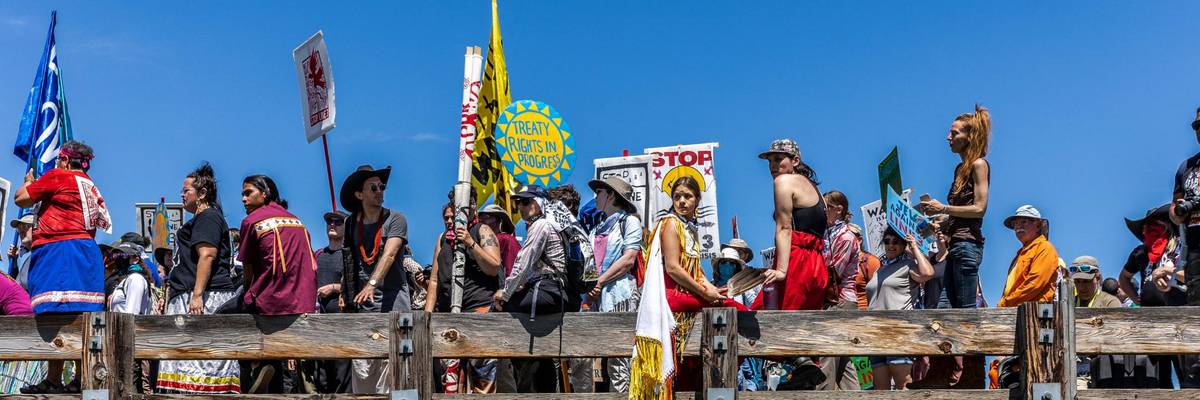
Indigenous-led water protectors gather on a bridge after a traditional water ceremony near the headwaters of the Mississippi River, part of a massive day of action on June 7, 2021 against the Line 3 tar sands pipeline in northern Minnesota. (Photo: Kerem Yucel/AFP via Getty Images)
Native American, climate, and environmental activists on Monday renewed calls for the Biden administration to fulfill its stated commitment to climate action and Indigenous rights and stop Enbridge's Line 3 tar sands pipeline after a Minnesota appellate court upheld a state agency's approval of the highly controversial project.
"Climate leadership means ending the fossil fuel era and stopping Line 3." --Collin Rees, Oil Change International
A three-judge panel of the Minnesota Court of Appeals ruled 2-1 Monday to affirm the Minnesota Public Utilities Commission's (PUC) decision that the Line 3 replacement and expansion is "necessary."
Pipeline foes, led by Indigenous tribes and environmental groups, argued that the PUC failed to demonstrate the demand for the tar sands oil--the world's dirtiest fuel--that the $9 billion Line 3 project would transport nearly 1,100 miles from Alberta, Canada to the port of Superior, Wisconsin, traversing tribal lands without consent and crossing hundreds of wetlands and bodies of water along the way.
Writing for the majority, Judge Lucinda Jesson--who acknowledged that "there was no option without environmental consequences" or "without impacts on the rights of Indigenous peoples"--argued that "the challenge" is "to alleviate those harms to the extent possible."
"While reasonable minds may differ on the central question of need for replacement Line 3, substantial evidence supports the commission's decision to issue a certificate of need," she wrote.
The lone dissenting judge, Peter Reyes, noted that the PUC "committed legal errors and acted arbitrarily or capriciously by granting [Enbridge] a certificate of need that is unsupported by substantial evidence."
"The PUC approved a new pipeline that benefits Canadian oil producers but traverses 340 miles of Minnesota land, which among other negative consequences will affect hunting, fishing, and other rights of [the] Red Lake Band of Chippewa Indians and White Earth Band of Ojibwe, with no benefit to Minnesota," Reyes wrote.
"Enbridge needs Minnesota for its new pipeline. But Enbridge has not shown that Minnesota needs the pipeline." --Judge Peter Reyes
"Such a decision cannot stand," he concluded. "Enbridge needs Minnesota for its new pipeline. But Enbridge has not shown that Minnesota needs the pipeline."
Indigenous water protector Dawn Goodwin, a leader of the anti-Line 3 RISE Coalition, told the Minneapolis Star-Tribune, "I guess I didn't have any hope in our court--I wanted to, but I did not. The good thing is that one of those judges gave a powerful dissent."
Winona LaDuke, co-founder and executive director of the Indigenous-led group Honor the Earth, said in a statement that, "We are sorely disappointed in this decision that allows the state of Minnesota under Gov. [Tim] Walz to continue to shove a pipeline through Ojibwe lands and waters at a time of escalating climate crisis."
"One immediate result is that hundreds of more arrests of water protectors will occur because of this," she said, a reference to the hundreds of activists arrested during two days of #StopLine3 protests last week. On Monday, Indigenous and environmental activists reported more arrests of water protectors on Anishinaabe treaty land in Minnesota.
Collin Rees, a senior campaigner at the advocacy group Oil Change International, called Monday's court decision "a clear example of our legal system failing communities and our climate."
"As Judge Peter Reyes noted in his dissent, Enbridge has repeatedly failed to support its arguments that this pipeline is needed," Rees said in a statement. "This incorrect decision means President [Joe] Biden and [White House Climate Adviser] Gina McCarthy must act immediately to stop Line 3's construction and revoke [former President Donald] Trump's fraudulent permits."
"Line 3 would emit the equivalent of 50 new coal-fired power plants," Rees continued. "It's a colossal disaster for the climate and for communities. Every day President Biden refuses to stop the Line 3 pipeline is a slap in the face to environmental justice communities and a renewed breaking of his promises on climate and Indigenous rights. Climate leadership means ending the fossil fuel era and stopping Line 3."
Margaret Levin, state director of the Sierra Club North Star Chapter, said that, "Today's decision is deeply disappointing and paves the way for the Minnesota Public Utilities Commission to continue to disregard the health of our communities, water, and climate as well as the ways of life and treaty rights of Ojibwe people."
"Construction on Line 3 is underway--all eyes now turn to the Biden administration to live up to their commitments to climate action and Indigenous rights by stopping Line 3."
Dear Common Dreams reader, It’s been nearly 30 years since I co-founded Common Dreams with my late wife, Lina Newhouser. We had the radical notion that journalism should serve the public good, not corporate profits. It was clear to us from the outset what it would take to build such a project. No paid advertisements. No corporate sponsors. No millionaire publisher telling us what to think or do. Many people said we wouldn't last a year, but we proved those doubters wrong. Together with a tremendous team of journalists and dedicated staff, we built an independent media outlet free from the constraints of profits and corporate control. Our mission has always been simple: To inform. To inspire. To ignite change for the common good. Building Common Dreams was not easy. Our survival was never guaranteed. When you take on the most powerful forces—Wall Street greed, fossil fuel industry destruction, Big Tech lobbyists, and uber-rich oligarchs who have spent billions upon billions rigging the economy and democracy in their favor—the only bulwark you have is supporters who believe in your work. But here’s the urgent message from me today. It's never been this bad out there. And it's never been this hard to keep us going. At the very moment Common Dreams is most needed, the threats we face are intensifying. We need your support now more than ever. We don't accept corporate advertising and never will. We don't have a paywall because we don't think people should be blocked from critical news based on their ability to pay. Everything we do is funded by the donations of readers like you. When everyone does the little they can afford, we are strong. But if that support retreats or dries up, so do we. Will you donate now to make sure Common Dreams not only survives but thrives? —Craig Brown, Co-founder |
Native American, climate, and environmental activists on Monday renewed calls for the Biden administration to fulfill its stated commitment to climate action and Indigenous rights and stop Enbridge's Line 3 tar sands pipeline after a Minnesota appellate court upheld a state agency's approval of the highly controversial project.
"Climate leadership means ending the fossil fuel era and stopping Line 3." --Collin Rees, Oil Change International
A three-judge panel of the Minnesota Court of Appeals ruled 2-1 Monday to affirm the Minnesota Public Utilities Commission's (PUC) decision that the Line 3 replacement and expansion is "necessary."
Pipeline foes, led by Indigenous tribes and environmental groups, argued that the PUC failed to demonstrate the demand for the tar sands oil--the world's dirtiest fuel--that the $9 billion Line 3 project would transport nearly 1,100 miles from Alberta, Canada to the port of Superior, Wisconsin, traversing tribal lands without consent and crossing hundreds of wetlands and bodies of water along the way.
Writing for the majority, Judge Lucinda Jesson--who acknowledged that "there was no option without environmental consequences" or "without impacts on the rights of Indigenous peoples"--argued that "the challenge" is "to alleviate those harms to the extent possible."
"While reasonable minds may differ on the central question of need for replacement Line 3, substantial evidence supports the commission's decision to issue a certificate of need," she wrote.
The lone dissenting judge, Peter Reyes, noted that the PUC "committed legal errors and acted arbitrarily or capriciously by granting [Enbridge] a certificate of need that is unsupported by substantial evidence."
"The PUC approved a new pipeline that benefits Canadian oil producers but traverses 340 miles of Minnesota land, which among other negative consequences will affect hunting, fishing, and other rights of [the] Red Lake Band of Chippewa Indians and White Earth Band of Ojibwe, with no benefit to Minnesota," Reyes wrote.
"Enbridge needs Minnesota for its new pipeline. But Enbridge has not shown that Minnesota needs the pipeline." --Judge Peter Reyes
"Such a decision cannot stand," he concluded. "Enbridge needs Minnesota for its new pipeline. But Enbridge has not shown that Minnesota needs the pipeline."
Indigenous water protector Dawn Goodwin, a leader of the anti-Line 3 RISE Coalition, told the Minneapolis Star-Tribune, "I guess I didn't have any hope in our court--I wanted to, but I did not. The good thing is that one of those judges gave a powerful dissent."
Winona LaDuke, co-founder and executive director of the Indigenous-led group Honor the Earth, said in a statement that, "We are sorely disappointed in this decision that allows the state of Minnesota under Gov. [Tim] Walz to continue to shove a pipeline through Ojibwe lands and waters at a time of escalating climate crisis."
"One immediate result is that hundreds of more arrests of water protectors will occur because of this," she said, a reference to the hundreds of activists arrested during two days of #StopLine3 protests last week. On Monday, Indigenous and environmental activists reported more arrests of water protectors on Anishinaabe treaty land in Minnesota.
Collin Rees, a senior campaigner at the advocacy group Oil Change International, called Monday's court decision "a clear example of our legal system failing communities and our climate."
"As Judge Peter Reyes noted in his dissent, Enbridge has repeatedly failed to support its arguments that this pipeline is needed," Rees said in a statement. "This incorrect decision means President [Joe] Biden and [White House Climate Adviser] Gina McCarthy must act immediately to stop Line 3's construction and revoke [former President Donald] Trump's fraudulent permits."
"Line 3 would emit the equivalent of 50 new coal-fired power plants," Rees continued. "It's a colossal disaster for the climate and for communities. Every day President Biden refuses to stop the Line 3 pipeline is a slap in the face to environmental justice communities and a renewed breaking of his promises on climate and Indigenous rights. Climate leadership means ending the fossil fuel era and stopping Line 3."
Margaret Levin, state director of the Sierra Club North Star Chapter, said that, "Today's decision is deeply disappointing and paves the way for the Minnesota Public Utilities Commission to continue to disregard the health of our communities, water, and climate as well as the ways of life and treaty rights of Ojibwe people."
"Construction on Line 3 is underway--all eyes now turn to the Biden administration to live up to their commitments to climate action and Indigenous rights by stopping Line 3."
Native American, climate, and environmental activists on Monday renewed calls for the Biden administration to fulfill its stated commitment to climate action and Indigenous rights and stop Enbridge's Line 3 tar sands pipeline after a Minnesota appellate court upheld a state agency's approval of the highly controversial project.
"Climate leadership means ending the fossil fuel era and stopping Line 3." --Collin Rees, Oil Change International
A three-judge panel of the Minnesota Court of Appeals ruled 2-1 Monday to affirm the Minnesota Public Utilities Commission's (PUC) decision that the Line 3 replacement and expansion is "necessary."
Pipeline foes, led by Indigenous tribes and environmental groups, argued that the PUC failed to demonstrate the demand for the tar sands oil--the world's dirtiest fuel--that the $9 billion Line 3 project would transport nearly 1,100 miles from Alberta, Canada to the port of Superior, Wisconsin, traversing tribal lands without consent and crossing hundreds of wetlands and bodies of water along the way.
Writing for the majority, Judge Lucinda Jesson--who acknowledged that "there was no option without environmental consequences" or "without impacts on the rights of Indigenous peoples"--argued that "the challenge" is "to alleviate those harms to the extent possible."
"While reasonable minds may differ on the central question of need for replacement Line 3, substantial evidence supports the commission's decision to issue a certificate of need," she wrote.
The lone dissenting judge, Peter Reyes, noted that the PUC "committed legal errors and acted arbitrarily or capriciously by granting [Enbridge] a certificate of need that is unsupported by substantial evidence."
"The PUC approved a new pipeline that benefits Canadian oil producers but traverses 340 miles of Minnesota land, which among other negative consequences will affect hunting, fishing, and other rights of [the] Red Lake Band of Chippewa Indians and White Earth Band of Ojibwe, with no benefit to Minnesota," Reyes wrote.
"Enbridge needs Minnesota for its new pipeline. But Enbridge has not shown that Minnesota needs the pipeline." --Judge Peter Reyes
"Such a decision cannot stand," he concluded. "Enbridge needs Minnesota for its new pipeline. But Enbridge has not shown that Minnesota needs the pipeline."
Indigenous water protector Dawn Goodwin, a leader of the anti-Line 3 RISE Coalition, told the Minneapolis Star-Tribune, "I guess I didn't have any hope in our court--I wanted to, but I did not. The good thing is that one of those judges gave a powerful dissent."
Winona LaDuke, co-founder and executive director of the Indigenous-led group Honor the Earth, said in a statement that, "We are sorely disappointed in this decision that allows the state of Minnesota under Gov. [Tim] Walz to continue to shove a pipeline through Ojibwe lands and waters at a time of escalating climate crisis."
"One immediate result is that hundreds of more arrests of water protectors will occur because of this," she said, a reference to the hundreds of activists arrested during two days of #StopLine3 protests last week. On Monday, Indigenous and environmental activists reported more arrests of water protectors on Anishinaabe treaty land in Minnesota.
Collin Rees, a senior campaigner at the advocacy group Oil Change International, called Monday's court decision "a clear example of our legal system failing communities and our climate."
"As Judge Peter Reyes noted in his dissent, Enbridge has repeatedly failed to support its arguments that this pipeline is needed," Rees said in a statement. "This incorrect decision means President [Joe] Biden and [White House Climate Adviser] Gina McCarthy must act immediately to stop Line 3's construction and revoke [former President Donald] Trump's fraudulent permits."
"Line 3 would emit the equivalent of 50 new coal-fired power plants," Rees continued. "It's a colossal disaster for the climate and for communities. Every day President Biden refuses to stop the Line 3 pipeline is a slap in the face to environmental justice communities and a renewed breaking of his promises on climate and Indigenous rights. Climate leadership means ending the fossil fuel era and stopping Line 3."
Margaret Levin, state director of the Sierra Club North Star Chapter, said that, "Today's decision is deeply disappointing and paves the way for the Minnesota Public Utilities Commission to continue to disregard the health of our communities, water, and climate as well as the ways of life and treaty rights of Ojibwe people."
"Construction on Line 3 is underway--all eyes now turn to the Biden administration to live up to their commitments to climate action and Indigenous rights by stopping Line 3."