
SUBSCRIBE TO OUR FREE NEWSLETTER
Daily news & progressive opinion—funded by the people, not the corporations—delivered straight to your inbox.
5
#000000
#FFFFFF
To donate by check, phone, or other method, see our More Ways to Give page.


Daily news & progressive opinion—funded by the people, not the corporations—delivered straight to your inbox.
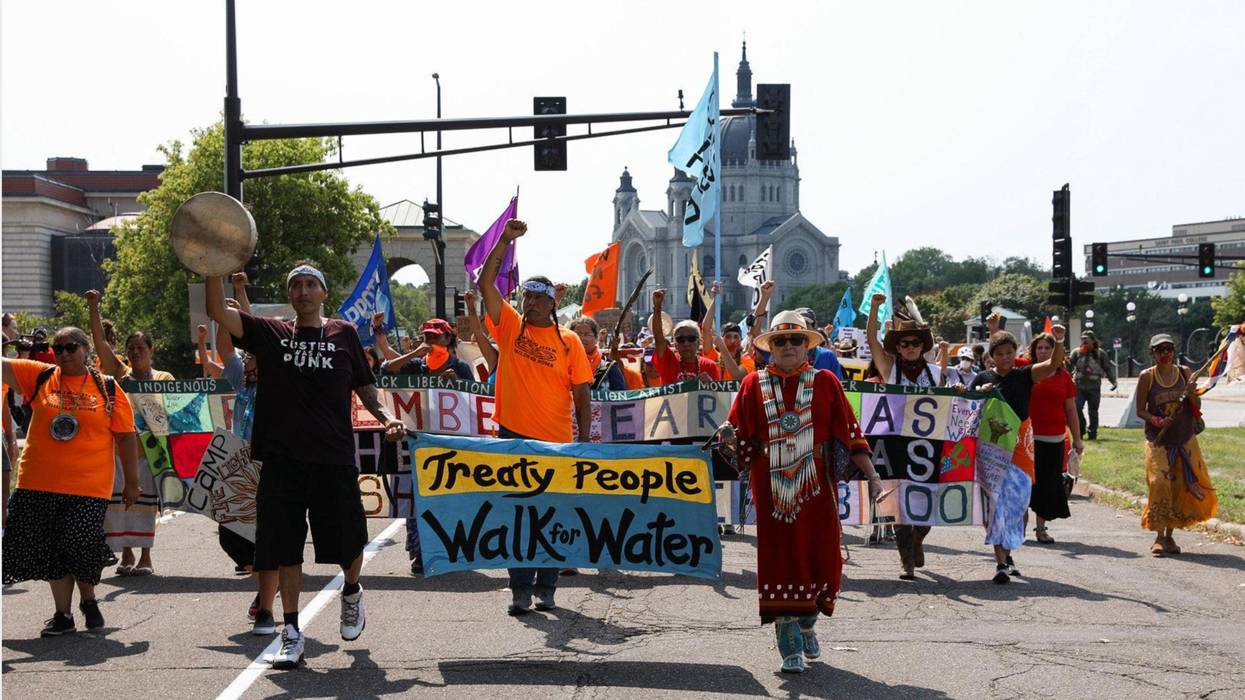
Indigenous and environmental activists on Wednesday vowed to keep up the fight against Enbridge's Line 3 pipeline expansion after the Canadian company announced the completion of the multi-billion-dollar tar sands project.
"From the belly of the beast north of the medicine line to rice beds that sustain the life-ways of the Anishinaabe... we will continue to fight for the natural and spiritual knowledge of the Earth."
--IEN
Calgary-based Enbridge on Wednesday announced the "substantial completion" of the 1,097-mile Line 3 expansion, which will enable the flow of up to 760,000 barrels of crude tar sands oil--the world's dirtiest fuel--from Alberta to the port of Superior, Wisconsin.
Line 3 traverses Anishinaabe treaty land without the consent of the Indigenous peoples who live there. The pipeline's route crosses 200 bodies of water and 800 wetlands, raising serious concerns about its climate impact, as well as accidents and leaks that are endemic to pipelines, and other issues including sex trafficking by Line 3 workers.
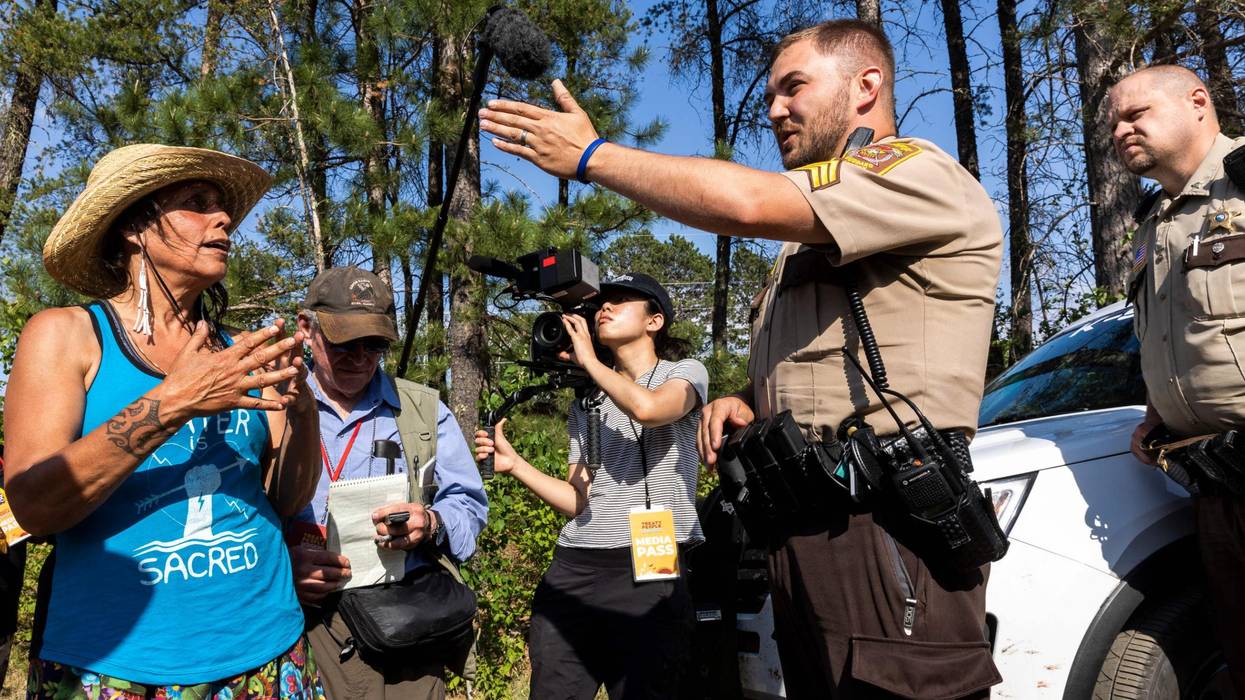
State and local law enforcement officers--some of their agencies paid by Enbridge under Minnesota state rules--have violently repressed anti-Line 3 demonstrations in northern Minnesota while arresting hundreds of water protectors in recent months.
Winona LaDuke, executive director of the Indigenous-led environmental justice group Honor the Earth, responded to Enbridge's announcement by declaring that "the fight to #StopLine3 is not over."
Other Indigenous and environmental leaders also vowed to keep fighting the project.
"The Line 3 fight is far from over, it has just shifted gears," the Indigenous Environmental Network (IEN) said in a statement.
"Do not think we are going quietly into the night, we will continue to stand on the frontlines until every last tar sands pipeline is shut down and Indigenous communities are no longer targeted but our right to consent or denial is respected," the group said.
"We promise to continue to show up each time even stronger with new voices and hearts ready to lead," IEN continued.
"From the belly of the beast north of the medicine line to rice beds that sustain the life-ways of the Anishinaabe all the way down to our relatives impacted in the bayous, we will continue to fight for the natural and spiritual knowledge of the Earth," the group added. "We will continue to fight and take care of one another and our Mother because she has always taken care of us."
The frontline Line 3 resistance group Camp Migizi said it "made a solemn promise to stop Line 3 and we intend to go down fighting. There is still work that needs to be done before the project is considered complete; we promise to disrupt and stop that work."
The group continued:
We ask that you remember us, as we will still be here, fighting to protect all that is sacred, even if they build Line 3. Our community that we have built here will still remain. We ask that you remember that just like all of the Indigenous communities we come from, we are still here learning, fighting, and healing.
We will remain an open camp, for queer BIPOC anarchists and water protectors alike to reconnect to the water, the land, and the world around us. We will still be here as you sit in your homes drinking Starbucks coffee, placing bets on which football team will win next Sunday.
We will still be here in the cold, in the heat, through the mud and the barbed wire. We ask that you remember us, because the fight for clean water is never over. We will remain, with all of our lives, the frontline.
Giniw Collective founder Tara Houska said that "this shameful moment marks what the promises of the Democratic Party to listen to climate science look like in action, what it looks like when human beings refuse to open our eyes to the burning world around us and respond with equal urgency."
"Biden and the other politicians who chose to do nothing as treaty rights were violated, waterways were polluted, and peaceful protesters were brutalized have placed themselves on the wrong side of history."
--Margaret Levin, Sierra Club
"Over 800 people from all walks of life were arrested here for protecting our land, treaty obligations to tribal nations were once again violated, [and] statutory requirements were cast aside in favor of corporate greed," Houska continued. "We were shot at with rubber bullets paid for by Enbridge, police officers in financial relationship with a foreign company used pain compliance on us, we face years in prison for defending the drinking water of tens of millions downstream from Alberta tar sands oil set to flow through the Mississippi River headwaters, 22 rivers, 800 wetlands."
Houska defiantly added: "We are not deterred. We answer the failures of governmental leadership to abandon the status quo that's killing all life with building the world we want to live in and standing up for what is right. Line 3 is one coffin nail of many, we cannot and will not stop fighting for a better tomorrow."
Environmental groups also pledged to continue resisting Line 3.
"President [Joe] Biden and the other politicians who chose to do nothing as treaty rights were violated, waterways were polluted, and peaceful protesters were brutalized have placed themselves on the wrong side of history," said Sierra Club North Star chapter director Margaret Levin. "We will continue to seek to hold them accountable for failing to prioritize the best interests of our communities over the desires of a foreign oil company."
"This is not the outcome we hoped for, but the fight to stop Line 3 has always been a fight for climate justice and a future free from fossil fuels, and that fight will not stop just because Enbridge has succeeded in building this pipeline," Levin added. "Our movement is powerful, and we are not going anywhere. We will keep pushing forward--demanding that our elected leaders live up to their promises and lifting our voices for healthy and safe communities and climate justice."
Line 3 opponents continue to implore the Biden administration to shut down the project. Three months ago, the president was accused of a "horrible and unconscionable betrayal" of his promises to combat the climate emergency and respect Indigenous rights after his administration filed a legal brief backing the federal government's 2020 approval of Line 3 under former President Donald Trump.
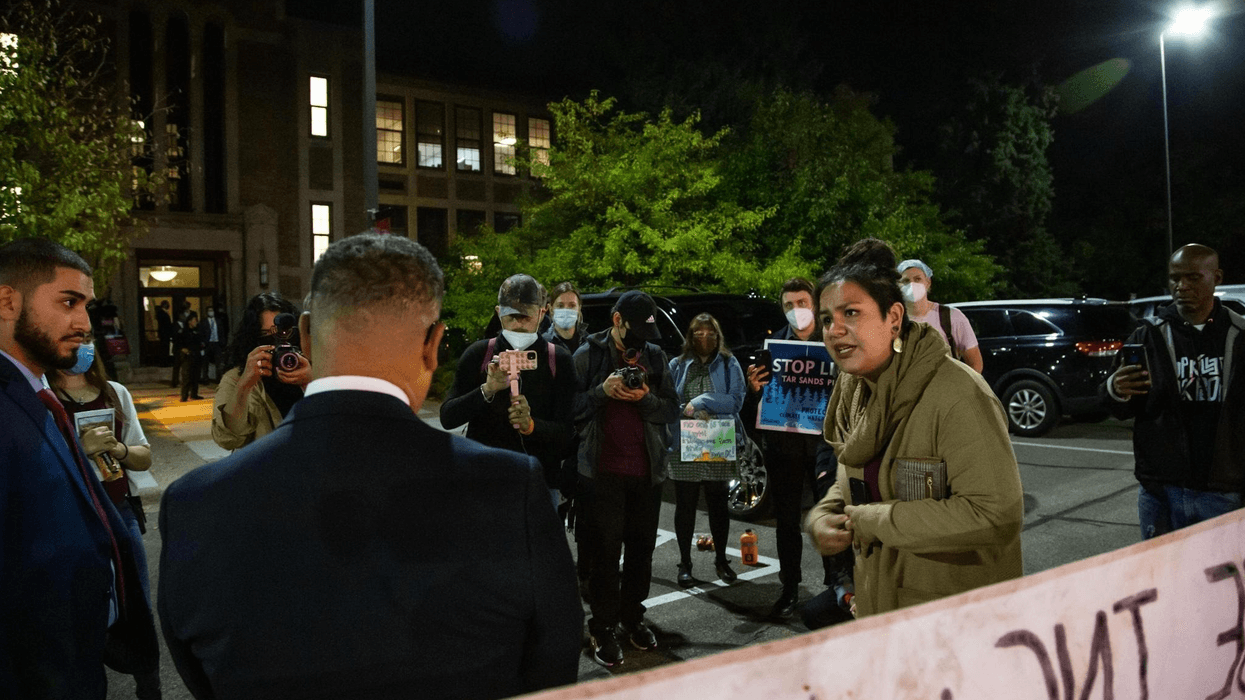
Water protectors fighting to stop Enbridge's Line 3 tar sands pipeline expansion interrupted a Thursday evening speech by Minnesota Attorney General Keith Ellison to challenge the Democrat's silence on the multi-billion-dollar project, which violates Anishinaabe treaty rights while endangering local ecosystems, Indigenous communities, and the global climate.
"What will you do about the frivolous charges brought against over 800 people drawing attention to Line 3's climate impacts and civil rights violations?"
--Water protector
"In 2015 at an anti-tar sands rally, you promised to stand with the First Nations brothers and sisters--that's a quote--and defend Mother Earth," one protester shouted out as he was removed from the St. Paul auditorium hosting a ceremony for the new dean of the Mitchell Hamline School of Law. "And yet you've been silent on Line 3... What is your plan? Are you going to take a stand?"
Another water protector asked, "What will you do about the frivolous charges brought against over 800 people drawing attention to Line 3's climate impacts and civil rights violations?"
Ellison, who was the keynote speaker, admonished the demonstrators but agreed to meet with them after the event.
In a video of a post-event exchange published by BLCK Press, Jaike Spotted-Wolf, a leader in the frontline Line 3 resistance group Camp Migizi, told Ellison that "two out of three tribes didn't approve" the pipeline, "and you guys went against treaty law, which is sovereign... you went above the treaty to approve that pipeline. And protesters have been violently arrested all summer long. What are your thoughts on that, as people are being sex-trafficked all along that pipeline?"
Camp Migizi founder Taysha Martineau showed Ellison a photo of their three daughters and asked, "Which one are the Enbridge workers going to target? Which one is going to be raped before the age of 15, which one is going to go missing, which one is going to get murdered, and which one are they going to attempt to sex traffic?"
As Ellison stood in sullen silence, Martineau continued: "This is an honest conversation that Indigenous women wake up every single day terrified about... The [Missing and Murdered Indigenous Women] issue is always going to be there."
"I'm supposed to be able to trust you," they told Ellison, who replied, "I didn't ask you to trust me."
"I've said I don't like Line 3," Ellison said. "If I had any authority to do anything about Line 3, I would."
The attorney general assured the protesters that he would look into sex trafficking and other abuses perpetrated by Line 3 workers.
In 2015, then-Congressman Ellison (D-Minn.) held up a sign reading "I Will Act on Climate" at a Tar Sands Resistance March in St. Paul, and declared, "We've got to stand together; we've got to say no to... fossil fuels; we've got to defend Mother Earth."
However, according to anti-Line 3 campaigners, Ellison has not taken a public stance on the project since being elected attorney general.
The administration of President Joe Biden--who earlier this month called the climate emergency a "code red" crisis--was accused in June of a "horrible and unconscionable betrayal" of his climate promises after filing a legal brief backing the federal government's 2020 approval of the Line 3 project under former President Donald Trump.
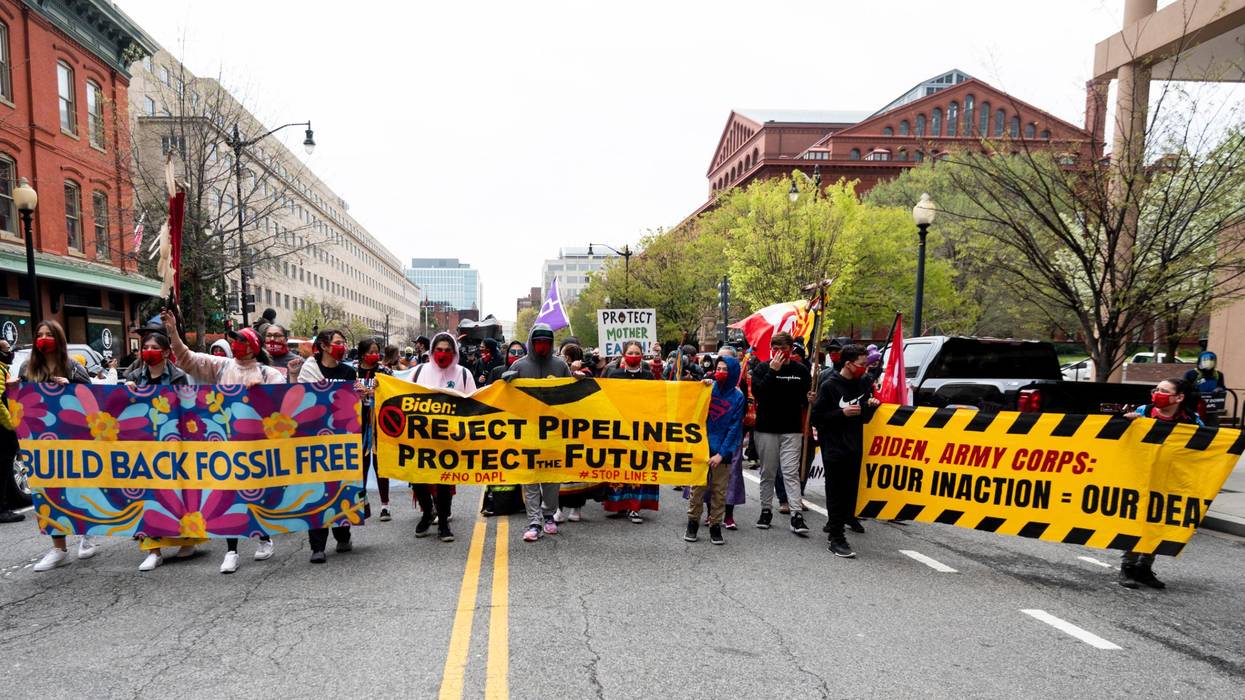
Earlier this week, after Democratic Minnesota Gov. Tim Walz kicked off Minnesota Climate Week by vowing to "recommit to combating climate change," Rep. Ilhan Omar (D-Minn.) tweeted, "Let's #StopLine3."
The Indigenous-led frontline group Honor the Earth denounced Walz for what they called his meaningless climate proclamation while imploring the governor to "take real action."
Indigenous women who are leading the fight against Enbridge's Line 3 tar sands pipeline met virtually with a United Nations expert on Tuesday to discuss human rights abuses of those who have joined the movement opposing the polluting project.
"The Biden administration has turned a blind eye, so we hope that international attention can protect the rights of our people and the water we all depend on."
--Winona LaDuke, Honor the Earth
"We met with the U.N. special rapporteur on human rights defenders because gross human rights violations are occurring at the hands of police in [a] financial relationship with Enbridge," Giniw Collective founder Tara Houska of Couchiching First Nation said in a statement.
Houska and Honor the Earth executive director Winona LaDuke of White Earth Nation have submitted a formal complaint about actions by law enforcement in Northern Minnesota to Mary Lawlor, the U.N. special rapporteur.
LaDuke and Houska, with support from the Women's Earth and Climate Action Network (WECAN), shared with Lawlor details about what Line 3 opponents have endured while protesting the Canadian company's effort to replace an aging pipeline with one that will have larger capacity and cross 200 waterways as well as Anishinaabe treaty territory.
When approving Line 3 in 2018, the Minnesota Public Utilities Commission required a Public Safety Escrow Trust funded by Enbridge to reimburse law enforcement for policing costs related to the pipeline--an arrangement that has angered activists on the ground.
Motherboard reported earlier this month that the company has paid police $2 million through the trust. According to the Pipeline Legal Action Network, more than 700 water defenders have been arrested for actions opposing Line 3 in Minnesota.
"Minnesota law enforcement has used pain compliance, psychological trauma, threats, rubber bullets, mace, and chemical warfare on people standing up for water," Houska explained, "which it then bills to a fund Enbridge pays into to the tune of $2 million to date--most of these charges are misdemeanors, all of them are nonviolent."
"We pose no threat. Enbridge threatens Anishinaabe cultural survival, the drinking water of millions, and the public's trust," she added. "Since the U.S. government is yet again failing Indigenous people and future generations, we turn to the international community. The world is watching."
LaDuke thanked Lawlor "for putting attention on what's happening in Northern Minnesota, where an international fossil fuel corporation is once again brutalizing Indigenous people to expand the footprint of its toxic and unneeded tar sands oil project."
"State and local government are working directly at the behest of the Enbridge corporation, and the Biden administration has turned a blind eye," she said, "so we hope that international attention can protect the rights of our people and the water we all depend on."
The meeting occurred on the same day as a national day of solidarity against Line 3 held by U.S. health professionals--who sent a letter to President Joe Biden echoing activists' demands, urging him to block the project like he did the controversial Keystone XL Pipeline earlier this year.
"Line 3 cuts through the heart of the Anishinaabe territory in Minnesota, violating treaty rights, damaging sacred wild rice beds, and threatening the health of our Indigenous communities, who have already experienced generations of oppression and trauma due to exploitation of their land and their people," the letter says. "Health professionals across the country stand in solidarity with our Indigenous leaders who are putting their bodies on the line to defend sacred water, land, and climate."
As state and local law enforcement in Minnesota intensify their violent repression of water protectors resisting Enbridge's Line 3 tar sands pipeline, Indigenous leaders on Thursday appealed for allies in their effort to pressure the U.S. government to honor Native American treaty rights and protect the environment and climate by stopping the toxic project.
"We are running out of time to do the right thing for future generations."
--Chase Iron Eyes,
Lakota People's Law Project
At least 20 Indigenous-led water protectors were brutally arrested in northern Minnesota last weekend, with law enforcement using tear gas, rubber-coated steel bullets, and pepper projectiles in an attempt to break resistance to the Canadian pipeline company's $9 billion Line 3 project.
Native American leaders pointed to recent events, including the violent repression of Stop Line 3 water protectors and the discovery of the remains of more than 1,000 Indigenous children at Indian boarding schools in Canada and the United States, as evidence of an ongoing "slow genocide."
"This is no accident," said Chase Iron Eyes, co-director and lead counsel for the Lakota People's Law Project, in a statement Thursday. "The drilling that Enbridge is being allowed to do here is a continuation of the same pattern of subjugation and genocide faced by Indigenous populations throughout history."
Iron Eyes continued:
Our treaties have been ignored, our children have been killed, and now our rivers are being poisoned. And when we stand up to the forces of extractive greed, we pay a heavy price. We are asking President [Joe] Biden to stop Line 3, and we need everyone who can to come to the frontlines in support. We need those who can't come here in person to amplify this message through every available channel.
"We are running out of time to do the right thing for future generations," said Iron Eyes.
If built as planned, Line 3 will carry up to 760,000 barrels of crude tar sands oil--the world's dirtiest fuel--from Alberta to the port of Superior, Wisconsin, crossing Anishinaabe treaty land without consent. The conduit's route is set to traverse more than 200 bodies of water and 800 wetlands, raising serious concerns not only about its climate impact, but also about accidents and leaks that plague pipelines.
"Eight hundred wetlands, that's what's at stake here," Indigenous lawyer and Giniw Collective co-founder Tara Houska said Thursday. "Beautiful, untouched ecosystems, endangered by a corporation with no knowledge of or respect for this land. They have no idea what they're doing here. President Biden has the power to stop this, but he's not listening closely enough."
Houska was among the water protectors who were violently arrested while protesting Line 3 last weekend.
"The level of brutality that was unleashed on us was very extreme," Houska, who said she was shot by police with rubber-coated steel bullets before being hospitalized and jailed, told Democracy Now! Wednesday.
"People were shot in their faces, in their bodies, in their upper torsos," she said. "I saw a young woman's head get split open right in front of me. It was a really, really brutal scene. And the arrests in person were also quite brutal, throwing people face down in the dirt and being extremely violent."
Houska continued:
When I was sitting on the side of a police vehicle with several others waiting to be brought to jail, I overheard several of the police officers talking about how they were going to get bonus time for this brutality they had unleashed upon us... Police officers are reimbursed for any costs associated with Enbridge Line 3 protests, and it seems like they welcome the opportunity. One police officer was actually grinning and smiling and said he had a great time and couldn't wait for us to come again.
They've billed over $1.7 million to the Public Safety Escrow Trust, in which Enbridge is dumping millions of dollars to incentivize and encourage police officers to repress, suppress, surveil, and harass Indigenous people and our allies that are helping us try to stop this pipeline from happening in our treaty territory.
The Minnesota Public Utilities Commission required the trust to reimburse law enforcement when approving the project in 2018.
Water protectors told Democracy Now! that they were denied medical care for injuries they suffered at the hands of police. Some of the activists also said they were denied proper food and held in solitary confinement.
"We need our brothers and sisters to stand with us."
--Tara Houska, Giniw Collective
Among others arrested in recent weeks were Lakota People's Law Project co-director Dan Nelson, Honor the Earth co-founder Winona LaDuke, and a journalist who goes by the camp name "River," who says he suffered a neck injury after being placed in a chokehold by police after recording officers arresting a water protector.
Houska called for allies to join water protectors on the frontlines of the fight against Line 3, saying that "we need our brothers and sisters to stand with us."
As part of the wider effort to stop Line 3, Honor the Earth and Indigenous Environmental Network, in partnership with over 200 artists and activists, on Thursday launched a six-figure ad buy, including full-page advertisements in the New York Times and Minneapolis Star Tribune, and a digital ad on the Washington Post website, calling on the Biden administration to stand with Anishinaabe people and stop Line 3.
The Lakota People's Law Project said that anyone who is interested in joining the fight against Line 3 should follow the organization and the Giniw Collective on social media, contact the group about going to the frontlines, and sign a petition urging Biden to stop the pipeline project like he rescinded the federal permit for the Keystone XL pipeline on his first day of office following years of grassroots organizing.
LaDuke recently told Slate: "Biden's acting like he canceled one pipeline so he gets a gold star. But you don't get a gold star from Mother Earth to let Line 3 go ahead. You don't get a gold star from the planet."
At least seven water protectors from the Indigenous-led movement to stop Enbridge's Line 3 were arrested on Monday while protesting at the Shell River in Minnesota, which the partially completed tar sands pipeline is set to cross in five places.
"Today women and other water protectors from across multiple communities in Minnesota sat together at the Shell River, near Park Rapids, Minnesota, in peaceful prayer to oppose the construction of Line 3," the group Honor the Earth said on Instagram. "These women represent many others who stand in solidarity with the protection of water across Anishinaabe treaty lands."
Honor the Earth executive director Winona LaDuke, one of the Indigenous women leading the fight against Line 3, was among those arrested and zip-tied by officers. According to the group, more than 500 people have been arrested for protesting the Canadian energy company's effort to replace an old pipeline with lower capacity.
The Minnesota Department of Natural Resources (DNR) has temporarily suspended some surface water-related permits for Line 3 in response to ongoing drought conditions in the state.
As Minnesota-based Bring Me The News reported Monday:
Starting July 15, Enbridge's water sources within the Crow Wing River, St. Louis River, Pine River, and Mississippi River-Brainerd watersheds are suspended. This suspension impacts 10 water sources used in dust control, and 13 water sources used in [hydrostatic testing and horizontal directional drilling].
That includes along the Shell River, where the group Honor the Earth said more than 40 water protectors were on the scene Monday.
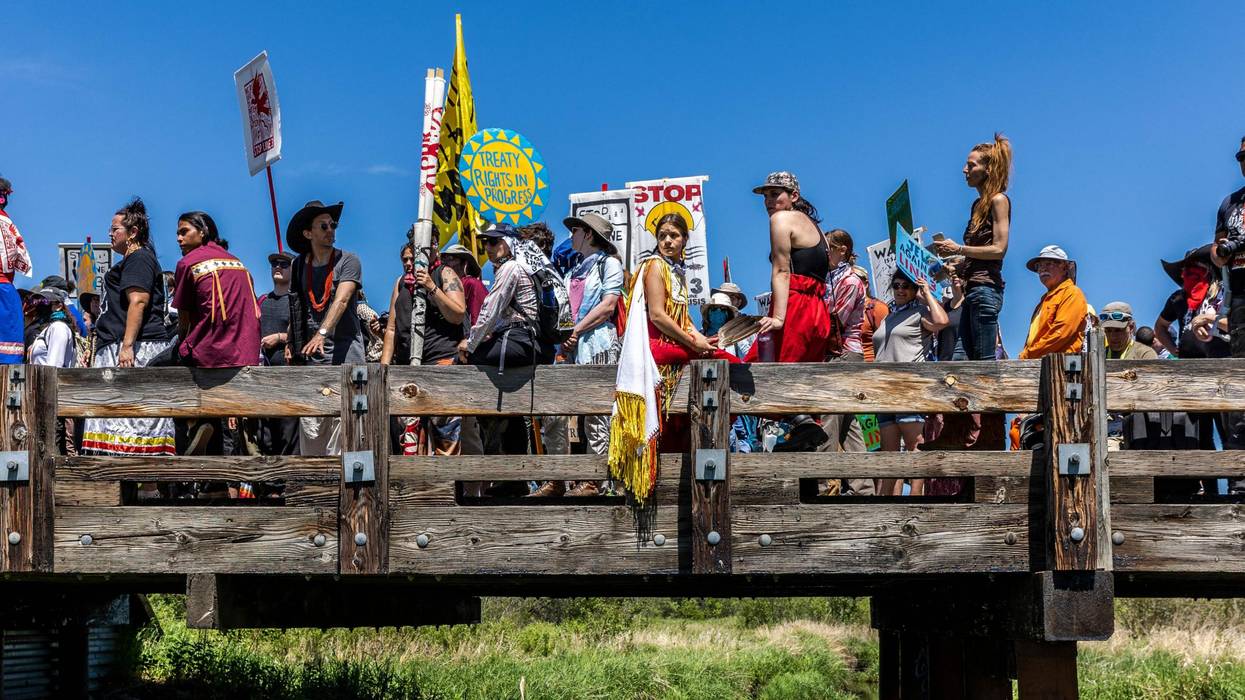
Last Thursday, about 200 people--including LaDuke and actor Marisa Tomei--gathered at the Shell River for a "Women for the Rivers" event.
"A society that permits violence on water and violence on women is a society we stand to change," LaDuke said ahead of the gathering last week. "Together on Thursday we will practice treaty rights and rally at the Shell River, where the Enbridge corporation is preparing to drill for the dangerous Line 3 tar sands pipeline--just one of 22 river crossings Line 3 will cross, including the Mississippi River twice! As Enbridge builds Line 3 through Anishinaabe treaty land, we continue to stand strong in our resistance."
The Duluth News Tribune reported that Tomei, during Thursday's event, took aim at President Joe Biden, who ran for office promising to combat the climate emergency.
"It's time to stop playing politics with the future of life on this planet," Tomei said. "If President Biden is serious about climate change, if he's serious about respecting the rights of Indigenous people, and if he's serious about making sure we're on track to have a livable planet then Line 3 must be stopped."
Earlier this month, more than 200 activists, celebrities, Democratic donors, and environmentalists sent a letter demanding that Biden stop Enbridge's pipeline project--like he did with Keystone XL on his first day in office--and to "firmly establish the principle that we will move forward toward real climate solutions."
That letter came after the Biden administration infuriated opponents of Line 3 last month by filing a legal brief in support of the U.S. Army Corps of Engineers' approval of the project under former President Donald Trump.
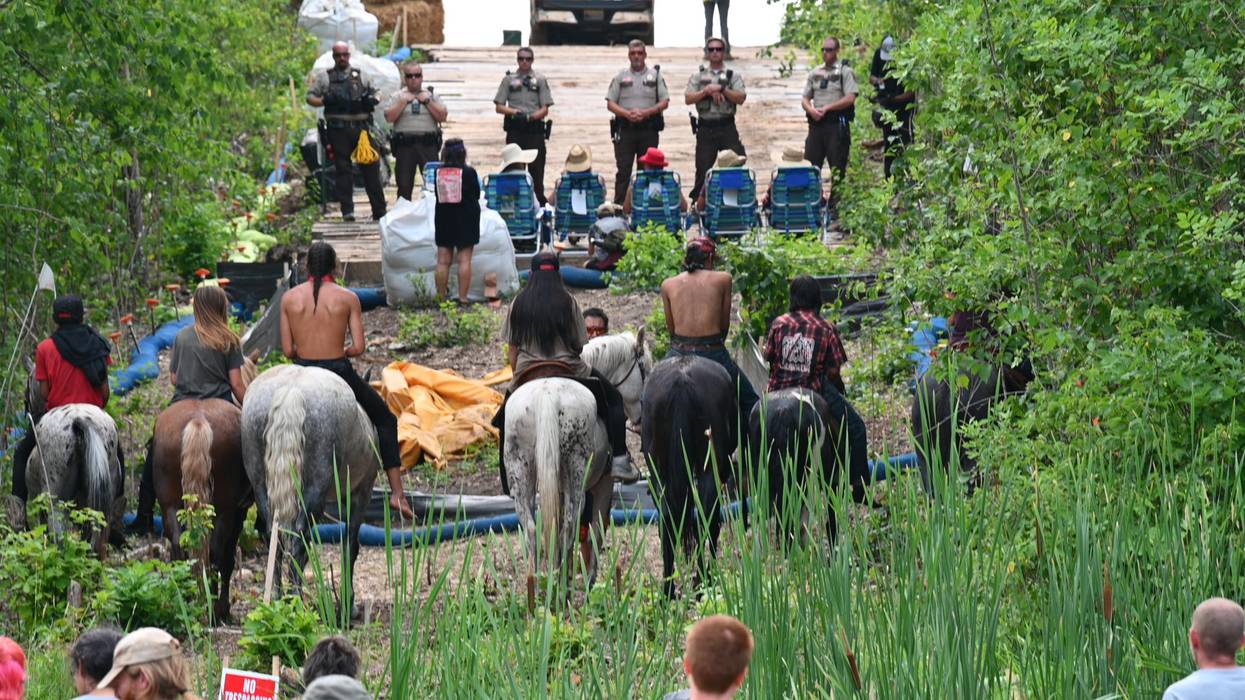
Biden's refusal so far to intervene on Line 3 has not deterred the pipeline's critics from continuing to fight against it in court and on the ground with peaceful acts of civil disobedience that have, at times, halted construction.
Actions opposing Line 3 have been met with force by local police--who, due to a state requirement for the project's approval, have sometimes been reimbursed for policing protests with money from Enbridge.
As Common Dreams reported last week, LaDuke and others filed suit against Minnesota's Hubbard County, the sheriff, and the local land commissioner for a police blockade of an Indigenous-led resistance camp located on private property.
Mara Verheyden-Hilliard, one of the attorneys representing the plaintiffs, said that "the Hubbard County Sheriff has attempted to illegally construct a de facto open-air prison to trap Indigenous environmental protectors and allies on their own property and to prevent others from joining in decolonization and treaty rights trainings and organizing against Enbridge's Line 3 pipeline."
The banks funding Line 3 are also under pressure from Indigenous and climate leaders, who held events over the weekend targeting the financial institutions.
"Stopping Line 3 is a matter of justice," says Stop the Money Pipeline on its webpage dedicated to project, which features resources to contact banks and support protesters.
"Steady direct action resistance forms cracks in the world of profit margins. As we learned at Standing Rock, Indigenous land defense poses a deep reputational risk to the financial institutions profiting from oil pipelines," the site says. "Activists all over the world are taking action to support the work on the ground--join the fight against Line 3 and together we can stop this toxic pipeline."
The Indigenous-led fight against Line 3 continued Tuesday as water protectors descended on the area of Willow River where Canadian energy giant Enbridge is working to install a "climate-wrecking" tar sands pipeline to replace one that was built in the 1960s.
Water protectors attached themselves to drilling equipment and built blockades on access roads in an effort to halt construction in Minnesota on Tuesday, according to a statement from organizers.
Pipeline opponents also joined Indigenous leaders Winona LaDuke, executive director of Honor the Earth, and Tania Aubid to stand in the river in prayer.
"We the people are here in the river because the rivers belong to the fish, they belong to the animals, and they belong to the people--and they don't belong to Enbridge," LaDuke said in a video from the river shared on social media.
Speaking from the river, which is part of the Mississippi watershed, Aubid said: "Minnesota, you will be held accountable along with the federal and Canadian governments for the genocide of Mother Earth."
"We cannot allow them to take these rivers," Taysha Martineau, a water protector of the Fond du Lac Tribe who has helped build Camp Migizi, said about Tuesday's direct action.
"Enbridge was given a cease-and-desist notice in order to protect the ceremonial lodge," Martineau explained. "The state of Minnesota has refused to abide by that order and so action was taken. Abide by the order or we will continue to use people power to shut it down."
An unnamed water protector locked down in Minnesota declared that "Line 3 is a catastrophic threat to the land, the water, the people, wild rice, and the climate."
"This pipeline violates the treaty rights of the Anishinaabe and is not being built with Indigenous consent," the water protector noted, before taking aim at the company behind it:
Enbridge has a long history of spills, many of which occur in the first 10 years of a pipeline operating. They do not care about the land, the people, or their workers. They only care about the money, so we are putting pressure on their pocketbooks by slowing the progress of Line 3 until we stop it altogether. Polluted water, land, and rapid climate change are threats to us all, and Line 3 will cause unpredictable levels of damage if it becomes active.
"Actions like this one are a fight for all of our survival," the activist added, "and should be seen as nothing less."
In a series of tweets from the river Tuesday, Honor the Earth raised concerns that "a spot in the river is warmer, and appears to have been polluted with drilling mud."
The advocacy group shared a photo of a nearby container labeled "spill kit," and said that there was "no one working to contain this drilling mud from washing downstream and polluting the river."
According to the Line 3 resistance movement, as of Tuesday, more than 500 people have been arrested for protesting the pipeline. As Common Dreams reported last week, some of them now face felony charges.
Under pressure from Indigenous leaders and climate justice advocates, the Minneapolis City Council last week unanimously passed a resolution opposing the pipeline, calling on elected leaders who can stop it to do so immediately, and requesting that the city's mayor and police chief refuse to participate in a law enforcement coalition formed in response to protests.
"This water we protect serves the people of your city," LaDuke said last week of the development in Minneapolis. "Together we need to stop the last tar sands pipeline."
Despite running on a broad promise to tackle the global climate emergency, to which the fossil fuel industry substantially contributed, President Joe Biden has so far refused to stop the project.
In fact, last month Biden's Department of Justice filed a legal brief in support of the federal government's approval of the project under former President Donald Trump.
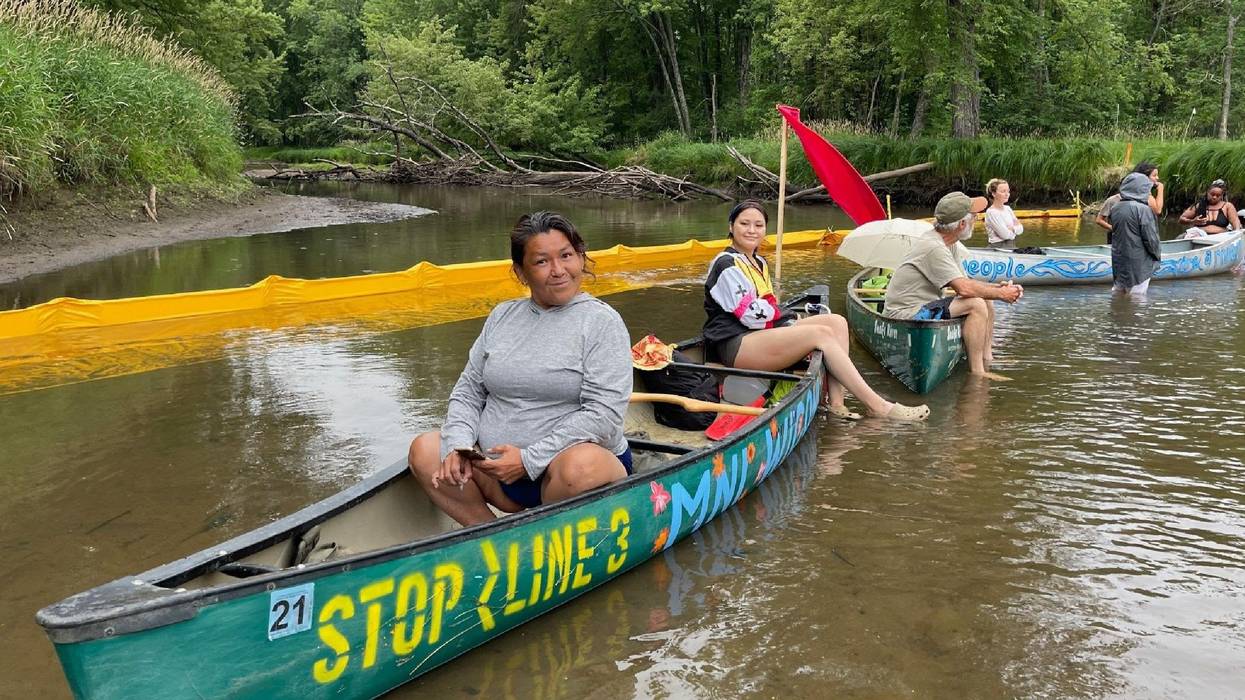
Tara Houska, founder of the Giniw Collective, called the DOJ's move "a horrific failure of the government's duty to tribal nations, to climate science, to the sacred."
Wen Stephenson, who protested against Enbridge in Massachusetts last week, wrote for The Nation Tuesday that "the Giniw Collective and #StopLine3 campaign are demanding that the Biden administration suspend the project and order a review of the water-crossing permits issued under Trump."
As Stephenson reports:
The state-level environmental impact statement (EIS), they point out, failed to consider the risks of (all but inevitable) oil spills; the impacts on "tribal cultural resources," such as wild rice beds sacred to Anishinaabe people; as well as the project's impact on climate change. If Biden orders a review and applies the same standard that compelled the Obama administration to reject the Keystone XL pipeline (to which Biden himself delivered the coup de grace upon taking office), then, as Houska says, "There's no way it's going to pass the test."
According to Stephenson, who concluded with a call for solidarity with Line 3's opponents, "What Enbridge is doing on Anishinaabe land in Minnesota, and what the fossil fuel industry and its political and financial backers are doing to drive global climate catastrophe, amounts to nothing less than a continuation of the genocide against the Indigenous peoples of the Americas and the Global South that began half a millennium ago."
Indigenous and environmental activists fighting against the Line 3 tar sands pipeline were outraged Thursday after the Biden administration filed a legal brief backing the federal government's 2020 approval of the project under former President Donald Trump.
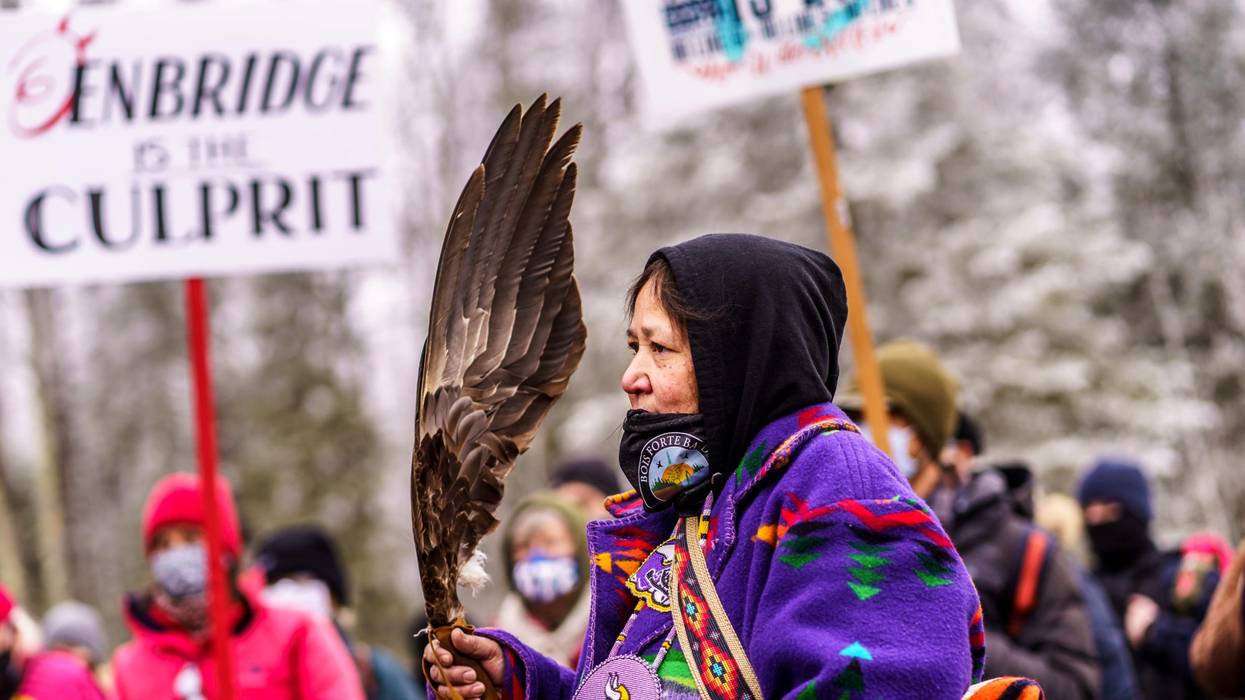
"This, quite simply, is pure cowardice."
--Generation Green New Deal
Critics of the project--which Canadian energy giant Enbridge has undertaken to replace an aging oil pipeline--blasted the U.S. Department of Justice's late Wednesday filing (pdf) as a betrayal of President Joe Biden's pledges to address the climate emergency and respect tribal rights.
"A White House that is serious about protecting communities needs to start by listening to communities when they say they don't want an oil pipeline threatening their water and land," said Janet Redman, Greenpeace USA climate campaign director. "Backing Enbridge's Line 3 tar sands oil pipeline is a massive failure for a president that campaigned on tackling the climate crisis. And it's a betrayal of what he promised the American people."
Benjamin Goloff, a campaigner at the Center for Biological Diversity, accused Biden of "siding with a handful of corrupt corporate elites over honoring treaty rights, climate, water, and the future of life on Earth."
"This is a racist pipeline project forced down the throats of our people, an ecological time bomb and a giveaway to a Canadian multinational oil interest," said Winona LaDuke, executive director of the Indigenous environmental group Honor the Earth, in a statement Thursday.
"If the president is genuine in his pledge to take climate justice and tribal rights seriously, his administration must stop defending the Trump administration's decision and undertake a genuine analysis of Line 3's environmental and human impacts," she asserted.
The route of Enbridge's new, larger pipeline crosses Anishinaabe treaty lands. Native American and climate groups have challenged it with actions on the ground--which have sometimes halted construction--and lawsuits at the state and federal level.
The Biden DOJ's brief is for a case filed in the federal district court in Washington, D.C. by Earthjustice on behalf of the White Earth Band of Ojibwe, the Red Lake Band of Chippewa, Honor the Earth, and the Sierra Club.
Those groups challenged the U.S. Army Corps of Engineers' November 2020 decision to grant a key water permit and permission for specific work related to Line 3. They argue that the corps violated several federal laws--the National Environmental Policy Act (NEPA), Clean Water Act (CWA), the Rivers and Harbors Act (RHA), and Administrative Procedure Act (APA).
The DOJ brief claims that the federal government met its legal obligations for the review and approval process through various actions, which included analyzing alternatives and preparing environmental assessments that considered "the impacts from the corps' authorizations, including to wetlands, the climate, low-income and minority populations, tribal rights to hunt, fish, and gather, and all of the issues to which plaintiffs draw special attention."
The brief notes that the corps considered a comprehensive Environmental Impact Statement prepared by Minnesota state authorities, and incorporated "important protections for wetlands, wild rice, and cultural resources as enforceable conditions of the permit and permission."
Since even before taking office in January, Biden has faced pressure to reverse the polluter-friendly policies of his predecessor--including by directing the corps to reconsider its approval of Line 3, fully accounting for its impacts on the global climate and tribal resources.
"We are extremely disappointed that the Biden administration continues the Trump administration's policy of ignoring tribal, environmental justice, and climate concerns in favor of fossil fuel industry profits."
--Moneen Nasmith, Earthjustice
"We are extremely disappointed that the Biden administration continues the Trump administration's policy of ignoring tribal, environmental justice, and climate concerns in favor of fossil fuel industry profits," Earthjustice attorney Moneen Nasmith said Thursday.
Sierra Club executive director Michael Brune called the DOJ's filing "a massive, tar sands pipeline-sized missed opportunity to break with the Trump administration's pro-polluter agenda and stand on the side of Indigenous rights and climate justice."
"Allowing Line 3 to move forward is, at best, inconsistent with the bold promises on climate and environmental justice President Biden campaigned and was elected on," he continued. "As Enbridge barrels ahead with construction, time is running out for Biden to stop them from doing permanent damage to critical water resources, trampling on tribal sovereignty, and polluting our climate."
"The president must listen to frontline communities, defend the right of all people to clean water and a healthy climate, and act immediately to shut down this dirty tar sands pipeline," Brune added.
In a statement about the development Thursday, leaders at the Minnesota arm of 350.org, which is among the groups organizing against Line 3, emphasized expert warnings about the need to rapidly phase out fossil fuels to prevent climate catastrophe on a global scale.
MN350 communications director Brett Benson said that "at a time when the world is getting hotter and the scientific community is sounding the alarm on the climate crisis, it is time for President Biden to step up and lead by ending this Trump-era expansion of fossil fuel infrastructure. Protecting our planet will take bold action, and bold action requires bold leadership. All eyes are on President Biden to do the right thing."
Warning about the dangers of inaction on the climate crisis, Andy Pearson, a Midwest tar sands organizer at 350, called the corps' approval "indefensible" and said that "Biden needs to take every opportunity to undo Trump's damage, and that means taking away Line 3's inadequate water permits."
"Line 3 would have the climate impact of 50 coal plants and violate treaties with the Anishinaabe," the campaigner noted. "Biden can stop Line 3 immediately by revoking Trump's water permits, and we call on him to act now to honor the treaties and protect our climate."
The Hill reported Thursday that "a White House spokesperson declined to comment, but it has said in the past that it will try to keep its judicial branch independent."
Despite the disappointment in court, Line 3's critics vow that this fight is far from over.
"We intend to keep opposing this pipeline," LaDuke told the New York Times. "We will file more legal challenges. Expect more resistance."
This post has been updated with comment from Greenpeace USA and MN350.
Native American, climate, and environmental activists on Monday renewed calls for the Biden administration to fulfill its stated commitment to climate action and Indigenous rights and stop Enbridge's Line 3 tar sands pipeline after a Minnesota appellate court upheld a state agency's approval of the highly controversial project.
"Climate leadership means ending the fossil fuel era and stopping Line 3." --Collin Rees, Oil Change International
A three-judge panel of the Minnesota Court of Appeals ruled 2-1 Monday to affirm the Minnesota Public Utilities Commission's (PUC) decision that the Line 3 replacement and expansion is "necessary."
Pipeline foes, led by Indigenous tribes and environmental groups, argued that the PUC failed to demonstrate the demand for the tar sands oil--the world's dirtiest fuel--that the $9 billion Line 3 project would transport nearly 1,100 miles from Alberta, Canada to the port of Superior, Wisconsin, traversing tribal lands without consent and crossing hundreds of wetlands and bodies of water along the way.
Writing for the majority, Judge Lucinda Jesson--who acknowledged that "there was no option without environmental consequences" or "without impacts on the rights of Indigenous peoples"--argued that "the challenge" is "to alleviate those harms to the extent possible."
"While reasonable minds may differ on the central question of need for replacement Line 3, substantial evidence supports the commission's decision to issue a certificate of need," she wrote.
The lone dissenting judge, Peter Reyes, noted that the PUC "committed legal errors and acted arbitrarily or capriciously by granting [Enbridge] a certificate of need that is unsupported by substantial evidence."
"The PUC approved a new pipeline that benefits Canadian oil producers but traverses 340 miles of Minnesota land, which among other negative consequences will affect hunting, fishing, and other rights of [the] Red Lake Band of Chippewa Indians and White Earth Band of Ojibwe, with no benefit to Minnesota," Reyes wrote.
"Enbridge needs Minnesota for its new pipeline. But Enbridge has not shown that Minnesota needs the pipeline." --Judge Peter Reyes
"Such a decision cannot stand," he concluded. "Enbridge needs Minnesota for its new pipeline. But Enbridge has not shown that Minnesota needs the pipeline."
Indigenous water protector Dawn Goodwin, a leader of the anti-Line 3 RISE Coalition, told the Minneapolis Star-Tribune, "I guess I didn't have any hope in our court--I wanted to, but I did not. The good thing is that one of those judges gave a powerful dissent."
Winona LaDuke, co-founder and executive director of the Indigenous-led group Honor the Earth, said in a statement that, "We are sorely disappointed in this decision that allows the state of Minnesota under Gov. [Tim] Walz to continue to shove a pipeline through Ojibwe lands and waters at a time of escalating climate crisis."
"One immediate result is that hundreds of more arrests of water protectors will occur because of this," she said, a reference to the hundreds of activists arrested during two days of #StopLine3 protests last week. On Monday, Indigenous and environmental activists reported more arrests of water protectors on Anishinaabe treaty land in Minnesota.
Collin Rees, a senior campaigner at the advocacy group Oil Change International, called Monday's court decision "a clear example of our legal system failing communities and our climate."
"As Judge Peter Reyes noted in his dissent, Enbridge has repeatedly failed to support its arguments that this pipeline is needed," Rees said in a statement. "This incorrect decision means President [Joe] Biden and [White House Climate Adviser] Gina McCarthy must act immediately to stop Line 3's construction and revoke [former President Donald] Trump's fraudulent permits."
"Line 3 would emit the equivalent of 50 new coal-fired power plants," Rees continued. "It's a colossal disaster for the climate and for communities. Every day President Biden refuses to stop the Line 3 pipeline is a slap in the face to environmental justice communities and a renewed breaking of his promises on climate and Indigenous rights. Climate leadership means ending the fossil fuel era and stopping Line 3."
Margaret Levin, state director of the Sierra Club North Star Chapter, said that, "Today's decision is deeply disappointing and paves the way for the Minnesota Public Utilities Commission to continue to disregard the health of our communities, water, and climate as well as the ways of life and treaty rights of Ojibwe people."
"Construction on Line 3 is underway--all eyes now turn to the Biden administration to live up to their commitments to climate action and Indigenous rights by stopping Line 3."
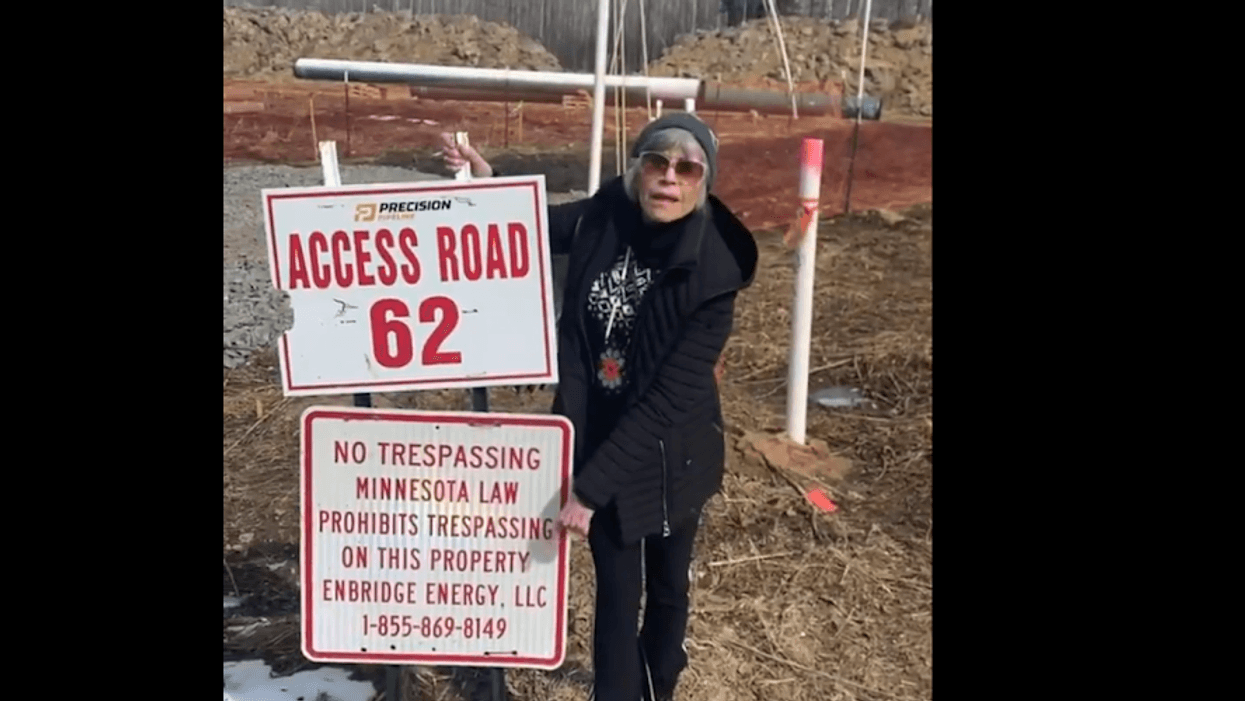
A "freshly vaccinated" Jane Fonda arrived in Minnesota on Sunday to join the ongoing protests against Canadian oil giant Enbridge's Line 3 pipeline, a multibillion-dollar tar sands project that scientists and activists have called an "urgent threat" to local waters and the global climate.
"Line 3's most serious immediate impacts will be on Indigenous peoples and their lands and waters along the line. But the increasing climate threats to Minnesota--and the planet--will be exponentially exacerbated by this pipeline."
--Jane Fonda, activist and actress
In a Facebook post announcing her arrival in Northern Minnesota, the 83-year-old activist and Oscar-winning actress said the Ojibwe Water Protectors "have invited me to join them in the fight to stop Line 3."
"We were driving down the highway and pulled over to see the impacts of the nearly one million barrels of tar sands per day being brought from Alberta, Canada to Superior, Wisconsin by Enbridge, a Canadian pipeline company responsible for the largest inland oil spill in the U.S.," she continued.
Fonda--an active participant in social justice causes for decades, which includes being arrested on the steps of the U.S. Capitol building in October 2019 after launching the #FireDrillFriday campaign to pressure federal lawmakers to address the climate crisis--noted that "Enbridge seeks to build a new pipeline corridor through untouched wetlands and the treaty territory of Anishinaabe peoples, through the Mississippi River headwaters to the shore of Lake Superior."
"We will be at the rivers that are being threatened by Line 3 over the next few days," she said, "gathering to pray and send a message to Enbridge that water is life."
In an accompanying video, Fonda added that "we're here to try to stop it."
As Common Dreams has reported, climate justice and Indigenous rights advocates are opposed to the expansion of the Line 3 pipeline because it would send 760,000 barrels of crude oil every day from Alberta through North Dakota and Minnesota, to Wisconsin--traversing more than 800 wetland habitats, violating the treaty rights of Anishinaabe peoples, and putting current and future generations at risk of polluted water and a degraded environment.
Since Enbridge began working on the pipeline in late 2020 despite pending lawsuits, opponents have attempted to halt construction through civil disobedience--with more than 130 arrests being made "so far in just the last few months," according to Tara Houska of the Giniw Collective--as well as a divestment campaign, organized by Stop the Money Pipeline.
Emphasizing the high-stakes nature of this fight against fossil fuel infrastructure, journalist Emily Atkin reported Monday that "Minnesota state legislators recently proposed a new bill that would impose harsh criminal penalties on anyone who participates in direct actions against Line 3--10 years in prison and $20,000 in fines."
Minnesota's Democratic Gov. Tim Walz, who said publicly in February of 2019 that projects like this one "don't just need a building permit to go forward, they also need a social permit," has been widely condemned for giving Enbridge the green light to continue working on Line 3 even though it has been described as "a tar sands climate bomb," and activists have pressured Walz to rescind the permit for the pipeline.
While the Minnesota Court of Appeals last month denied a request to halt construction as legal battles continue, Rep. Ilhan Omar (D-Minn.)--who met with Enbridge opponents in late January--has urged President Joe Biden to exercise his authority to shut down Line 3 as he did the Keystone XL pipeline, given that both projects come with devastating ecological and social consequences.
Ahead of an early afternoon press conference on Monday with Houska and Winona LaDuke of Honor the Earth, Fonda said in a news release that "Line 3's most serious immediate impacts will be on Indigenous peoples and their lands and waters along the line. But the increasing climate threats to Minnesota--and the planet--will be exponentially exacerbated by this pipeline."
"In short," she added--repeating a common refrain of water protectors--"Line 3 is a climate time bomb."
A diverse coalition of more than 370 environmental and tribal rights organizations demanded Monday that President Joe Biden act immediately to halt construction of Enbridge's Line 3 pipeline, a multi-billion-dollar crude oil project that the groups called "an urgent threat" to Minnesota waters and the global climate.
In a letter (pdf), the coalition representing more than 10 million people in the U.S. and Canada urged Biden to "take swift action to revoke the Line 3 tar sands oil pipeline's permits and stop its construction," pointing to the president's January decision to pull the plug on the Keystone XL pipeline as a model for future action.
"The fight against Line 3 is a defining moment in the history of the U.S. to honor the sacred lands of our tribes and take responsibility for making right a great wrong of land trespass and destruction of sacred sites."
--Faith Spotted Eagle, Brave Heart Society
"We urge you to direct the Army Corps of Engineers to immediately reevaluate and suspend or revoke the Line 3 project's Clean Water Act Section 404 permit," the groups wrote. "Additionally, we urge you to revoke or amend Line 3's presidential permit, as you did for Keystone XL, to make it clear that the permit does not authorize this massive expansion."
"Line 3 is a threat to water, Indigenous rights, and our global climate," the groups warned, "and its rushed construction in the midst of the Covid-19 pandemic is an extreme danger to Minnesotan communities and energy workers alike."
With the approval of the state government, Enbridge--a Canada-based energy giant--began construction of the Minnesota portion of its Line 3 replacement project in December despite vocal opposition from Indigenous leaders, who warned the pipeline endangers local waters and tribal lands.
If completed, the pipeline would have the capacity to transport more than 750,000 barrels of crude oil per day along a more than 1,000-mile route stretching from Alberta, Canada to Wisconsin, crossing hundreds of lakes and rivers along the way.
As Common Dreams has reported in recent weeks, the pipeline has drawn sustained resistance and acts of civil disobedience from local activists and Indigenous tribes amid growing pressure on Biden to exercise his authority to halt the destructive project. More than 130 water protectors are currently facing criminal charges for their roles in recent Line 3 protests, according to Tara Houska of Stop the Money Pipeline.
Faith Spotted Eagle, coordinator of the Brave Heart Society and one of the new letter's signatories, said in a statement Monday that "the fight against Line 3 is a defining moment in the history of the U.S. to honor the sacred lands of our tribes and take responsibility for making right a great wrong of land trespass and destruction of sacred sites and disregard of nation-to-nation bridge-building."
"Make it right," she added.
Another signatory, Winona LaDuke of Honor the Earth, noted that "Line 3's most serious immediate impacts will be on Indigenous peoples and their lands and waters along the line."
"But the increasing climate threats to Minnesota--and the planet--will be exponentially exacerbated by this pipeline. In short, Line 3 is a climate time bomb," said LaDuke. "Tar sands is the dirtiest and most expensive oil on the planet to extract, and this Line 3 would add the equivalent emissions of 50 coal-fired power plants. It's up to President Biden to continue with the country's renewable energy agenda and reduce our reliance on fossil fuels. After his action to halt Keystone XL, stopping Line 3 is essential."
Read the coalition's full letter:
We write to urge you to take swift action to revoke the Line 3 tar sands oil pipeline's permits and stop its construction. Line 3 is a threat to water, Indigenous rights, and our global climate, and its rushed construction in the midst of the Covid-19 pandemic is an extreme danger to Minnesotan communities and energy workers alike.
We urge you to direct the Army Corps of Engineers to immediately reevaluate and suspend or revoke the Line 3 project's Clean Water Act Section 404 permit. The Army Corps failed to consider significant information on Line 3's impacts in reaching its original determination, including the risk of oil spills, climate change impacts, and impacts on Indigenous peoples. The Army Corps also refused to prepare a federal Environmental Impact Statement for Line 3, despite overwhelming evidence that the project would have significant impacts.
Additionally, we urge you to revoke or amend Line 3's presidential permit, as you did for Keystone XL, to make it clear that the permit does not authorize this massive expansion. Your rejection of the Keystone XL pipeline's presidential permit was a clear signal that the Biden administration represents a break from the fossil fuel giveaways of the Trump administration .Line 3 would be the same diameter as Keystone XL, would carry the same heavy tar sands oil through the Midwest, and was also inappropriately permitted by the Trump administration. As you indicated in your Day One Executive Order, "the United States must [...] exercise vigorous climate leadership in order to achieve a significant increase in global climate action and put the world on a sustainable climate pathway. Leaving the Keystone XL pipeline permit in place would not be consistent with my administration's economic and climate imperatives." The same logic applies to Line 3, which would lock in fossil fuel dependence for decades to come.
Since 2014, thousands of Minnesotans have shown up at hearings, talked to neighbors, written letters, and organized in their communities to oppose Enbridge's Line 3 pipeline. Hundreds of thousands of Americans across the country, from all walks of life, have joined them in opposing the project. Line 3 is a clear danger to their climate, water, and land, and would undermine the Indigenous rights of the Anishinaabe people.
Climate scientists warn that we must keep the vast majority of known fossil fuels reserves in the ground, and drastically reduce greenhouse gas emissions before 2030. Analysis has shown that building Line 3 would unlock the emissions equivalent to building 50 coal plants, costing society more than $287 billion in climate impacts in just its first 30 years of operation. Adding such fuel to the fire in the midst of our climate crisis is unacceptable. Simply put: No one can be a leader on climate change and support the Line 3 project--a choice must be made.
The proposed route for Line 3 crosses 227 lakes and rivers, including the Mississippi River and rivers that feed directly into Lake Superior, putting those waterways at risk of a spill from the 760,000 barrels of tar sands oil that would flow through Line 3 every day. Tar sands oil sinks in water, making it nearly impossible to clean up from wetland areas. A spill could destroy prize fishing lakes and sacred wild rice beds, and gut the local economy.
Enbridge's negligent 2010 spill of over 1 million gallons of tar sands oil from its aging Line 6Binto the Kalamazoo River demonstrated the immensity of this threat, with a cleanup cost of over $1.2 billion. Enbridge's newer pipelines are no safer than its old ones. Since 2002, the company's pipelines have had 73 spills due to equipment installed less than 10 years before the incident. The existing Line 3 pipeline was constructed in the 1960s and has deteriorated to a point that it is only able to operate at partial capacity--390,000 barrels per day--due to structural concerns. Given these risks, this old and deteriorating tar sands pipeline should be shut down for safety reasons, not given the green light to double capacity and reroute through the pristine forests and waterways of the Great Lakes region. Enbridge should not be trusted near precious bodies of water like the Mississippi River.
Enbridge's route crosses the 1854 and 1855 treaty territory where Anishinaabe people retain the right to hunt, fish, gather medicines, and harvest wild rice. The impact of construction--or worse, an oil spill--would permanently damage their ability to exercise these rights. Three Tribal governments and hundreds of Anishinaabe and Dakota community members in Minnesota are actively opposing this pipeline. Building Line 3 would carry on a legacy of state-and U.S. government-sanctioned oppression of Indigenous people, directly contradicting your important promises to strengthen Nation-to-Nation relationships with Tribal Nations and Indigenous peoples.
In the largest public comment period on Line 3 in Minnesota, 94% of the comments submitted opposed construction of the pipeline. Your administration's announcements on protecting our nation's lakes and rivers, cleaning up aging and retired fossil fuel infrastructure currently polluting delicate environments, and moving to a clean energy economy powered by good,union jobs show the direction the United States is heading. With these commitments to building the energy economy of the future, we must not continue to allow fossil fuel companies to move forward with dangerous projects like Line 3 that would last many decades.
According to the state of Minnesota's own analysis, Enbridge failed to demonstrate Line 3 was needed, and didn't provide a legally required oil demand forecast--a part of the process that is even more critical in a world of rapidly changing oil markets and climate policy. The Minnesota Department of Commerce recommended that Line 3 be denied approval, and the judge responsible for presiding over the case issued a legal recommendation that Enbridge's proposal did not meet the standards set by state law.
We urge you and all federal leadership to stand firm against the Line 3 pipeline and act now to halt its construction. The pipeline's construction is an urgent threat to the waters of Minnesota and Lake Superior, as well as to our global climate. The facts are not in Enbridge's favor, and the time for climate action is now. A thoughtful, science-based approach shows a clear conclusion: Line 3 must not be built.