

SUBSCRIBE TO OUR FREE NEWSLETTER
Daily news & progressive opinion—funded by the people, not the corporations—delivered straight to your inbox.
5
#000000
#FFFFFF
To donate by check, phone, or other method, see our More Ways to Give page.
Daily news & progressive opinion—funded by the people, not the corporations—delivered straight to your inbox.
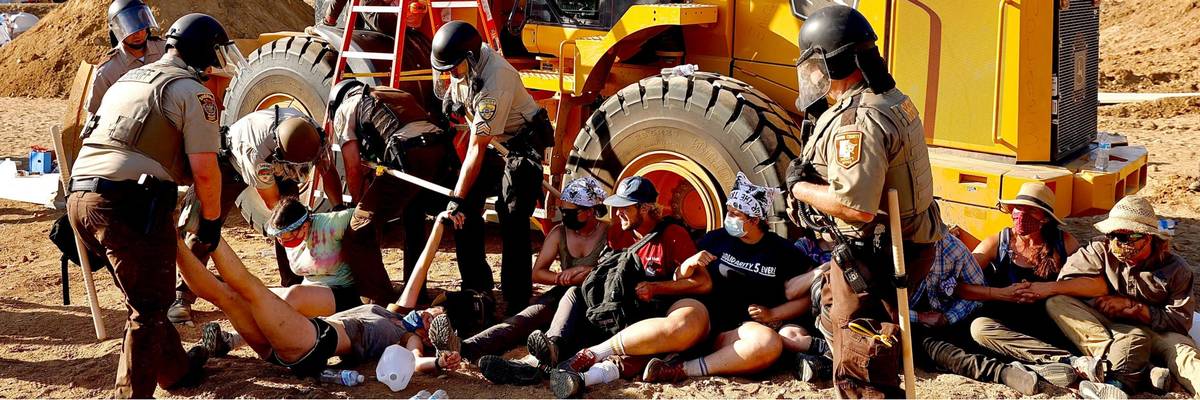
Police in riot gear arrest water protectors at a pumping station for the Enbridge Line 3 tar sands pipeline near Itasca State Park in Minnesota on June 7, 2021. (Photo: Kerem Yucel/AFP via Getty Images)
Seizing the momentum after a day of major direct action against the Line 3 tar sands pipeline in northern Minnesota, Indigenous and green groups on Wednesday stepped up their pressure on President Joe Biden to honor Native American treaties and protect the environment and climate by stopping the toxic project.
"Biden did the right thing on KXL, now it's time to go a step further and say no to all new fossil fuel projects everywhere." --Jamie Henn, 350.org
The climate advocacy group 350.org said more than 200 water protectors were arrested on Monday and Tuesday after Treaty People Gathering activists blocked access to a pipeline construction site and chained themselves to equipment. Hundreds of Giniw Collective and allied water protectors shut down the Two Inlets pumping station for over 29 hours, while over 1,500 protesters marched to a planned pipeline construction site near the headwaters of the Mississippi River.
Authorities used a helicopter to create a choking cloud of rotor wash dust meant to intimidate and disperse demonstrators, as well as what the New York Times said "appeared to be a crowd-dispelling sonic device known as an LRAD, or Long Range Acoustic Device."
Numerous prominent activists participated in Monday's protests, including Honor the Earth co-founder Winona LaDuke; Giniw Collective co-founder Tara Houska; 350.org co-founder Bill McKibben; Indigenous organizers Dawn Goodwin, Taysha Martineau, Nancy Beaulieu, and Simone Senogles; and actor/activists Rosanna Arquette and Jane Fonda.
The $9 billion Line 3 project--which if built as planned will carry up to 750,000 barrels of crude tar sands oil, the world's dirtiest fuel, from Alberta to the port of Superior, Wisconsin--will cross Anishinaabe treaty land without the tribe's consent. The project's planned route traverses more than 200 bodies of water and 800 wetlands, raising red flags not only about its impact on the climate, but also about accidents and leaks that plague pipelines.
The protests drew international attention and galvanized campaigners to push the Biden administration to order the U.S. Army Corps of Engineers to suspend or revoke the Clean Water Act Section 404 permit for Enbridge, the Canadian company building Line 3.
Biden previously delighted pipeline foes when he rescinded the federal permit for the Keystone XL pipeline on his first day of office following years of grassroots organizing. On Wednesday, TC Energy, the Canadian firm behind Keystone XL, said it has terminated the project.
However, the president has disappointed many activists by refusing to shut down the Dakota Access Pipeline (DAPL), site of massive direct action protests at Standing Rock in 2016, and for defending a massive Trump-era drilling project in Alaska that is expected to produce up to 160,000 barrels of oil per day over a 30-year-period.
Tribal leaders are also hoping that Interior Secretary Deb Haaland, who participated in the Standing Rock protests and is the first Native American Cabinet secretary in U.S. history, will help persuade Biden to cancel Line 3's permit.
The Stop Line 3 coalition is circulating a petition urging Biden to act now. As of Wednesday afternoon, more than 200,000 people have signed the page.
"We have very few options left," Simone Senogles of the Indigenous Environmental Network and RISE Coalition said in a statement. "We are here to protect the water, the wild rice, and the next seven generations of life. Keystone XL was stopped on the merits of environmental justice and treaty rights; this is no different. We demand President Biden take action now."
Fonda--who at Monday's protest held a sign reading, "President Biden, Which Side Are You On?--appeared Tuesday on CNN's "New Day" and urged the administration to move to halt Line 3. The actress and activist said she was "very, very grateful" for Biden's cancellation of Keystone XL and some drilling leases in Alaska's Arctic National Wildlife Refuge.
"He's done a lot of very good things. But not enough. Not bold enough. And not fast enough. We're up against time," Fonda said of the president. "The scientists say we have less than nine years to cut our emissions in half. Line 3 is going in the absolute opposite direction, and the news every day is telling us, emissions are going up, not down."
"So we have to put our bodies on the line and do whatever we can to get our administration to call a halt to these permits," she added.
Reacting to Wednesday afternoon's news of the Keystone XL victory, 350.org co-founder and #NoKXL campaign leader Jamie Henn said in a statement that the cancelled pipeline is "now the most famous fossil fuel project killed by the climate movement, but it won't be the last."
"The same coalition that stopped this pipeline is now battling Line 3 and dozens of other fossil fuel projects across the country," Henn added. "Biden did the right thing on KXL, now it's time to go a step further and say no to all new fossil fuel projects everywhere."
Dear Common Dreams reader, It’s been nearly 30 years since I co-founded Common Dreams with my late wife, Lina Newhouser. We had the radical notion that journalism should serve the public good, not corporate profits. It was clear to us from the outset what it would take to build such a project. No paid advertisements. No corporate sponsors. No millionaire publisher telling us what to think or do. Many people said we wouldn't last a year, but we proved those doubters wrong. Together with a tremendous team of journalists and dedicated staff, we built an independent media outlet free from the constraints of profits and corporate control. Our mission has always been simple: To inform. To inspire. To ignite change for the common good. Building Common Dreams was not easy. Our survival was never guaranteed. When you take on the most powerful forces—Wall Street greed, fossil fuel industry destruction, Big Tech lobbyists, and uber-rich oligarchs who have spent billions upon billions rigging the economy and democracy in their favor—the only bulwark you have is supporters who believe in your work. But here’s the urgent message from me today. It's never been this bad out there. And it's never been this hard to keep us going. At the very moment Common Dreams is most needed, the threats we face are intensifying. We need your support now more than ever. We don't accept corporate advertising and never will. We don't have a paywall because we don't think people should be blocked from critical news based on their ability to pay. Everything we do is funded by the donations of readers like you. When everyone does the little they can afford, we are strong. But if that support retreats or dries up, so do we. Will you donate now to make sure Common Dreams not only survives but thrives? —Craig Brown, Co-founder |
Seizing the momentum after a day of major direct action against the Line 3 tar sands pipeline in northern Minnesota, Indigenous and green groups on Wednesday stepped up their pressure on President Joe Biden to honor Native American treaties and protect the environment and climate by stopping the toxic project.
"Biden did the right thing on KXL, now it's time to go a step further and say no to all new fossil fuel projects everywhere." --Jamie Henn, 350.org
The climate advocacy group 350.org said more than 200 water protectors were arrested on Monday and Tuesday after Treaty People Gathering activists blocked access to a pipeline construction site and chained themselves to equipment. Hundreds of Giniw Collective and allied water protectors shut down the Two Inlets pumping station for over 29 hours, while over 1,500 protesters marched to a planned pipeline construction site near the headwaters of the Mississippi River.
Authorities used a helicopter to create a choking cloud of rotor wash dust meant to intimidate and disperse demonstrators, as well as what the New York Times said "appeared to be a crowd-dispelling sonic device known as an LRAD, or Long Range Acoustic Device."
Numerous prominent activists participated in Monday's protests, including Honor the Earth co-founder Winona LaDuke; Giniw Collective co-founder Tara Houska; 350.org co-founder Bill McKibben; Indigenous organizers Dawn Goodwin, Taysha Martineau, Nancy Beaulieu, and Simone Senogles; and actor/activists Rosanna Arquette and Jane Fonda.
The $9 billion Line 3 project--which if built as planned will carry up to 750,000 barrels of crude tar sands oil, the world's dirtiest fuel, from Alberta to the port of Superior, Wisconsin--will cross Anishinaabe treaty land without the tribe's consent. The project's planned route traverses more than 200 bodies of water and 800 wetlands, raising red flags not only about its impact on the climate, but also about accidents and leaks that plague pipelines.
The protests drew international attention and galvanized campaigners to push the Biden administration to order the U.S. Army Corps of Engineers to suspend or revoke the Clean Water Act Section 404 permit for Enbridge, the Canadian company building Line 3.
Biden previously delighted pipeline foes when he rescinded the federal permit for the Keystone XL pipeline on his first day of office following years of grassroots organizing. On Wednesday, TC Energy, the Canadian firm behind Keystone XL, said it has terminated the project.
However, the president has disappointed many activists by refusing to shut down the Dakota Access Pipeline (DAPL), site of massive direct action protests at Standing Rock in 2016, and for defending a massive Trump-era drilling project in Alaska that is expected to produce up to 160,000 barrels of oil per day over a 30-year-period.
Tribal leaders are also hoping that Interior Secretary Deb Haaland, who participated in the Standing Rock protests and is the first Native American Cabinet secretary in U.S. history, will help persuade Biden to cancel Line 3's permit.
The Stop Line 3 coalition is circulating a petition urging Biden to act now. As of Wednesday afternoon, more than 200,000 people have signed the page.
"We have very few options left," Simone Senogles of the Indigenous Environmental Network and RISE Coalition said in a statement. "We are here to protect the water, the wild rice, and the next seven generations of life. Keystone XL was stopped on the merits of environmental justice and treaty rights; this is no different. We demand President Biden take action now."
Fonda--who at Monday's protest held a sign reading, "President Biden, Which Side Are You On?--appeared Tuesday on CNN's "New Day" and urged the administration to move to halt Line 3. The actress and activist said she was "very, very grateful" for Biden's cancellation of Keystone XL and some drilling leases in Alaska's Arctic National Wildlife Refuge.
"He's done a lot of very good things. But not enough. Not bold enough. And not fast enough. We're up against time," Fonda said of the president. "The scientists say we have less than nine years to cut our emissions in half. Line 3 is going in the absolute opposite direction, and the news every day is telling us, emissions are going up, not down."
"So we have to put our bodies on the line and do whatever we can to get our administration to call a halt to these permits," she added.
Reacting to Wednesday afternoon's news of the Keystone XL victory, 350.org co-founder and #NoKXL campaign leader Jamie Henn said in a statement that the cancelled pipeline is "now the most famous fossil fuel project killed by the climate movement, but it won't be the last."
"The same coalition that stopped this pipeline is now battling Line 3 and dozens of other fossil fuel projects across the country," Henn added. "Biden did the right thing on KXL, now it's time to go a step further and say no to all new fossil fuel projects everywhere."
Seizing the momentum after a day of major direct action against the Line 3 tar sands pipeline in northern Minnesota, Indigenous and green groups on Wednesday stepped up their pressure on President Joe Biden to honor Native American treaties and protect the environment and climate by stopping the toxic project.
"Biden did the right thing on KXL, now it's time to go a step further and say no to all new fossil fuel projects everywhere." --Jamie Henn, 350.org
The climate advocacy group 350.org said more than 200 water protectors were arrested on Monday and Tuesday after Treaty People Gathering activists blocked access to a pipeline construction site and chained themselves to equipment. Hundreds of Giniw Collective and allied water protectors shut down the Two Inlets pumping station for over 29 hours, while over 1,500 protesters marched to a planned pipeline construction site near the headwaters of the Mississippi River.
Authorities used a helicopter to create a choking cloud of rotor wash dust meant to intimidate and disperse demonstrators, as well as what the New York Times said "appeared to be a crowd-dispelling sonic device known as an LRAD, or Long Range Acoustic Device."
Numerous prominent activists participated in Monday's protests, including Honor the Earth co-founder Winona LaDuke; Giniw Collective co-founder Tara Houska; 350.org co-founder Bill McKibben; Indigenous organizers Dawn Goodwin, Taysha Martineau, Nancy Beaulieu, and Simone Senogles; and actor/activists Rosanna Arquette and Jane Fonda.
The $9 billion Line 3 project--which if built as planned will carry up to 750,000 barrels of crude tar sands oil, the world's dirtiest fuel, from Alberta to the port of Superior, Wisconsin--will cross Anishinaabe treaty land without the tribe's consent. The project's planned route traverses more than 200 bodies of water and 800 wetlands, raising red flags not only about its impact on the climate, but also about accidents and leaks that plague pipelines.
The protests drew international attention and galvanized campaigners to push the Biden administration to order the U.S. Army Corps of Engineers to suspend or revoke the Clean Water Act Section 404 permit for Enbridge, the Canadian company building Line 3.
Biden previously delighted pipeline foes when he rescinded the federal permit for the Keystone XL pipeline on his first day of office following years of grassroots organizing. On Wednesday, TC Energy, the Canadian firm behind Keystone XL, said it has terminated the project.
However, the president has disappointed many activists by refusing to shut down the Dakota Access Pipeline (DAPL), site of massive direct action protests at Standing Rock in 2016, and for defending a massive Trump-era drilling project in Alaska that is expected to produce up to 160,000 barrels of oil per day over a 30-year-period.
Tribal leaders are also hoping that Interior Secretary Deb Haaland, who participated in the Standing Rock protests and is the first Native American Cabinet secretary in U.S. history, will help persuade Biden to cancel Line 3's permit.
The Stop Line 3 coalition is circulating a petition urging Biden to act now. As of Wednesday afternoon, more than 200,000 people have signed the page.
"We have very few options left," Simone Senogles of the Indigenous Environmental Network and RISE Coalition said in a statement. "We are here to protect the water, the wild rice, and the next seven generations of life. Keystone XL was stopped on the merits of environmental justice and treaty rights; this is no different. We demand President Biden take action now."
Fonda--who at Monday's protest held a sign reading, "President Biden, Which Side Are You On?--appeared Tuesday on CNN's "New Day" and urged the administration to move to halt Line 3. The actress and activist said she was "very, very grateful" for Biden's cancellation of Keystone XL and some drilling leases in Alaska's Arctic National Wildlife Refuge.
"He's done a lot of very good things. But not enough. Not bold enough. And not fast enough. We're up against time," Fonda said of the president. "The scientists say we have less than nine years to cut our emissions in half. Line 3 is going in the absolute opposite direction, and the news every day is telling us, emissions are going up, not down."
"So we have to put our bodies on the line and do whatever we can to get our administration to call a halt to these permits," she added.
Reacting to Wednesday afternoon's news of the Keystone XL victory, 350.org co-founder and #NoKXL campaign leader Jamie Henn said in a statement that the cancelled pipeline is "now the most famous fossil fuel project killed by the climate movement, but it won't be the last."
"The same coalition that stopped this pipeline is now battling Line 3 and dozens of other fossil fuel projects across the country," Henn added. "Biden did the right thing on KXL, now it's time to go a step further and say no to all new fossil fuel projects everywhere."

